

Top 10 BESS Projects: Ameresco’s 50 MW Tesla Deal and 255 MW in Illinois (2024-2025)
Behind-the-meter (BTM) battery energy storage systems have fundamentally evolved from customer-side tools for bill management into active, utility-integrated resources for grid stability. This shift is creating a new, dynamic two-way relationship between utilities and customers. Key projects in 2024 and 2025 highlight this trend, including large-scale commercial deployments like Ameresco’s 50 MW asset in Arizona and policy-driven initiatives such as the 255 MW of capacity awarded through Illinois’s BESS incentive program. The dominant theme for 2025 is the rise of large-scale aggregation and third-party “Energy-as-a-Service” models, where specialized developers build and manage BTM systems, removing the financial and technical burden from the host customer.
1. Illinois BESS Incentive Awards
Company: NRG Midwest and others
Installation Capacity: 255 MW (combined)
Applications: Grid stability and renewable energy integration
Source: Powering Up Illinois: A Guide to Battery Storage Incentives and …
2. Equinix Data Centers BTM Power
Company: Equinix, Bloom Energy
Installation Capacity: Over 100 MW
Applications: Data center power reliability and cost management
Source: Powering Data Centers | Megawatts to Megabytes – Orrick
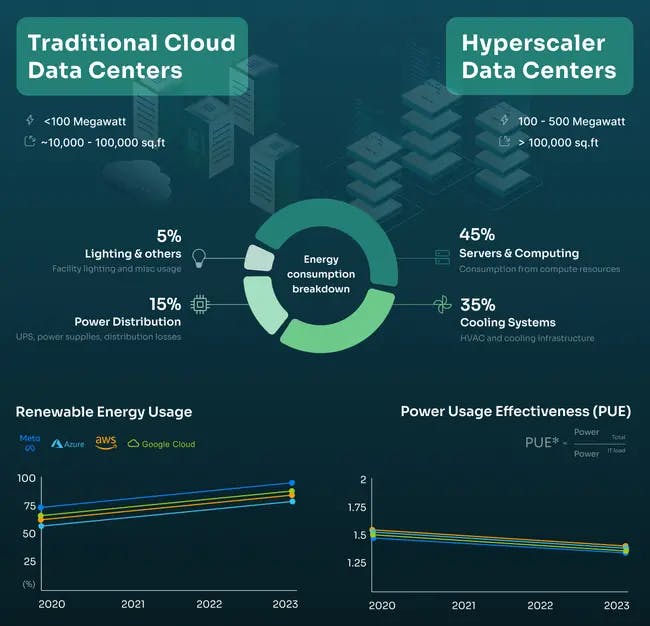
Hyperscalers Drive Massive Data Center Energy Demand
This chart directly explains the business case for Equinix’s BTM power project. It illustrates that the massive energy consumption of data centers (‘hyperscalers’) necessitates dedicated, on-site energy solutions to ensure reliability and manage costs.
(Source: Energy Central)
3. Ameresco BTM Battery Asset
Company: Ameresco, Tesla
Installation Capacity: 50 MW
Applications: Commercial and industrial (C&I) energy services under a Storage Services Agreement
Source: Ameresco Announces 50 MW Battery Energy Storage Asset to …
4. SWITCH Power BTM Portfolio
Company: SWITCH Power
Installation Capacity: 8.5 MW
Applications: Grid flexibility and renewable integration for C&I customers
Source: Powering Canada’s Future: A Clean Electricity Strategy
5. Valley Clean Air Now (VCAN) Microgrid
Company: Valley Clean Air Now (VCAN)
Installation Capacity: 3.3 MW
Applications: Long-duration (10+ hours) resilience for C&I users
Source: [PDF] Study of Long-Duration and Multi-day Energy Storage

Diagram Defines Types of Microgrid Deployments
This diagram is a perfect match as it provides a foundational definition of what a microgrid is. It serves as an educational introduction for the reader before the text dives into the specifics of the VCAN microgrid project.
(Source: POWER Magazine)
6. Rocky Mountain Power VPP
Company: Rocky Mountain Power, Sonnen
Installation Capacity: Not specified (aggregated residential systems)
Applications: Residential virtual power plant (VPP) for grid demand response
Source: Conservative Foundations Lead to Largest Utility-Run Behind-the …
7. Wakefield Municipal BTM Storage
Company: Wakefield Municipal Gas & Light Department
Installation Capacity: 3.2 MW / 5.3 MWh
Applications: Peak load management for a municipal utility
Source: [PDF] Benefits and Applications of Battery Energy Storage in Massachusetts

Services of Behind-the-Meter Energy Storage
This chart effectively illustrates the benefits that the Wakefield municipal storage project aims to achieve. It outlines the key services, like peak shaving and backup power, that justify the investment in a BTM asset.
(Source: ScienceDirect.com)
8. Templeton Municipal BTM Storage
Company: Templeton Municipal Light & Water Plant
Installation Capacity: 1.6 MW / 3.5 MWh
Applications: Local grid reliability and cost reduction for a municipal utility
Source: [PDF] Benefits and Applications of Battery Energy Storage in Massachusetts
9. Green Mountain Power (GMP) ESS Lease Program
Company: Green Mountain Power (GMP)
Installation Capacity: Not specified (aggregated residential systems)
Applications: Residential backup power and utility grid services via a VPP
Source: [PDF] VIRTUAL POWER PLANT – RMI

Domestic Solar Creates Grid ‘Duck Curve’
This chart visualizes the ‘duck curve,’ a grid management challenge caused by high solar penetration. It perfectly explains the problem that Green Mountain Power’s innovative ESS lease program is designed to solve by shifting energy from midday to evening.
(Source: LinkedIn)
10. Delmarva Power VPP Proposal
Company: Delmarva Power
Installation Capacity: Not specified
Applications: Proposed VPP on public land for grid services
Source: [PDF] Electricity Generation in Maryland Oct 2024

Grid Storage Applications Diversify and Grow
A proposal for a new VPP would need to detail the various services it could provide to the grid. This chart supports the Delmarva proposal by showing the growing diversity of grid storage applications, making the business case for the VPP.
(Source: Deloitte)
Table: Top BTM Battery Projects (2024-2025)
| Company | Installation Capacity (MW) | Applications | Source |
|---|---|---|---|
| NRG Midwest & others | 255 | Grid stability & renewable integration | Powering Up Illinois |
| Equinix & Bloom Energy | 100+ | Data center power reliability | Orrick |
| Ameresco & Tesla | 50 | C&I energy services via SSA | Ameresco |
| SWITCH Power | 8.5 | Grid flexibility | Natural Resources Canada |
| Valley Clean Air Now (VCAN) | 3.3 | Long-duration resilience | Michigan PSC |
| Rocky Mountain Power & Sonnen | N/A | Residential VPP & demand response | Luminary Strategies |
| Wakefield Municipal Gas & Light | 3.2 | Municipal peak load management | Clean Energy Group |
| Templeton Municipal Light & Water | 1.6 | Municipal grid reliability | Clean Energy Group |
| Green Mountain Power | N/A | Residential VPP & backup power | RMI |
| Delmarva Power | N/A | Proposed VPP on public land | Maryland DNR |
255 MW, Illinois BESS Projects Show Policy Impact
The diversity of applications for BTM battery storage signals its widening adoption across multiple market segments. Projects are no longer confined to a single use case. Large commercial users like Equinix are deploying over 100 MW of BTM power to ensure operational reliability for their data centers and sidestep long utility interconnection queues. At the same time, smaller municipal utilities, such as Wakefield Municipal Gas & Light and Templeton Municipal Light & Water Plant in Massachusetts, are using BTM assets for precise peak load management to reduce expensive capacity charges. In the residential sector, utilities like Rocky Mountain Power and Green Mountain Power are creating new value by aggregating customer-sited batteries into virtual power plants (VPPs). This range of applications demonstrates that BTM storage has become a versatile solution for C&I, utility, and residential customers alike.

BTM Energy Storage Capacity Shows Rapid Growth
This chart provides the national context for the specific Illinois projects discussed in the section. It shows that the 255 MW deployment is part of a larger, nationwide trend of rapid growth in behind-the-meter storage.
(Source: ScienceDirect.com)
USA Focus: Illinois, Arizona & Vermont Lead BESS Models
Geographically, the United States is a clear leader in developing and scaling innovative BTM storage models, with activity concentrated in states with supportive policies or acute grid needs. Illinois stands out for its policy-driven approach, with a state-led incentive program directly awarding contracts for 255 MW of capacity. Arizona is emerging as a hub for large-scale C&I projects, highlighted by Ameresco’s 50 MW asset, the largest of its kind in the state. Meanwhile, Vermont and Utah are pioneering new utility-customer relationships through the successful VPP programs from Green Mountain Power and Rocky Mountain Power, respectively. These programs are creating a blueprint for turning residential customers into active grid participants. The inclusion of an 8.5 MW portfolio in Ontario by SWITCH Power also indicates growing government-backed BTM adoption in Canada.

US Energy Storage Projects by Grid Region
For a section focusing on leading US states and BESS models, this map is the ideal illustration. It provides a geographical overview of where energy storage projects are concentrated across different US grid regions.
(Source: Frontiers)
BESS Maturity, Ameresco’s 20-Year Service Agreement
These installations confirm the commercial maturity of BTM battery technology and the business models that support it. The Ameresco project in Arizona, which uses 58 Tesla Megapack units, is underpinned by a 20-year Storage Services Agreement (SSA). This long-term financing structure proves that large-scale BTM assets are bankable and can provide predictable returns, making them attractive to third-party developers and financiers. In the residential space, the success of utility lease programs like Green Mountain Power’s, which reduces the upfront cost for homeowners, shows a mature model for scaling distributed assets. While most projects rely on established lithium-ion technology, the VCAN project in California, with its non-lithium-ion, 10-hour duration system, points toward the next stage of technological development focused on extended resilience.

Global Battery Storage Capacity Sees Major Growth
A discussion on BESS maturity and long-term service agreements is enhanced by a global perspective. This chart shows the worldwide scale of the industry’s growth, contextualizing the market’s maturation in the US.
(Source: REN21)
Ameresco’s 50 MW Project Signals BESS-as-a-Service Growth (2025)
For the year ahead, expect an acceleration of third-party “as-a-Service” models for BTM storage, particularly within the commercial and industrial sector. This shift will be driven by customers seeking energy resilience and cost savings without the complexities of owning and operating energy assets.
- If large energy users continue to face grid reliability challenges and lengthy interconnection delays, they will increasingly turn to BTM solutions.
- Watch for a rise in partnerships between specialized developers like Ameresco and large customers, especially in power-intensive industries like data centers, mirroring the Equinix strategy.
- This will likely lead to an increase in long-term contracts like 20-year Storage Service Agreements (SSAs). These agreements de-risk BTM adoption by removing the upfront capital and operational burden from the host customer, with Ameresco’s 50 MW project serving as a key blueprint for the market.

Five ‘D’s’ Outlined as Key Energy Trends
This chart outlines the high-level market drivers (Decarbonization, Decentralization, etc.) that are creating the opportunity for new business models like BESS-as-a-Service. It explains the ‘why’ behind the growth signal mentioned in the section heading.
(Source: Indigo Advisory Group)
The questions your competitors are already asking
This report covers one angle of the commercial shift towards third-party owned, utility-integrated BTM battery assets. The questions that matter most depend on your work.
- Which companies are gaining or losing ground in the BTM Energy-as-a-Service market?
- What is the outlook for BTM battery aggregation as a utility grid resource by 2030?
- Which C&I and data center operators are adopting third-party managed BTM battery storage?
- What is actually happening with Illinois’s 255 MW BESS incentive program deployments since the awards were announced?
This report does not answer these. Enki Brief Pro does.
Your question, your angle, your framework. SWOT, PESTL, scenario modelling. The same niche depth, built around the decision your work actually depends on.
