

Post-Combustion Capture Policy, $2.6 B Aalborg Portland Subsidy, $7.5 B DOE Cuts, and 2 Competing Models (2021 to 2026)
Industrial Decarbonization Risks, Aalborg Portland Policy Stability vs. US Volatility
The commercial viability of large-scale industrial carbon capture projects now depends more on the structure of government policy than on technology readiness, with a clear divergence in risk profiles emerging between Europe and North America. The Danish government’s contract-based subsidy for Aalborg Portland provides a bankable, low-risk model, while the politically-driven cancellation of US federal grants demonstrates a high-risk environment that deters long-term capital investment.
- Between 2021 and 2024, momentum for Carbon Capture, Utilisation, and Storage (CCUS) grew in both regions, driven by foundational policies. The US introduced the enhanced 45 Q tax credit of $85/tonne through the Inflation Reduction Act, while Europe relied on its rising Emissions Trading System (ETS) carbon price and initial large-scale projects like Ørsted’s.
- The market shifted in 2025 and 2026, exposing two fundamentally different approaches to de-risking projects. Denmark awarded Aalborg Portland a 15-year, $2.6 billion contract for its ACCSION project, guaranteeing a fixed price of approximately €117 ($126) per ton of CO 2 captured. This Carbon Contract for Difference (Cf D) model provides the long-term revenue certainty required for project financing.
- In stark contrast, the US demonstrated significant policy instability during the same period. In May 2025, the Department of Energy (DOE) cancelled $3.7 billion in awards for 24 decarbonization projects. This was followed by a larger termination of $7.5 billion across 321 awards in October 2025, jeopardizing major initiatives including the Direct Air Capture (DAC) Hubs involving companies like Occidental.
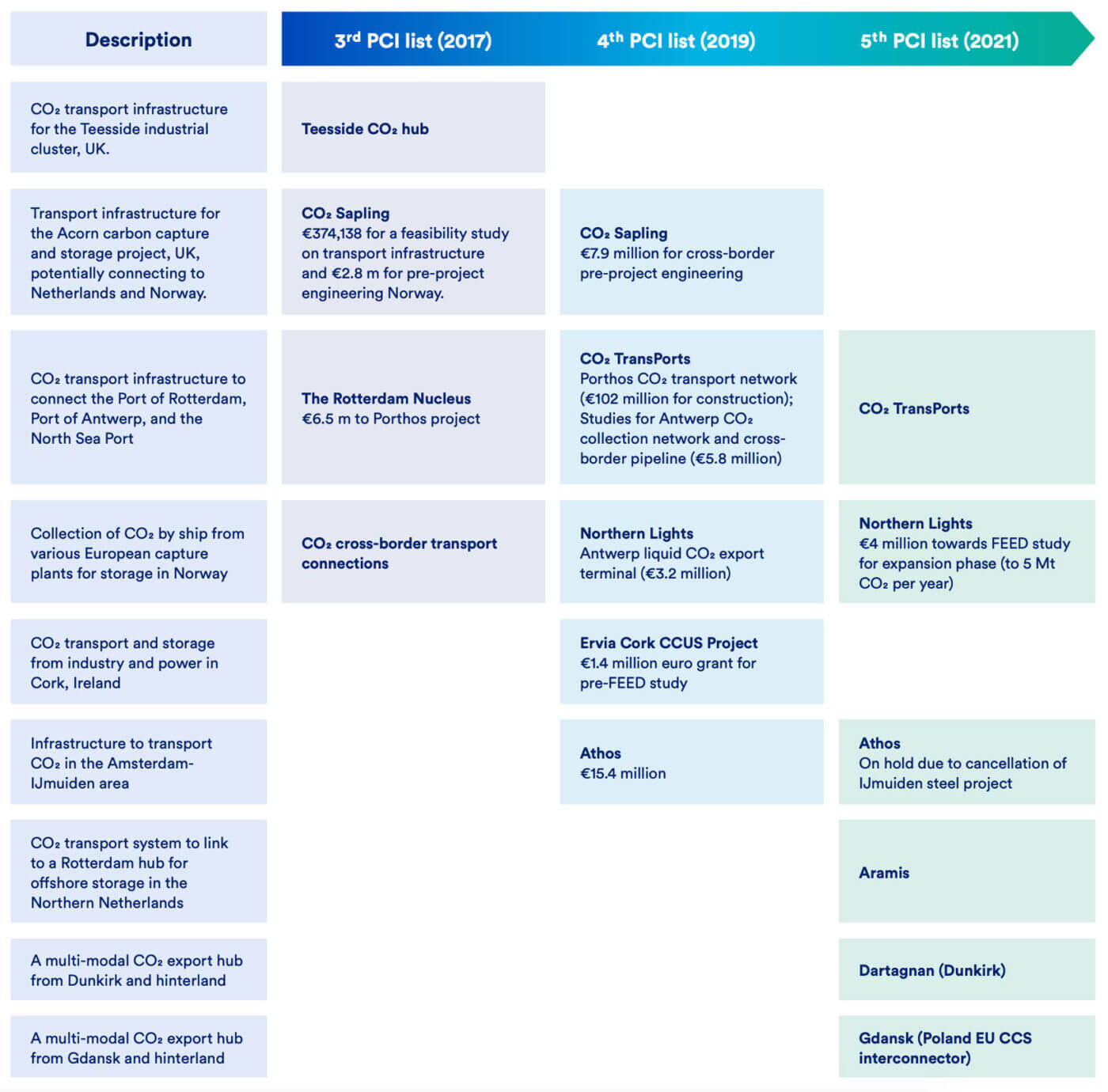
Chart Shows Stable EU Funding for CCS Projects
The chart’s depiction of stable EU funding directly supports the section’s central theme of European policy stability, providing a clear visual contrast to the ‘US Volatility’ mentioned in the heading.
(Source: Clean Air Task Force)
$11.2 B in US Cancellations, Aalborg Portland Deal Highlights Policy Impact on CCS Funding
Massive US funding cancellations in 2025 effectively froze the domestic carbon management market, illustrating how political risk can erase project pipelines overnight. This stands in direct opposition to the European model, where legally binding, long-duration contracts like the one for Aalborg Portland are specifically designed to attract and secure the private capital needed for multi-billion-dollar infrastructure builds.
- The US administration’s reversal of clean energy funding in 2025 created a chilling effect on investment. The two rounds of cancellations totaled over $11.2 billion, directly impacting a wide range of initiatives from industrial capture to DAC hubs, which also impacted projects from companies like Shell. These actions undermine the financial assumptions of projects that relied on federal grants for development.
- The Danish model functions as a government-backed offtake agreement, transforming CO 2 abatement from a compliance cost into a contracted revenue stream. By providing a 15-year payment guarantee, the government removes carbon price volatility and policy uncertainty, making the project bankable for private financiers.
- The US 45 Q tax credit, while valuable, remains less direct than a Cf D. Its value depends on a company’s tax liability and is subject to future legislative changes, presenting a higher risk profile for investors compared to a direct, long-term government contract.
Table: US Department of Energy (DOE) Carbon Management Project Cancellations in 2025
| Partner / Project | Time Frame | Details and Strategic Purpose | Source |
|---|---|---|---|
| Second Round of Cancellations | Oct 8, 2025 | 321 awards totaling over $7.5 billion were terminated. This action jeopardized major carbon management initiatives, including the development of Direct Air Capture (DAC) Hubs in Louisiana and Texas. | Carbon Capture Coalition |
| First Round of Cancellations | May 30, 2025 | The DOE rescinded $3.7 billion in funding across 24 carbon capture and industrial decarbonization projects. This was the first major signal of a policy shift away from federally supported clean energy initiatives. | Utility Dive |
Europe vs. North America, Aalborg Portland Highlights Diverging CCS Investment Climates
Europe is solidifying its position as the more stable and attractive region for large-scale industrial CCS investment by establishing a replicable, low-risk policy playbook. While North America showed early promise with aggressive incentives, recent political volatility in the US has created significant uncertainty, causing a geographic divergence in investor confidence and project execution.
- From 2021 to 2024, North America appeared to be a primary growth market, spurred by the US Inflation Reduction Act’s 45 Q tax credits and Canada’s establishment of its own CCS investment tax credit. Europe’s progress was steady but appeared more fragmented, relying on the EU ETS and national-level initiatives.
- The Aalborg Portland deal in 2026 marks an inflection point, establishing Denmark as a leader and providing a clear, bankable blueprint for other European nations like Germany and the UK, which are developing similar Cf D mechanisms to support their industrial clusters.
- This contrasts with the US, where the 2025 funding cuts have stalled momentum. Meanwhile, Canada is aligning more with the European model. The Canada Growth Fund’s $200 million investment in Entropy Inc. is coupled with a 15-year fixed-price carbon credit purchase agreement, demonstrating a preference for long-term certainty over fluctuating tax incentives.

Map Details European Carbon Capture Project Landscape
The map provides a geographical overview of Europe’s CCS projects, visually representing the ‘investment climate’ and project density discussed in the section, thereby illustrating the European side of the comparison with North America.
(Source: Clean Air Task Force)
Aalborg Portland Validates TRL-9 CCS, Political Will Is Now the Bottleneck (2021 to 2026)
The successful financing of the Aalborg Portland project confirms that the core technology for post-combustion capture is commercially ready for full-scale deployment at Technology Readiness Level (TRL) 8-9. The primary impediment to widespread adoption is no longer a technical gap but a commercial and political one, centering on the absence of financial models that can bridge the gap between high upfront capital costs and volatile carbon market prices.
- Between 2021 and 2024, the industry focus was on demonstrating the technical feasibility and cost-effectiveness of capturing CO 2 from dilute flue gas streams like those in cement, where costs can exceed $120 per ton.
- The Aalborg Portland deal shifts the conversation from technology to finance. By providing a €117/ton subsidy, the Danish government acknowledged that the technology works but is not economically viable on its own at current carbon prices. The contract solves the economic problem, not a technical one.
- The US project cancellations further reinforce this point. The projects were not halted due to technology underperformance but because of a shift in political priorities. This proves that even with mature technology, projects are not executable without stable, long-term policy support that outlasts election cycles.

Carbon Capture Must Scale Dramatically for 2050 Net-Zero
This chart illustrates the massive scale-up required for CCS, which powerfully reinforces the section’s argument that the challenge is no longer technological readiness (TRL-9) but the ‘political will’ needed to bridge this gap.
(Source: Clean Air Task Force)
SWOT Analysis, Aalborg Portland CCS Precedent and Market Risks
The Danish precedent for funding industrial CCS provides a powerful, replicable model that significantly de-risks private investment, representing a major strength for the industry’s future. However, the sector’s fundamental weakness remains its high cost and deep reliance on government support, while its greatest external threat is the potential for policy instability and delays in shared CO 2 transport and storage infrastructure.
Table: SWOT Analysis for Industrial CCS Post-Aalborg Precedent
| SWOT Category | 2021 – 2024 | 2025 – 2026 | What Changed / Validated |
|---|---|---|---|
| Strengths | Technology maturing to TRL 8-9. Growing policy support via EU ETS and US 45 Q. | Replicable, bankable Cf D financing model established by Aalborg Portland deal. Proven playbook for de-risking high CAPEX. | The primary strength shifted from technology potential to a proven financial mechanism for unlocking private capital. |
| Weaknesses | High cost of capture for industrial sources (€100+/ton) creates a large viability gap with carbon market prices. | Continued dependency on large, long-term government subsidies. High upfront CAPEX remains a barrier without state backing. | The weakness of high cost was not eliminated but was addressed by a specific policy tool (Cf Ds), confirming the market cannot function without it. |
| Opportunities | Massive addressable market in hard-to-abate sectors (cement, steel). Creation of a CO 2 transport & storage economy. | Ability to replicate the Danish Cf D model across Europe (Germany, UK) and other regions to accelerate projects. Development of a market for low-carbon materials like green cement from producers such as Fortera. | The opportunity is now less theoretical, with a clear pathway to finance the first wave of large-scale industrial projects. |
| Threats | Risk of CO 2 transport and storage infrastructure bottlenecks. Nascent public opposition (NIMBYism). | Extreme policy volatility and risk of funding cancellation demonstrated in the US. Delays in shared infrastructure remain a critical dependency. | Policy instability was validated as the single greatest threat to the industry’s growth, capable of halting progress despite technological readiness. |
1 Key Signal to Watch, Aalborg Portland Cf D Model Adoption in Germany & UK
The most critical catalyst for the European industrial CCS market in the next 12-18 months will be the successful execution of similar Cf D-style subsidy auctions in Germany and the United Kingdom. These outcomes will determine whether the Danish model becomes the continental standard, unlocking a coordinated, multi-country wave of investment in decarbonization infrastructure.
- If Germany and the UK award long-term, fixed-price contracts for their industrial clusters, it will validate the Danish playbook and send a powerful signal to private investors that a stable, pan-European market for carbon management is forming. This would likely trigger a series of Final Investment Decisions (FIDs) for capture projects.
- Watch the “strike price, ” or the guaranteed price per ton of CO 2, in these upcoming auctions. The values will establish a competitive benchmark for the cost of industrial abatement across Europe and reveal the level of subsidy required to make projects bankable.
- Conversely, significant delays, programmatic changes, or a failure to award contracts in these key industrial nations would signal a loss of political will. This would fragment the European market, deter private capital, and suggest the Aalborg Portland deal was an outlier rather than a precedent.

European Clean Energy Investment Exceeded $500B by 2020
The chart establishes the large and growing scale of clean energy investment in Europe, providing critical context for the section’s discussion on why specific policy mechanisms like CfDs are being considered in the UK and Germany to effectively channel this capital.
(Source: Clean Air Task Force)
The questions your competitors are already asking
This report covers one angle of the commercial viability of industrial carbon capture. The questions that matter most depend on your work.
- How does the Danish Carbon Contract for Difference (CfD) model compare to the US 45Q tax credit for de-risking industrial CCS projects?
- What is the outlook for post-combustion capture deployment in the cement sector by 2030?
- Which industrial operators are gaining or losing ground based on the policy stability in Europe versus the US?
- What is the status of the industrial decarbonization projects affected by the DOE’s $7.5B in funding cuts?
This report does not answer these. Enki Brief Pro does.
Your question, your angle, your framework. SWOT, PESTL, scenario modelling. The same niche depth, built around the decision your work actually depends on.
