

CBAK Energy BESS Capacity Expansion, 38 GWh Target, Anker Innovations JV, and 99.3% Revenue Growth (2025 to 2026)
CBAK Energy Manufacturing Scale-Up Amid BESS Market Oversupply Risks
CBAK Energy’s aggressive manufacturing expansion, aimed at capturing a larger share of the global BESS market, is on a collision course with significant market headwinds, including intensifying price competition and potential oversupply from dominant Chinese producers. The company’s strategy to scale production of its large cylindrical cells is validated by strong revenue growth, but its long-term profitability hinges on navigating a market where average BESS prices are rapidly declining.
- From 2021 to 2024, CBAK Energy was considered a niche supplier. It executed a strategic pivot in 2024 to begin mass production of its 32140 large cylindrical cells, a move that began its transition toward becoming a contender in the utility-scale segment.
- By early 2025, the company’s total production capacity stood at 2.3 GWh. This figure more than tripled to 8.3 GWh by mid-2026, driven by the expansion of its Nanjing facility and the commissioning of a new line for its 40135 cells.
- This rapid scale-up aligns with a booming market, with global BESS shipments projected to hit 600 GWh in 2026. However, this growth has also led to a supply glut and price erosion, with average BESS prices falling to as low as $298/k Wh in some regions by March 2026.
- Competition is also intensifying from alternative chemistries. The emergence of sodium-ion batteries, which offer a 20-40% lower material cost per k Wh than LFP, presents both a future opportunity for CBAK (which is developing them) and an immediate threat from specialized competitors.
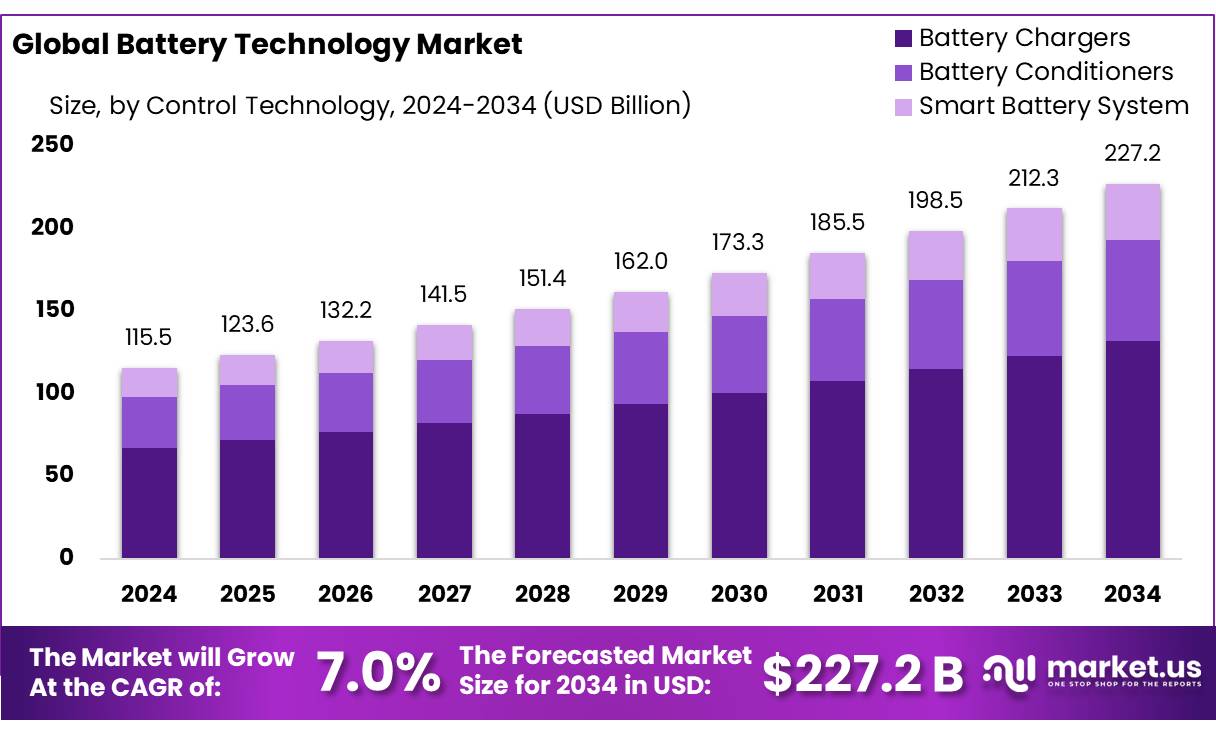
Battery Technology Market to Exceed $227B by 2034
The chart’s projection of a $227B market provides the macro-level context for CBAK’s manufacturing scale-up, illustrating the massive potential reward that justifies taking on the BESS market oversupply risks mentioned in the section.
(Source: Market.us News)
$1 B in Sector Investments, CBAK Energy’s 38 GWh Expansion Plan
While CBAK Energy has announced an ambitious, and as yet unfunded, target to expand capacity to 38 GWh, the broader energy storage sector is attracting substantial capital, validating the long-term demand thesis but also elevating the competitive stakes. Major technology and energy companies are making multi-million and billion-dollar investments across the value chain, from advanced battery intelligence software to alternative long-duration storage technologies, creating a highly dynamic and well-capitalized competitive environment.
- CBAK Energy’s own investment has been focused on tangible capacity growth, scaling from 2.3 GWh at the start of 2025 to 8.3 GWh by June 2026 through expansions at its existing Chinese facilities.
- In June 2026, battery intelligence software firm Electra AI announced a merger with Iron Horse valued at over $250 million, demonstrating significant investment in the software layer that optimizes BESS performance and profitability.
- Illustrating the interest in alternative chemistries for long-duration storage, Google reportedly invested approximately $1 billion in Form Energy in February 2026 for its iron-air battery technology, targeting a capital expenditure of around $33.33/k Wh.
- Downstream, major energy players like Total Energies continue to deploy capital into BESS projects, commissioning a 75 MWh battery park in March 2026, which directly pulls demand for cells from manufacturers like CBAK.

Lithium-Ion Market to Exceed $133B by 2030
This chart quantifies the significant growth in the core lithium-ion market, providing the fundamental rationale for the large-scale sector investments and CBAK’s ambitious 38 GWh expansion plan discussed in the section.
(Source: The Business Research Company)
Table: Comparative Battery Sector Investments (2026)
| Partner / Project | Time Frame | Details and Strategic Purpose | Source |
|---|---|---|---|
| CBAK Energy | June 2026 | Announced a potential capacity expansion from a current 8.3 GWh to a future target of 38 GWh to meet projected global demand for its cylindrical cells. | Energy Digital |
| Electra AI / Iron Horse | June 2026 | A merger valued at over $250 million to create a combined entity focused on battery intelligence software with a 5.3 TWh pipeline. | Stock Titan |
| Google / Form Energy | February 2026 | A reported $1 billion investment by Google into Form Energy’s iron-air battery technology, aimed at securing low-cost, long-duration energy storage. | Reddit / r/energy |
| Total Energies | March 2026 | Commissioned a 75 MWh BESS project in France, part of its strategy to develop 1.3 GW of storage capacity by 2030. | Total Energies |
CBAK Energy Anker Innovations JV, a Strategic Move to Mitigate Geopolitical Risk
CBAK Energy’s most significant strategic alliance is its joint venture with Anker Innovations to establish a manufacturing facility in Malaysia, a calculated move to diversify its production footprint beyond China and mitigate rising geopolitical and supply chain risks. This partnership is central to its ambition to serve Western markets, particularly the U.S., where Foreign Entity of Concern (FEOC) rules, which took effect in 2026, restrict tax credits for BESS projects using components from certain Chinese entities.
- The partnership with Anker Innovations, announced in November 2025, establishes a new battery cell manufacturing facility in Malaysia explicitly to target the U.S. and European markets.
- By producing its flagship models outside of China, CBAK aims to create a supply chain that can comply with U.S. Inflation Reduction Act (IRA) incentives, a critical driver of the North American BESS market.
- During the first half of 2026, CBAK did not announce any other major partnerships, indicating a strategic focus on executing the Malaysian plant and leveraging industry trade shows in Europe and Africa for business development rather than forming new alliances.
- This contrasts with the period before 2025, where its focus was primarily on domestic supply chains and customers within China from its Nanjing and Dalian production centers.

North America to Lead Fast-Charge Battery Market
The chart highlights the significant market opportunity in North America, a key target market for geographic diversification. This supports the section’s theme of using strategic JVs to mitigate geopolitical risks associated with over-reliance on a single region.
(Source: Research Nester)
Table: CBAK Energy Strategic Partnerships
| Partner / Project | Time Frame | Details and Strategic Purpose | Source |
|---|---|---|---|
| Anker Innovations | November 2025 | Formation of a joint venture to establish a new battery cell manufacturing facility in Malaysia. The project is designed to produce flagship battery models for export to the U.S. and European markets, diversifying its supply chain away from China. | Portersfiveforce.com |
China vs. International, CBAK Energy’s Geographic Diversification Strategy
CBAK Energy is executing a dual-pronged geographic strategy, reinforcing its established competitive position within China while simultaneously building the manufacturing and commercial infrastructure needed to penetrate high-value international markets in Europe, Africa, and North America. While China remains its revenue core and manufacturing base, the company’s future growth trajectory is increasingly tied to its success outside of its home market, particularly in light of Western policies designed to build non-Chinese battery supply chains.
- Within China, CBAK solidified its market standing in April 2026, achieving the #2 rank for 26650/26700 cell shipments and the #3 rank for 32140 cylindrical cell shipments, underscoring its manufacturing strength in specialized form factors for the domestic LEV and industrial markets.
- The company’s expansion of its Nanjing facility to 8 GWh in late 2025 serves as a primary supply hub for Eastern China and the rapidly growing Southeast Asian market, where demand is high for electric two- and three-wheelers.
- In 2026, CBAK actively courted international customers by showcasing its technologies at key industry events, including Autoexpo Kenya and The Battery Show Europe, demonstrating a clear intent to expand its commercial reach.
- The planned Malaysian facility with Anker Innovations is the cornerstone of its international strategy, representing a critical step to serve future customers in the U.S. and Europe and de-risk its operations from over-reliance on a single country. This is a significant shift from its pre-2025 posture, which was almost entirely China-focused. U.S. energy storage growth is a key target.

China Dominates Global Battery Supply Chain
The chart visually establishes the central premise of the section—China’s overwhelming dominance of the battery supply chain. This provides the critical context for why a geographic diversification strategy is necessary for CBAK.
(Source: LinkedIn)
Cylindrical LFP Cell Commercialization, CBAK Energy’s Focus on Niche Formats
CBAK Energy has successfully transitioned from a niche supplier to a commercially scaled manufacturer by focusing its technological development on large-format cylindrical cells, a form factor that offers advantages in energy density and thermal management for BESS and LEV applications. The company has validated the maturity of its core products through mass production and is now using their proven performance characteristics, such as long cycle life, as a key differentiator to compete against industry giants.
- The strategic shift to mass-produce the 32140 large cylindrical cell, initiated in 2024, was the catalyst for the company’s recent growth, moving it into the utility-scale BESS and EV markets.
- By the end of 2025, the company had commissioned a new 2.3 GWh production line specifically for its 40135 cells, demonstrating its ability to bring new, specialized product lines to commercial scale rapidly.
- In 2026, CBAK is marketing the technical superiority of its cells, highlighting that its 40135 FS 2 model demonstrates superior capacity retention over 2, 500 cycles and its standard 40135 cell offers over 4, 000 cycles, a critical performance metric for BESS operators focused on Levelized Cost of Storage (LCOS).
- While its LFP technology is now commercially mature, CBAK is also exploring next-generation chemistries, including sodium-ion, to address the cost-sensitive segment of the energy storage market, indicating a forward-looking technology roadmap.

Battery Chemistries Compared on Key Performance Metrics
The section focuses on CBAK’s strategic choice of Cylindrical LFP cells. The chart, by comparing various chemistries on key metrics, can visually explain the technical and commercial rationale behind specializing in LFP for certain niche applications.
(Source: IDTechEx)
SWOT Analysis, CBAK Energy’s Growth vs. Geopolitical Headwinds
CBAK Energy’s recent strategic pivot has unlocked impressive revenue growth and a strong market position in niche cylindrical cell formats, but this momentum is challenged by significant external threats, including intense price competition and geopolitical policies aimed at curbing reliance on Chinese supply chains. The company’s future success depends on leveraging its technological strengths to navigate these market weaknesses and threats.

Battery Technologies Mapped to Key Energy Applications
A SWOT analysis involves assessing market opportunities. This chart, which maps different battery technologies to their applications, provides a visual overview of the competitive landscape and potential niches, directly informing the ‘Opportunities’ component of the analysis.
(Source: IDTechEx)
Table: SWOT Analysis for CBAK Energy BESS Cell Manufacturing
| SWOT Category | 2021 – 2024 | 2025 – 2026 | What Changed / Resolved / Validated |
|---|---|---|---|
| Strengths | Operated as a niche battery supplier with established production facilities in China. | Achieved +99.3% Yo Y revenue growth (Q 1 2026). Secured top 3 market rank in China for 26650/32140 cells. Demonstrated technology with long cycle life (>2, 500 cycles). | The 2024 strategic pivot to mass-produce large cylindrical cells was validated by rapid revenue growth and achieving a significant market share in China for those specific products. |
| Weaknesses | Limited production scale and geographic concentration in China. Dependent on a narrow product portfolio. | Heavy reliance on Chinese domestic market for revenue. Ambitious 38 GWh expansion target is not yet funded or fully de-risked. | The company’s primary weakness, its geographic concentration, is being actively addressed through the Malaysian JV, but execution risk remains high. |
| Opportunities | Growing global demand for EVs and energy storage. | Exponential growth in global BESS market (projected $90 B in 2026). Targeting new applications like residential storage and AI data center backup power. Expansion into Europe and Africa. | The company is successfully capitalizing on the booming BESS and LEV markets, with its product showcases in new regions (Kenya, Europe) in 2026 confirming its intent to seize these opportunities. |
| Threats | Intense competition from larger, more established battery manufacturers like CATL and BYD. | Geopolitical headwinds, including U.S. FEOC rules restricting market access. Intense price competition and oversupply from China. Rise of lower-cost alternative chemistries like sodium-ion. | Threats have intensified. Western protectionist policies (FEOC) became a direct risk in 2026, and market-wide price wars driven by Chinese overcapacity are putting pressure on margins. |
CBAK Energy 38 GWh Target, Execution Risk vs. Record Sales Projections
The single most critical factor for CBAK Energy’s success in the coming year is its ability to execute its ambitious 38 GWh capacity expansion while securing the international offtake agreements needed to absorb that new volume. If the company successfully ramps up its Malaysian facility and converts its European and North American business development efforts into firm contracts, it could solidify its position as a key global player. However, if execution falters or demand is absorbed by lower-cost competitors, its significant capital investments could be at risk.
- If this happens: Watch for announcements confirming the construction timeline and commissioning date for the Malaysian facility with Anker Innovations. A successful and timely launch is the primary signal of its international strategy’s viability.
- And this happens: Monitor for new, large-volume supply agreements with customers in Europe or North America, particularly for residential BESS or the emerging AI data center backup power market, which CBAK has publicly targeted.
- Then these could be happening: The company could successfully navigate U.S. FEOC restrictions, giving it a competitive advantage over other Chinese-based suppliers in the lucrative U.S. market. It would also validate its high-stakes capacity expansion, justifying the capital expenditure and supporting its projections for record sales in 2026.

CBAK’s Valuation Lags Industry Peers
The section discusses the execution risk versus sales projections for CBAK’s 38 GWh target. The chart, showing that CBAK’s valuation lags its peers, directly quantifies the market’s skepticism and perceived risk, making it a highly relevant illustration for this topic.
(Source: Simply Wall St)
The questions your competitors are already asking
This report covers one angle of CBAK Energy’s expansion in the BESS supply chain. The questions that matter most depend on your work.
- Which companies are gaining or losing ground in the large cylindrical cell market for BESS?
- CBAK Energy investments and funding. Is the company’s 38 GWh capacity expansion on track for its 2026 target?
- How do CBAK’s large cylindrical LFP cells compare to sodium-ion batteries for utility-scale BESS?
- CBAK Energy activities in BESS. Is the Anker Innovations joint venture progressing from pilot to deployment?
This report does not answer these. Enki Brief Pro does.
Your question, your angle, your framework. SWOT, PESTL, scenario modelling. The same niche depth, built around the decision your work actually depends on.
