

Biochar India Offtake Agreements, 180, 000 Tonne Altitude Deal, 425, 000 Tonne Engrow Pact, and 5 Major Deals (2025-2026)
Biochar Projects Scale-Up, Altitude 180 k Tonne Deal Validates Commercial Readiness
The Indian biochar market has shifted from early-stage, fragmented projects before 2024 to a period of rapid commercial-scale acceleration, validated by large, multi-year offtake agreements in 2025 and 2026. This transition is marked by a move from small, localized soil amendment applications to a focus on generating high-integrity, permanent Carbon Dioxide Removal (CDR) credits for the global voluntary carbon market.
- Before 2025, the Indian biochar sector was characterized by pilot programs and academic research focused on agricultural co-benefits. The commercial activity was limited, with few large-scale projects capable of producing credits for international buyers.
- Beginning in 2025, the market structure changed with the entrance of major corporate buyers and specialized financiers. A January 2025 deal between Google and Varaha for 100, 000 tonnes of biochar credits signaled a new phase of corporate demand, which was followed by a similar offtake agreement between Microsoft and Varaha in January 2026.
- The June 2026 agreement between Swiss financier Altitude and Indian developer Equilibrium for 180, 000 tonnes of CDR credits over eight years represents a maturation of the market. It demonstrates a shift toward long-term, bankable contracts that provide the revenue certainty needed to secure project financing and scale production infrastructure.
- This trend is further confirmed by Altitude’s broader strategy in India, which includes a deal for 425, 000 tonnes from Engrow in April 2026 and a 360, 000-tonne agreement with Alcom in December 2025. These multi-year procurements are creating a stable demand floor, encouraging more developers to enter the market.
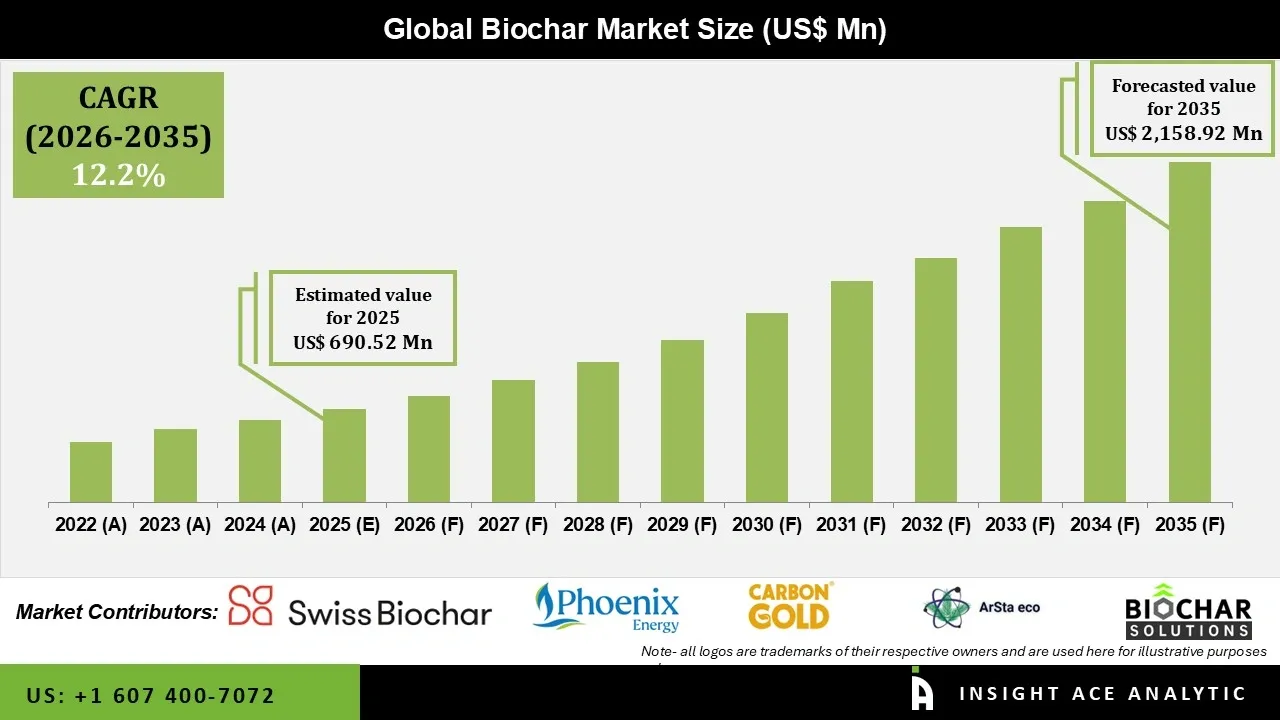
Global Biochar Market Set for Robust Double-Digit Growth
The global biochar market is projected for significant expansion, growing at a robust 12.2% CAGR from 2026 to 2035. It is set to nearly triple its value from an estimated US$ 690.52 million in 2025 to US$ 2,158.92 million by 2035, signaling strong market confidence and adoption across various sectors.
Biochar Market Growth Fuels Carbon Removal & Sustainable Agriculture
This accelerating market growth for biochar, driven by its dual benefits in carbon sequestration and soil enhancement, creates a foundational economic incentive for scaling carbon dioxide removal (CDR) solutions. The increasing investment reflects a broader shift towards nature-based climate solutions and sustainable agricultural practices, vital for environmental and economic resilience.
Biochar Carbon Removal Certificates Show Exponential Growth
Cumulative Biochar CORCs issued by Puro.earth surged from negligible levels in 2019 to over 400,000 by 2025. This exponential growth, particularly from 2023 to 2025, signals rapid scaling in biochar-based carbon removal capacity and demand within the voluntary carbon market.
(Source: India’s Carbon Removal Market: Key Projects, Buyers & What’s Next?)
Altitude 3 Major Offtakes, Securing Over 965, 000 Tonnes of CDR Credits (2025-2026)
Long-term offtake agreements have become the primary mechanism for financing and de-risking biochar projects in India, with financiers like Altitude and corporate buyers like Microsoft and Google securing significant future supply. These forward purchases are critical for developers, as they underwrite the capital expenditure required to build and expand pyrolysis facilities. By locking in future revenue streams, developers can access financing that would otherwise be unavailable for nascent climate technologies.
- The structure of these deals provides financial certainty, a key enabler for scaling operations. The Altitude-Equilibrium agreement, for instance, is a multi-year contract that allows Equilibrium to plan for sustained growth and infrastructure build-out across its project sites in India.
- Financiers are aggressively aggregating supply from multiple sources to build diversified portfolios of high-quality credits. Altitude’s agreements with Equilibrium (180, 000 tonnes), Engrow (425, 000 tonnes), and Alcom (360, 000 tonnes) demonstrate a clear strategy to become a dominant supplier of Indian-origin biochar CDR credits.
- Direct corporate purchasing is also a major driver. Tech companies with ambitious net-zero targets are bypassing intermediaries to secure large volumes directly from project developers. The agreements between Google and Varaha, and Microsoft and Varaha, are prime examples of this trend, creating intense competition for a limited supply of high-integrity credits.
Table: Major Biochar Carbon Removal Offtake Agreements Involving India
| Buyer / Financier | Supplier | Time Frame | Details and Strategic Purpose | Source |
|---|---|---|---|---|
| Altitude | Equilibrium | Jun 2026 | A multi-year offtake for 180, 000 tonnes of biochar CDR credits, providing Equilibrium with long-term revenue to scale its climate infrastructure projects in India. | Carbon Pulse |
| Altitude | Engrow | Apr 2026 | Procurement of 425, 000 Carbon Removal Certificates (CORCs) from biochar facilities in Southern India, expanding Altitude’s portfolio of high-quality CDR. | Altitude |
| Microsoft | Varaha | Jan 2026 | Offtake agreement for an undisclosed volume of biochar and other carbon removal credits generated from projects with smallholder farmers in India. | Ag Funder News |
| Altitude | Alcom | Dec 2025 | Agreement to procure 360, 000 CORCs from biochar facilities in India and the Philippines, diversifying Altitude’s geographic supply base. | Altitude |
| Varaha | Jan 2025 | One of the largest-ever biochar offtake agreements, securing 100, 000 tonnes of credits from a project in Gujarat to support Google’s net-zero goals. | Reuters |
India Biochar Leadership, Altitude Deal Cements Position as a Global CDR Production Hub
India is solidifying its position as a global leader for biochar-based carbon removal, driven by its massive agricultural feedstock availability and an increasingly supportive domestic policy environment. The country’s unique combination of low-cost raw materials and a clear regulatory pathway for carbon credit generation makes it an attractive destination for international capital and corporate buyers.
- India possesses the potential to sustainably produce an estimated 83 million tons of biochar annually, which could deliver around 0.2 gigatons of net carbon removal per year. This immense capacity is rooted in the country’s large agricultural sector, which generates vast quantities of crop residue that can be converted into biochar.
- The Indian government has created crucial policy tailwinds for the sector. The establishment of the Carbon Credit Trading Scheme (CCTS) explicitly recognizes biochar projects for credit generation, providing a clear monetization pathway for developers within both domestic and international markets.
- In April 2025, the approval of new methodologies for India’s voluntary carbon market provided further regulatory clarity, revitalizing the offset landscape and giving project developers the confidence to invest in new capacity.
- The influx of international partners like Switzerland-based Altitude and U.S.-based buyers like Microsoft and Google confirms India’s strategic importance. These entities are actively seeking high-integrity credits from Indian projects to meet their climate commitments, channeling significant investment into the country’s CDR infrastructure.
$140 Per Tonne, Altitude Deal Highlights Biochar’s Cost Advantage Over Other CDR Tech
Biochar’s high technological maturity and favorable cost profile have established it as the most commercially viable and scalable permanent carbon removal solution in the near term. This economic advantage is a primary reason why it attracts significant offtake agreements from pragmatic buyers focused on securing the largest volume of durable CDR for their capital.
- Biochar production is a proven technology with a high Technology Readiness Level (TRL 8-9), indicating it is ready for full commercial deployment. Unlike more speculative CDR methods, biochar does not face significant technical hurdles to scaling, which de-risks execution for buyers like Altitude.
- The unit economics are highly favorable compared to other engineered removal pathways. Platts assessed the price for Indian biochar at $140/mt CO 2 e in October 2025, while production costs can range from $80 to $250 per tonne. In contrast, Direct Air Capture (DAC) can cost upwards of $680 per tonne.
- This cost-effectiveness translates directly to market dominance in terms of delivered volume. In 2024, biochar accounted for 86% of all CDR deliveries globally, demonstrating its position as the only permanent removal method operating at a meaningful scale today.
- The recognition of co-benefits, such as improved soil fertility and water retention, provides an additional value proposition. A 2026 study found that carbon credit prices increase with verified co-benefits, offering an additional revenue stream that further strengthens project economics.

Biochar Carbon Removal Certifications Soar to Over 400,000 CORCs by 2025
Puro.Earth data shows cumulative biochar CORCs exploding from negligible levels in 2019 to over 400,000 by 2025. This exponential growth, with a sharp increase from ~150,000 CORCs in 2023 to ~350,000 in 2024, signals robust market adoption and validation for biochar as a scalable carbon removal solution.
Strong Market Validation De-risks Large-Scale Biochar CDR Projects
The rapid rise in CORC issuance confirms biochar’s credibility and demand in the voluntary carbon market. This market maturity de-risks large-scale projects like Altitude Equilibrium’s 180,000-tonne CDR target in India, indicating a strong appetite for verifiable, permanent carbon removal solutions.
Asia Pacific Biochar Market Set for Explosive Growth
The Asia Pacific biochar market is projected for substantial growth, increasing from an estimated $558 million in 2023 to over $1.6 billion by 2032, driven by rising demand for carbon removal and sustainable agriculture. This significant expansion presents a clear opportunity for early market entrants.
(Source: Biochar Market Size to Hit USD 3,452.76 Mn By 2035)
SWOT Analysis, Altitude and India’s Biochar Market Opportunities and Scaling Risks
The Indian biochar market’s primary strengths are its vast, low-cost feedstock and supportive policy, creating a major opportunity to meet surging global demand for CDR. However, the sector faces significant threats from potential lapses in quality control and the operational challenges of scaling distributed production models while maintaining high standards of Monitoring, Reporting, and Verification (MRV).
Table: SWOT Analysis for India’s Biochar Carbon Removal Market
| SWOT Category | 2021 – 2023 | 2024 – 2025 | What Changed / Validated |
|---|---|---|---|
| Strengths | Theoretical abundance of agricultural waste (e.g., rice husks, coconut shells). Low labor costs. | Demonstrated conversion of feedstock potential into commercial projects. Platts assessed Indian biochar price at $140/tonne, validating cost-competitiveness. | The market has validated that India’s feedstock advantage translates into a globally competitive cost structure for CDR credits. |
| Weaknesses | Fragmented supply chains for feedstock collection. Lack of standardized production technology and quality control. | Scaling challenges remain, particularly in logistics for distributed models. Ensuring consistent quality across numerous small-scale producers is a key operational hurdle. | While large offtakes signal demand, the operational complexity of scaling production has emerged as a primary internal weakness for developers to solve. |
| Opportunities | Nascent interest from corporate buyers in permanent CDR. Potential for government support for sustainable agriculture. | Massive influx of demand confirmed by offtakes from Google, Microsoft, and Altitude. India’s CCTS and methodology approvals (Apr 2025) created a clear monetization pathway. | The opportunity has moved from theoretical to tangible, with billions of dollars in corporate climate commitments now actively seeking high-integrity biochar credits from India. |
| Threats | Risk of low-quality credits (non-additionality, poor permanence) damaging market reputation. Policy uncertainty. | Scrutiny over MRV and permanence has intensified. Any failure by a major project to deliver high-quality, verified credits could sour buyer sentiment across the market. | The primary threat is now execution risk. The market’s credibility hinges on the ability of developers like Equilibrium and Varaha to meet the stringent quality standards set by certifiers like Isometric and Puro.earth. |
Altitude India Execution, Watch for Credit Delivery and CCTS Price Stability in 2026
The critical signal for the Indian biochar market in the next 12-18 months is the successful, on-time delivery of high-integrity carbon credits under major offtake agreements like the Altitude-Equilibrium deal. Successful execution will validate the bankability of Indian projects and attract a new wave of capital, while any failures could trigger a sharp contraction in buyer confidence.
- If developers successfully deliver the initial tranches of credits that meet rigorous third-party verification standards, watch for an acceleration of new project financing and a potential increase in credit prices as buyers compete for proven supply. This would confirm that India can scale production without sacrificing quality.
- These deliveries could be happening in a market with strong underlying demand signals. Reports from late 2025 indicated that as much as 89% of the 2025 biochar credit supply was already committed, signaling extreme supply scarcity that would be exacerbated by successful, scaled delivery.
- Conversely, if projects experience significant delays or fail verification audits, watch for a cooling of investor sentiment. Buyers may become hesitant to sign new long-term offtakes, and financiers like Altitude may apply stricter due diligence, slowing market growth.
- The performance of India’s domestic Carbon Credit Trading Scheme (CCTS) is another key indicator. Stable and predictable pricing within the CCTS will provide an essential revenue floor for projects, complementing international demand and strengthening the overall financial viability of the sector.
The questions your competitors are already asking
This report covers one angle of biochar commercialization in India. The questions that matter most depend on your work.
- Biochar carbon credit verification process India
- Agricultural waste supply chain for biochar India
- India carbon credit trading scheme price
- Biochar project development costs India
This report does not answer these. Enki Brief Pro does.
Your question, your angle, your framework. SWOT, PESTL, scenario modelling. The same niche depth, built around the decision your work actually depends on.
