

DAC Buyer Agreements, Frontier’s $915 M Commitment, TD Bank’s 18, 000 Tonne Offtake, and 6 Corporate Deals (2026)
The Direct Air Capture (DAC) market in 2026 is defined by a critical transition from pilot-scale projects to commercial execution. This shift is driven by a growing cohort of corporate buyers moving away from speculative spot purchases toward long-term, multi-year offtake agreements. These agreements are essential for securing future supply of high-durability carbon dioxide removal (CDR) credits and for helping developers de-risk capital-intensive projects. In 2026, the global DAC market valuation is estimated between US$156.3 million and US$372.3 million. Projections show rapid expansion, with a compound annual growth rate (CAGR) forecasted between 43.6% and 62%, indicating strong confidence in the sector’s future despite current high operational costs of $400 to $800 per tonne of CO₂.
DAC Offtake Models, Frontier’s $915 M Commitment Signals A Strategic Shift
The primary mechanism for purchasing Direct Air Capture credits has evolved from small, ad-hoc purchases to structured, long-term offtake agreements and advance market commitments (AMCs). This change is a direct response to the high capital costs of DAC facilities, providing developers with the revenue certainty required to secure project financing and scale operations.
- During the 2021 to 2024 period, the DAC market was characterized by early adopters, mainly in the technology sector, making relatively small, exploratory purchases to understand the technology and establish a foothold in the nascent carbon removal space.
- By 2026, the market has matured toward large-scale, long-term commitments. The most significant example is Frontier, a buyer coalition including Stripe, Google, and Anthropic, which announced $915 million in new funding commitments in June 2026. This AMC model aggregates demand to send a powerful market signal and accelerate a portfolio of carbon removal technologies.
- Individual corporate offtakes are also becoming standard practice. The June 2026 agreement between TD Bank Group and developer Deep Sky for over 18, 000 tonnes of DAC credits over a 10-year term demonstrates the expansion of the buyer base into the financial services industry.
- However, the market remains sensitive to external factors. In April 2026, Microsoft, a pioneer in carbon removal procurement, paused new credit purchases. This action highlights how shifts in corporate strategy or perceptions of federal support can introduce volatility and risk for developers reliant on a concentrated pool of buyers.
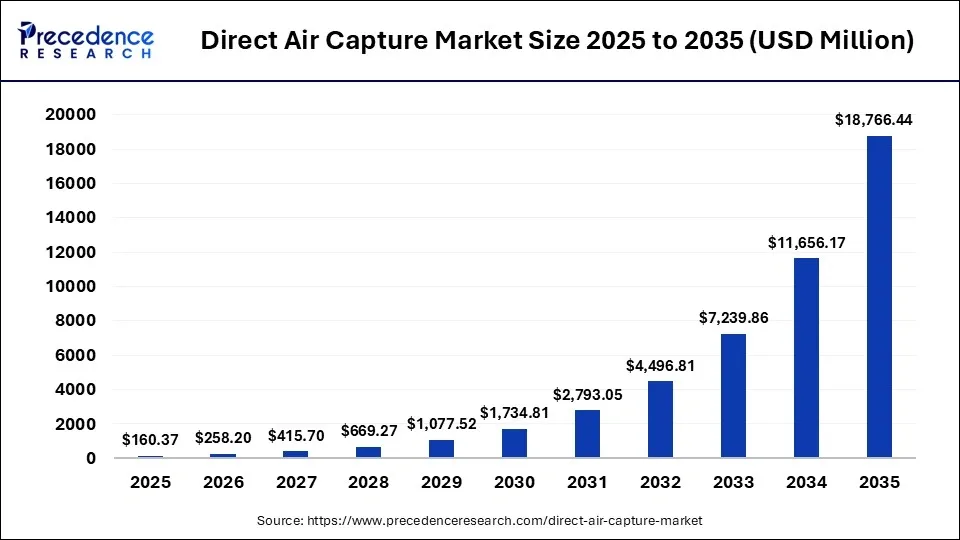
DAC Market Skyrockets, Projecting 100x Growth by 2035
The Direct Air Capture (DAC) market is poised for explosive growth, projected to surge over 100x from $160.37M in 2025 to $18.7B by 2035. By 2026, the market is expected to reach $258.20M, signaling rapid early-stage expansion and increasing demand from DAC credit buyers.
Buyer Demand & Regulatory Support Fueling DAC Market Surge
This aggressive market expansion indicates strong buyer confidence and significant investment in carbon removal, driven by corporate net-zero targets and evolving regulatory frameworks. Early market participants can capitalize on scaling demand and unlock substantial economic opportunities.
Direct Air Capture Market Set for Hyper-Growth: 61.67% CAGR to $4.25 Billion by 2034
The Direct Air Capture (DAC) market is projected to skyrocket from $91.21 million in 2026 to an astounding $4.25 billion by 2034, reflecting a staggering 61.67% CAGR. This signals an exponential increase in demand for DAC solutions and a rapidly maturing carbon removal economy.
Deep Sky 2 Major Offtake Agreements Validate Multi-Buyer Strategy (2026)
Project developers are successfully building bankable business cases by securing foundational offtake agreements from a diverse set of buyers across multiple industries. This multi-buyer strategy reduces reliance on any single corporate partner and creates a more resilient revenue model for financing the construction of new DAC facilities.
- Canadian developer Deep Sky exemplifies this strategy, securing a landmark 10-year deal with TD Bank Group in June 2026 for more than 18, 000 tonnes of carbon removal credits. This deal is significant for bringing a major North American financial institution into the DAC market as a large-volume offtaker.
- In May 2026, Deep Sky also announced carbon removal credit agreements with Lufthansa Group and Engie. These partnerships diversify its buyer base into the aviation and energy sectors, demonstrating the broadening appeal of high-durability credits for companies with hard-to-abate emissions.
- By securing these multi-year contracts, developers like Deep Sky and Climeworks provide proof points that anchor financing for new projects. The agreements with buyers like Airbus, Shopify, Swiss Re, and UBS serve as a demand signal that justifies investment in scaling DAC technology.
Table: Key Direct Air Capture Offtake Agreements in 2026
| Buyer / Coalition | DAC Provider | Volume / Value | Contract Term | Source |
|---|---|---|---|---|
| Frontier (Stripe, Google, Anthropic, etc.) | Portfolio of Companies | $915 million in new funding | 8-10 years | Frontier consortium to invest a further $915 m into carbon removal tech |
| TD Bank Group | Deep Sky | Over 18, 000 tonnes | 10 years | Deep Sky Announces Direct Air Capture Carbon Removal Offtake Agreement with TD |
| Lufthansa Group | Deep Sky | Not Specified | Multi-year | Deep Sky and Lufthansa Group Enter Carbon Removal Credit Agreement |
| Engie | Deep Sky | Not Specified | Not Specified | Engie Signs DAC Carbon Removal Deal with Deep Sky |
| Airbus, Shopify, Swiss Re, UBS | Climeworks | Not Specified | Multi-year agreements | How DAC & Carbon Removal Markets Are Scaling in 2026 |
| Amazon | Carbon Engineering | Not Specified | Offtake agreement in place | Top 3 Carbon Capture Leaders to Drive the Net-Zero Race in 2026 |
North America vs. Europe, Canada Emerges as a Key DAC Hub
While Europe pioneered early DAC projects, North America has become the epicenter for commercial-scale development and offtake agreements in 2026. This geographical shift is driven by a combination of strong federal policy incentives in the U.S., abundant renewable energy, and a favorable environment for project development in Canada.
- From 2021 to 2024, market attention was focused on European projects, particularly Climeworks‘ Orca and Mammoth plants in Iceland, which served as crucial technology demonstrators and were supported by early corporate buyers.
- In 2026, Canada has emerged as a strategic location for DAC development. Deep Sky is building its carbon removal infrastructure in Quebec, leveraging the province’s vast hydropower resources to power its energy-intensive operations and attract buyers seeking low-carbon-footprint credits.
- The United States continues to foster a strong development pipeline, supported by the Department of Energy’s Regional DAC Hubs program and enhanced 45 Q tax credits, which provide up to $180 per ton for CO₂ captured and sequestered. This policy framework is foundational for large projects involving developers like Carbon Engineering.
- Europe is working to create a competitive market, with the EU establishing its first voluntary standard for permanent carbon removals in February 2026. However, the volume and scale of commercial offtake agreements currently announced are more concentrated in North America.
Commercial-Scale Operations, Climeworks and Carbon Engineering Lead DAC Deployment
In 2026, Direct Air Capture technology has advanced from research and small pilots to the first phase of commercial-scale execution, but significant cost and energy-use challenges persist. The market’s ability to move from promise to proven delivery at scale is the central test for developers and their corporate backers.
- The prior period of 2021-2024 was defined by the successful operation of demonstration facilities that proved the technical viability of DAC. Climeworks‘ Orca plant, which came online in 2021, was a key milestone, capturing thousands of tonnes of CO₂ annually and validating its solid sorbent technology.
- By 2026, leading developers like Climeworks and Carbon Engineering are focused on megatonne-scale projects. The large, multi-year offtake agreements being signed are predicated on the assumption that this tenfold increase in scale is technologically and logistically achievable within the next decade.
- Cost remains the most significant barrier to widespread adoption. With prices ranging from $400 to $800 per tonne, DAC credits are a premium product accessible mainly to a small group of well-capitalized companies or those in hard-to-abate sectors with few other decarbonization options.
- A crucial market validation event occurred in June 2026, when the first DAC credits generated in North America were delivered. This milestone marks an important step in building credibility and demonstrating that developers like Air Capture and others can fulfill their offtake contracts.
Future DAC Growth, Frontier’s AMC Model Provides a Path to Scale
The most critical factor for the Direct Air Capture market’s trajectory is whether the advance market commitment (AMC) model, successfully implemented by Frontier, can be replicated across other industries to expand the buyer base beyond its current concentration in the technology sector.
- If more corporations in finance, aviation, and heavy industry follow the lead of TD Bank and Lufthansa by signing long-term offtake agreements, watch for a corresponding acceleration in new DAC project financings and announcements in the next 12-24 months.
- The formation of new, industry-specific buyer coalitions would be a strong positive signal. An AMC focused on the aviation or shipping industries, for example, could aggregate demand to support DAC-to-fuels projects and secure a supply of sustainable aviation fuel (SAF).
- Conversely, if credit purchasing remains dominated by a handful of large technology companies, the market’s growth could be constrained. Any further purchasing pauses, similar to Microsoft‘s, could undermine developer confidence and make it more difficult to finance the next generation of megatonne-scale facilities.
The questions your competitors are already asking
This report covers one angle of Direct Air Capture commercialization. The questions that matter most depend on your work.
- companies buying direct air capture credits
- direct air capture credit price forecast
- new direct air capture projects North America
- direct air capture technology comparison solid vs liquid
This report does not answer these. Enki Brief Pro does.
Your question, your angle, your framework. SWOT, PESTL, scenario modelling. The same niche depth, built around the decision your work actually depends on.
