

HIF Global DAC for E-Methanol, $7 B Texas Project, 1 Mabanaft Offtake, and 5 Global Facilities (2021 to 2026)
E-Methanol Commercial Scale, HIF Global Secures 2 Major Offtakes
The e-methanol sector has moved from pilot-scale validation to targeting commercial bankability, driven by developers securing large-scale offtake agreements necessary to de-risk multi-billion-dollar production facilities. Before 2025, activity centered on proving integrated technology pathways, such as at HIF Global’s Haru Oni facility in Chile. Since January 2025, the focus has shifted to securing the commercial viability of massive first-of-a-kind projects through long-term supply contracts, which are critical for obtaining project financing.
- In the period from 2021 to 2024, the primary industry achievement was the operational launch of integrated pilot plants. HIF Global’s Haru Oni project in Chile, backed by partners including Porsche and Siemens Energy, became the world’s first facility to produce e-fuels at a commercial scale, validating the technical feasibility of combining green hydrogen and captured CO 2.
- Since Q 1 2025, the strategy has pivoted to securing revenue streams for future GW-scale plants. In April 2025, HIF Global signed a Heads of Agreement (HOA) with Mabanaft for the offtake of 100, 000 tons of e-methanol per year, directly supporting the development of its project portfolio.
- This commercial momentum continued into 2026. HIF Global signed another significant agreement in February 2026 with e Fuel One Gmb H for the annual supply of 100, 000 tons of e-methanol, demonstrating growing demand from European fuel distributors and further strengthening the business case for its new facilities.
- The market’s evolution is also visible in competitor actions. In August 2025, European Energy and Mitsui & Co. launched the world’s first large commercial e-methanol plant in Denmark, signaling that the industry is advancing beyond isolated pilot projects toward replicable commercial models.
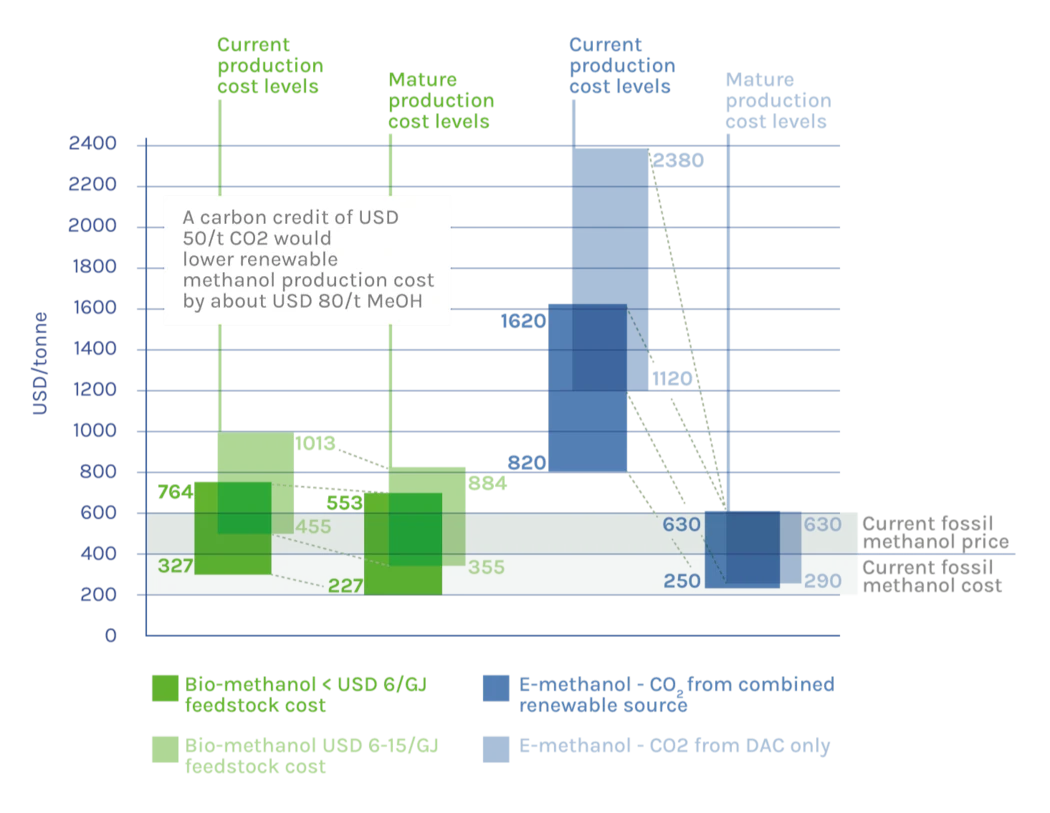
Path to Cost-Parity for Renewable Methanol
This chart illustrates the economic viability underpinning HIF Global’s commercial-scale aspirations. The path to cost-parity is essential for securing long-term offtake agreements, as it assures buyers that e-methanol will become competitive with conventional fuels.
(Source: Global Maritime Forum)
$15.3 B in Planned Projects, HIF Global Investment Pipeline
Developers are committing over $15 billion in capital for a new generation of large-scale e-fuel facilities, a decisive shift from the smaller investments that characterized the pilot phase before 2025. This wave of investment is concentrated on vertically integrated projects that combine renewable power, GW-scale electrolysis, and CO 2 capture to achieve economies of scale. HIF Global is leading this trend, with its announced project pipeline in the Americas and Australia representing the bulk of this planned capital expenditure.
- The scale of investment has increased dramatically since 2025, with projects now routinely sized in the billions. HIF Global’s Matagorda facility in Texas is planned as a $6 billion to $7 billion project, while its Paysandú project in Uruguay is estimated at $5.3 billion.
- These investments are supported by a strategic rationale to lower production costs through scale. For its $4 billion Brazil project, HIF Global announced in February 2026 that it expects significant CAPEX savings, underscoring the focus on financial optimization for these large builds.
- Investment is also flowing into the enabling technology supply chain. The commitment to large projects like Matagorda necessitates parallel investment in manufacturing capacity for key components like electrolyzers, creating a feedback loop that drives down costs for the entire industry.

E-fuels Market to Reach $66.3B by 2030
The chart showing the large total addressable market for e-fuels provides crucial context for HIF Global’s $15.3 billion investment pipeline. It frames the company’s significant capital expenditure as a strategic move to capture a share of a rapidly growing, multi-billion dollar industry.
(Source: MarketsandMarkets)
Table: HIF Global Strategic Project Investments
| Partner / Project | Time Frame | Details and Strategic Purpose | Source |
|---|---|---|---|
| HIF Matagorda | 2025 – Today | Announced a $6-7 billion facility in Texas designed to utilize 1.8 GW of electrolyzer capacity. The project leverages U.S. policy support to establish a major North American e-fuels hub. | Houston Business Journal |
| HIF Paysandú | 2025 – Today | Received environmental location feasibility approval in November 2025 for a proposed $5.3 billion e-fuels project in Uruguay, securing a key development milestone in South America. | Global e-Fuels |
| Brazil Project | 2025 – Today | Announced in April 2025, this $4 billion project in Brazil aims to produce up to 800, 000 tonnes of e-methanol annually, targeting cost efficiencies through scale and local partnerships. | Reuters |
| India Project | 2025 | In February 2025, HIF Global India proposed a $1 billion investment for an e-fuel project in Odisha, signaling expansion into the Asian market. | The New Indian Express |
HIF Global 2 Key Supplier Deals, Electric Hydrogen and Mabanaft (2025 to 2026)
Strategic partnerships have become the primary mechanism for building out the e-methanol value chain, with a clear focus since 2025 on securing technology suppliers for core components and credit-worthy offtakers for the final product. Before this period, partnerships were centered on research and pilot-scale validation. Now, alliances are commercial in nature, designed to ensure that GW-scale projects are both technologically equipped and financially de-risked from the outset.
- In September 2025, HIF Global selected Electric Hydrogen (EH 2) to supply 1.8 GW of advanced PEM electrolyzer systems for its Texas facility. This decision locks in a critical technology provider for industrial-scale green hydrogen production, a key dependency for the project.
- The agreement with Mabanaft in April 2025 for 100, 000 tons of e-methanol per year establishes a foundational offtake relationship with a major German energy company. This provides revenue certainty and improves the project’s bankability with potential lenders.
- Similarly, the February 2026 HOA with e Fuel One Gmb H for another 100, 000 tons of e-methanol further diversifies HIF Global’s customer base and confirms market demand in Europe, a key target region due to its emissions regulations.
- The competitive landscape for carbon capture and removal is also shaped by partnerships, with specialized firms like Climeworks signing long-term credit purchase deals with corporate buyers like TD Bank Group and Swiss Re, creating a separate but related market for captured atmospheric CO 2.
Table: HIF Global Strategic Partnerships and Alliances
| Partner / Project | Time Frame | Details and Strategic Purpose | Source |
|---|---|---|---|
| e Fuel One Gmb H | Feb 2026 | Signed a Heads of Agreement for the long-term offtake of 100, 000 tons of certified e-methanol annually. This secures a key customer in the German fuel distribution market. | HIF Global |
| Electric Hydrogen (EH 2) | Sep 2025 | Selected to supply advanced PEM electrolyzer systems for the 1.8 GW Matagorda e-Fuels Facility in Texas, securing a key technology for green hydrogen production at scale. | Gasworld |
| Mabanaft | Apr 2025 | Signed a Heads of Agreement for the long-term purchase of e-methanol, starting with an initial offtake of 100, 000 tons per year, de-risking project financing. | HIF Global |
| Porsche & Siemens Energy | 2021 – 2024 | Key partners in the development and operation of the Haru Oni pilot plant in Chile, which served as the technical validation for HIF Global’s integrated e-fuel production model. | Green Fuel Journal |
US vs South America, HIF Global’s Geographic Project Strategy
HIF Global’s geographic strategy is bifurcated, prioritizing project development in regions with either exceptional renewable energy resources, like South America and Australia, or highly favorable policy environments, such as the United States. Before 2025, the focus was on resource-rich locations like Chile for its pilot project. The introduction of the U.S. Inflation Reduction Act (IRA) created a powerful new incentive, making Texas a prime location for the company’s largest planned investment and signaling a dual-track approach to global expansion.
- The United States: The $6-7 billion Matagorda project in Texas is a direct response to the IRA’s 45 Q and 45 V tax credits. The $180/tonne credit for CO 2 captured via DAC and stored, or $130/tonne if utilized, fundamentally changes the economic calculus for such projects in the U.S.
- South America: Projects in Chile (Haru Oni), Uruguay (Paysandú), and Brazil are sited to take advantage of abundant and low-cost solar and wind power. These regions offer the potential for producing globally competitive green hydrogen, a primary cost driver for e-methanol.
- Australia: The Tasmania project leverages the island’s high-capacity renewable energy grid to support a facility expected to produce over 200, 000 tonnes of e-methanol annually, targeting export markets in Asia and beyond.
- This global diversification mitigates geopolitical and regulatory risks. By developing a portfolio across different continents, HIF Global avoids dependence on a single policy framework or energy market, building a more resilient global supply network.
DAC Technology Status, HIF Global Integrates TRL 6-7 Systems
The core technological risk in the DAC-to-methanol pathway is the maturity gap between its key components. While methanol synthesis is a commercially proven process (TRL 8-9), Direct Air Capture (DAC) remains a developing technology (TRL 6-7), with high costs and limited large-scale operational history. HIF Global’s strategy involves integrating this less mature technology into its commercial facilities, assuming the risk that costs will fall and reliability will improve as the industry scales.
- The primary barrier for DAC is cost, with current estimates ranging from $100 to $1, 000 per tonne of captured CO 2. This contrasts sharply with point-source capture from industrial facilities, which can cost as little as $15 – $35 per tonne, creating a significant cost premium for using atmospheric CO 2.
- In March 2025, HIF Global began the installation of its first DAC unit at its Chilean site, moving the technology from the design phase to physical integration with an operational e-fuel plant. This provides a critical testbed for optimizing the process.
- Despite its cost, DAC is critical to the long-term vision because it is not limited by geography or the availability of industrial CO 2 sources. This allows production plants to be located in areas with the best renewable energy resources, which is a core tenet of HIF Global’s strategy.
- The industry is addressing this maturity challenge through modular designs and partnerships with specialized DAC providers like Climeworks and Carbon Engineering, which are focused exclusively on scaling capture technology and driving down the cost curve.

E-Methanol Costs Projected to Drop Significantly
This chart directly supports the section on DAC technology status. The projected drop in e-methanol costs is a direct consequence of technological advancements, such as the maturation of DAC systems to TRL 6-7, which improve efficiency and reduce production expenses.
(Source: Springer Nature)
HIF Global SWOT Analysis, Strengths and Policy Dependencies (2021 to 2026)
HIF Global’s market position is defined by its strength as a first-mover with a global, multi-billion-dollar project pipeline, but it is exposed to significant threats related to policy dependence and project execution risk. The company has successfully translated its pilot-phase technical validation into a portfolio of commercially ambitious projects backed by major offtake agreements. However, the financial viability of these capital-intensive facilities hinges on continued, robust government support and the successful scale-up of developing technologies like DAC.
Table: SWOT Analysis for HIF Global’s DAC-to-Methanol Strategy
| SWOT Category | 2021 – 2024 | 2025 – 2026 | What Changed / Validated |
|---|---|---|---|
| Strength | Demonstrated technical leadership with the operational Haru Oni pilot plant in Chile, proving the integrated e-fuel production concept. | Established a globally diversified portfolio of GW-scale projects (USA, Uruguay, Brazil, Australia) and secured two major offtake agreements for 200, 000 total tonnes/year. | The company successfully converted its technical proof-of-concept into a bankable portfolio of large-scale commercial projects, validating its first-mover advantage. |
| Weakness | The business model was reliant on high-cost, pilot-scale technology with an unproven economic case for commercial-scale production. | Projects remain highly capital-intensive (e.g., $7 B for Matagorda), with long development timelines and a continued dependence on immature and costly DAC technology (TRL 6-7). | While commercial interest is validated, the underlying weakness of high capital costs has not been resolved; it has been magnified by the shift to GW-scale projects. |
| Opportunity | Growing decarbonization mandates in shipping and aviation created a theoretical future market for sustainable fuels like e-methanol. | The U.S. IRA introduced powerful tax credits (45 Q, 45 V) that drastically improve project economics. Market forecasts project the green methanol market to exceed $11 B by 2030. | The opportunity shifted from a theoretical future market to a tangible, policy-driven commercial environment, making large-scale investments immediately more attractive, especially in the U.S. |
| Threat | Risk that the cost of green hydrogen and DAC would not decline fast enough to compete with fossil fuels or other green alternatives. | Extreme dependence on government subsidies (IRA). A “CO 2 supply crunch” is emerging as a bottleneck for e-fuels, and competition is growing from projects using lower-cost biogenic CO 2. | The primary threat is now policy risk. Any reduction or removal of subsidies like the IRA would severely impact the financial viability of the current project pipeline. Execution risk for these FOAK projects is also a major threat. |
Watch for Matagorda FID, HIF Global’s Critical 2026 Milestone
The most critical strategic action for the DAC-to-fuels industry in the year ahead is achieving a Final Investment Decision (FID) on a GW-scale production facility, with HIF Global’s Matagorda project in Texas serving as the key litmus test. An FID would signal that the combination of offtake agreements, technology partnerships, and policy incentives is sufficient to secure the billions in private capital needed to move from ambition to construction. This event would validate the entire commercial model that HIF Global and its competitors are pursuing.
- If an FID is announced for the Matagorda project, watch for a rapid acceleration of investment into the U.S. e-fuels supply chain. This includes manufacturing capacity for electrolyzers and DAC components, as well as downstream infrastructure for methanol transport and bunkering. This would confirm the IRA’s effectiveness in catalyzing first-of-a-kind clean energy infrastructure.
- These events could be happening: a wave of similar project announcements from competitors seeking to replicate the model in other IRA-advantaged locations. The de-risking of the first major project will provide a clear roadmap for others, potentially leading to a land rush for sites with both strong renewable resources and grid access.
- However, if the project faces significant delays in reaching FID, watch for a strategic pivot back toward projects utilizing lower-cost biogenic or industrial CO 2 sources. This would signal that the cost and maturity gap of DAC technology remains too high for private capital to bear, even with strong policy support, pushing purely atmospheric CO 2-based fuels further into the future.
The questions your competitors are already asking
This report covers one angle of the e-methanol sector’s path to commercial bankability. The questions that matter most depend on your work.
- HIF Global activities in North America. Is the Texas e-methanol project progressing from planning to a Final Investment Decision?
- HIF Global investments and funding. Are the Mabanaft and e-Fuel One offtakes sufficient to secure project financing for its GW-scale facilities?
- Who are HIF Global’s key technology partners for Direct Air Capture (DAC) and electrolysis for their US project pipeline?
This report does not answer these. Enki Brief Pro does.
Your question, your angle, your framework. SWOT, PESTL, scenario modelling. The same niche depth, built around the decision your work actually depends on.
