

Direct Lithium Extraction Drilling Under VW, BMW Plants, a $1.6 B Disruption Catalyst, and New Offtake Models (2021 to 2026)
Automotive Supply Chain Risk, BMW’s $1.6 B AESC Plant Halt Signals Shift
Automakers are aggressively shifting from fragile, long-distance global supply chains toward localized mineral sourcing models, a strategic pivot catalyzed by tangible, high-cost disruptions. The abrupt halt of the $1.6 billion AESC battery plant in South Carolina, a key supplier for BMW, serves as a primary validation for this new paradigm, exposing the profound risks of relying on a concentrated pool of international partners subject to geopolitical and trade policy volatility.
- Prior to 2025, the dominant strategy involved securing large-scale supply from established mining regions in Australia and South America, with processing heavily concentrated in China. This created a long and vulnerable chain for European and North American automakers.
- The market shift was sharply illuminated in June 2025, when Envision AESC paused construction on its South Carolina factory intended to supply BMW’s U.S. electric vehicle production. This single event threatened BMW’s entire North American “Neue Klasse” EV launch and forced the company to consider importing cells from China, directly undermining the strategic goal of supply chain localization.
- This disruption gives immediate strategic weight to hyper-local sourcing models, such as the one proposed by U.S. startup Atana Elements. Its plan to drill for lithium directly beneath Volkswagen and BMW-supplier battery factories in Europe is no longer a theoretical exercise but a direct response to a proven, multi-billion-dollar risk.
- The model specifically targets Europe’s unique dilemma: a massive push for electrification running into a “permitting nightmare” for new greenfield mining projects, which can take over a decade to approve. Atana’s brownfield approach aims to circumvent this critical bottleneck entirely.
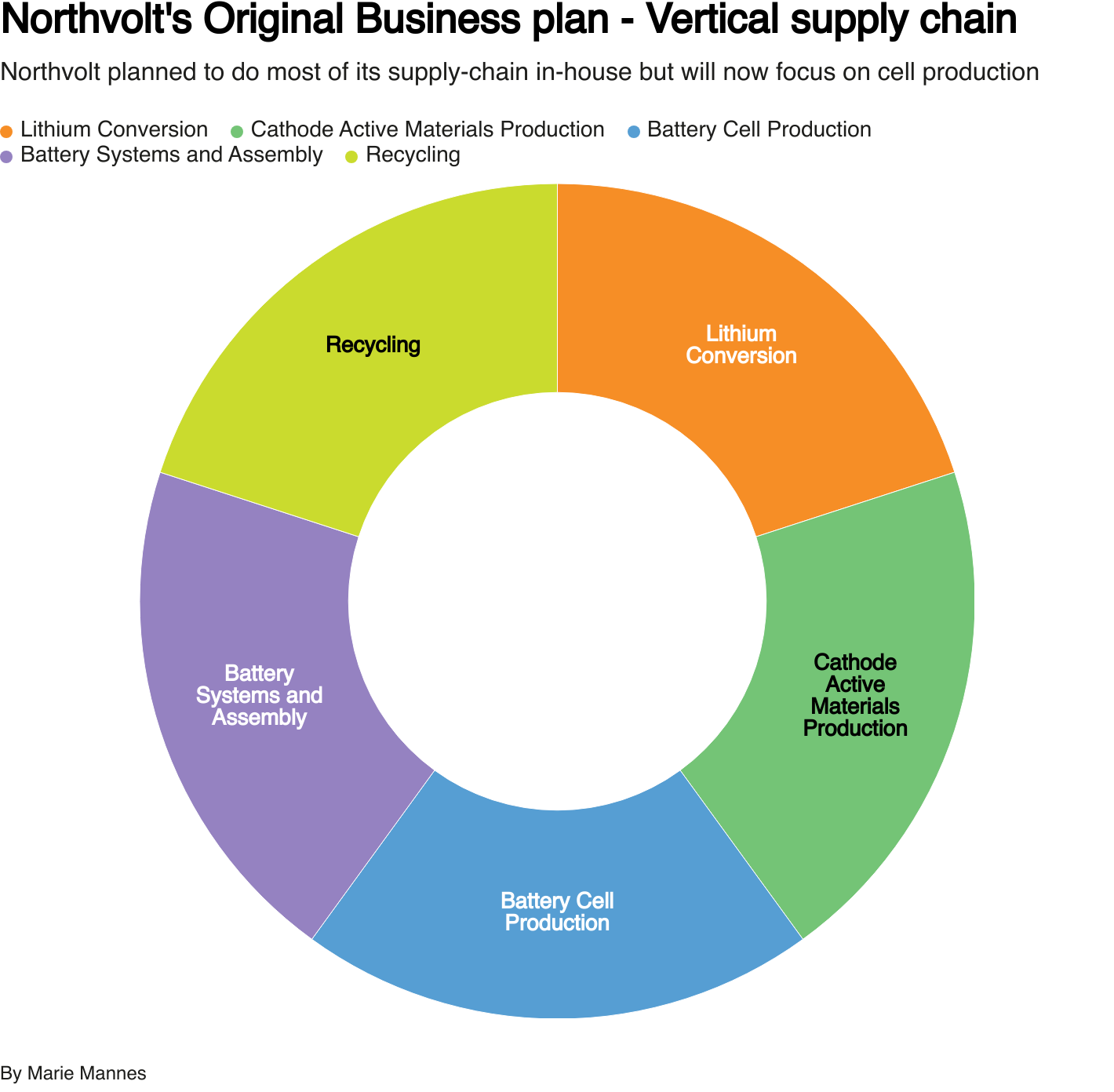
Northvolt Abandons Full Vertical Integration Plan
This chart, showing another major battery player shifting strategy, provides context for the BMW/AESC issue. It illustrates that the plant halt is part of a broader industry trend where companies are re-evaluating supply chain risks and abandoning overly complex integration plans.
(Source: Reuters)
$92 B in US Investments, Automotive Battery Manufacturing Expansion
Massive capital investment into downstream battery manufacturing in North America and Europe is creating intense, concentrated demand for upstream minerals like lithium, forcing automakers to secure supply through new, more integrated models. This manufacturing build-out, exemplified by the $92 billion committed to 78 new U.S. battery facilities, makes localized extraction not just a cost-saving measure but a necessity to ensure these multi-billion-dollar plants can operate at capacity.
- The U.S. has seen an investment surge following the Inflation Reduction Act, with private sector capital flowing into the battery supply chain. This creates a powerful downstream pull for raw materials that currently cannot be met by domestic supply.
- BMW is a key participant in this expansion, with its portion of a $1.7 billion total U.S. investment funding a new high-voltage battery assembly plant in Woodruff, South Carolina, scheduled to begin operations in 2026.
- Similarly, Volkswagen is executing a multi-billion Euro strategy through its subsidiary Power Co, aiming to establish 240 GWh of battery cell production capacity in Europe by 2030.
- These enormous manufacturing footprints are predicated on a stable, predictable, and cost-effective lithium supply, a condition the current global market cannot guarantee. This structural vulnerability is what makes the prospect of a “zero-kilometer” lithium supply from beneath the factory floor so compelling.
Table: Selected Automotive Battery Plant Investments and Disruptions
| Partner / Project | Time Frame | Details and Strategic Purpose | Source |
|---|---|---|---|
| BMW (Supplier: AESC) | Jun 2025 | Construction on the $1.6 billion battery cell plant in Florence, SC, was halted. This facility was critical for supplying BMW’s upcoming U.S. EV production, creating a major supply chain crisis. | Automotive News |
| BMW | 2026 (Planned Start) | A high-voltage battery assembly plant in Woodruff, SC, is part of a $1.7 billion U.S. investment. It is designed to support the “Neue Klasse” EV platform but now faces uncertainty for its cell supply. | electrive.com |
| BMW | 2027 (Planned Start) | EV and battery production will launch at the San Luis Potosí, Mexico, plant. This diversifies production away from the U.S. and Europe, mitigating regional risks. | Mexico Business News |
| Volkswagen (Power Co) | 2024 – 2030 | Part of a major European strategy to build 240 GWh of cell capacity by 2030. This massive scale-up intensifies the need for a secure, domestic European lithium supply chain. | Science Direct |

EV Battery Market to Near-Double by 2032
This chart provides the market context for the ‘Investments and Disruptions’ detailed in the section’s table. The explosive market growth forecast explains the motivation for the huge investments and also the ‘growing pains’ like disruptions that occur during rapid scaling.
(Source: Persistence Market Research)
Europe vs. North America, BMW Sourcing Strategy Diversifies
While North America and Europe are both aggressively building out battery manufacturing capacity, they face different primary constraints, forcing divergent upstream sourcing strategies. U.S. policy has catalyzed a manufacturing construction boom, but Europe’s primary obstacle is its inability to permit new mines, making innovative, low-impact extraction models like brownfield drilling a uniquely European solution.
- In North America, the post-2022 period has been defined by a rush to build gigafactories, spurred by incentives in the Inflation Reduction Act. This has led to projects like BMW’s South Carolina plant, with the main challenge now shifting to securing the raw material inputs for these factories.
- Europe faces a more complex problem. It has numerous battery plants under construction by Volkswagen, Northvolt, and others, but its domestic mining projects are consistently stalled by regulatory and social opposition. This creates a severe structural dependency on imports.
- Atana Elements’ strategy to explore for lithium under industrial sites in Germany and Poland is tailored to solve this specific European bottleneck. It leverages existing industrial zones to bypass the need for greenfield permitting that has blocked other projects.
- Automakers are responding with geographic diversification. BMW’s decision to establish battery production in Mexico starting in 2027 is a clear move to create a supply chain independent of both U.S. policy risks and European extraction hurdles.

Chart Shows Historical Asian Dominance in Battery Production
The section describes BMW’s strategy to diversify sourcing between Europe and North America. This chart explains the ‘why’ behind this strategy by visualizing the industry’s historical over-reliance on Asia, which makes geographic diversification a critical move to de-risk supply chains.
(Source: Green Car Reports)
Direct Lithium Extraction Reaches TRL 8, Atana Elements Eyes Commercial Scale
Direct Lithium Extraction (DLE) has matured from a speculative technology to a near-commercial reality, reaching Technology Readiness Levels (TRL) of 7-8. This advancement is the critical enabler for new business models like hyper-local sourcing, providing a credible technological foundation that was absent in the 2021-2024 period and attracting investment from major energy firms.
- Between 2021 and 2024, DLE was primarily in the lab or small pilot phase, viewed as a promising but unproven alternative to conventional ponds and hard-rock mining. Its commercial viability and cost-effectiveness were still largely theoretical.
- Since 2025, DLE has advanced significantly. Companies like Energy X and others are deploying demonstration-scale projects. The technology now boasts lithium recovery rates of 70% to over 90%, a substantial improvement over the 40-60% achieved by traditional evaporation ponds.
- The process is significantly faster, extracting lithium in hours or days instead of the 18-24 months required for evaporation. It also has a much smaller physical footprint and lower water consumption, as the brine is reinjected.
- This proven maturation is why companies like Atana Elements can now credibly propose a drilling-based model to major industrial partners, and why energy giants like Exxon Mobil have committed to entering the lithium business using DLE. The technology is now sufficiently de-risked to support bankable projects.
Table: SWOT Analysis of Hyper-Local Lithium Sourcing
| SWOT Category | 2021 – 2024 Analysis | 2025 – 2026 Analysis | What Changed / Validated |
|---|---|---|---|
| Strength | Theoretical advantage in reducing logistics costs and carbon footprint. Potential for better ESG profile compared to large open-pit mines. | Ability to bypass Europe’s multi-year “permitting nightmare” for greenfield mines. Provides unparalleled supply chain security and price stability for co-located battery plants. | The AESC plant halt in 2025 validated supply chain risk as a tangible, multi-billion dollar problem, turning security from a benefit into a primary driver. |
| Weakness | Technology risk associated with unproven DLE performance at scale. High geological risk of drilling without confirmation of economic lithium concentrations. | High initial CAPEX compared to conventional brine operations. Still reliant on the at-scale performance of DLE, which has limited commercial operating history. | DLE technology advanced to TRL 7-8, reducing technology risk. However, the geological risk remains until test drilling is completed at specific sites. |
| Opportunity | Potential to unlock unconventional lithium resources in geothermal brines, an underdeveloped resource category. | A successful pilot would create a replicable model for industrial zones across Europe (e.g., Upper Rhine Graben). Transforms brownfield industrial land into a valuable resource asset. | The EU’s Critical Raw Materials Act created strong policy incentives for domestic sourcing, providing a powerful tailwind for this model that was less pronounced before 2024. |
| Threat | Competition from large, low-cost conventional lithium producers in South America and Australia. Price volatility in the global lithium market. | Lower-than-expected lithium concentrations in the targeted brines could make projects uneconomic. Rapid innovation by other DLE companies could create superior, competing technologies. | The threat of supply disruption from a single-source foreign supplier was validated, making automakers more willing to pay a potential “green premium” for secure, local supply. |

Automakers Face Billions in U.S. Tariff Costs
This chart is highly relevant to a SWOT analysis of ‘hyper-local’ sourcing. The threat of tariffs on imported materials is a major driver for localization, directly informing the ‘Opportunities’ (avoiding tariffs) and ‘Threats’ (geopolitical trade risks) of the analysis.
(Source: International Organization of Motor Vehicle Manufacturers)
Atana’s Pilot Success: Watch for 2026 Offtake Agreements with VW
The single most critical signal for the viability of the hyper-local sourcing model is the result of Atana Elements’ initial test drilling beneath European industrial sites. A successful confirmation of economic lithium concentrations will immediately trigger offtake negotiations with anchor customers like Volkswagen and BMW, who will move quickly to secure a first-mover advantage on a de-risked, domestic supply.
- If this happens: Expect automakers to move beyond simple offtake agreements to direct equity investments or joint ventures with Atana or similar companies. This vertical integration would secure exclusive, long-term supply and insulate them from market volatility.
- Watch this: The primary signal will be any formal announcement of confirmed lithium concentrations and flow rates from Atana’s test wells. A secondary signal will be the emergence of copycat ventures targeting other geothermal-rich industrial regions in Europe.
- These could be happening: Automakers and industrial landholders may already be conducting portfolio-wide geological assessments to identify properties with subterranean resource potential. This could lead to a revaluation of industrial real estate, with geothermal access becoming a key strategic consideration for site selection and M&A, a trend that is already emerging for Critical Metals Corp.

Chart Maps Key Players in Battery Ecosystem
As the section discusses a new offtake agreement between Atana and VW, a map of the battery ecosystem is the perfect visual aid. It allows the reader to place both the emerging player and the established automaker within the broader industry landscape to understand the partnership’s significance.
(Source: MarketsandMarkets)
The questions your competitors are already asking
This report covers one angle of the strategic shift toward hyper-local lithium extraction for automotive battery manufacturing. The questions that matter most depend on your work.
- What is the outlook for Direct Lithium Extraction (DLE) deployment under European auto plants, and how has the BMW-AESC disruption impacted its business case?
- How does a hyper-local DLE model compare to traditional lithium sourcing from Australia and South America for supply chain security?
- Which automakers beyond VW and BMW are exploring hyper-local lithium sourcing models to de-risk their EV supply chains?
This report does not answer these. Enki Brief Pro does.
Your question, your angle, your framework. SWOT, PESTL, scenario modelling. The same niche depth, built around the decision your work actually depends on.
