

MP Materials Rare Earth Processing, $400 M Do D Equity Deal, $110/kg Price Floor, and 1 New Texas Campus (2021 to 2026)
Rare Earth Production, MP Materials Shifts from Concentrate to Magnet Manufacturing
The Western Hemisphere’s rare earth element (REE) supply chain is being fundamentally restructured through a strategic pivot from merely exporting raw concentrate to establishing a fully domestic, mine-to-magnet value chain. Before 2025, the U.S. market, represented by MP Materials, was almost entirely dependent on China for downstream processing, shipping over 90% of its mined material abroad. The period from 2025 to today marks a decisive shift, driven by government industrial policy aimed at mitigating geopolitical risk and capturing the high-value manufacturing segments of the REE market.
- Between 2021 and 2024, MP Materials primarily operated as a mining and concentrating company at its Mountain Pass, California, facility. The business model involved selling REE concentrate, with the majority destined for Chinese processors, leaving the U.S. exposed to supply chain disruptions and without capabilities in the critical separation and magnet-making stages.
- A strategic transformation began in 2025, underscored by the start of trial Nd Fe B magnet production at its Fort Worth, Texas facility in January 2025. This marked the first tangible step toward vertical integration, moving beyond concentrate sales and into finished product manufacturing within the U.S.
- This shift accelerated dramatically with the announcement of a landmark public-private partnership with the U.S. Department of Defense (Do D) on July 10, 2025. This agreement provided the capital and market stability necessary for large-scale domestic expansion, directly countering China’s market control.
- By Q 1 2026, MP Materials was demonstrating significant progress in its upstream-to-downstream strategy, producing a record 917 metric tons of separated Neodymium-Praseodymium (Nd Pr). This operational success provides the direct feedstock for its growing magnet manufacturing ambitions.
- The long-term vision was solidified in February 2026 with the announcement of a new $1.25 billion “10 X” magnet manufacturing campus in Northlake, Texas. This facility is designed to scale production capacity to approximately 10, 000 metric tons per year, enough to supply a significant portion of U.S. demand for high-performance magnets.
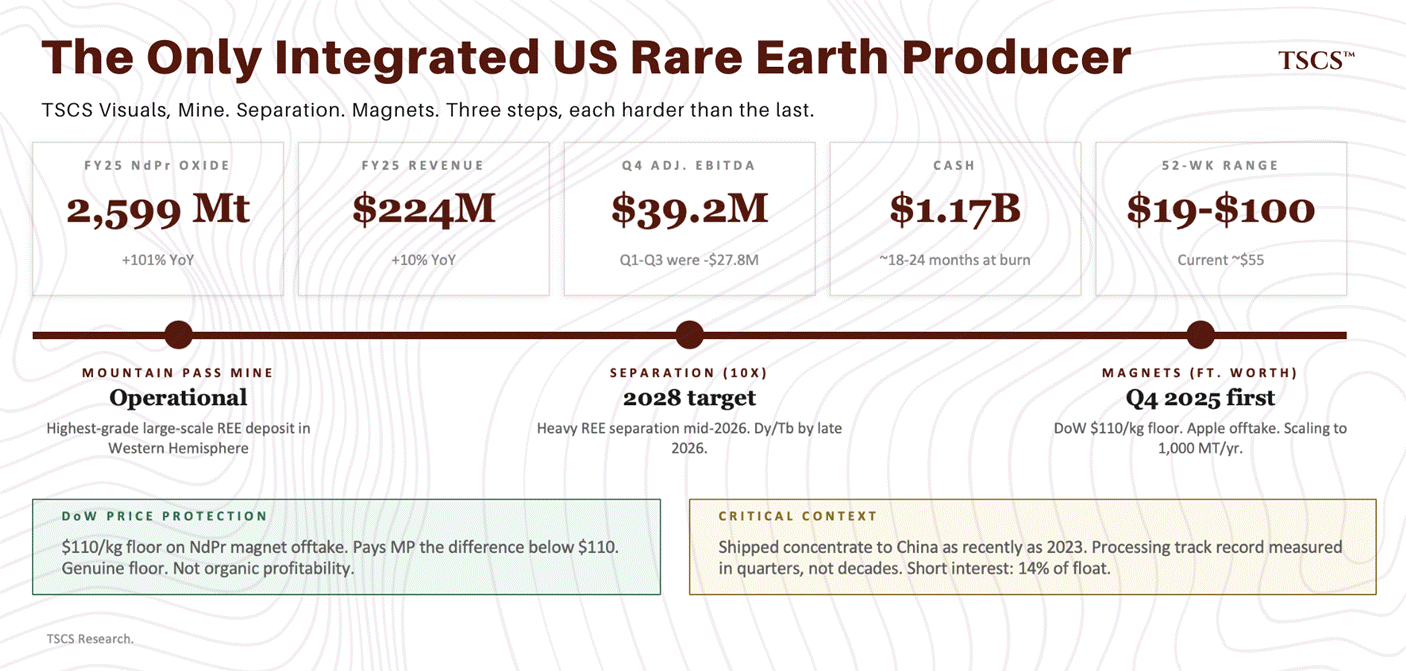
MP Materials Ramps Up Integrated Rare Earth Processing by 2026
MP Materials is aggressively onshoreing the rare earth supply chain, with magnet production commencing Q4 2025 and heavy REE separation targeted for mid-late 2026. This vertical integration, moving from mining (2,599 Mt NdPr Oxide in FY25) to magnets, aims to establish the Western Hemisphere’s first fully integrated rare earth-to-magnet pipeline.
De-risking Supply: US Vertical Integration Secures Critical Rare Earth Magnets
This transition moves beyond raw material extraction, fundamentally reshaping the Western rare earth supply chain to reduce critical reliance on China. Integrating separation and magnet production unlocks significant value-add, creating a secure, vertically integrated source for high-demand applications (e.g., EV motors, defense) and bolstering economic sovereignty.
MP Materials Doubles NdPr Sales, Accelerating Downstream Processing in Q1 2026
MP Materials significantly accelerated its midstream operations in Q1 2026, with NdPr sales volumes surging to 1,006 metric tons. This represents an almost doubling (79% QoQ) from 562 metric tons in Q4 2025, demonstrating strong execution in downstream processing and increasing market demand.
(Source: West needs its own pricing to escape China’s rare earths grip | Reuters)
$550 M in Federal Support, MP Materials Secures Capital for Downstream Expansion
Direct federal investment has become the primary enabler of MP Materials’ expansion into downstream processing, de-risking the enormous capital expenditures required to compete with established state-subsidized Chinese producers. This financial backing is not a standard grant but a deep, strategic partnership that includes equity stakes and long-term loans, signaling a national commitment to re-shoring this critical industry.
- The most significant financial event was the Do D’s commitment, announced in July 2025, which included a $400 million direct equity investment in MP Materials. This made the U.S. government a major shareholder and aligned the company’s success with national security interests.
- In addition to the equity stake, the Do D partnership provided a $150 million loan specifically to support the development of heavy rare earth separation capabilities. This targets a key technological and supply chain vulnerability, as heavy REEs are crucial for high-temperature magnet performance.
- These government funds directly support the build-out of the company’s Texas manufacturing footprint, including the initial Fort Worth facility and the recently announced $1.25 billion Northlake campus, which will house the next phase of magnet production scale-up.
Table: MP Materials Strategic Investments
| Partner / Project | Time Frame | Details and Strategic Purpose | Source |
|---|---|---|---|
| “10 X” Manufacturing Campus | Feb 2026 | A planned $1.25 billion rare earth magnet manufacturing campus in Northlake, Texas. The facility is designed to scale production to approximately 10, 000 metric tons of Nd Fe B magnets annually, serving EV and defense markets. | MP Materials Selects Northlake, Texas, as the Site of “10 X” |
| U.S. Department of Defense | Jul 2025 | A $400 million equity investment and a $150 million loan as part of a transformational public-private partnership. The funds are designated to accelerate U.S. magnet independence and establish heavy REE separation capabilities. | MP Materials Announces Transformational Public-Private Partnership |
![US - MP Materials Corp [MP] - Rare Earth Production | MacroMicro — Integrated US Rare Earth Producer Accelerates Downstream Processing](https://747c20b0.delivery.rocketcdn.me/wp-content/uploads/2026/08/enki_app_chart_aHR0cHM6Ly9zdWJz-1.png)
Integrated US Rare Earth Producer Accelerates Downstream Processing
MP Materials, the only integrated US rare earth producer, is rapidly advancing its downstream processing capabilities. It plans heavy REE separation by mid-2026 and Dy/Tb separation by late 2026, following NdPr oxide production up 101% YoY to 2,599 Mt in FY25. This builds towards Q4 2025 magnet production for Apple, scaling to 1,000 MT/yr.
Domestic REE Processing Critical for Supply Chain Resilience & National Security
The urgent pivot to domestic downstream processing directly challenges China’s 2023 dominance in REE concentrate processing, fortifying Western supply chain resilience for critical minerals. Achieving self-sufficiency in heavy REE separation by late 2026 is pivotal for national security and sustained growth in advanced manufacturing sectors like defense and high-tech electronics, currently buoyed by a $110/kg NdPr price floor.
MP Materials Charts Path to Fully Integrated US Rare Earth Value Chain
MP Materials is actively establishing a three-stage, fully integrated rare earth value chain from mining to final NdPr magnet production. This includes significant investment in new facilities (dotted outline) to move beyond raw materials to separated rare earth products and, critically, into downstream manufacturing of high-value magnets.
(Source: US – MP Materials Corp [MP] – Rare Earth Production | MacroMicro)
MP Materials 10-Year Do D Offtake Agreement Solidifies Downstream Demand
MP Materials has secured its downstream expansion through strategic partnerships that provide both long-term demand certainty and access to international processing capabilities, directly mitigating market and technical risks. The cornerstone of this strategy is a landmark agreement with the U.S. government, complemented by targeted international and commercial collaborations.
- The July 2025 partnership with the Do D is the most critical alliance, creating a synthetic market for MP Materials’ output. It includes a 10-year offtake commitment and establishes a price floor of $110 per kilogram for eligible Nd Pr products through 2035, protecting the company from the price volatility historically used by China to stifle foreign competition.
- To address the specific challenge of heavy rare earth processing, MP Materials formed a joint venture with Saudi Arabia’s Ma’aden in November 2025. This collaboration, also involving The Pentagon, aims to build refining capacity outside of China, diversifying the supply chain for materials like terbium and dysprosium.
- The United States-Japan Framework for Securing the Supply of Critical Minerals, signed in October 2025, provides a diplomatic and commercial foundation for future offtake agreements with Japanese industrial consumers, a key end-market for high-performance magnets.
Table: MP Materials Partnership Data
| Partner / Project | Time Frame | Details and Strategic Purpose | Source |
|---|---|---|---|
| Saudi Arabian Mining Company (Ma’aden) & The Pentagon | Nov 2025 | A joint venture to establish a rare-earth processing facility. This partnership is part of a broader U.S. strategy to build bilateral agreements with allies to develop REE capabilities outside of China, specifically targeting heavy rare earths. | US critical-minerals diplomacy: from America-First deals to Pax Silica |
| Government of Japan | Oct 2025 | A framework agreement between the U.S. and Japan to secure critical mineral supply chains. The pact aims to identify and support projects that address supply gaps, creating a favorable environment for MP Materials to secure offtake with Japanese firms. | United States – Japan Framework for Securing the Supply |
| U.S. Department of Defense (Do D) | Jul 2025 | A public-private partnership including a 10-year offtake agreement with a $110/kg Nd Pr price floor. This guarantees a foundational level of demand and revenue, de-risking the investment in downstream manufacturing capacity. | Unpacking the Do D and MP Materials Critical Minerals Partnership |
U.S. Centric Strategy, MP Materials Focuses on Domestic Processing in Texas
The geographic focus of rare earth processing and manufacturing is decisively shifting back to the United States after decades of concentration in China, with Texas emerging as the new hub for America’s mine-to-magnet supply chain. This re-shoring is a deliberate industrial policy choice, moving value-added activities from Asia to a secure domestic environment.
- Between 2021 and 2024, the geographic map of MP Materials’ value chain was split. Mining and concentration occurred at Mountain Pass, California, but the critical, high-value steps of separation, metallization, and magnet manufacturing happened almost exclusively in China.
- Beginning in 2025, the geography contracted to become almost entirely U.S.-based. The launch of trial magnet production in Fort Worth, Texas, established the state as the center of the company’s downstream ambitions.
- The selection of Northlake, Texas, for the new $1.25 billion “10 X” campus in February 2026 cements the state’s role as the nexus of the U.S. rare earth magnet industry. This consolidates the supply chain, reducing logistical complexity and exposure to international trade disputes.
- While the primary focus is domestic, the November 2025 joint venture with Ma’aden in Saudi Arabia shows a targeted international strategy. This collaboration aims to build heavy rare earth refining capacity in a partner country, addressing a specific technical gap that remains a challenge to fully domesticate.
Downstream Processing, MP Materials Navigates Execution Risk at Commercial Scale
MP Materials is currently in a critical transition from proven upstream mining operations to the technologically complex and commercially unproven stages of downstream processing and magnet manufacturing at scale in the U.S. While the company has mastered mining and concentration, the maturity of its downstream capabilities is still in the early commercialization phase, representing the primary execution risk and focal point for 2026.
- From 2021 to 2024, the company’s technology was mature only in its upstream segment: operating the Mountain Pass mine and producing REE concentrate. The more advanced downstream technologies for separation and magnetics were not operational within the company.
- The period from 2025 to today is defined by the effort to mature these downstream technologies. The start of trial production at the Fort Worth facility in January 2025 moved magnet-making from the R&D phase to the pilot/early commercial stage.
- A major validation point for its separation technology came in Q 1 2026, with the production of 917 metric tons of separated Nd Pr. This demonstrates that the company can successfully execute the crucial intermediate step between concentrate and metal at a growing scale.
- The next stage of technological maturation involves mastering metallization (converting oxides to metal alloys) and magnet manufacturing at a competitive cost and quality. The success of the Fort Worth facility and the future Northlake campus depends on resolving these engineering challenges, which have historically hindered non-Chinese producers. Competition from other government-backed players like USA Rare Earth and Australia’s Lynas Rare Earths adds pressure to execute efficiently.
SWOT Analysis, MP Materials’ Government Backing and Execution Hurdles
The strategic position of MP Materials has been transformed by direct U.S. government intervention, which has converted many of its historical weaknesses and external threats into strengths and opportunities. However, the company’s success remains contingent on overcoming significant internal execution challenges in its downstream manufacturing ramp-up.
- Strengths: The company’s core advantages have been amplified, moving from simply owning a large resource to having a guaranteed market with a price floor, courtesy of the Do D partnership.
- Weaknesses: The primary weakness remains the execution risk associated with scaling complex downstream chemical and metallurgical processes, which have not been performed at scale in the U.S. for decades.
- Opportunities: The geopolitical environment and the energy transition create a massive opportunity for a secure, Western-based supplier of magnets for EVs, wind turbines, and defense systems.
- Threats: While the Do D price floor mitigates the threat of Chinese price dumping, technical setbacks and competition from other Western players, such as Energy Fuels and Iluka Resources, remain relevant.
Table: SWOT Analysis for MP Materials and the U.S. REE Supply Chain
| SWOT Category | 2021 – 2024 | 2025 – 2026 | What Changed / Validated |
|---|---|---|---|
| Strengths | Owner of the only large-scale REE mine in the Western Hemisphere (Mountain Pass). Low-cost upstream production of concentrate. | Fully integrated mine-to-magnet potential. Guaranteed offtake and $110/kg Nd Pr price floor from the Do D. Direct government equity partnership. | The July 2025 Do D partnership transformed the business model from a price-taking commodity producer to a strategically backstopped industrial champion with revenue certainty. |
| Weaknesses | Dependence on China for downstream processing and revenue. Exposure to extreme price volatility of REEs. Lack of domestic separation and magnet manufacturing expertise. | High capital intensity for downstream build-out. Significant execution risk in scaling complex chemical separation, metallization, and magnet production. | The weakness shifted from market/price risk to internal execution risk. The $550 M in federal funding and loans directly addresses the capital intensity weakness but does not resolve the technical execution challenge. |
| Opportunities | Growing demand for magnets from EVs and wind turbines. Bipartisan U.S. political support for creating a domestic supply chain. | Becoming the anchor supplier for a secure, ex-China REE supply chain for the U.S. and its allies. Securing major offtake agreements with Western automakers and defense contractors. | China’s export restrictions enacted in April 2025 and its blacklisting of MP Materials in June 2026 validated the urgency of the company’s mission and unlocked unprecedented government support, turning a potential threat into a major opportunity. |
| Threats | Price manipulation by Chinese state-owned enterprises. Geopolitical risks associated with dependence on a single country for processing. | Competition from other Western-backed projects (USA Rare Earth, Lynas). Technological hurdles in achieving cost-competitive production. Potential for project delays and cost overruns. | The Do D’s $110/kg price floor directly neutralizes the primary threat of Chinese price dumping. The main remaining threats are internal (execution risk) and competitive from other non-Chinese producers. |
Scenario Modelling, MP Materials Magnet Production Milestones for 2026
The single most critical factor for MP Materials in the year ahead is the successful execution of its downstream manufacturing ramp-up, specifically achieving consistent, cost-effective production of Nd Fe B magnets at its Fort Worth facility. The company’s ability to hit its production and quality targets will be the leading indicator of its long-term viability as an integrated producer.
- If this happens: If MP Materials demonstrates steady magnet production that meets commercial specifications throughout 2026, validating its downstream process.
- Watch this: Watch for the announcement of one or more major commercial offtake agreements with Western automotive OEMs or Tier 1 suppliers. The $500 million Apple agreement from July 2025 serves as a precedent. Successful production will unlock further commercial-level deals beyond the government backstop.
- These could be happening: An accelerated timeline for the development of the “10 X” campus in Northlake could be announced. The company might also secure additional private financing or partnerships for further downstream or heavy REE processing capabilities, building on the Ma’aden JV. Its valuation would likely reflect a de-risked manufacturing profile, shifting focus from resource holder to technology and industrial leader.
The questions your competitors are already asking
This report covers one angle of MP Materials’ trajectory into downstream processing. The questions that matter most depend on your work.
- Other rare earth processing projects in the US
- Automaker rare earth supply agreements outside China
- US heavy rare earth supply chain plans
- China rare earth export restrictions details
This report does not answer these. Enki Brief Pro does.
Your question, your angle, your framework. SWOT, PESTL, scenario modelling. The same niche depth, built around the decision your work actually depends on.
