

Tin Supply Chain Risk, $53, 462/tonne Price High, 73% U.S. Import Reliance, and 50% China Refining Dominance (2025 to 2026)
AI Demand Shock, Tin Supply Chain Risks and Critical Vulnerabilities
The explosive growth of artificial intelligence has created a structural demand shock for tin, transforming the industrial metal into a strategic commodity and exposing critical vulnerabilities in its global supply chain. Before 2025, tin demand was stable, driven by traditional electronics and packaging. The AI-driven data center construction boom that accelerated in 2025 and 2026 has fundamentally altered this, creating an inelastic demand curve tied directly to high-performance computing hardware and revealing a supply chain ill-equipped to respond.
- The insatiable computational demand of AI has ignited a global data center construction boom, with 190 gigawatts (GW) of new hyperscale capacity announced as of early 2026.
- Tin’s primary application is solder, which accounts for over 50% of its global consumption and is the irreplaceable metallic glue connecting components in every server, GPU, and printed circuit board (PCB) used in these AI factories.
- Based on 2025 data, AI server production consumes between 6, 000 to 8, 000 metric tons of tin annually, a figure projected to more than triple to 25, 000 metric tons by 2030.
- This demand surge directly elevates the risk profile, as the supply chain is highly concentrated and has a limited pipeline of new projects, making it unable to absorb the demand shock without significant price volatility and supply disruptions.
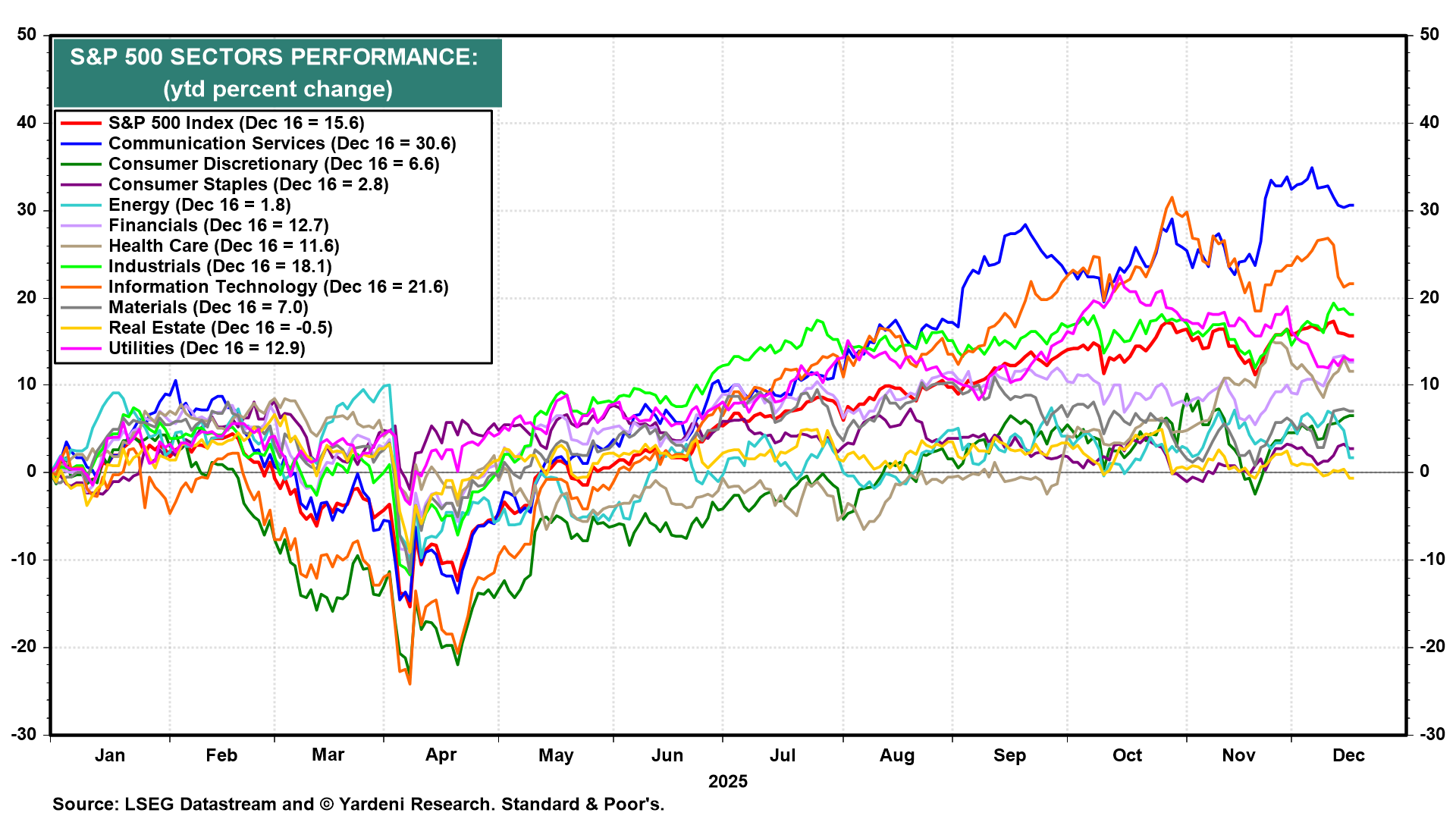
Tech Sectors Lead S&P 500 Gains in 2025
The chart’s headline about tech sector gains directly supports the concept of an ‘AI Demand Shock’ mentioned in the section heading. The strong performance of the tech sector, driven by AI, is the root cause of the increased demand for tin, making this chart an ideal illustration for the section’s premise.
(Source: Yardeni Research)
$53, 462/tonne Peak, Tin Price Volatility and Structural Market Deficit
The market has responded to the new demand paradigm with extreme price volatility and forecasts of a structural supply deficit, signaling a fundamental repricing of tin’s strategic value. The price surges in early 2026 were not a temporary spike but the initial market reaction to a widening gap between an AI-fueled demand curve and an inelastic, geographically concentrated supply base.
- Tin prices on the London Metal Exchange (LME) reached a nominal all-time high of $53, 462 per tonne in January 2026, a dramatic increase from the roughly $38, 000 per tonne seen in late 2025.
- Analysts have raised their 2026 price forecasts, with BMI increasing its prediction to $35, 000 per ton and some bank base cases holding at $40, 000 per ton, reflecting sustained market tightness.
- A supply deficit is widely expected to materialize in 2026, as a projected 3% growth in refined tin production will be insufficient to meet the forecast 3.5% increase in demand.
- The global tin market, valued at $6.82 billion in 2025, is now projected to grow to $10.48 billion by 2034, reflecting the new long-term demand realities.
Table: Tin Price Observations and Forecasts (2025-2026)
| Date | Market Segment | Price (USD per Tonne) | Source |
|---|---|---|---|
| Jun 11, 2026 | Futures Market | $52, 493 | Macro Micro |
| Feb 5, 2026 | Non-ferrous Metals Market | $50, 000 | Coface |
| Jan 26, 2026 | Tin Futures Peak | $51, 500 | Sun Sirs |
| Jan 15, 2026 | LME 3-Month | $53, 462 (Nominal All-Time High) | International Tin Association |
| Dec 5, 2025 | Base Metals Forecast (BMI) | $35, 000 (2026 Forecast) | GOLDINVEST.de |
| Oct 17, 2025 | Base Metals Forecast (Bank) | $40, 000 (2026 Base Case) | Forbes |
Asia Dominance, Tin Refining Concentration and Geopolitical Choke Points
The tin supply chain is dangerously concentrated, with both mining and refining dominated by a handful of Asian countries, creating a significant geopolitical choke point for the global technology industry. This concentration gives nations like China immense leverage and exposes Western nations, which are highly import-dependent, to severe supply chain risks from political instability, resource nationalism, or deliberate trade restrictions.
- Asia is the epicenter of global tin production, with China alone accounting for approximately 50% of the world’s refined tin supply and housing the world’s largest producer, Yunnan Tin Company Limited.
- The concentration is even more pronounced in midstream processing, with seven of the top ten global tin smelters located in Asia, creating a critical bottleneck for the entire electronics industry.
- The European Union is highly exposed, importing around 85% of its tin metal, while the U.S. has a net import reliance of 73%, making both regions vulnerable to disruptions in key producing nations like Indonesia, Myanmar, and China.
- The demonstrated willingness of nations to use critical mineral export controls as a geopolitical tool makes the concentration of tin refining a direct threat to the national security and technological competitiveness of Western countries.
Supply Chain Maturity, Tin Production Fails to Meet AI Demand Surge
While tin as a material and its applications are technologically mature, the global supply chain has proven immature and inflexible in its ability to meet the sudden, structural demand shift driven by the AI sector. The long lead times for new mining projects and the capital-intensive nature of refining mean that supply is inelastic in the short-to-medium term, a stark contrast to the exponential growth in demand from data center construction that began accelerating in 2025.
- Prior to 2024, the tin market was a stable, low-growth commodity market with a supply chain optimized for predictable demand from sectors like packaging and consumer electronics.
- The AI boom, which intensified from 2025 onwards, exposed the fragility of this system. A thin pipeline of new mining projects and a lack of investment in new refining capacity outside of Asia created the conditions for the current supply deficit.
- The political and social challenges of mining, as seen with disruptions in Myanmar and policy shifts in Indonesia, further constrain the supply chain’s ability to respond, highlighting its lack of resilience.
- Western policy responses, such as the EU’s Critical Raw Materials Act and the US’s Promoting Resilient Supply Chains Act, are acknowledgments of this immaturity but are long-term solutions that will not resolve the immediate supply-demand imbalance in 2026.
SWOT Analysis, Tin Market Strengths and Strategic Vulnerabilities
The strategic value of tin has been fundamentally redefined by its indispensable role in the AI-powered data center boom, creating a new set of market dynamics defined by inelastic demand and a fragile, concentrated supply chain. This shift has amplified both the inherent strengths of tin as a critical material and the profound weaknesses of its global production system.
Table: SWOT Analysis for the Strategic Tin Market
| SWOT Category | 2021 – 2024 | 2025 – 2026 | What Changed / Validated |
|---|---|---|---|
| Strengths | Essential for solder in all electronics; excellent conductivity and corrosion resistance. | Irreplaceable in high-density AI hardware, including GPUs, PCBs, and advanced semiconductor packaging. | AI boom validated tin’s status as a critical, non-substitutable input for high-performance computing, making demand inelastic. |
| Weaknesses | Production concentrated in a few countries (China, Indonesia, Myanmar); known price volatility. | Extreme geographic concentration in refining (~50% in China) becomes a critical geopolitical vulnerability; thin pipeline of new mines. | The 2025-2026 AI demand shock exposed the supply chain’s inability to scale, turning a known weakness into a systemic risk for the entire tech sector. |
| Opportunities | Growing electronics market; potential for new applications in renewable energy. | AI-driven demand creates a supercycle; high prices incentivize new mining projects (e.g., in Cornwall, UK) and recycling (urban mining). | Record-high prices and government incentives (e.g., EU CRMA) create a strong business case for investment in supply diversification and circular economy initiatives. |
| Threats | Supply disruptions from political instability; potential for lead-free solder alternatives. | Geopolitical weaponization through export controls; a structural supply deficit leading to sustained high prices and project delays. | The threat of supply disruption is no longer theoretical; it is an active risk being priced into the market and driving national security policy in the US and EU. |
2026 Supply Deficit, Tin Geopolitical Risk and Corporate Hedging Strategies
Looking ahead, the most critical action for technology companies and governments is to aggressively mitigate the risk of a fragile and geopolitically concentrated tin supply chain. The structural deficit expected in 2026 is not a cyclical event but a new market reality that requires a strategic, not just tactical, response. The primary signals to watch are corporate and governmental efforts to secure supply outside the spot market.
- If corporations are serious about de-risking, watch for a significant increase in long-term offtake agreements with non-Asian producers, direct equity investments in mining projects, and strategic partnerships to create closed-loop recycling systems.
- These actions could be happening now as a direct response to the price volatility of early 2026 and the clear policy signals from Western governments to diversify supply chains away from single points of failure.
- A key indicator of success will be the financing and development of new tin mines and refineries in politically stable jurisdictions, though these are long-term projects with lead times of 5-10 years.
- Failure to execute these hedging strategies will leave the pace of AI infrastructure development hostage to tin price volatility and the geopolitical decisions of a small number of producing nations.
The questions your competitors are already asking
This report covers one angle of the commercial risks in the tin supply chain for AI data centers. The questions that matter most depend on your work.
- Which tin producers are positioned to gain or lose from the AI demand shock?
- What is the outlook for new tin mining and refining capacity coming online by 2030 to meet AI demand?
- Which hyperscale data center operators are most exposed to tin supply chain volatility and China’s refining dominance?
This report does not answer these. Enki Brief Pro does.
Your question, your angle, your framework. SWOT, PESTL, scenario modelling. The same niche depth, built around the decision your work actually depends on.
