

Gas Turbine Lead Times: Baker Hughes 1.8 GW Kodiak Deal, a 1 GW Firm Order, and Supply Chain Strain (2025-2026)
Turbine Supply Strain, Baker Hughes 1.8 GW Deal Signals a Market Shift
The primary constraint for data center expansion has shifted from capital availability to power procurement, forcing developers into a new strategic imperative: securing long-term manufacturing capacity for power generation equipment. The July 2026 framework agreement between Baker Hughes and Kodiak Gas Services for up to 1.8 GW of gas turbines is the clearest signal of this market realignment, demonstrating that access to hardware is now the critical path for growth in the AI era.
Pre-2025: Grid Reliance and Early Signals
Before 2025, the standard model for powering data centers relied almost exclusively on utility-provided grid electricity. While effective for gradual growth, this model began to show signs of strain as interconnection queues lengthened and grid capacity in key regions like Northern Virginia and Silicon Valley became saturated. Developers treated power as an operational expenditure and a location-scouting problem, not a supply chain challenge. The early warnings of a systemic constraint were present in grid study applications but had not yet materialized into a crisis that demanded a fundamental change in strategy for power sourcing.
Post-2025: The BTM Strategic Shift
The explosive growth of AI workloads after 2024 rendered the traditional grid-dependent model untenable for hyperscale timelines. With grid upgrade timelines stretching to a decade and turbine lead times reaching five to seven years, the market pivoted aggressively toward behind-the-meter (BTM) generation. The Baker Hughes–Kodiak deal exemplifies this new reality. By securing a 1 GW firm order for delivery by 2030, Kodiak is not just buying turbines; it is buying schedule certainty for its data center clients in a market where major manufacturers are reportedly booked through 2028. This move transforms power from a utility service into a capital asset secured years in advance, a core component of the Baker Hughes distributed energy strategy.
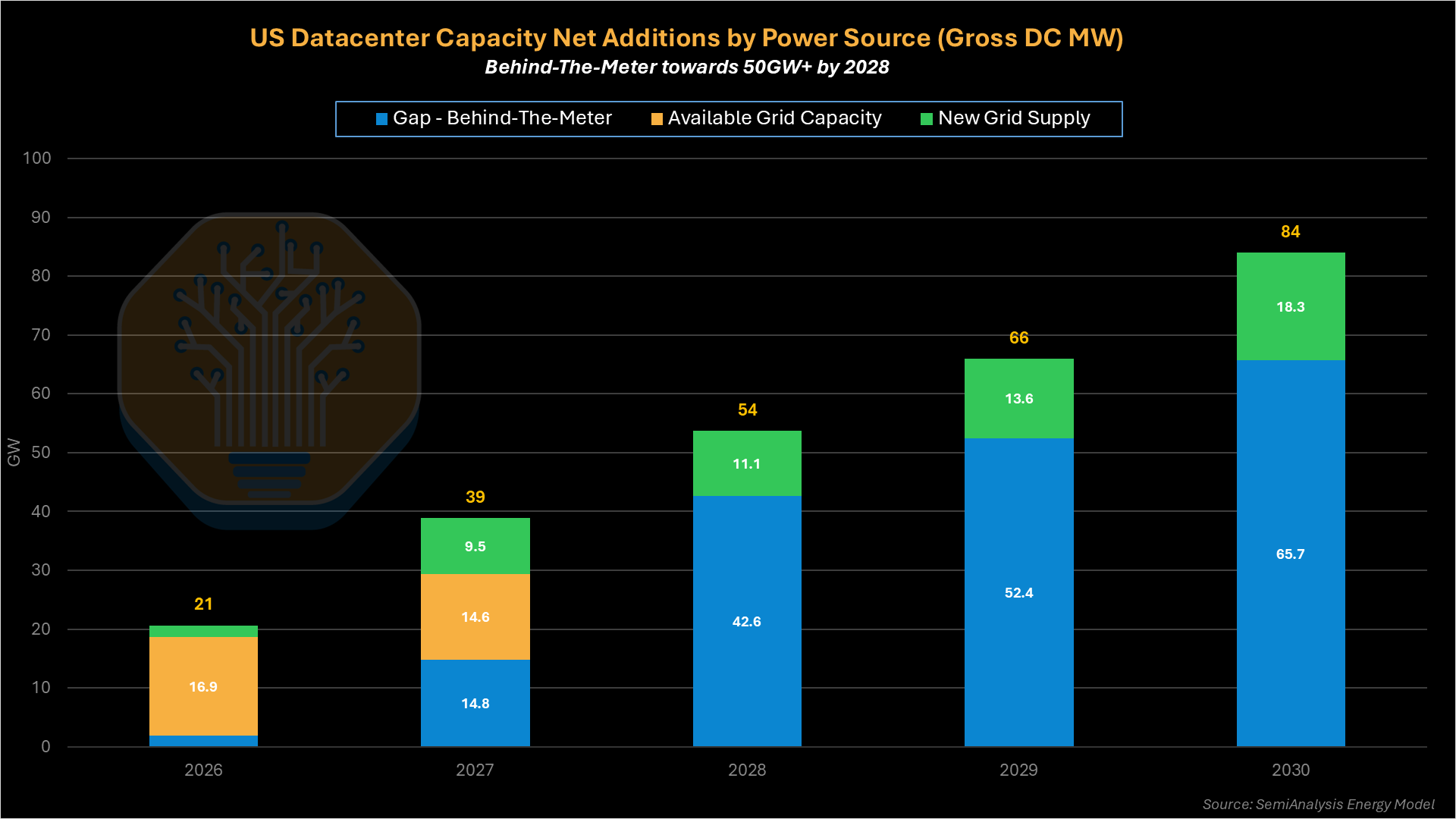
Behind-the-Meter Power Becomes Dominant for US Data Centers
US data center capacity additions are projected to surge to 84 GW by 2030, with Behind-The-Meter solutions fulfilling a massive 65.7 GW (78%) of this demand. This signifies a critical shift away from traditional grid supply as data centers increasingly seek self-generation solutions.
(Source: SemiAnalysis Energy Model — via The Gas Turbine Supply that Nobody Sees Coming)
Baker Hughes 1.8 GW Kodiak Agreement and Data Center Power Deals (2025-2026)
Strategic partnerships in the energy sector have pivoted to prioritize securing manufacturing slots and long-term supply pipelines for power generation equipment, reflecting a market where hardware availability dictates project viability. The recent wave of alliances is defined by large-volume, multi-year commitments designed to de-risk development schedules for the power-intensive data center industry.
The Kodiak 1.8 GW Framework
The landmark agreement between Baker Hughes and Kodiak Gas Services, announced in July 2026, is the archetype of this new partnership model. It establishes a framework for up to 1.8 GW of gas turbine capacity, anchored by a firm initial award for approximately 1 GW. This is not a project-specific order but a strategic capacity reservation, giving Kodiak a significant competitive advantage by guaranteeing access to critical hardware in a severely constrained global market. The deal ensures Kodiak can offer its data center clients a clear path to power their expansions, bypassing grid-related delays.
Broader Data Center Power Alliances
This trend extends beyond a single deal, indicating a systemic industry response. Baker Hughes has secured a series of contracts underscoring its central role in the 2025 power play for AI data centers. This includes a May 2025 order to supply Nova LT™ gas turbines for a 270 MW Frontier Infrastructure data center project and another significant order from Twenty 20 Energy in early 2026. These partnerships are structured to provide dedicated, on-site power, confirming that securing the supply chain for BTM generation is now a primary strategic objective for energy providers and developers serving the digital infrastructure market.
Table: Selected Baker Hughes Data Center Power Partnerships (2025-2026)
| Partner / Project | Time Frame | Details and Strategic Purpose | Source |
|---|---|---|---|
| Kodiak Gas Services | July 2026 | Framework agreement for up to 1.8 GW of gas turbine technology for BTM data center projects, with a firm initial order for ~1 GW to be delivered by 2030. | Baker Hughes |
| Twenty 20 Energy | Feb. 2026 | Order for gas turbines to power U.S. data center infrastructure, part of a trend of energy service companies securing hardware for BTM solutions. | Baker Hughes |
| Frontier Infrastructure | May 2025 | Agreement to supply Nova LT™16 gas turbines for a U.S. data center project, delivering 270 MW of reliable power. | Baker Hughes |
| TURBINE-X Energy Inc. | Mar. 2025 | Order secured by Baker Hughes to supply gas turbine technology, highlighting demand from specialized energy solution providers for data center applications. | X-Group |
1 GW Initial Order, Baker Hughes Validates Gas Turbine Scalability
While gas turbines represent a technologically mature category, their recent application at gigawatt-scale for dedicated, behind-the-meter data center power marks a distinct and rapid commercialization phase. In this new context, the technology’s primary value attributes are its proven reliability and ability to be deployed at a scale and speed that currently outmatches alternative 24/7 power sources, making it the default solution for meeting urgent AI-driven energy demand.
Proven Technology for a New Problem
The selection of Nova LT™ and Frame 5 gas turbines for the Kodiak deal underscores a market preference for proven, high-reliability industrial hardware. These are not experimental technologies; they are established workhorses of the energy industry. Their “maturity” in this context is their immediate commercial readiness to solve the data center power crisis. Unlike emerging technologies that are still in pilot phases, these turbines offer a bankable, scalable solution that can be manufactured and deployed in the volumes required to support the construction of massive data center campuses, which can demand hundreds of megawatts per site.
Future-Proofing with Hydrogen and CCS
The strategic selection of turbine technology also includes a forward-looking approach to decarbonization. The Nova LT series is recognized for its operational flexibility, including models capable of blending hydrogen, which provides a pathway to lower carbon intensity over the asset’s life. This aligns with broader Baker Hughes hydrogen initiatives. Furthermore, pairing gas-fired power with carbon capture is becoming a key strategy for mitigating emissions from these facilities. This technical optionality allows developers to address today’s urgent power needs with natural gas while retaining a credible route to meet future environmental regulations and corporate sustainability goals.
US Market Focus, Baker Hughes 2027 Execution Scenario
The critical factor for 2027 will be the supply chain’s ability to execute on its massive backlog of turbine orders. Any manufacturing or delivery delays will have a direct and disruptive impact on the build-out schedules of major data center projects that have already committed to a behind-the-meter power strategy.
Monitoring Manufacturing Timelines
If Baker Hughes or its competitors announce any slips in their manufacturing schedules or delivery dates in quarterly earnings calls, watch for subsequent announcements of project delays from partners like Kodiak or their hyperscale clients. The entire value proposition of the BTM strategy hinges on speed-to-market. A delay of six months in turbine delivery could translate directly to a six-month delay in a data center going live, representing a significant loss of revenue and competitive positioning for the operator.
Tracking Fuel and Carbon Strategies
As these gas-fired power plants are commissioned, watch for the developers and operators to announce long-term natural gas hedging strategies or physical supply agreements to mitigate fuel price volatility. Concurrently, expect to see the first pilot projects integrating hydrogen blending or small-scale carbon capture at these sites. These moves would signal that the industry is actively working to de-risk the long-term operational and environmental profile of these critical assets, moving beyond initial deployment to sustainable, long-term operation.
The questions your competitors are already asking
This report covers one angle of the power equipment supply chain for AI data centers. The questions that matter most depend on your work.
- Gas turbine manufacturers data center backlog
- Data center power plants hydrogen blending projects
- New data center projects seeking behind the meter power
- Grid upgrade projects for data center hubs
This report does not answer these. Enki Brief Pro does.
Your question, your angle, your framework. SWOT, PESTL, scenario modelling. The same niche depth, built around the decision your work actually depends on.
