

Equinix PEM Fuel Cell Test, 500 k W Geo Pura Pilot and 100+ MW Bloom Energy Deal (2025 to 2026)
Equinix Hydrogen Pilots and Commercial-Scale Natural Gas Deployments
Equinix’s recent activities reveal a dual-track fuel cell strategy, executing large-scale, commercially viable natural gas deployments today while running small, targeted hydrogen pilots to de-risk a long-term transition. This approach separates immediate, grid-independent power needs from future decarbonization goals, highlighting the current economic and technical chasm between the two fuel sources.
Equinix 100 MW Natural Gas Strategy
The company’s primary strategy addresses immediate power demands with mature technology. In February 2025, Equinix expanded its long-standing partnership with Bloom Energy to surpass 100 MW of fuel cell capacity across its U.S. data centers. This builds upon an existing 72 MW fleet of solid oxide fuel cells (SOFCs) that are commercially operational. Critically, these systems run on natural gas today, providing a reliable and cost-effective source of on-site power that mitigates grid instability. This large-scale deployment contrasts sharply with the company’s hydrogen initiatives, underscoring that natural gas-powered fuel cells are its current solution for at-scale, low-emission power.
Equinix 500 k W Hydrogen Pilot
While scaling its natural gas fleet, Equinix initiated a small-scale hydrogen pilot to prepare for future mandates. In June 2026, the company began a 12-week trial of a hydrogen-powered backup generation system at its DB 3 data center in Dublin. The pilot uses two Proton-Exchange Membrane (PEM) fuel cell units from Geo Pura with a combined capacity of only 500 kilowatts (0.5 MW). This capacity represents just 8% of the power used by that single data center. The project’s stated purpose is not commercial operation but research and development to validate the technology’s operational viability and safety in a live, mission-critical environment. Its small size, short duration, and research focus position it firmly as a long-range planning exercise, not a near-term diesel replacement.
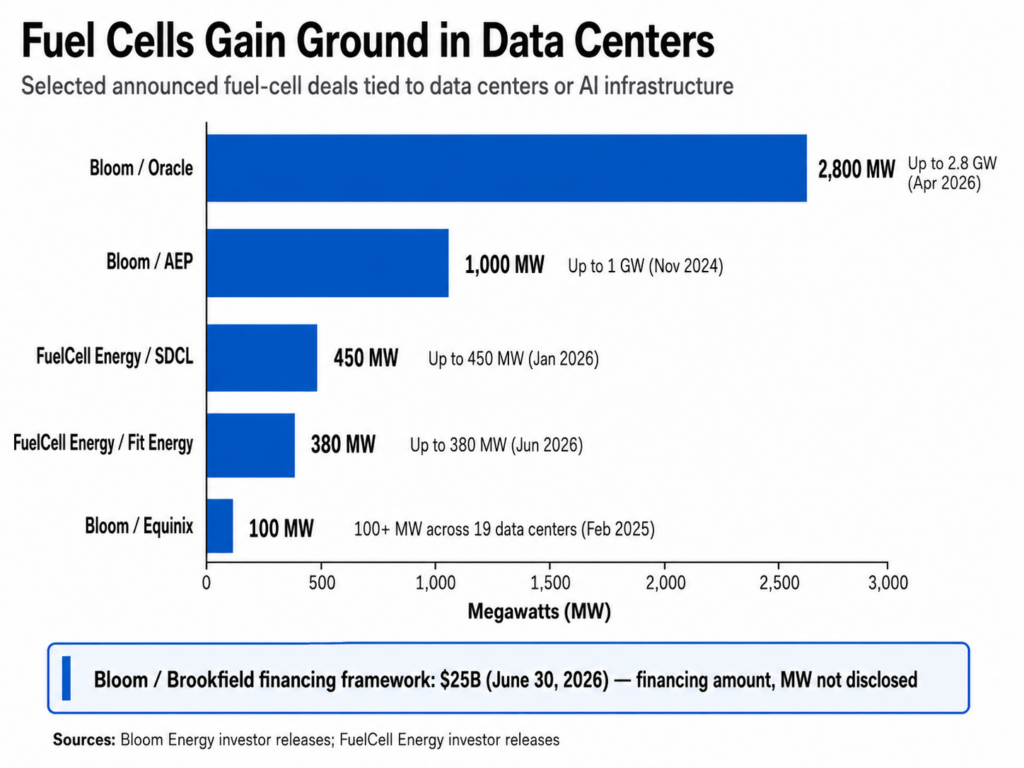
Fuel Cells Rapidly Scale to Power Data Centers, Driven by Multi-Gigawatt Deals
Fuel cells are gaining significant traction in data centers, with announced deals totaling over 4.7 GW by 2026. Bloom/Oracle leads with a substantial 2,800 MW deal by April 2026, while Equinix has committed to 100 MW across 19 data centers by February 2025, signaling a rapid shift towards decarbonized backup power.
Massive Financing Underscores Fuel Cells” Role in Decarbonizing AI-Driven Data Centers
The transition to fuel cells, bolstered by a $25B financing framework, is critical for decarbonizing data center backup generation, especially with AI infrastructure driving unprecedented power demands. This shift positions fuel cells as a viable, scalable alternative to traditional fossil fuel-based systems, meeting both sustainability goals and energy resilience needs.
(Source: Bloom Energy, FuelCell Energy — via Fuel cell investment by data centers set to grow tenfold, reaching $30 billion by 2030)
Equinix Hydrogen Partnerships, Geo Pura Pilot vs. Bloom Energy Scale (2025 to 2026)
Equinix‘s partnerships clearly delineate its strategy between immediate commercial power generation and long-term hydrogen research. The alliances for its U.S. operations are focused on scaled, commercial deployments with established partners, while its European hydrogen initiative involves a consortium aimed at technology validation and pathfinding in a highly regulated market.
- The company’s most significant fuel cell partnership is its multi-year, expanding agreement with Bloom Energy. This commercial relationship grew in February 2025 to cover more than 100 MW of natural gas-powered SOFCs for prime power at U.S. data centers, indicating a focus on scalable, bankable projects.
- In contrast, the June 2026 Dublin pilot is a temporary, three-way partnership between Equinix, Irish utility ESB, and technology provider Geo Pura. This collaboration is structured as a research initiative to test a 500 k W system, demonstrating a focus on learning and de-risking rather than commercial-scale energy production.
- The design of the Bloom Energy systems as “hydrogen-ready” acts as a strategic bridge between the two partnership models. While running on natural gas today, the ability to accept hydrogen blends of up to 50% allows Equinix to leverage its commercial partnership for a potential future transition, contingent on the success of R&D pilots like the one in Dublin.
Table: Equinix Key Fuel Cell Partnerships (2025 to 2026)
| Partner(s) | Time Frame | Details and Strategic Purpose | Source |
|---|---|---|---|
| ESB, Geo Pura | June 2026 | A 12-week research pilot of two 250 k W PEM hydrogen fuel cell units for backup power at the DB 3 data center in Dublin. The strategic purpose is technology validation and operational learning in a power-constrained market. | Equinix Newsroom |
| Bloom Energy | February 2025 | Expansion of a long-term commercial agreement to surpass 100 MW of natural gas-powered SOFCs for prime power in U.S. data centers. The strategic purpose is to secure scalable, on-site power to support AI growth and bypass grid constraints. | Bloom Energy Investor Relations |
Dublin vs. U.S., Equinix Fuel Cell Geographic Strategy
Equinix’s geographic application of fuel cell technology is sharply divided, with large-scale commercial deployments concentrated in the U.S. and targeted R&D pilots occurring in power-constrained European hubs like Dublin. This regional split reflects differing grid realities, regulatory pressures, and the relative maturity of the technologies being deployed.
United States Commercial Focus
The U.S. is the center of Equinix‘s commercial fuel cell strategy. Before 2025, the company had already deployed dozens of megawatts of natural gas-powered SOFCs with Bloom Energy. The expansion to over 100 MW in 2025 confirms that the U.S. market provides the commercial and regulatory environment for at-scale deployments. This strategy is driven by the need for reliable prime power for AI workloads and serves as a method to circumvent grid interconnection delays and capacity shortfalls, leveraging a mature technology and an established domestic supply chain for natural gas.
Dublin R&D Testbed
In contrast, the selection of Dublin for the 500 k W hydrogen pilot in 2026 is a strategic choice driven by constraints, not commercial readiness. Dublin is a major data center hub facing a de facto moratorium on new grid connections, creating intense regulatory and social pressure to find clean, on-site power alternatives. By testing hydrogen here, Equinix addresses local policy concerns and uses the challenging environment as a real-world laboratory. The pilot is less about powering the data center and more about demonstrating a commitment to finding solutions for such constrained markets, providing valuable data for future operations in similar European locales.
SWOT Analysis, Equinix Hydrogen Fuel Cell Strategy
Equinix‘s hydrogen strategy leverages its market leadership to explore future technologies, but its success remains contingent on external market developments beyond its direct control, particularly green hydrogen cost and infrastructure. The company’s dual-track approach mitigates near-term risk by relying on proven natural gas technology while positioning for a potential long-term hydrogen economy.
Table: SWOT Analysis for Equinix Hydrogen Fuel Cell Strategy
| SWOT Category | Strengths | Weaknesses | Opportunities | Threats |
|---|---|---|---|---|
| Summary | Leverages market leadership and existing fuel cell operational experience from the Bloom Energy partnership to de-risk new technology. Strong relationships with utilities like ESB facilitate pilot projects. | The Dublin hydrogen pilot at 500 k W is insignificant compared to multi-megawatt data center loads. The strategy remains heavily dependent on natural gas, with a 15-year timeline for commercial hydrogen viability. | Solve grid constraints in key markets like Dublin, enabling growth where it is currently stalled. Achieve corporate sustainability goals and establish a first-mover advantage in operating hydrogen-powered facilities. | The cost of green hydrogen is reportedly 3 x that of natural gas, making it commercially non-viable at scale. Competitors like Microsoft are testing larger 3 MW systems, potentially outpacing Equinix‘s research. Lack of hydrogen infrastructure and unfavorable regional tax policies (e.g., Texas) present major barriers. |
Scenario Modelling, Equinix 500 k W Pilot and Hydrogen Viability
The primary strategic function of the Dublin pilot is to generate operational data, not kilowatts; its success will inform Equinix’s long-term capital planning for a transition that the company itself projects is 15 years away. The key signals to watch are not about immediate deployment but about the milestones that could shorten that timeline.
- If the 12-week pilot demonstrates high reliability, watch for Equinix to announce a follow-on, megawatt-scale pilot (1-5 MW) within the next 18-24 months, likely in another power-constrained market. An absence of such an announcement would signal significant technical or economic obstacles were encountered.
- A critical dependency is government support, which Equinix has publicly called for. Watch for specific green hydrogen production incentives or subsidies from the Irish government or the EU. Such policies are a prerequisite to closing the price gap with diesel and natural gas.
- The external market for green hydrogen is the biggest variable. Watch for the levelized cost of green hydrogen in Europe to drop below $3.00/kg. This price point would be a major inflection point, potentially accelerating investment timelines across the industry.
- Watch the next commercial agreement with Bloom Energy. The current “hydrogen-ready” SOFCs can accept up to a 50% blend. Any future agreements specifying a higher blend tolerance or a commitment to test 100% hydrogen SOFCs would be a strong signal that Equinix sees a more tangible, near-term path for hydrogen integration through its existing prime power provider.
The questions your competitors are already asking
This report covers one angle of Equinix’s data center power strategy. The questions that matter most depend on your work.
- Other data centers using natural gas fuel cells
- Microsoft data center hydrogen fuel cell tests
- Government subsidies for green hydrogen
- Cost to convert natural gas fuel cells to hydrogen
This report does not answer these. Enki Brief Pro does.
Your question, your angle, your framework. SWOT, PESTL, scenario modelling. The same niche depth, built around the decision your work actually depends on.
