

Oracle Data Center Expansion, $70 B Cap Ex Plan, $40 B Nvidia Deal, and Open AI Partnership (2025-2027)
AI Data Center Buildout Risks, Oracle Faces Power and Supply Chain Delays
The entire data center industry, including Oracle, is encountering unprecedented execution risks from power shortages and supply chain delays that threaten the viability of aggressive buildout plans. The AI-driven demand surge since 2025 has transformed the market from steady, predictable growth into a high-stakes rush for capacity, straining global infrastructure beyond its limits. Successfully navigating these physical constraints, not just financial commitments, will determine the next leaders in AI computing.
- Prior to 2024, data center development was primarily constrained by capital and land acquisition. Today, the main bottlenecks are power availability and grid interconnection. Securing the necessary electricity for gigawatt-scale AI campuses is now a multi-year process that is slowing development across major hubs, with grid operators like PJM facing a 7 GW gap between new project requests and available capacity.
- The intense demand for AI infrastructure has created severe supply chain shortages for critical electrical equipment, particularly high-voltage transformers and switchgear. These components have lead times extending over a year, causing significant project delays for all major builders. This has forced developers to explore on-site power solutions from companies like Bloom Energy and Fuel Cell Energy or alternative energy PPAs from firms like Fervo Energy.
- Industry-wide, between 30% and 50% of large data center projects scheduled for completion in 2026 are projected to be delayed or canceled due to these power and equipment constraints. Reports indicate that Oracle itself has already delayed several projects, confirming that its massive capital outlay does not grant it immunity from these fundamental market realities.
- In response to power density challenges inside the facilities, operators are increasingly turning to advanced cooling solutions. Companies like Schneider Electric and Modine are seeing high demand for liquid cooling technologies, which are essential for managing the heat generated by clusters of high-performance GPUs.
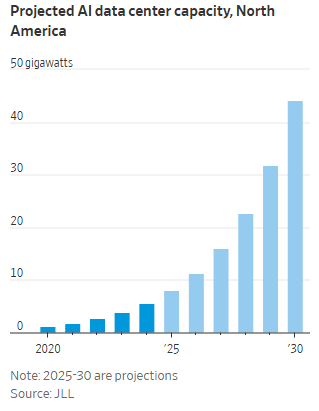
AI Data Center Power Demand Skyrocketing
This chart directly illustrates the ‘power’ risk highlighted in the section heading, showing that escalating power demand is a critical challenge for Oracle’s data center buildout.
(Source: IEEE ComSoc Technology Blog – IEEE Communications Society)
$70 B in Planned Cap Ex, Oracle’s Debt-Fueled AI Infrastructure Strategy
Oracle’s capital expenditure plan represents a fundamental strategic shift, financed primarily through debt, which introduces substantial financial risk and contrasts sharply with the cash-flow-funded models of its hyperscaler rivals. This aggressive spending demonstrates a deliberate decision to prioritize rapid infrastructure scale-up over short-term financial metrics, a high-risk, high-reward approach to capturing a significant share of the AI market.
- The company’s spending is accelerating dramatically, rising from $21.2 billion in fiscal year 2025 to a projected $55.7 billion in fiscal 2026, and a planned $70 billion in fiscal 2027. This spending trajectory is directly tied to securing large, multi-year AI cloud contracts.
- This expansion is not funded by organic cash flow but by leveraging the balance sheet. Oracle already holds over $100 billion in debt and plans to raise an additional $45 billion to $50 billion in calendar year 2026 through debt and equity to finance the buildout.
- This strategy has pushed the company into negative free cash flow, a significant deviation from its historical financial profile that has raised concerns among investors about its long-term financial discipline and ability to service its growing debt load.
- In contrast, competitors like Microsoft, Google, and Amazon are funding their own massive AI buildouts, with combined spending projected to exceed $400 billion in 2026, largely from their substantial operating cash flows, giving them greater financial flexibility.
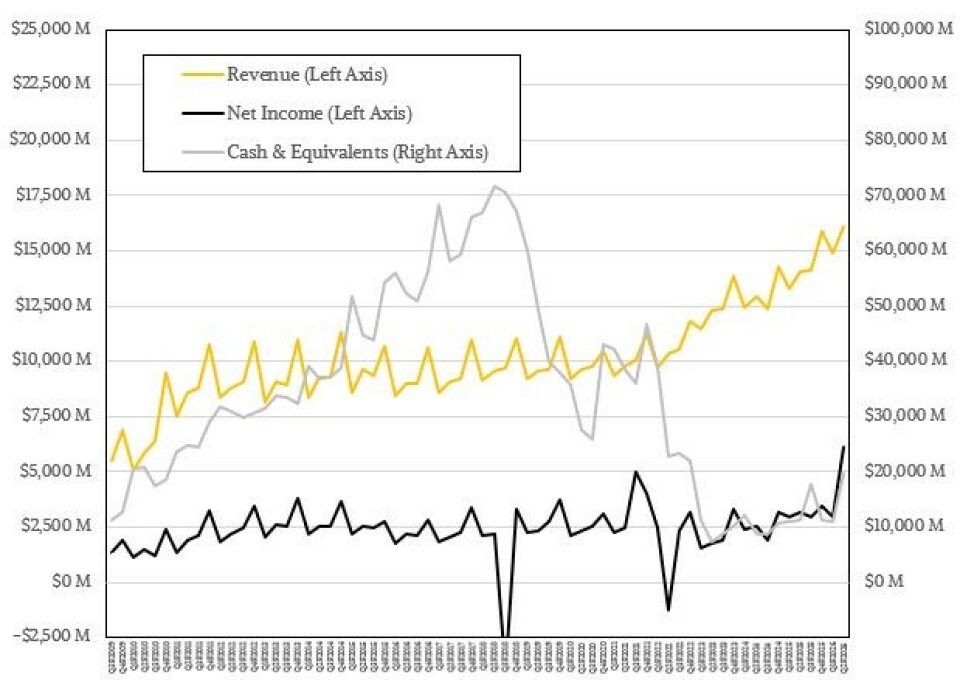
Oracle’s Cash Position Declines Amid AI Spending
The chart’s depiction of a declining cash position visually reinforces the section’s theme of a ‘debt-fueled’ strategy, highlighting the financial pressures of Oracle’s massive capital expenditure.
(Source: The Next Platform)
Table: Oracle’s Capital Expenditure Plan for Data Centers
| Company | Time Frame | Details and Strategic Purpose | Source |
|---|---|---|---|
| Oracle | FY 2027 (Plan) | Planned net cash outlay of $70 billion for capital expenditures, plus $20 billion from partners, to rapidly scale AI capacity. | Reuters |
| Oracle | FY 2026 (Projection) | Projected capital expenditures of $55.7 billion, an increase from an earlier guidance of $50 billion. | Govly |
| Oracle | 2026 (Plan) | Plans to raise between $45 billion and $50 billion in debt and equity to fund its AI and cloud infrastructure ambitions. | Silicon ANGLE |
| Oracle | FY 2025 (Actual) | Full-year capital expenditure was $21.2 billion, establishing the baseline for its subsequent massive spending increase. | Data Center Dynamics |
Oracle’s Open AI and Nvidia Deals, 3 Key Alliances for AI Capacity (2025-2026)
Oracle’s infrastructure strategy is anchored by foundational, multi-year partnerships with key AI players, providing the demand-side rationale for its high-risk capital investment. These alliances, particularly with Open AI and Nvidia, are not just customer relationships but deep integrations that justify building highly specialized, large-scale compute environments ahead of broad market demand.
- The most critical driver is the expanded, multi-year agreement to provide Oracle Cloud Infrastructure (OCI) for Open AI. This positions OCI as a core provider for training large language models, necessitating a massive buildout of GPU capacity.
- To fulfill this and other AI contracts, Oracle is making a substantial investment in hardware, committing approximately $40 billion to procure advanced GPUs from Nvidia. This makes Oracle one of Nvidia’s largest customers and highlights its dependency on a single supplier for critical components.
- To de-risk its balance sheet, Oracle is also leveraging financing partnerships. In one such deal, Related Digital secured $16 billion in financing with help from Blackstone to develop data centers specifically for OCI, effectively moving some capital expenditure off Oracle’s direct books.
- In a move to attract enterprise customers, Oracle and Google have formed a multi-cloud partnership. This allows customers to interconnect OCI and Google Cloud with no data transfer fees, a tactic designed to lower the barrier for companies with existing multi-cloud strategies to adopt OCI for specific workloads like AI.
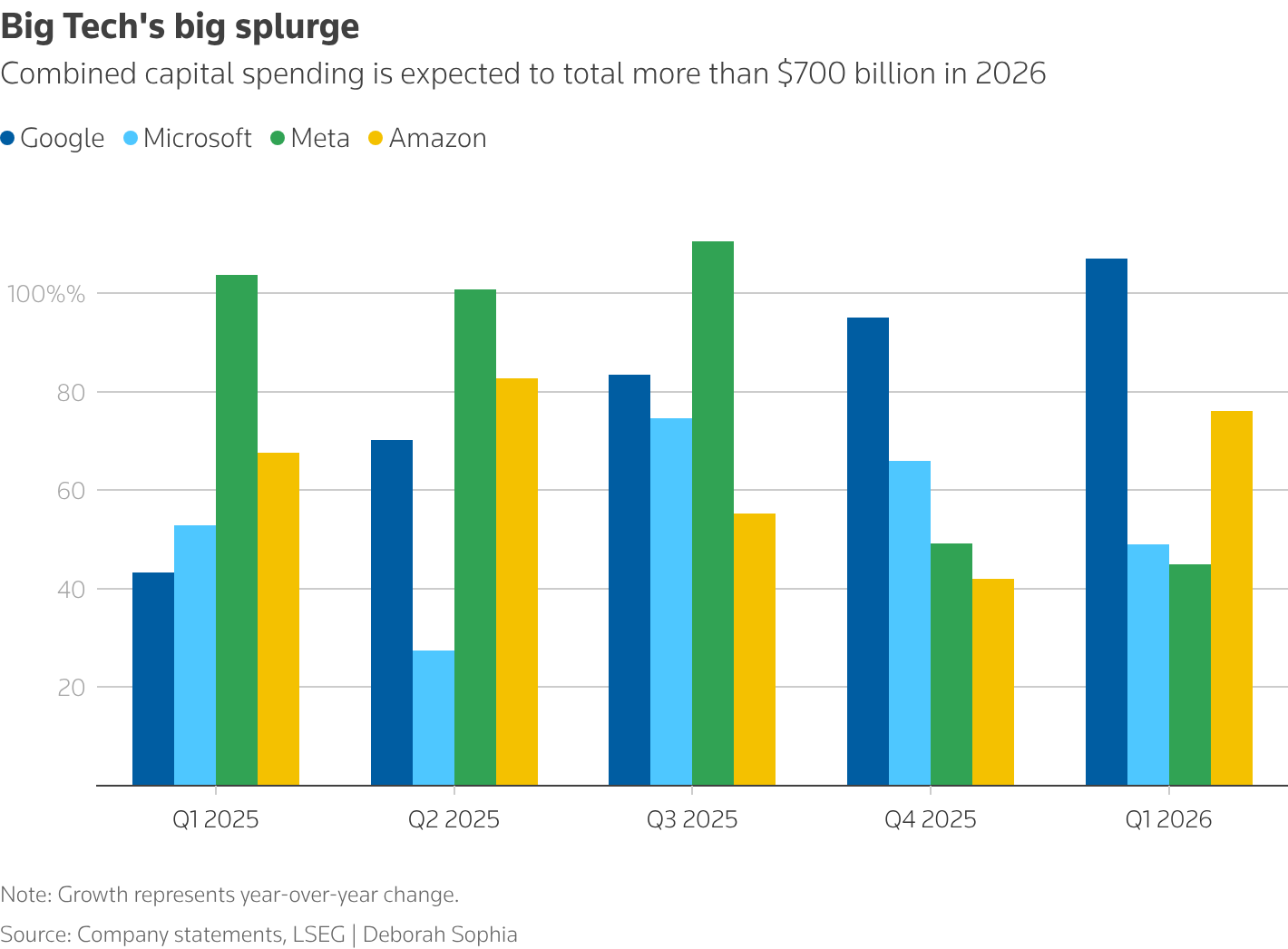
Big Tech’s AI CapEx Spending Surges
This chart provides the competitive context for Oracle’s alliances, showing that the massive AI CapEx surge across Big Tech necessitates strategic partnerships to secure capacity.
(Source: Reuters)
Table: Oracle’s Strategic AI and Financing Partnerships
| Partner / Project | Time Frame | Details and Strategic Purpose | Source |
|---|---|---|---|
| Related Digital, Blackstone | April 2026 | Financing of $16 billion was secured to develop new data centers for OCI. This partnership model allows Oracle to expand capacity with less direct capital outlay. | Stock Titan |
| Nvidia | May 2025 | Oracle will spend approximately $40 billion on Nvidia chips to power a new US data center for Open AI, securing the core hardware for its AI infrastructure. | Financial Times |
| Open AI | 2025 – Ongoing | A major, multi-year agreement for Oracle to provide OCI to train Open AI’s models. This cornerstone contract underpins the rationale for the massive infrastructure expansion. | Com Soc Tech Blog |

Data Center VC Funding Surges in 2025
This chart contextualizes Oracle’s financing partnerships by showing a wider industry trend of surging VC funding into the data center space, indicating a favorable investment climate.
(Source: New Market Pitch)
US-Centric Buildout, Oracle Focuses on North American AI Demand
While Oracle operates a global cloud footprint, its current monumental spending surge is heavily concentrated in the United States to directly serve the immediate needs of its major AI partners. This represents a strategic narrowing of focus compared to the period before 2024, when the company pursued a broader, more distributed geographic expansion to compete with rivals on global presence.
- From 2021 to 2024, Oracle’s cloud expansion strategy was focused on opening smaller cloud regions in numerous countries to achieve geographic parity with AWS and Microsoft Azure and serve local data sovereignty requirements.
- Since 2025, the strategy has pivoted to constructing massive, centralized AI super-clusters predominantly in the U.S. The primary driver is the need to build dedicated capacity for North American AI leaders like Open AI, AMD, and x AI.
- The plan to spend $40 billion on Nvidia chips for a new U.S. data center for Open AI is the clearest evidence of this geographic concentration. This single project’s value dwarfs many of Oracle’s previous international investments combined.
- While smaller, targeted international investments continue, such as a planned $2 billion investment in Germany over five years, they are now secondary to the large-scale U.S. buildout. This indicates a prioritization of serving foundational AI clients over broad geographic coverage.

Hyperscale Data Center Market to Hit $608B
Illustrating the large market size, this chart supports the section’s focus on North American demand, implying that Oracle’s US-centric buildout is targeting a substantial and growing opportunity.
(Source: MarketsandMarkets)
SWOT Analysis of Oracle’s $70 B Data Center Expansion Strategy
Oracle’s strategy presents a clear strength in its contracted revenue and focused AI partnerships, but it is exposed to significant weaknesses in its debt-heavy financing and major external threats from industry-wide infrastructure constraints. The opportunity to capture a durable position in the AI infrastructure market is significant, but the path is laden with financial and operational risks that are unique in their scale and concentration.
- Strengths: A record $638 billion in Remaining Performance Obligations (RPO) provides a strong, contracted revenue backlog that justifies the massive upfront investment.
- Weaknesses: A debt load exceeding $100 billion and negative free cash flow create significant financial fragility and limit flexibility compared to cash-rich competitors.
- Opportunities: By building specialized, at-scale capacity for cornerstone AI clients, Oracle has an opportunity to leapfrog competitors in the high-growth AI training market.
- Threats: The strategy is highly vulnerable to industry-wide power and supply chain bottlenecks, with 30-50% of planned 2026 projects facing delays or cancellation.
Table: SWOT Analysis for Oracle’s AI Data Center Investment
| SWOT Category | 2021 – 2024 | 2025 – Present | What Changed / Validated |
|---|---|---|---|
| Strengths | Strong enterprise database business and a growing but distant #4 cloud (OCI). | Massive contracted revenue backlog ($638 B RPO) driven by large, multi-year AI deals with partners like Open AI. | The validation of OCI as a viable platform for large-scale AI workloads, shifting its strength from general cloud to specialized compute. |
| Weaknesses | Significant debt from past acquisitions (e.g., Cerner) and a perception of lagging in the cloud race. | Debt exceeds $100 billion, with negative free cash flow resulting from massive Cap Ex. Heavy reliance on partners for financing. | The financial model shifted from a stable, cash-flow-positive enterprise to a high-burn, debt-fueled infrastructure builder. |
| Opportunities | Leverage its existing enterprise customer base to upsell cloud services. Compete on price for commodity cloud workloads. | Capture a significant share of the nascent but exploding AI training and inference market by building specialized, at-scale GPU capacity. | The emergence of generative AI created a new, high-value market segment where Oracle could compete without having to beat incumbents on general-purpose cloud. |
| Threats | Intense competition from dominant, well-capitalized hyperscalers (AWS, Microsoft, Google). Slow enterprise cloud migration. | Severe, industry-wide power grid limitations and supply chain shortages for critical equipment are delaying 30-50% of all data center projects. | The primary risk shifted from market competition to physical execution. The ability to build is now as important as the ability to sell. |
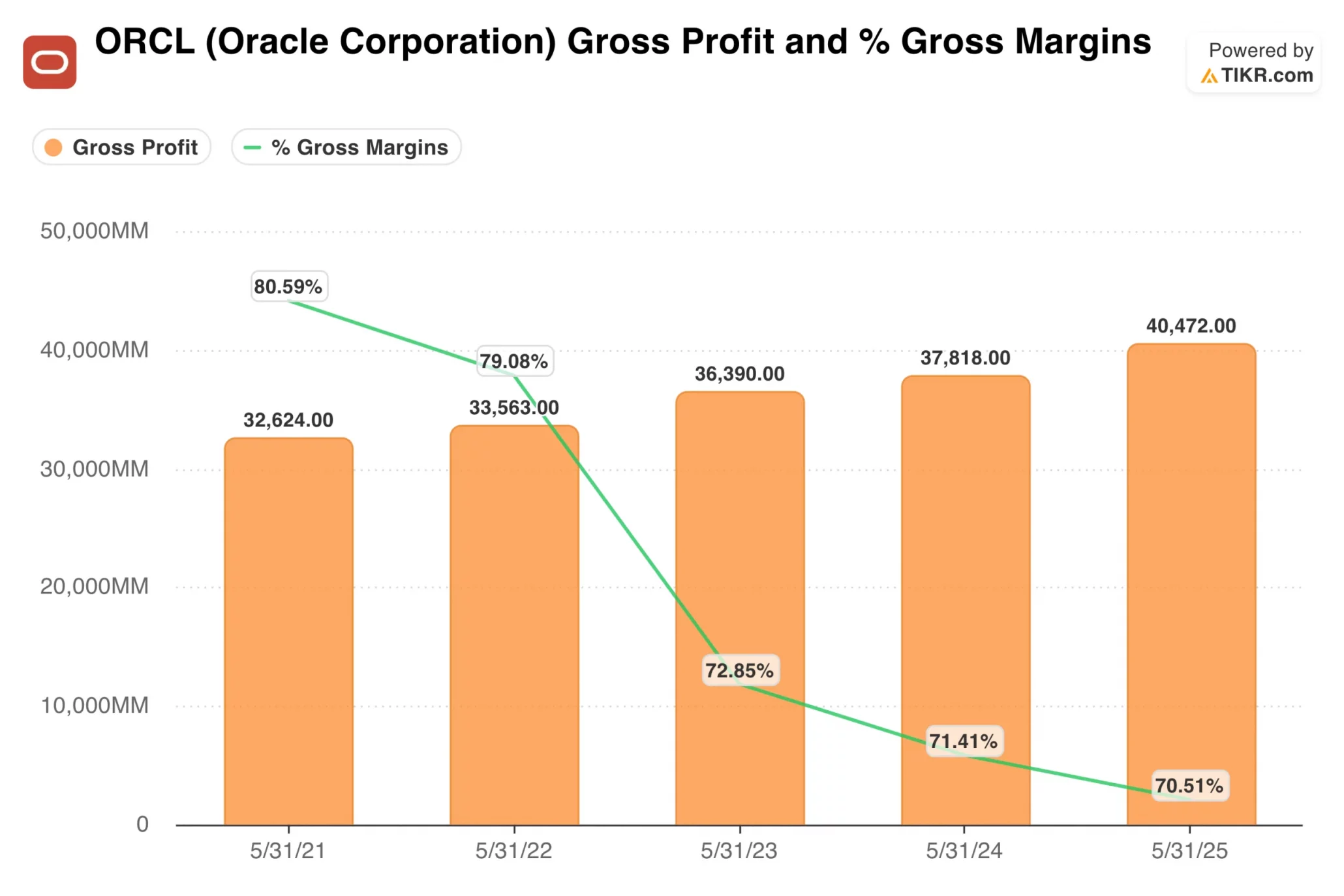
Oracle’s Gross Margins Decline Amid Profit Growth
This chart provides a specific data point for the SWOT table, highlighting a potential ‘Weakness’ or ‘Threat’ in the form of declining gross margins, which could impact the long-term profitability of the high-CapEx strategy.
(Source: TIKR.com)
Scenario Modeling for Oracle: Will Execution Risks Stall its $70 B Plan?
The single most critical variable for Oracle’s success in the next 18-24 months is its ability to execute its ambitious buildout plan faster and more efficiently than competitors despite severe industry-wide constraints. Investor focus has shifted from the size of the spending commitment to the tangible pace of construction and power procurement.
- If this happens: Oracle successfully brings its large-scale data centers online on or ahead of schedule, avoiding major delays from power and supply chain issues. Watch this: Announcements of new OCI capacity coming online, particularly for AI workloads, and confirmation that key customer deployments (like Open AI’s) are scaling as planned. This could be happening: This would validate its high-risk strategy, allowing it to convert its massive RPO into strong revenue growth and solidify its position as a key AI infrastructure provider.
- If this happens: Oracle succumbs to the same project delays and cancellations affecting 30-50% of the industry. Watch this: Analyst reports or company disclosures indicating scaled-back timelines, reduced Cap Ex guidance, or an inability to meet customer demand. This could be happening: The company’s negative cash flow would worsen, its debt servicing ability would come under intense pressure, and competitors like Microsoft would use the window to widen their infrastructure lead.
- If this happens: Oracle increasingly relies on third-party developers and financiers to build its data centers. Watch this: An increase in deals similar to the $16 billion financing arrangement with Related Digital and Blackstone. This could be happening: This would shift Oracle’s model from an owner-operator to a massive tenant, preserving capital but potentially reducing long-term margins and operational control. The success of this model would depend on the financial health and execution capability of its partners.
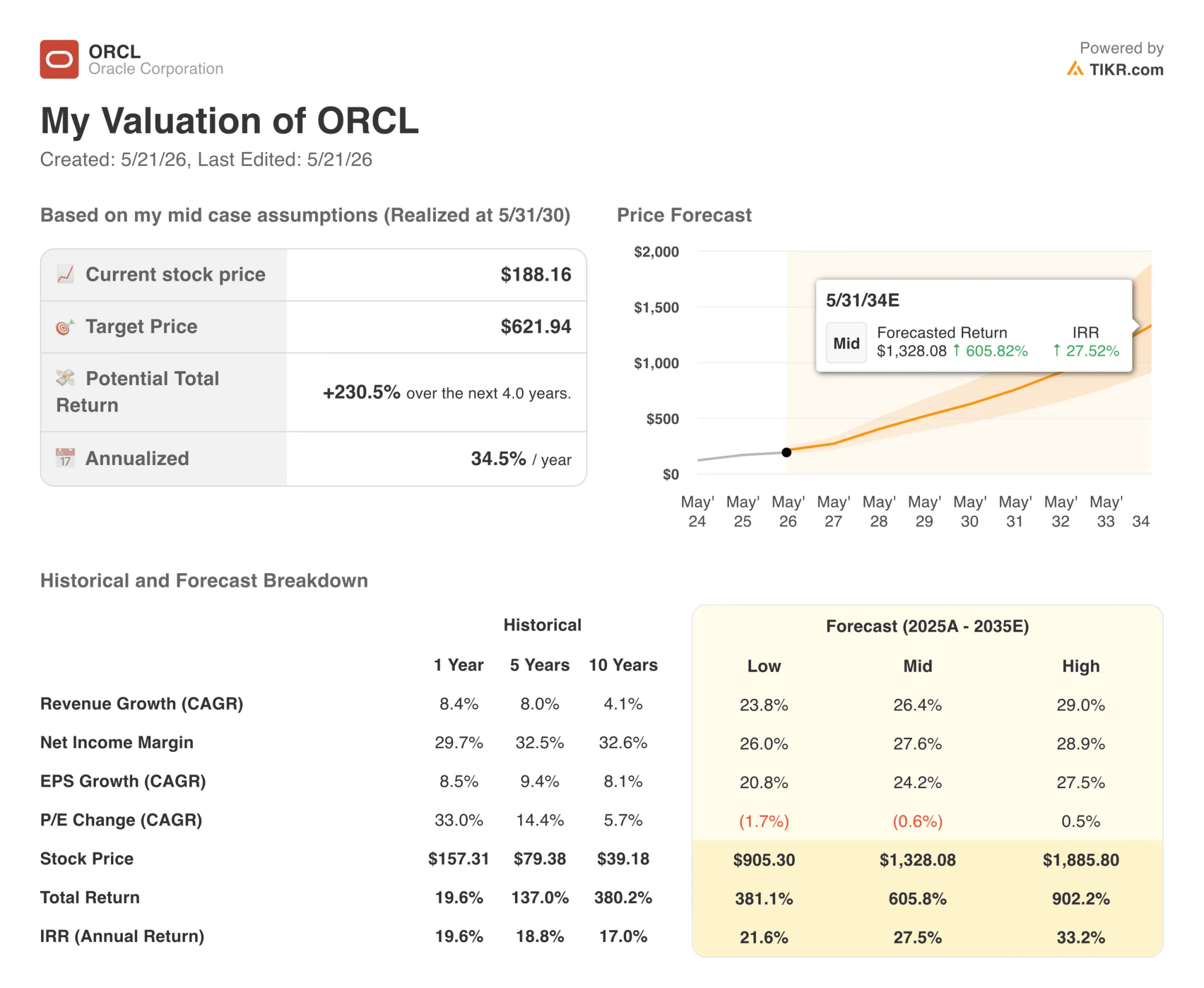
Oracle Revenue Growth Forecasted at 26.4%
As a key forward-looking metric, this revenue growth forecast is a perfect input for the ‘Scenario Modeling’ discussed in this section, helping to project potential financial outcomes of Oracle’s plan.
(Source: TIKR.com)
The questions your competitors are already asking
This report covers one angle of the execution risks threatening Oracle’s massive AI data center expansion. The questions that matter most depend on your work.
- Oracle investments and funding. Is its $70 billion data center buildout on track, or are power and supply chain delays causing a significant setback?
- Which hyperscalers are gaining or losing ground in the AI data center race as power and supply chain constraints intensify?
- Who are the key suppliers for high-voltage transformers and switchgear, and can they meet the demand from Oracle and other hyperscalers?
- Which hyperscale data center operators are adopting on-site power solutions from companies like Bloom Energy and FuelCell Energy?
This report does not answer these. Enki Brief Pro does.
Your question, your angle, your framework. SWOT, PESTL, scenario modelling. The same niche depth, built around the decision your work actually depends on.
