

AI Compute Financing, $35 B Apollo Deal for Anthropic, 3.5 GW Target, and $500 B in Related Projects (2021 to 2026)
AI Infrastructure Risk, Power Grid Bottlenecks Emerge as the Primary Execution Constraint
The primary execution risk for large-scale AI deployment has decisively shifted from technology development to the physical constraints of power availability and grid infrastructure. Before 2024, the main concern was the viability of AI models and access to venture capital. Now, as demonstrated by the $35 billion debt financing for Anthropic, the core challenge is securing gigawatts of power and connecting to a grid that is unprepared for such concentrated load growth. This “infrastructure-ization” of AI compute treats processing hardware like a power plant or pipeline, but its success is now directly tied to the decade-long timelines of energy project development, not the months-long cycles of software.
- Prior to 2025, the AI industry’s primary constraint was access to high-performance chips and the venture capital to fund R&D. The risk was centered on whether AI models could achieve commercial viability.
- From 2025 onward, the constraint has become physical infrastructure. The most acute risk is the inability to connect massive data centers to the power grid, with interconnection queues in key markets like the U.S. showing delays of 4 to 8 years.
- The scale of demand is creating direct reliability risks. A single large AI data center can now require up to 1 GW of power. The IEA estimates that nearly 20% of planned data center projects globally could face significant delays due to grid and power generation shortfalls.
- This shift is also creating political and social risks. Surging power demand is forecast to increase electricity costs in some states by over 50% by 2030, creating the potential for public backlash and moratoriums on new data center construction.
$900 B+ in AI Infrastructure Deals, Anthropic and Open AI Lead Capital Surge
The period from 2025 to 2026 marks a fundamental change in how AI infrastructure is financed, moving from dilutive venture equity to massive, asset-backed debt and strategic capital for physical hardware. The $35 billion private credit facility for Anthropic, arranged by Apollo and Blackstone, exemplifies this trend by treating AI compute as a tangible, utility-like asset class. This deal, alongside colossal funding rounds and contracts for Open AI, shows that the market’s primary focus is now on securing the industrial-scale physical layer of computing and data centers, with capital commitments approaching a trillion dollars.
- The $35 billion private credit deal for Anthropic finances Google’s Tensor Processing Units (TPUs) and signals a shift to debt-based infrastructure financing, de-risking the investment by backing it with physical hardware rather than speculative software.
- Open AI has engaged in even larger capital formation, including a $122 billion funding round in April 2026 to expand its systems infrastructure and a separate $110 billion strategic round with partners like Amazon and Nvidia.
- Beyond direct funding, major contracts underscore the scale of infrastructure demand. Oracle and Open AI signed a five-year, $300 billion cloud computing contract for GPU capacity, while a $500 billion project with Soft Bank and Oracle aims to build multiple dedicated AI data centers.
- This contrasts with the 2021–2024 period, which was characterized by smaller, equity-based venture rounds focused on AI model research and development, rather than financing the underlying physical hardware at such a massive scale.

Oracle-Led Transactions Spike Sharply into 2026
The section describes a ‘Capital Surge’ in AI deals. The chart provides a direct visualization of this trend, showing a sharp spike in transactions that illustrates the broader market’s capital momentum.
(Source: debt serious – Substack)
Table: Major AI Infrastructure Investments and Partnerships
| Company / Project | Time Frame | Details and Strategic Purpose | Source |
|---|---|---|---|
| Anthropic | Jun 2026 | $35 billion private credit deal led by Apollo and Blackstone to finance Google TPUs. Secures massive compute capacity for model training via an asset-backed debt structure, avoiding equity dilution. | Financial Times |
| Oracle & Open AI | Apr 2026 | $300 billion five-year cloud computing contract for Oracle to supply Open AI with vast GPU capacity starting in 2027. This is an infrastructure-as-a-service deal at an unprecedented scale. | Intuition Labs.ai |
| Open AI | Apr 2026 | $122 billion funding round to expand AI systems infrastructure, including chip procurement and data center construction. Focused on building out the physical foundation for next-generation models. | Data Center Knowledge |
| Open AI | Mar 2026 | $110 billion strategic funding from Amazon ($50 B), Nvidia ($30 B), and Soft Bank ($30 B). This alliance aims to reshape the global AI compute supply chain. | Forbes India |
| Open AI Data Center Project | Jan 2025 | $500 billion partnership with Soft Bank and Oracle to construct multiple AI-specific data centers across the U.S., a direct investment in the physical buildings and power infrastructure. | Tech Crunch |

Diagram Details $35B Anthropic AI Infrastructure Deal
The section is intended to detail major investments. The chart, a diagram breaking down a specific $35B deal, serves as a perfect case study for this section, fulfilling the role of a detailed entry in a list of major partnerships.
(Source: KuCoin)
US Dominance in AI Infrastructure, Anthropic Deal Reinforces Concentration
The global buildout of AI infrastructure is heavily concentrated in the United States, a trend reinforced by policy, capital markets, and the sheer scale of domestic power demand. The 2022 CHIPS and Science Act, which provides $52 billion in subsidies and a 25% investment tax credit, created a powerful incentive for domestic semiconductor manufacturing and deployment. This, combined with the U.S. having the world’s largest private credit markets capable of funding deals like Anthropic’s $35 billion financing, has made the nation the default location for developing and deploying cutting-edge AI. New chip packaging plants, such as the one being built by SK Hynix in Indiana, further cement this domestic supply chain focus.
- In the 2021-2024 period, while R&D was global, the manufacturing supply chain for advanced semiconductors was heavily concentrated in Asia, particularly Taiwan.
- From 2025 onward, U.S. policy and market forces have driven a concentration of not just design but also deployment and advanced packaging within the U.S. Data centers are projected by EPRI to consume between 9% and 17% of all U.S. electricity by 2030.
- The U.S. government is actively accelerating this trend, with 38 states offering specific tax incentives for data center construction and the White House issuing directives to speed up federal permitting for this critical infrastructure.
- In contrast, U.S. export controls on advanced AI chips to China, tightened in October 2023, are actively limiting the buildout of equivalent infrastructure abroad, further consolidating leadership within the U.S. and allied nations.

Tech Now Represents 55% of US Capital Spending
This chart provides the macroeconomic evidence for the ‘US Dominance’ theme of the section. It shows that a majority of US capital spending is in tech, underpinning the nation’s leading position in financing AI infrastructure.
(Source: LinkedIn)
Anthropic and Open AI Signal Shift to Execution, Validating AI Compute as TRL 9
The technology being financed is no longer speculative R&D but commercially mature, TRL 9 (Technology Readiness Level 9) hardware being deployed at an industrial scale. The period from 2021 to 2024 focused on proving the capabilities of large language models. The period since 2025 is defined by the execution challenge of deploying sufficient compute power to meet proven demand. The Anthropic financing of Google TPUs and its broader deal with Broadcom for custom ASICs, along with hyperscalers developing their own chips, shows the market has matured to the point of optimizing hardware for specific, known workloads to improve performance and energy efficiency.
- Between 2021 and 2024, the primary technology focus was on Nvidia’s general-purpose GPUs (like the A 100 and H 100), which were essential for the flexible research and development of new AI architectures.
- Starting in 2025, the market shows a distinct trend toward specialization. Anthropic’s deal involves custom chips (ASICs), which are designed for specific tasks and can offer superior performance-per-watt for scaled-out inference and training.
- This signals that AI companies have a clear enough understanding of their future computational needs to commit billions of dollars to specialized, less-flexible hardware, a classic sign of a maturing technology stack. The goal is no longer just capability, but operational efficiency at scale.
- The use of a $35 billion debt facility confirms this maturity. Debt investors require predictable cash flows from the underlying asset, meaning they view AI compute clusters as reliable, revenue-generating infrastructure, not high-risk technology ventures.
SWOT Analysis for AI Compute Financing
The strategic environment for financing AI compute has been transformed by its validation as a new, power-intensive infrastructure asset class. While the opportunity to fund the physical backbone of the AI economy is enormous, the primary threat has shifted from technological or market-adoption risk to the hard physical limits of the global energy and power grid infrastructure.
- Strengths: The core strength is the transition to asset-backed financing, which unlocks immense pools of private credit and lowers the cost of capital compared to dilutive equity.
- Weaknesses: The strategy is critically dependent on a stable power supply, but grid interconnection queues and generation shortfalls create multi-year execution risks.
- Opportunities: This financing model creates a direct follow-on opportunity to fund the necessary power generation and transmission assets, a natural fit for infrastructure investors like Apollo and Blackstone.
- Threats: The primary threat is grid instability and the potential for public and political backlash against data centers due to rising electricity prices and energy consumption.

P/E Ratios of Major AI Tech Stocks Compared
The chart on P/E ratios is crucial for a ‘SWOT Analysis for AI Compute Financing.’ High P/E ratios are an Opportunity, enabling easier capital raising, while their volatility can be a Threat to the financing environment.
(Source: AOL.com)
Table: SWOT Analysis for AI Compute Infrastructure
| SWOT Category | 2021 – 2024 | 2025 – 2026 | What Changed / Validated |
|---|---|---|---|
| Strengths | Strong VC backing for AI R&D; rapid algorithmic improvements; dominance of Nvidia’s GPU platform provided a standardized hardware base. | Access to massive private credit markets (e.g., Apollo deal); predictable, utility-like demand for compute; ability to structure deals as asset-backed debt. | The financing model shifted from high-risk venture equity to lower-risk infrastructure debt, validating compute as a bankable asset class. |
| Weaknesses | High cash burn for R&D; uncertainty over AI model monetization; dependence on a single hardware supplier (Nvidia). | Extreme power density requirements (30 k W+ per rack); long lead times for grid interconnection (4-8 years); reliance on complex global chip supply chains. | The primary weakness shifted from financial and technological uncertainty to physical infrastructure bottlenecks, particularly power and grid capacity. |
| Opportunities | First-mover advantage in foundational models; capturing developer mindshare; building proprietary datasets. | Financing follow-on energy infrastructure (power plants, transmission); creating a new asset class for institutional investors; optimizing TCO with custom ASICs. | The opportunity expanded from software dominance to financing the entire physical ecosystem, including the energy infrastructure required to power it. |
| Threats | Algorithmic breakthroughs by competitors; failure to find product-market fit; high cost of training runs limiting experimentation. | Grid instability and blackouts in high-density regions; public backlash over electricity and water use; an “AI bubble” bursting, stranding hardware assets. | The primary threat is now systemic and physical. The failure to build out the energy grid fast enough is the most significant risk to realizing returns on these massive hardware investments. |
Scenario Modelling for AI-Driven Power Demand
The most critical variable determining the success of the multi-trillion-dollar AI infrastructure buildout is the response of electric utilities and grid operators. If utilities aggressively update their capital expenditure plans to build new generation and transmission specifically for data center loads, the growth trajectory can be sustained. However, if their response is slow, AI’s expansion will be physically constrained, stranding billions in hardware investments. The key signal to watch is the next cycle of Integrated Resource Plan (IRP) filings from major utilities in data center hotspots like Virginia, Georgia, and Texas.
- Bull Case Signal: Utilities like Dominion Energy and Georgia Power announce multi-billion dollar increases in their 2026-2030 capital plans, explicitly citing data center demand. This would include fast-tracking natural gas peaker plants and signing long-term PPAs for new nuclear, such as the one between Microsoft and Constellation, and large-scale renewable projects.
- Bear Case Signal: Regional Transmission Organizations (RTOs) like PJM and MISO report that their interconnection queues are growing longer, with data center projects facing indefinite delays. This would be accompanied by state-level moratoriums on new data center connections due to grid stability concerns.
- What to Watch: Monitor the financial reports and investor calls of major utilities for specific line items and commentary on “data center load growth.” Also, track the volume and pricing of corporate PPAs signed by hyperscalers and AI labs. A surge in long-duration (15-20 year) PPAs for new-build generation is a strong leading indicator of a successful energy-sector response.
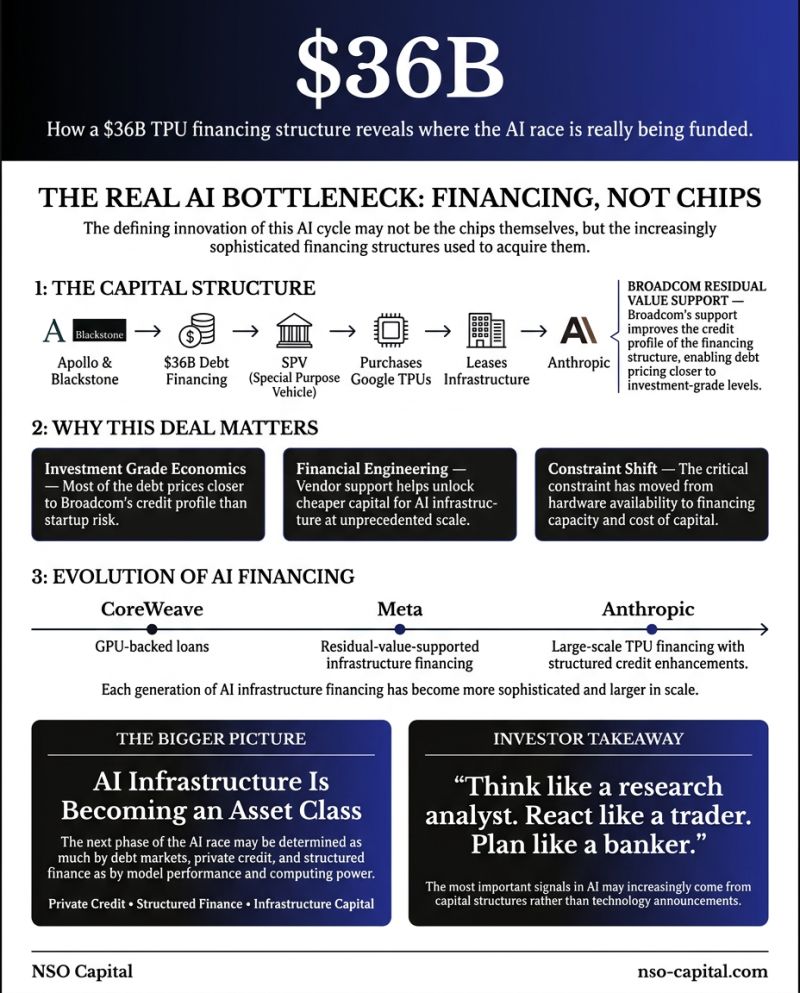
AI Infrastructure Financed by $36B Debt Deal
This chart, showing a massive investment in new AI infrastructure, provides a concrete input for ‘Scenario Modelling.’ The scale of this deal is a key variable in forecasting the resulting increase in datacenter capacity and future power demand.
(Source: LinkedIn)
The questions your competitors are already asking
This report covers one angle of financing the massive power and infrastructure build-out required for AI compute. The questions that matter most depend on your work.
- What is actually happening with the $35 billion in debt financing for Anthropic since the Apollo and Blackstone deal was announced?
- Which AI companies are gaining or losing ground based on their ability to secure gigawatt-scale power agreements?
- What is the outlook for large-scale AI data center deployment by 2026, considering 4-to-8-year grid interconnection queues?
- What are the opportunities for energy developers and utilities in the $500 billion AI infrastructure market?
This report does not answer these. Enki Brief Pro does.
Your question, your angle, your framework. SWOT, PESTL, scenario modelling. The same niche depth, built around the decision your work actually depends on.
