

Denmark DAC Strategy, DKK 28.7 B CCUS Fund, 5 Mt CO 2 Target, and 1 Postponed Tender (2025)
DAC Commercial Adoption in Denmark: Policy Framework Focus and BECCS Precedence (2025)
Denmark’s 2025 strategy for Carbon Dioxide Removal (CDR) prioritizes the construction of a state-funded market and foundational infrastructure over the immediate, large-scale deployment of Direct Air Capture (DAC). The nation is leveraging more technologically mature and economically viable methods like Bioenergy with Carbon Capture and Storage (BECCS) as commercial pathfinders, establishing the full-chain carbon management ecosystem that future DAC projects will require.
The “110% by 2050” Climate Mandate
Denmark’s approach is driven by a legally binding goal to achieve a 110% reduction in greenhouse gas emissions by 2050 relative to 1990 levels. This “climate positive” target makes negative emissions technologies non-negotiable.
- In April 2025, the Danish government’s climate projection acknowledged that CDR technologies like DAC are critical for meeting its long-term goals, particularly for negating emissions from hard-to-abate sectors.
- The national strategy requires capturing 5 million metric tons (Mt) of CO₂ annually by 2030, creating a demand signal for technologies including BECCS, point-source capture, and eventually, DAC.
BECCS as a Commercial Precedent
The government’s near-term focus is on proven technologies to initiate the carbon removal industry. By funding large-scale BECCS and point-source capture projects first, Denmark is resolving critical infrastructure and regulatory hurdles.
- These early projects validate the technical and commercial viability of CO₂ transport and storage in the North Sea, providing essential infrastructure and operational learning for future DAC deployment.
- This infrastructure-first approach de-risks subsequent investments in more nascent technologies by establishing a ready-to-use sequestration network.
| Policy / Program⇅ | Market Segment⇅ | Jurisdiction⇅ | Mechanism Type⇅ | Key Financial Metric / Value⇅ | Time Period⇅ | Source⇅ |
|---|---|---|---|---|---|---|
| Danish CCS Funding Pool | Carbon Capture and Storage (CCS) | Denmark | Competitive Tender / Subsidy | DKK 28.7 Billion (approx. $4.1B) | 2025 | What is carbon capture and storage (CCS)? Here’s what … ↗ |
| Ørsted Kalundborg CO₂ Hub | Bioenergy with Carbon Capture (BECCS) | Denmark | 20-year Subsidy Contract | DKK 8 Billion (approx. $1.15B) | 2025 | CDR Business models ↗ |
| US 45Q Tax Credit (Inflation Reduction Act) | Direct Air Capture (DAC) | United States | Tax Credit | $180 per tonne for DAC with geologic storage | 2025 | STAYING THE COURSE ↗ |
| US 45Q Tax Credit (Inflation Reduction Act) | Point-Source Carbon Capture | United States | Tax Credit | $85 per tonne for point-source with geologic storage | 2025 | STAYING THE COURSE ↗ |
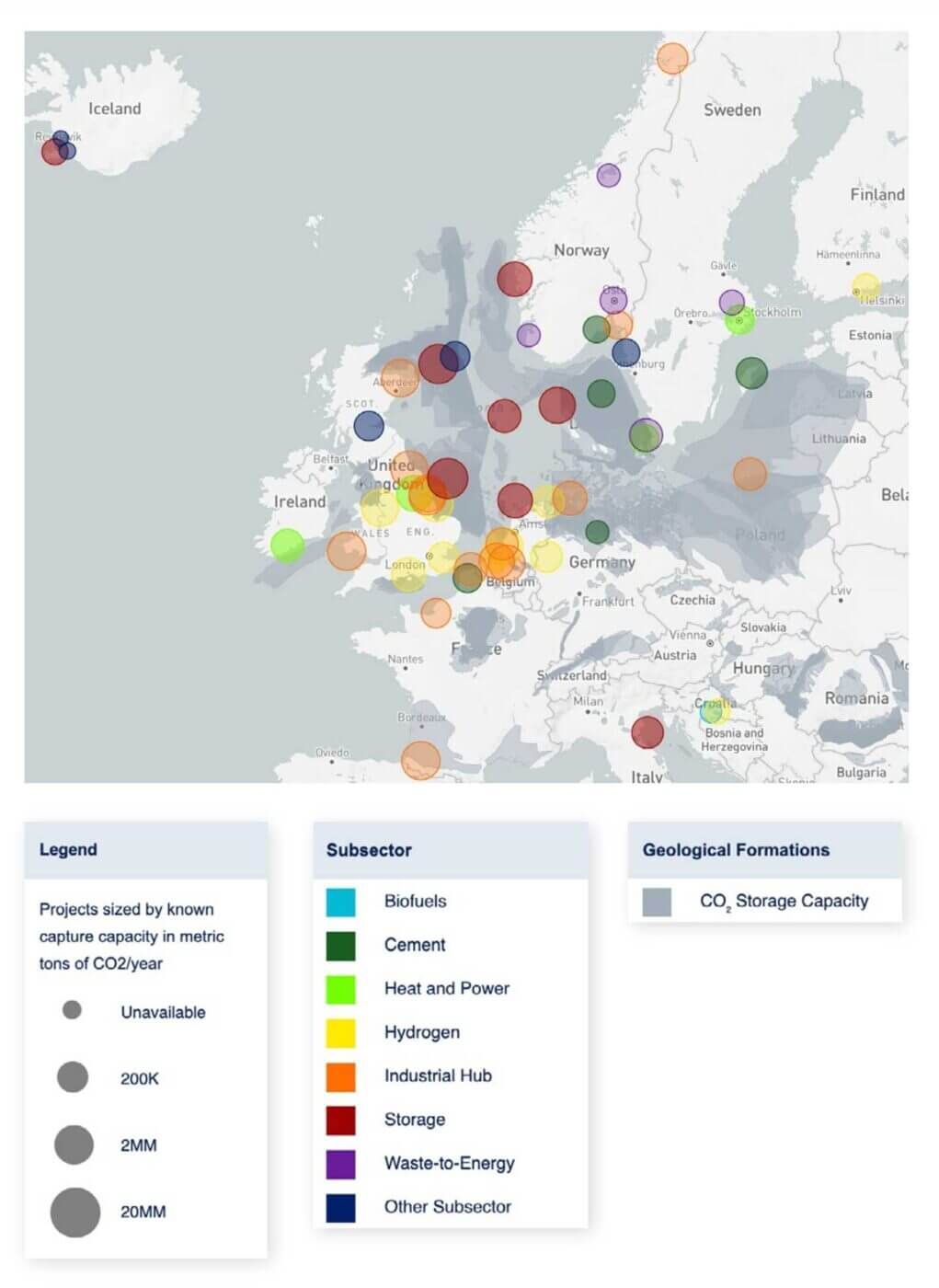
Denmark Emerges as a Major Carbon Capture Hub with Large-Scale Projects
Denmark hosts multiple large-scale CO2 capture projects, including significant Industrial Hub (orange) and Storage (red) initiatives, with individual capacities ranging from 2MM to 20MM metric tons of CO2/year. This positions Denmark as a key player in European carbon management, leveraging its strategic offshore CO2 storage capacity.
Denmark’s CCS Infrastructure Critical for European Industrial Decarbonization
Denmark’s advanced CO2 capture and storage infrastructure is critical for decarbonizing European heavy industries, creating a blueprint for cross-border carbon management. Its focus on integrated industrial and storage solutions, coupled with significant geological storage potential, offers a scalable pathway to reduce emissions from hard-to-abate sectors across the North Sea region.
(Source: Shell Carbon Capture 2025, $7.5B DOE Cuts Hit Climeworks)
DKK 28.7 B State-Led Funding for Denmark Carbon Removal, Tender Delays Signal Market Hurdles
Denmark’s primary mechanism for stimulating its carbon removal market is substantial public funding designed to guarantee revenue and de-risk private investment. However, developments in 2025 revealed a potential misalignment between government expectations and the economic realities of current CCUS projects, including high costs and long development timelines.
Denmark’s Public Procurement Model
The government has established a robust financial framework to kickstart the industry, centered on competitive tenders for carbon capture and storage services. This model aims to create a stable market until private sector demand matures.
- A major funding pool of DKK 28.7 billion (approximately $4.1 billion) was active in 2025 to support CCUS projects through state procurement of CDR services.
- This strategy is designed to provide long-term revenue certainty for project developers, which is crucial for securing financing for capital-intensive infrastructure.
December 2025 Tender Postponement
A significant signal of market friction appeared late in the year when a major tender process was delayed. This development suggests challenges in finding projects that meet the government’s desired price points and timelines.
- In December 2025, the Danish Energy Agency postponed the bid submission deadline for its next major CCS tendering procedure, which was to allocate a portion of the public funds.
- This delay points to difficulties in the market, likely related to the high costs of first-of-a-kind projects and economic uncertainty, impacting the ability of bidders to submit compliant proposals.
Table: Key Danish CCUS Funding and Policy Developments (2025)
| Initiative / Event | Time Frame | Details and Strategic Purpose | Source |
|---|---|---|---|
| CCS Tender Postponement | Dec 2025 | The Danish Energy Agency pushed back the bid submission deadline for its next major CCS tender, signaling potential difficulties in aligning project proposals with government economic and timeline expectations. | Offshore Energy |
| DKK 28.7 B CCUS Funding Pool | Active in 2025 | A DKK 28.7 billion (approx. $4.1 billion) public fund was in operation to support carbon capture and storage projects via state-run tenders, aiming to de-risk private investment. | Nordea |
| National Climate Projection Release | Apr 2025 | The government’s updated climate status report confirmed that CDR technologies like DAC are essential for achieving the net-zero by 2050 goal, reinforcing the strategic importance of the sector. | INNO-CCUS |
| Country⇅ | Market Segment⇅ | Incentive Mechanism⇅ | Value per Tonne CO2 (DAC)⇅ | Contract Duration⇅ | Primary Goal⇅ | Source⇅ |
|---|---|---|---|---|---|---|
| Denmark | CDR/CCUS | Direct Subsidies (CCUS & NECCS Funds) / Tenders | Variable (determined by tender bids) | 8-20 years | Secure financing for specific large-scale projects via long-term contracts. | Carbon Removal in Denmark: Policy, Targets & Funding ↗ |
| United States | CDR/CCUS | 45Q Tax Credit | $180 (for geologic storage) | 12 years (credit claim period) | Provide a broad market-based incentive to spur private investment. | U.S. Preserves and Increases 45Q Credit in “One Big … ↗ |
Denmark CCUS Partnerships: Copenhagen Infrastructure Partners and Vestforbrænding CCS Project
While direct DAC-specific partnerships in Denmark remained in the planning stages in 2025, collaborations in the broader CCUS value chain are critical for building shared infrastructure. The alliance between Copenhagen Infrastructure Partners and Vestforbrænding exemplifies the project structures forming to integrate capture with transport and storage.
Developing Full-Chain CCUS Projects
Effective carbon management requires partnerships that span the entire value chain, from CO₂ capture at industrial facilities to final sequestration. The Vestforbrænding project is a template for this integrated model.
- In January 2025, Copenhagen Infrastructure Partners (CIP) and the waste management company Vestforbrænding announced a partnership to develop a large-scale CO₂ capture project at a waste-to-energy facility near Copenhagen.
- This collaboration aims to capture approximately 500, 000 tons of CO₂ per year, providing a significant offtake volume that helps justify the investment in shared transport and storage infrastructure that future DAC projects can also use.
Table: Notable Denmark CCUS Partnership (2025)
| Partner / Project | Time Frame | Details and Strategic Purpose | Source |
|---|---|---|---|
| Copenhagen Infrastructure Partners & Vestforbrænding | Jan 2025 | Partnership to develop a large-scale CCS project at the Vestforbrænding waste-to-energy plant. The project aims to capture 500, 000 tons of CO₂ annually, creating an anchor project for regional CCUS infrastructure. | Carbon Herald |
| Project / Partnership⇅ | Market Segment⇅ | Key Entities⇅ | Annual CO2 Capacity (Tonnes)⇅ | Key Details⇅ | Source⇅ |
|---|---|---|---|---|---|
| Ørsted Kalundborg CO₂ Hub | BECCS | Ørsted, Danish Energy Agency, Microsoft | 800000 | Awarded a 20-year, 8 billion DKK subsidy contract. Involves a large-scale offtake agreement with Microsoft for carbon removal credits. | CDR Business models ↗ |
| Glostrup CCS Facility | BECCS | Copenhagen Infrastructure Partners (CIP), Vestforbrænding | 500000 | Partnership announced in Jan 2025 to capture CO2 from a waste-to-energy plant. | Copenhagen Infrastructure Partners And Vestforbrænding … ↗ |
| Project Greensand | CO2 Storage Infrastructure | Consortium including INEOS, Wintershall Dea | N/A (Storage Infrastructure) | Developing offshore CO2 storage sites in the North Sea, enabling capture projects in Denmark and potentially other EU countries. | Carbon capture and storage in Europe: Slow but significant … ↗ |
Technology Readiness in Denmark: BECCS at Commercial Scale, DAC Remains Pre-Commercial
In 2025, Denmark’s carbon removal portfolio showed a clear technological divergence: while BECCS and point-source capture are advancing toward commercial-scale operation, DAC remains in a pre-commercial, strategic planning phase, held back primarily by high costs and technological immaturity.
BECCS and Point-Source Capture Progress
Activities in 2025 were concentrated on more mature CCUS applications that offer a clearer path to near-term emissions reductions and removal volumes. These projects serve as the vanguard for the nation’s entire carbon management industry.
- Projects like the Vestforbrænding initiative and others targeting waste incineration and biogas facilities represent the most tangible progress, moving from planning to development.
- These projects are leveraging existing, proven technologies for amine-based post-combustion capture, reducing the technical risk profile compared to novel DAC methods.
DAC’s High Cost Barrier
Despite its strategic importance for long-term climate goals, large-scale DAC deployment is not yet economically viable without significant further cost reductions or higher carbon prices.
- The cost of DAC remains a primary barrier, estimated to be several times higher than point-source capture, making it uncompetitive in the current state-funded tenders which prioritize volume and cost-efficiency.
- The government’s strategy implicitly acknowledges this by focusing current funding on more mature technologies, while viewing DAC as a future solution that will benefit from the infrastructure being built today.
| Technology⇅ | Market Segment⇅ | Low-End Cost ($/tonne CO₂)⇅ | High-End Cost ($/tonne CO₂)⇅ | Time Period⇅ | Source⇅ |
|---|---|---|---|---|---|
| Direct Air Capture (DAC) | Technological Carbon Removal | 200 | 700 | 2025 | ORCHESTRATING CARBON REMOVAL: HOW SCIENCE, … ↗ |
| Biochar | Hybrid Carbon Removal | 80 | 200 | 2025 | Exploring the pathways of carbon removal technologies ↗ |
| Point-Source Capture | Emissions Abatement | 25 | 340 | 2025 | Capturing Carbon – Columbia Business School ↗ |
SWOT Analysis of Denmark’s 2025 DAC and Carbon Removal Strategy
Denmark’s 2025 strategy reveals a nation with strong political will and financial commitment, creating a powerful foundation for a future carbon management economy. However, this ambition is constrained by the current immaturity and high cost of DAC technology, along with emerging challenges in aligning state-led market creation with private sector project economics.
Table: SWOT Analysis for Denmark’s DAC and CCUS Strategy (2025)
| SWOT Category | 2021 – 2024 | 2025 | What Changed / Validated |
|---|---|---|---|
| Strengths | Ambitious climate targets (70% by 2030) and strong political consensus. Initial planning for CCUS funding and North Sea storage potential. | Legally binding “climate positive” target (110% by 2050). A DKK 28.7 B CCUS fund is active. Clear strategic role for CDR is defined in national projections. | The government’s commitment was validated by activating a massive public fund and embedding CDR explicitly into its 2050 climate law, moving from ambition to a clear procurement-based strategy. |
| Weaknesses | Theoretical reliance on immature DAC technology. Lack of a concrete funding mechanism to stimulate a market. | High cost of DAC remains prohibitive for current tenders. No large-scale DAC projects are operational. The market is entirely dependent on state tenders for revenue. | The weakness of DAC’s high cost was validated, as 2025 activity focused exclusively on more mature BECCS and point-source capture, confirming DAC is not yet commercially competitive. |
| Opportunities | Potential to become a first-mover in European CO₂ storage and establish a full-chain carbon management industry. | Partnerships like CIP and Vestforbrænding establish templates for integrated CCUS projects. Progress on BECCS de-risks shared infrastructure for future DAC. | The opportunity to build a full CCUS value chain began to materialize with anchor projects forming, demonstrating a viable pathway for integrating capture, transport, and storage. |
| Threats | Risk that technology costs for DAC would not decline fast enough to meet long-term targets. Uncertainty over private sector appetite. | The December 2025 postponement of a major CCS tender signals a potential misalignment between government price expectations and project developer costs, risking delays to the overall timeline. | The theoretical risk of market friction became a tangible threat with the tender delay, highlighting that even substantial public funding may not be enough to overcome high initial project costs. |
| Forecast Provider⇅ | Market Segment⇅ | 2025 Market Size ($B)⇅ | Forecast Year⇅ | Forecast Market Size ($B)⇅ | Implied CAGR (%)⇅ | Source⇅ |
|---|---|---|---|---|---|---|
| Mordor Intelligence | Direct Air Capture | 0.19 | 2030 | 2.58 | 68.32 | Direct Air Capture Market Size, Trends & Share Report 2030 ↗ |
| Research Nester | Direct Air Capture | 0.15 | 2035 | 17.57 | 61.30 * | Direct Air Capture Market Size, Growth Trends & Forecast | 2026-2035 ↗ |
| IMARC Group | Direct Air Capture | 0.13 | 2034 | 13.50 * | 60.69 | Direct Air Capture Market Size, Trends & Growth 2034 – IMARC Group ↗ |
Denmark 2026 DAC Outlook: Tender Success Is a Critical Signal
The outcome of the rescheduled CCUS tender in 2026 will serve as the most critical signal for the near-term trajectory of Denmark’s entire carbon removal sector. Its success or failure will determine if the government’s procurement model is sufficient to accelerate the build-out of infrastructure needed to meet its ambitious 2030 and 2050 targets.
- If the tender succeeds with multiple awards, it will validate the state-led procurement model and likely accelerate final investment decisions on several large-scale capture and storage projects, solidifying the North Sea storage hub.
- Watch the winning bid prices. The clearing price of the tender will establish a de facto national price for carbon removal and reveal how close the market is to commercial viability without heavy subsidies.
- These developments could be happening: If the tender struggles again, expect the Danish government to re-evaluate its procurement strategy, potentially introducing new mechanisms or subsidies specifically targeted at higher-cost technologies like DAC to ensure long-term goals remain achievable.
| Forecast Provider⇅ | Market Segment⇅ | 2025 Market Size ($B)⇅ | Forecast Year⇅ | Forecast Market Size ($B)⇅ | CAGR (%)⇅ | Source⇅ |
|---|---|---|---|---|---|---|
| Maximize Market Research | Direct Air Capture | 4.65 | Global Direct Air Carbon Capture Technology Market ↗ | |||
| Credence Research | Direct Air Capture | 2.45 | 2032 | 11.69 | 29.74 | Direct Air Capture Market Size, Growth, Share and Forecast 2032 ↗ |
| Market Research Future | Direct Air Capture | 0.20 | 2035 | 27.50 | Direct Air Capture Market Size, Share, Trends, Report 2035 ↗ | |
| Precedence Research | Direct Air Capture | 0.16 | 2035 | 18.77 | Direct Air Capture Market Size, Share and Trends 2026 to 2035 ↗ | |
| Research Nester | Direct Air Capture | 0.15 | 2035 | 61.30 | Direct Air Capture Market Size, Growth Trends & Forecast … ↗ | |
| Research and Markets | Direct Air Capture | 0.10 | 2032 | 2.30 | 57.30 | Direct Air Capture – Global Strategic Business Report ↗ |
The questions your competitors are already asking
This report covers one angle of Denmark’s carbon capture commercialization strategy. The questions that matter most depend on your work.
- Results of the next Danish carbon capture tender
- North Sea carbon storage project updates
- Cost per ton for Danish bioenergy carbon capture projects
- Companies developing direct air capture in Denmark
This report does not answer these. Enki Brief Pro does.
Your question, your angle, your framework. SWOT, PESTL, scenario modelling. The same niche depth, built around the decision your work actually depends on.
