

Renew Home VPPs for Data Centers, 16.8 GW Sunrun & Tesla Deal, 1 GW NRG Project, and 4 Key Initiatives (2024-2026)
VPP Commercial Scale, Renew Home 16.8 GW Capacity for Data Centers
The aggregation of residential distributed energy resources (DERs) into Virtual Power Plants (VPPs) has transitioned from regional, utility-focused pilot programs to a mainstream, industrial-scale solution directly addressing the power demands of the data center industry. This strategic pivot is defined by the formation of gigawatt-scale VPPs that offer capacity-as-a-service to hyperscalers, representing a fundamental shift in how new electricity demand is met without relying on traditional generation infrastructure.
- Between 2021 and 2024, the VPP market was characterized by smaller-scale, localized programs primarily designed to provide ancillary services to utilities. These initiatives served as critical proving grounds for aggregation software and customer engagement models but rarely exceeded a few hundred megawatts in capacity.
- A definitive turning point occurred on June 24, 2026, with the announcement that Sunrun, Tesla, and Renew Home would form a partnership to offer 16.8 GW of flexible capacity from aggregated residential assets. This initiative, the largest of its kind in the United States, explicitly targets data centers and utilities as primary offtakers.
- The market’s focus has broadened from utility grid balancing to serving large, concentrated industrial loads. This is further evidenced by the November 2024 announcement of a nearly 1.0 GW AI-powered VPP in Texas by NRG, Renew Home, and Google Cloud, and a June 2026 agreement between Google and Voltus for a 100 MW VPP from commercial and industrial loads to support data center growth.
- This escalation in scale demonstrates that VPP aggregators are no longer just participating in existing energy markets but are now creating new markets by offering tailored, rapidly deployable capacity products directly to the largest sources of new demand. The VPP aggregates resources from approximately 9 million U.S. homes and 12 million connected devices.
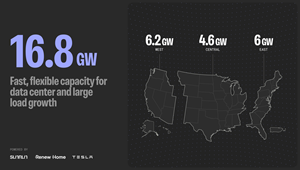
Renew Home Delivers 16.8 GW Capacity for Data Center Growth
The “Renew Home” initiative, supported by Tesla and Suyun, is projecting 16.8 GW of fast, flexible power capacity to address the escalating demand from data centers and large loads across the United States. This capacity is strategically distributed, with the West region providing 6.2 GW, the East 6 GW, and the Central region contributing 4.6 GW.
Distributed Energy Crucial for Data Center Scalability and Grid Stability
As data center expansion intensifies, traditional grid infrastructure faces significant strain. Renew Home’s substantial 16.8 GW VPP capacity, integrating residential assets, offers a critical decentralized solution. This model enhances grid resilience, minimizes transmission losses, and ensures reliable, localized power delivery, crucial for avoiding blackouts and facilitating sustainable growth in energy-intensive sectors.
Data Center Energy Demand to Double by 2026, Driven by AI
U.S. data center electricity demand is projected to surge from 23 GW in 2023 to 42 GW by 2026, reaching 134 GW by 2030. This exponential growth is primarily driven by AI tasks, which demand 1,000x more electricity than traditional web searches, severely straining existing grid infrastructure.
(Source: Renew Home to roll out new VPP features this summer | Utility Dive)
Renew Home 4 Major VPP Alliances for Grid and Data Centers (2024-2026)
Strategic partnerships between DER management platforms, asset owners, utilities, and large energy consumers have become the primary vehicle for achieving the scale required to serve industrial load. These alliances combine software expertise with massive fleets of residential batteries and smart thermostats, creating a new class of power resource that is both large-scale and highly flexible.
- The most significant collaboration is the nationwide U.S. VPP formed by Sunrun, Renew Home, and Tesla, which aggregates 16.8 GW of capacity. This partnership leverages Renew Home’s platform to manage 9.0 GW of flexible HVAC load and combines it with 7.8 GW of solar-plus-battery systems from Sunrun and Tesla customers.
- In Texas, Renew Home partnered with utility NRG and Google Cloud to develop a 1.0 GW VPP. This initiative highlights the growing role of AI in optimizing DER dispatch to enhance grid resilience while managing consumer energy costs, establishing a model for utility-led VPPs at scale.
- To directly address its own operational needs, Google also formed a partnership with Voltus for a 100 MW VPP. This three-year agreement, announced in June 2026, focuses on aggregating commercial and industrial flexible loads, demonstrating that hyperscalers are pursuing multiple VPP strategies simultaneously.
- These U.S.-based, residential-heavy partnerships stand in contrast to the established European model exemplified by Next Kraftwerke’s 15.5 GW VPP, which aggregates a more diverse portfolio of assets including industrial loads and larger renewable generators across multiple countries.
Table: Renew Home VPP Partnership Analysis
| Partnership / Initiative | Time Frame | Details and Strategic Purpose | Source |
|---|---|---|---|
| Sunrun, Renew Home, Tesla | June 2026 | Announced a 16.8 GW nationwide VPP combining residential batteries and smart thermostats. The primary goal is to offer “capacity-as-a-solution” to data centers and utilities, bypassing the need for new power plant construction. | latitudemedia.com |
| Google, Voltus | June 2026 | A three-year agreement to build a 100 MW VPP from commercial and industrial loads specifically to support Google’s growing data center energy needs. | theenergymag.com |
| NRG, Renew Home, Google Cloud | November 2024 | Announced a plan to develop a nearly 1.0 GW AI-powered VPP in Texas. The project leverages smart thermostats and Google’s AI to improve grid resilience and lower consumer energy costs in a high-growth market. | renewhome.com |
US vs. Europe VPPs, Renew Home Nationwide Deployment Focus
While Europe has long been the leader in VPP capacity, the recent surge in U.S. data center power demand is catalyzing a new, residential-centric VPP model that is rapidly achieving comparable scale. The U.S. market is now defined by nationwide initiatives targeting industrial customers, a clear departure from the European model focused on participating in established pan-European electricity markets.
- Prior to 2025, the VPP market was dominated by European players like Next Kraftwerke, which built a 15.5 GW portfolio by aggregating a diverse mix of assets, including industrial loads and distributed renewable generators, to trade in wholesale markets. U.S. activity was limited to state-level pilots.
- The period from 2025 to 2026 marks the emergence of the U.S. as a VPP powerhouse, driven by a different set of market fundamentals. The Renew Home-led 16.8 GW program is the premier example of a nationwide VPP purpose-built to solve a specific industrial challenge: data center load growth.
- Geographic focus within the U.S. is concentrated in regions with both high data center density and grid constraints, such as Texas. The 1 GW NRG and Renew Home project in Texas is a direct response to ERCOT’s soaring energy demand and grid resilience concerns.
- The U.S. strategy leverages a massive, largely untapped resource in residential DERs, particularly smart thermostats and batteries. This contrasts with the European VPP model, which has historically relied more heavily on commercial and industrial assets.
16.8 GW Scale, Renew Home VPP Technology Reaches Maturity
The technology underpinning VPPs has evolved from software capable of managing thousands of endpoints for simple demand response events into sophisticated, AI-driven platforms that can orchestrate millions of diverse assets to deliver firm, dispatchable, gigawatt-scale capacity. The launch of multi-gigawatt commercial VPPs signals that the technology has reached a state of commercial maturity and scalability sufficient for industrial applications.
- In the period from 2021 to 2024, VPP platforms were primarily in a refinement phase, demonstrating their ability to manage a limited number of homogenous assets for utility programs. The core technical challenge was reliable communication and control.
- The 2026 announcement of the 16.8 GW VPP validates a major leap in technological capability. The aggregation platform, with Renew Home at its core, demonstrates the ability to co-optimize two distinct asset classes at an unprecedented scale: dispatchable batteries from Sunrun and Tesla (7.8 GW) and flexible HVAC load from smart thermostats (9.0 GW).
- This initiative involves coordinating an estimated 12 million connected devices across 9 million homes, proving the platform’s ability to handle the data processing, forecasting, and secure dispatch signals required for such a large and distributed fleet.
- The integration of artificial intelligence, as seen in the NRG, Renew Home, and Google Cloud project, represents the next frontier of technological maturity. AI algorithms are now being used to optimize dispatch not just for grid needs but also for consumer comfort and economic benefit, solving a key challenge for residential VPPs.
SWOT Analysis, Renew Home VPP Strengths and Market Risks
The VPP model, as exemplified by the Renew Home-led alliance, presents a powerful solution to the data center energy challenge, capitalizing on speed and existing assets. However, its strengths are balanced by operational complexities and external market and regulatory risks that could influence its long-term growth trajectory.
- The primary strength is the ability to deploy gigawatts of capacity far faster and cheaper than constructing new power plants, directly addressing the urgent timelines of hyperscalers.
- A key opportunity lies in the explosive and predictable demand growth from data centers, providing a clear, high-value offtake market that did not exist for VPPs at this scale previously.
- Weaknesses include the operational complexity of managing millions of individual, customer-sited assets and ensuring reliable performance across a heterogeneous device population.
- The most significant threat is regulatory uncertainty, as market rules for DER participation in wholesale markets are still evolving, which could impact the economic viability of these large-scale VPPs.
Table: SWOT Analysis for VPPs in the Data Center Market
| SWOT Category | 2021 – 2024 | 2025 – 2026 | What Changed / Validated |
|---|---|---|---|
| Strengths | Provided ancillary services to utilities; offered grid flexibility at a small scale; leveraged existing software platforms. | Delivers industrial-scale capacity (16.8 GW); fast deployment timeline vs. traditional generation; leverages millions of existing residential assets. | The model has been validated as a utility-scale resource, not just a niche grid service. Speed and cost advantages are now its primary value proposition for industrial customers. |
| Weaknesses | Difficulty scaling beyond pilot programs; inconsistent performance of aggregated assets; complex customer acquisition and management. | High operational complexity of managing 12 million devices; reliance on consumer behavior and participation; performance validation at gigawatt-scale is new. | While the technology has scaled, the operational challenge of ensuring firm capacity from a disaggregated fleet remains a key execution risk at this new magnitude. |
| Opportunities | Growing DER adoption; nascent utility interest in non-wires alternatives; early development of wholesale market participation rules (FERC 2222). | Explosive data center electricity demand (projected to reach 134.4 GW by 2030); strong DOE support for VPPs; direct offtake agreements with hyperscalers. | The emergence of data centers as a massive, concentrated buyer of clean, flexible capacity has created a bankable offtake market that justifies gigawatt-scale aggregation. |
| Threats | Unfavorable utility rate design; slow regulatory reform; competition from natural gas peaker plants. | Cybersecurity risks of a massive, distributed network; potential for adverse regulatory changes impacting DER compensation; competition from other fast-response resources like utility-scale BESS. | As VPPs become a significant market force, they attract greater scrutiny. Cybersecurity and regulatory headwinds are now more pronounced threats than in the pilot phase. |

16.8 GW Residential VPP Capacity Targets Data Center Load
A significant 16.8 GW of fast, flexible capacity is being aggregated across the US (6.2 GW West, 4.6 GW Central, 6 GW East) from residential sources, driven by ‘Renew Home” and partners like Sunrun and Tesla, directly addressing the escalating energy demands of data centers and large load growth.
Decentralized Energy Solutions Address Data Center Grid Challenges
The collaboration between residential solar providers (Sunrun), VPP aggregators (Renew Home), and energy storage (Tesla) creates a scalable, decentralized power solution. This mitigates grid constraints for energy-intensive data centers and offers a more sustainable, resilient energy supply than traditional grid expansion.
Data Center Energy Demand to Surge, Outpacing Nations
Data centers worldwide are projected to consume 835 TWh by 2026, nearly doubling their 2022 consumption of 415 TWh. This surge means data centers will consume more electricity than countries like Canada (553 TWh), Germany (507 TWh), France (426 TWh), and Great Britain (287 TWh) by 2026, highlighting a critical energy demand challenge.
(Source: AI Data Center Power: Grid Limits Reshape Energy in 2026)
Renew Home 2027 Outlook, VPPs for Data Center Capacity
If the Renew Home-led VPP consortium successfully executes its first commercial offtake agreement with a hyperscale data center in the coming year, watch for this “capacity-as-a-solution” model to be rapidly replicated across other U.S. regions with high grid congestion. The successful delivery of reliable, dispatchable power from millions of homes to an industrial offtaker would cement VPPs as a primary tool for managing rapid load growth.
- If this happens: The Sunrun, Tesla, and Renew Home alliance signs a multi-year capacity agreement with a named data center operator in 2027. Watch this: Other major DER and EV fleet operators will quickly form competing alliances to aggregate their own assets and offer similar products.
- This could be happening: Utilities and grid operators, facing competition for flexible resources, may accelerate programs that integrate VPPs directly into their integrated resource plans and invest in modernizing distribution grids to better accommodate them, potentially working with firms like Sempra.
- If this happens: Initial performance data from the 16.8 GW VPP demonstrates consistent and reliable capacity delivery during peak demand events. Watch this: Financial institutions will develop new financing instruments tailored to large-scale VPPs, lowering the cost of capital and further accelerating deployment.
- This could be happening: A significant underperformance or failure to meet capacity commitments in an early contract could cause data center developers to revert to more traditional solutions like dedicated natural gas generation or direct investment in utility-scale projects, slowing VPP momentum.
The questions your competitors are already asking
This report covers one angle of the commercial pivot of virtual power plants. The questions that matter most depend on your work.
- virtual power plant contracts for data centers
- US rules for virtual power plant market access
- European virtual power plant companies
- companies providing VPP software platforms
This report does not answer these. Enki Brief Pro does.
Your question, your angle, your framework. SWOT, PESTL, scenario modelling. The same niche depth, built around the decision your work actually depends on.
