

Virtual Power Plants for Data Centers, Google 100 MW Voltus VPP, and 7 GW in Project Delays (2025 to 2026)
VPP Adoption for Data Centers, Projects, and Commercial Scale Signals
The strategic imperative for data center operators has shifted from passive energy consumption to active grid participation, driven by systemic power constraints and the economic advantages of virtual power plants (VPPs).
- Between 2021 and 2024, VPPs were largely considered a niche solution for grid services, with data center involvement limited to isolated demand response pilots. The primary focus for data centers was securing long-term power purchase agreements from traditional, centralized sources.
- Starting in 2025, the dynamic inverted as the AI-driven power crisis intensified, with an estimated 7 GW of U.S. data center capacity facing delays or cancellation in 2026 due to grid connection challenges. This made the rapid deployment capability of VPPs a primary solution, not an alternative.
- Hyperscalers began treating their on-site power infrastructure, including massive Uninterruptible Power Supply (UPS) battery systems, as dispatchable grid assets. This “Data Center as a VPP” model moved from theory to commercial practice, creating new revenue streams from previously dormant backup systems.
- The market saw a clear transition from data centers being a threat to grid stability to becoming a potential stabilizing asset. This is evidenced by formal partnerships between VPP aggregators and hyperscalers designed to provide flexible, localized capacity, bypassing decade-long waits for transmission upgrades. Other operators are exploring a mix of solutions, including on-site gas turbines from firms like Baker Hughes or long-term options like advanced nuclear.
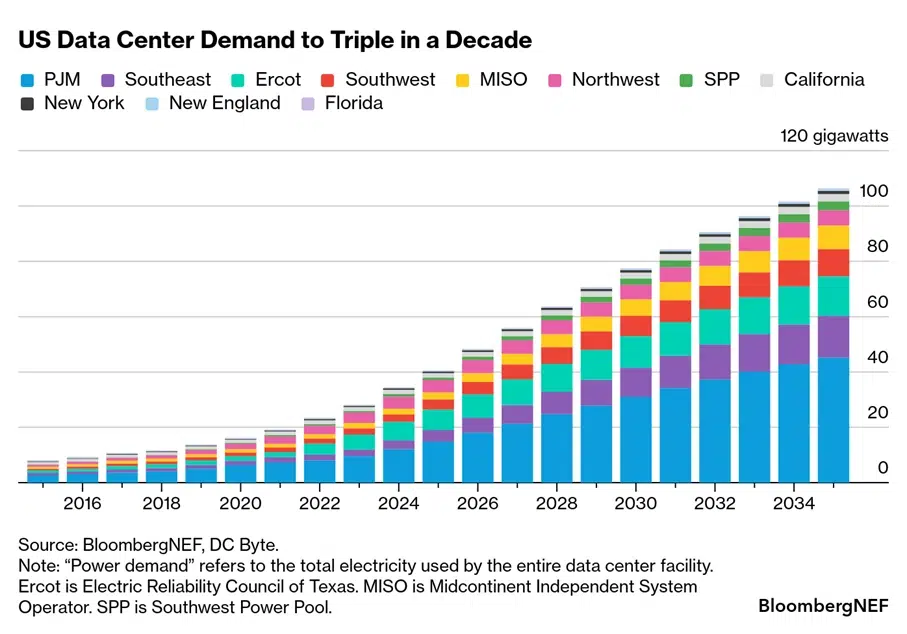
US Data Center Power Demand to Triple
This chart provides the critical ‘why’ for Section 0 on VPP adoption. The dramatic projection of demand tripling establishes the urgent need for the VPP solutions and projects discussed in the section.
(Source: BloombergNEF)
$1.4 Trillion in Utility Spending, AI Data Center Demand Accelerates VPP Investment
Massive capital inflows are being directed toward both sides of the VPP equation, with utilities upgrading infrastructure to support data center loads and VPP operators deploying distributed assets to meet that demand more quickly.
- U.S. utilities have planned an estimated $1.4 trillion in spending through 2030 specifically to build out infrastructure to support the explosive growth of AI data centers. This infrastructure spending highlights the scale of the challenge that VPPs are positioned to address more efficiently.
- The global VPP market itself is attracting significant investment, with forecasts showing growth from approximately $6.0 billion in 2025 to over $30.9 billion by 2033, representing a compound annual growth rate of 22.6%.
- Federal policy is amplifying investment through direct incentives. Tax credits now cover up to 50% of the eligible capital costs for distributed energy resources (DERs) like batteries and solar, which form the building blocks of VPPs.
- The economic case for VPPs is validated by projected cost savings. The deployment of 60 GW of VPP capacity in the U.S. is estimated to save ratepayers between $15 billion and $35 billion in avoided grid infrastructure costs.

Data Center Energy Consumption Surges Amid AI Boom
This chart is a direct match for Section 1. The headline mirrors the section’s theme, which links accelerating investment directly to the AI data center demand boom.
(Source: Statista)
Table: Data Center and VPP Investment Signals
| Entity / Sector | Time Frame | Details and Strategic Purpose | Source |
|---|---|---|---|
| U.S. Utilities | Through 2030 | Planned spending of $1.4 trillion to upgrade grid infrastructure to accommodate the power demand from AI data centers. This investment underscores the long-term, high-cost nature of traditional solutions. | Tech Insider |
| Global Hyperscalers | 2026 | Projected capital expenditures approaching $725 billion, a significant portion of which is dedicated to building out power and cooling for AI-ready facilities. | Avanza Energy |
| Global Data Center Construction | 2025 | Aggregate global spending on data center construction was projected at $425 billion, with costs per megawatt for advanced AI facilities ranging from $7 million to $20 million. | S&P Global |
| Federal Tax Credits (U.S.) | 2025-2026 | Federal incentives cover up to 50% of eligible capital costs for DERs, directly subsidizing the deployment of VPP assets that can support data centers. | Energy Central |
Google 2 Key Partnerships, Voltus and Meta Alliances Validate VPP Model (2025 to 2026)
Strategic partnerships between hyperscale data center operators, VPP aggregators, and utilities have become the primary mechanism for integrating distributed energy resources to meet AI’s power demand.
- Before 2025, collaborations were rare and typically centered on research or small-scale pilots. The dominant model was a simple transactional relationship between a data center and its utility provider.
- The period from 2025 to 2026 saw the emergence of landmark commercial agreements that established a new operational blueprint. These partnerships are not just about procuring power; they are about creating flexible, two-way relationships with the grid.
- The alliance between Google and Voltus to deploy a 100-megawatt VPP on the PJM grid serves as a key validation point. It demonstrates a scalable model where aggregated consumer and commercial DERs provide flexible capacity directly to data center loads.
- Similarly, the collaboration between infrastructure provider Vertiv and VPP specialist CPower aims to create a standardized pathway for data centers to monetize their on-site energy assets, accelerating their participation in energy markets.
- Tech giants are also exploring frontier energy technologies. In July 2026, Meta announced agreements for space-based solar power and ultra-long-duration energy storage, signaling a multi-pronged strategy to secure carbon-free energy. While some operators like Microsoft are investigating dedicated nuclear solutions, the immediate demand is being met by more flexible assets.
Table: Key VPP and Data Center Partnerships
| Lead Partner / Project | Time Frame | Details and Strategic Purpose | Source |
|---|---|---|---|
| Google and Voltus | June 2026 | Deploying a 100 MW VPP on the PJM grid, aggregating DERs like smart thermostats and EVs to provide flexible power capacity for data centers. This serves as a model for using off-site resources to power large loads. | Energy Change Makers |
| Meta | July 2026 | Announced agreements for advanced energy procurement, including space-based solar and ultra-long-duration energy storage solutions, to secure 24/7 carbon-free power for its data centers. | Energy Choice Matters.com |
| Vertiv and CPower | April 2026 | A collaboration to help data centers accelerate interconnection and monetize their on-site energy assets (like UPS systems and backup generators) by participating in demand response and VPP programs. | CPower Energy |
| EDF and Santander UK | January 2026 | A partnership where Santander provides project financing for energy storage assets, which EDF then optimizes for market participation. This financial model is crucial for scaling the DERs that power VPPs. | Fractal Energy Storage Consultants |
U.S. Data Centers and VPPs, A Symbiotic Relationship Emerges
The United States has become the global epicenter for the convergence of data center power demand and VPP deployment, driven by the concentration of the AI industry and proactive, albeit evolving, regulatory support.
- Prior to 2025, VPP activity was concentrated in a few states with favorable market structures, such as California and Texas. Data center siting was driven primarily by land cost, tax incentives, and fiber availability.
- By 2026, power availability became the single most critical factor in data center siting, making regions with accessible grid capacity and supportive DER policies paramount. This has concentrated VPP and data center co-development in specific utility territories.
- The PJM Interconnection, the largest grid operator in the U.S., is a focal point of activity, as seen in the Google and Voltus partnership. Its mature wholesale electricity market provides clear price signals and mechanisms for VPPs to monetize their services.
- U.S. federal policy provides a strong tailwind. The Department of Energy’s (DOE) “VPP Liftoff” report and subsequent actions directing FERC to create clear rules for large loads like data centers are creating a national framework that reduces state-by-state regulatory risk.
- The scale is significant, with U.S. data center demand projected to grow from 4% of total electricity use in 2024 to potentially 12% or more by 2030. In parallel, the DOE has set a strategic goal to triple VPP capacity to between 80 GW and 160 GW by 2030 to help meet this demand.

DER Capacity to Greatly Exceed Data Center Demand
This chart perfectly illustrates the ‘Symbiotic Relationship’ described in Section 5 by visually comparing the scale of the problem (data center demand) with the scale of the solution (DER capacity, which enables VPPs).
(Source: The Pew Charitable Trusts)
Technology Maturity of Virtual Power Plants for Data Centers, From Niche to Necessity
Virtual power plant technology has transitioned from a developing concept to a commercially mature, essential solution for managing the energy demands of the AI economy.
- In the 2021-2024 period, VPPs were often characterized as being in the pilot or demonstration phase. The primary challenges were software integration, establishing reliable control of diverse DERs, and convincing utilities and grid operators of their reliability.
- From 2025 onward, the core technology of VPPs, centered on AI-driven software platforms for aggregation and dispatch, has been validated at scale. Companies like Voltus, Tesla, and Uplight have proven their ability to manage thousands of distributed assets reliably.
- The key technological shift has been the integration of data center assets themselves, specifically UPS battery systems, into the VPP. This required developing software and control hardware that could interact with mission-critical infrastructure without compromising reliability.
- The maturity is now less about the core VPP technology and more about the standardization of its integration. The focus has shifted to creating repeatable, scalable interconnection processes and market products that allow data centers to seamlessly participate as grid resources.

VPPs Key to Meeting Future Grid Demand Gap
The headline ‘VPPs Key…’ directly supports the theme of Section 6, ‘From Niche to Necessity.’ It frames VPPs as the essential solution to a future grid problem, matching the section’s narrative.
(Source: RMI)
Data Center VPP SWOT Analysis, Strengths and Execution Risks
The integration of Virtual Power Plants and data centers is driven by a strong value proposition but faces regulatory and operational hurdles that will dictate the pace of adoption.
- Strengths: VPPs offer unparalleled speed-to-power, deploying flexible capacity in months, compared to the 5-10 years needed for new transmission or generation, directly addressing the primary bottleneck for AI expansion.
- Weaknesses: The distributed nature of VPPs introduces a complex cybersecurity attack surface that requires robust, coordinated defense, while institutional resistance from utilities accustomed to centralized control can slow down market integration.
- Opportunities: The staggering growth in AI power demand creates a massive, addressable market, supported by favorable federal policies and the potential to turn data center backup power systems into revenue-generating assets.
- Threats: A patchwork of state and federal regulations can create uncertainty and slow deployment, while the failure to rapidly scale VPPs could result in widespread data center project cancellations, potentially limiting economic growth tied to AI.
Table: SWOT Analysis for Virtual Power Plants for Data Centers
| SWOT Category | 2021 – 2024 (Initial Phase) | 2025 – 2026 (Acceleration Phase) | What Changed / Validated |
|---|---|---|---|
| Strengths | Theoretical benefits of demand response and DER aggregation for grid services. Primarily focused on residential or small commercial loads. | Proven ability to provide rapid, flexible capacity (“speed-to-power”) for large industrial loads. Data centers leverage on-site batteries as a revenue-generating grid asset. | The value proposition shifted from ancillary grid services to a primary solution for securing power for new, large-scale industrial development. |
| Weaknesses | Software and control systems were still maturing. Concerns over the reliability of aggregating thousands of small, diverse assets. | Cybersecurity of a massively distributed control network becomes a paramount concern. Institutional inertia from utilities slows market rule changes needed for full integration. | The core technology was validated, but the operational and security risks associated with scaling it to control critical infrastructure became the new primary weakness. |
| Opportunities | Modest revenue streams from participating in ancillary service markets. Deferring local distribution upgrades. | Meeting the multi-gigawatt, immediate power needs of the AI industry. Accessing federal tax credits covering up to 50% of DER costs. Saving billions in grid-wide infrastructure costs. | The market opportunity grew exponentially, driven by the AI power crisis, making VPPs a critical enabler of a major economic sector. |
| Threats | Regulatory ambiguity and lack of standardized market rules for DER participation. Competition from natural gas peaker plants. | Slow regulatory adaptation at the state and RTO/ISO level creating a bottleneck. The risk that power constraints cause major AI project cancellations, impacting economic growth. | The primary threat shifted from technological viability to the speed at which regulatory and market structures could adapt to accommodate the technology at scale. |
By 2030, VPP Integration Will Be a Standard Component of Data Center Strategy
The most critical strategic expectation is that VPP integration will become a standard, non-negotiable component of any major data center’s energy and operational planning by the end of the decade.
- If this happens, watch this: Expect to see data center RFPs begin to include mandatory requirements for VPP participation or the developer’s ability to operate as a grid-flexible load. Siting decisions will be explicitly tied to the VPP market rules and DER interconnection queues in a given ISO or utility territory. We may also see more utilities, like those served by grid operators such as ISO-NE, offer specific tariffs.
- These could be happening: Specialized VPP platforms focused exclusively on aggregating and monetizing data center load flexibility will emerge and attract significant venture funding. We will also see a rise in “Energy-as-a-Service” contracts where a third party develops and operates on-site DERs (batteries, solar) for a data center in exchange for the right to dispatch those assets into a VPP. The current trend of project delays due to power constraints, which affected up to 50% of projects in 2026, will begin to ease in regions with mature VPP markets, creating a clear competitive advantage for those areas.

Flexible Data Centers Can Add Gigawatts to Grid
This chart perfectly illustrates the forward-looking conclusion of Section 9. It quantifies the end-state where VPP integration becomes standard, showing data centers as grid-positive assets.
(Source: Deloitte)
The questions your competitors are already asking
This report covers one angle of how virtual power plants are solving data center power constraints. The questions that matter most depend on your work.
- Grid capacity for new data centers by US region
- How data centers monetize backup power systems
- Top virtual power plant companies for industrial loads
- Onsite power generation options for data centers
This report does not answer these. Enki Brief Pro does.
Your question, your angle, your framework. SWOT, PESTL, scenario modelling. The same niche depth, built around the decision your work actually depends on.
