

Equinor AI Strategy, $130 M in Savings, a $1.6 B Gas Investment, and 4 Key Partnerships (2025)
Equinor AI Projects Move From Pilot to Commercial Scale
In 2025, Equinor’s artificial intelligence strategy matured from experimentation to a core value driver, delivering a reported $130 million in savings by scaling applications across its value chain. This transition marks a significant shift from the industry’s common pilot-phase approach, demonstrating quantifiable returns on digital investment. The company’s success is built on a “dual transformation” strategy, using AI to optimize its core oil and gas operations while simultaneously building capabilities for the energy transition.
Equinor’s $130 M AI-Driven Savings in 2025
The $130 million in value creation was not from a single project but resulted from the broad deployment of AI tools across the organization. This includes applications in predictive maintenance, subsurface analysis, and well planning. A key example is the Artificial Intelligence Maturation (AIM) project, which identified an alternative development plan for Phase 3 of the Johan Sverdrup field, saving the partnership $12 million. This pragmatic approach to integrating AI into existing workflows validates the financial case for digitalization in the energy sector.
Scaling Predictive Maintenance Across Assets
A major contributor to the savings was Equinor‘s scaled predictive maintenance program. The system actively monitors over 700 rotating machines using approximately 24, 000 sensors across all company facilities. By analyzing this data stream, AI models predict potential equipment failures and optimize maintenance schedules, directly reducing operational expenditure and preventing costly unplanned downtime. This contrasts with earlier industry efforts that were often limited to single assets or specific types of equipment.
Subsurface AI: Well Planning and Seismic Analysis
In subsurface operations, Equinor has used AI to fundamentally change its workflows. By 2025, the company had increased its seismic data interpretation capacity by a factor of ten, allowing geologists to generate more comprehensive subsurface models in a fraction of the time. This accelerated analysis, supported by partnerships with firms like Databricks, enables faster and more accurate exploration and field development decisions. The AIM project further exemplifies this by transforming months-long manual well planning into a rapid evaluation of thousands of alternatives.
| Date⇅ | Project / Investment⇅ | Market Segment⇅ | Investment Value (USD)⇅ | Key Outcome / Capacity⇅ | Source⇅ |
|---|---|---|---|---|---|
| Oct 2, 2025 | Hysun Investment | Green Hydrogen | €3 million (part of round) | Investment by Equinor Ventures to boost green hydrogen technology development. | Equinor Ventures, backed by Axon Partners Group, bets on Spanish … ↗ |
| Sep 16, 2025 | 44.01 Investment | Carbon Capture | Equinor Ventures led an investment round into 44.01, a company that mineralizes CO2. | Equinor Ventures invests in 44.01 ↗ | |
| Aug 4, 2025 | General AI/Digital Agreements | Digital Transformation | ~$36 million (NOK 380 million over 5 years) | Agreements signed to advance AI and digital initiatives across the company. | Equinor’s AI Strategy: Analysis of Dominance in Energy AI ↗ |
| Jul 15, 2025 | Natural Gas Production Boost | Natural Gas | $1.6 billion | Investment to increase natural gas production, generating 1,000 direct and indirect jobs per year. | List Of More Than $90 Billion In Energy, A.I. Data Center … ↗ |
| Feb 6, 2025 | Strategic Investment Shift | Renewable Energy / Oil & Gas | Decision to halve investment in renewable energy over the next two years while increasing oil and gas production. | Norwegian oil giant Equinor cuts green investment in half ↗ |
$4.6 B in Funding, Equinor Strategic Capital Allocation
Equinor executed a disciplined capital allocation strategy in 2025, balancing investments between its core hydrocarbon business and future-oriented energy systems. The company committed significant capital to boost natural gas production to meet rising demand, partly driven by the AI sector itself, while also financing major renewable energy projects. This approach uses the profitability of its AI-optimized fossil fuel assets to fund a pragmatic and targeted energy transition.
Equinor’s Strategic Pivot in Renewables Investment
In February 2025, Equinor announced it would halve its rate of investment in renewable energy over the subsequent two years to focus capital on its most profitable oil and gas assets. However, this did not signal a full retreat. The company continued to make substantial, targeted investments, including injecting nearly $1 billion into Orsted and securing over $3 billion in financing for its Empire Wind 1 project. This indicates a strategy of portfolio optimization rather than abandonment of its long-term transition goals.
Equinor’s $1.6 B Bet on Natural Gas Production
A central pillar of Equinor’s 2025 strategy was a $1.6 billion investment to increase natural gas production, a move designed to supply energy markets and capitalize on the surging power demand from AI and data centers. In April 2025, the company reinforced this strategy by forming a new power business unit that combines its renewable, natural gas, and energy storage assets. This new unit is explicitly designed to support grid stability and monetize the energy needs of the digital economy, positioning Equinor as both a user and a key supplier within the AI ecosystem.
Table: Equinor Key Investments and Capital Decisions (2025)
| Partner / Project | Time Frame | Details and Strategic Purpose | Source |
|---|---|---|---|
| Orsted | Sep 2025 | Equinor invested nearly $1 billion into Orsted by subscribing to shares in a rights issue, supporting the company after setbacks in the U.S. market and reinforcing its strategic interest in offshore wind. | Reuters |
| Natural Gas Production Expansion | Jul 2025 | Announced a $1.6 billion investment to boost natural gas production. The project is positioned to supply energy markets with growing demand, including the AI and data center sectors. | PA Environment Daily |
| Green Investment Strategy | Feb 2025 | Announced a strategic decision to halve investment in renewable energy over the next two years, while simultaneously increasing oil and gas production to maximize returns from core assets. | BBC |
| Empire Wind 1 | Jan 2025 | Secured over $3 billion in project financing for its 810 MW Empire Wind 1 offshore wind project in New York, a key asset in its renewables portfolio. | NS Energy |
| Date⇅ | Company / Project⇅ | Market Segment⇅ | Investment Value (USD)⇅ | Key Outcome / Goal⇅ | Source⇅ |
|---|---|---|---|---|---|
| Sep 1, 2025 | Orsted | Offshore Wind | Nearly $1 Billion | Inject capital by subscribing to a rights issue to support Orsted following setbacks in the US market. | Equinor to inject nearly $1 billion into Orsted following US … ↗ |
| Jul 15, 2025 | Pennsylvania Natural Gas | Natural Gas | $1.6 Billion | Boost natural gas production, generating an estimated 1,000 direct and indirect jobs per year. | List Of More Than $90 Billion In Energy, A.I. Data Center … ↗ |
| Feb 6, 2025 | Equinor Strategic Pivot | Renewable Energy | Not Applicable | Strategic decision to halve investment in renewable energy over the next two years while increasing oil and gas production. | Norwegian oil giant Equinor cuts green investment in half ↗ |
| Jan 3, 2025 | Empire Wind 1 | Offshore Wind | Over $3 Billion (Project Financing) | Secure project financing to advance the 810MW offshore wind project in New York. | Equinor secures over $3bn funding for 810MW Empire Wind 1 … ↗ |
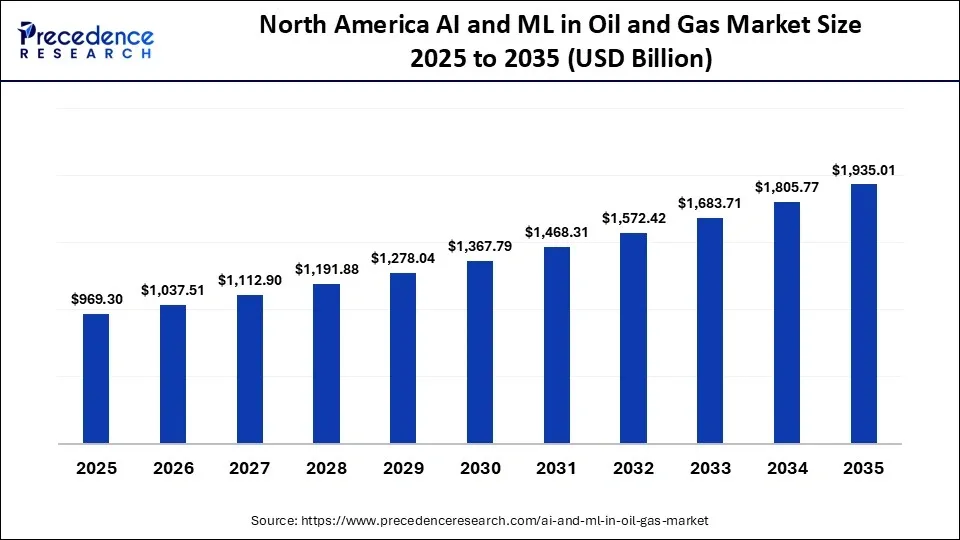
North American AI/ML in Oil & Gas Market Set for Near-Doubling by 2035
The North America AI and ML in Oil and Gas market is projected to nearly double, from $969.30 billion in 2025 to $1,935.01 billion by 2035. This represents a substantial and consistent growth trajectory for AI adoption within the energy sector.
(Source: Precedence Research — via Valero AI 2025, $315 M Darling Sustainable Aviation Fuel)
Partnership Analysis, Equinor AI Initiatives for 2025
Equinor‘s 2025 partnerships reveal a deliberate, two-tiered approach: alliances with technology providers like HCLTech and Databricks to build its digital foundation, and collaborations with operational specialists like SLB and Greenpower Monitor to execute projects and enhance asset performance. This network is critical for both optimizing current operations and developing future energy systems.
Equinor Digital Infrastructure Partnerships
To power its AI ambitions, Equinor deepened its relationships with core technology providers. An expanded collaboration with HCLTech focuses on cloud migration, automation, and cyber resilience, forming the IT backbone for its digital tools. The company also adopted Microsoft Azure Data Manager for Energy to unify datasets and break down silos, a prerequisite for advanced AI modeling. A partnership with Databricks was instrumental in optimizing seismic data pipelines, directly enabling the tenfold increase in interpretation speed.
Equinor Operational and Energy Transition Alliances
On the operational front, Equinor awarded a significant EPC contract to SLB One Subsea for the Eirin and Gina Krog field development, the result of a year-long collaborative digital design phase. For its renewables portfolio, a contract with Greenpower Monitor (DNV) to implement the GPM Horizon platform is set to drive operational excellence in its onshore assets. These partnerships show a clear strategy of embedding digital collaboration directly into project execution and asset management.
Table: Equinor Strategic Partnerships (2025)
| Partner / Project | Time Frame | Details and Strategic Purpose | Source |
|---|---|---|---|
| Greenpower Monitor (DNV) | Dec 2025 | Contracted to implement the GPM Horizon software to optimize operational performance across Equinor‘s onshore renewable energy portfolio. | DNV |
| POSCO INTERNATIONAL | Nov 2025 | Expanded cooperation focused on key energy sectors including offshore wind and steel to accelerate the transition to a new energy mix. | POSCO Newsroom |
| SLB One Subsea | Aug 2025 | Awarded an EPC contract for a subsea project following a year-long collaborative and digitally integrated FEED phase, demonstrating a modern approach to project execution. | SLB |
| HCLTech | Jul 2025 | Expanded digital collaboration to accelerate cloud migration, enhance cyber resilience, and implement automation for improved operational efficiency. | HCLTech |
| Databricks | May 2025 | Collaborated to optimize seismic data pipelines, leveraging the Databricks platform for faster and more scalable processing of critical exploration data. | Databricks |
| Date⇅ | Partner⇅ | Market Segment⇅ | Partnership Type⇅ | Key Details / Value⇅ | Source⇅ |
|---|---|---|---|---|---|
| Nov 5, 2025 | POSCO INTERNATIONAL | Renewable Energy / Steel | Cooperation Expansion | Expanding cooperation in key energy sectors including offshore wind and steel. | POSCO INTERNATIONAL Strengthens Its Partnership for … ↗ |
| Aug 25, 2025 | SLB OneSubsea | Subsea / Field Development | EPC Contract | Awarded an Engineering, Procurement, and Construction (EPC) contract for the Eirin and Gina Krog fields following a year-long collaborative design phase. | SLB OneSubsea Awarded EPC Contract for Equinor’s … ↗ |
| Aug 7, 2025 | SLB | Upstream / Well Planning | Strategic Integration | Aimed to modernize and streamline the well planning process by enabling seamless digital collaboration. | Equinor’s strategic integration: Enhancing digital planning … ↗ |
| Jul 16, 2025 | NYU Tandon School of Engineering | Offshore Wind / Innovation | Accelerator Program | Announced a new cohort of six companies for the 2025 offshore wind innovation accelerator. | The Latest Tailwinds for Offshore Wind Innovation ↗ |
| Jul 10, 2025 | Microsoft | Cloud / Data Management | Technology Implementation | Equinor implemented Microsoft Azure Data Manager for Energy to enhance data efficiency and support its low-carbon objectives. | Equinor targets data efficiency and a low-carbon future with … ↗ |
| Jul 2, 2025 | HCLTech | IT Services / Digital Transformation | Collaboration Expansion | Expanded their existing digital collaboration to leverage HCLTech's capabilities in digital, engineering, cloud, and AI. | HCLTech and Equinor expand digital collaboration ↗ |
| Jun 3, 2025 | bp | Offshore Wind | Joint Venture | Involved in a US$1.1 billion US offshore wind joint venture. | Laura Hulett | Herbert Smith Freehills Kramer | Global law … ↗ |
US vs Europe, Equinor Geographic Focus for AI Deployment
Equinor‘s AI initiatives in 2025 were geographically concentrated in its core operational areas of the North Sea and the United States, reflecting a strategy of deploying advanced digital tools where they can have the largest financial and operational impact. This represents a sharpening of focus compared to the broader, more exploratory phase of digitalization in previous years.
Equinor North Sea Digital Operations Hub
The North Sea remains the central hub for Equinor‘s digital innovation. Projects like Johan Sverdrup, Eirin, and Gina Krog serve as the proving grounds for AI-driven well planning, predictive maintenance, and integrated operations. The $12 million in savings from the AIM project on Johan Sverdrup Phase 3 is a direct result of applying these advanced technologies in a mature, high-value basin where even marginal efficiency gains translate into significant financial returns.
Equinor’s Strategic US Energy Plays
In the United States, Equinor’s strategy is twofold. The company is advancing major renewable projects like the 810 MW Empire Wind 1 project in New York, which will rely on AI and digital twins for optimization once operational. Concurrently, its $1.6 billion investment in natural gas production, centered in Pennsylvania, directly links its fossil fuel business to the growing energy needs of the US domestic market, including the country’s expanding data center infrastructure.
| Date⇅ | Company⇅ | Market Segment⇅ | Partner⇅ | Partnership Type⇅ | Key Details⇅ | Source⇅ |
|---|---|---|---|---|---|---|
| Nov 5, 2025 | Equinor | Energy Transition | POSCO INTERNATIONAL | Strategic Cooperation | Expanding cooperation in key energy sectors including offshore wind and steel to advance energy mix transition. | POSCO INTERNATIONAL Strengthens Its Partnership for … ↗ |
| Sep 17, 2025 | ORLEN (Competitor) | Digital Transformation | Google Cloud | Technology Collaboration | Partnering to accelerate AI adoption and drive digital transformation and business growth initiatives. | ORLEN partners with Google Cloud to step up AI adoption ↗ |
| Jul 16, 2025 | Equinor | Innovation Ecosystem | NYU Tandon School of Engineering | Accelerator Program | Partnership for an accelerator program to support six companies in the 2025 cohort for offshore wind innovation. | The Latest Tailwinds for Offshore Wind Innovation ↗ |
| Jul 2, 2025 | Equinor | Digital Transformation | HCLTech | Expanded Collaboration | Expanded digital collaboration to support transformation via cloud migration, cyber resilience, automation, and AR-powered user experiences. | HCLTech and Equinor expand digital collaboration ↗ |
| May 12, 2025 | Equinor | Data Analytics | Databricks | Technology Implementation | Collaboration to optimize seismic data pipelines, enabling faster, more scalable, and efficient data processing. | How Equinor Optimized Seismic Data Pipeline with Databricks ↗ |
Technology Maturity of Equinor AI Initiatives for 2025
By 2025, Equinor successfully advanced several key AI applications from the pilot stage to commercially scaled technologies that are integral to its operations. This maturity is demonstrated not by experimentation, but by widespread deployment, quantifiable financial returns, and the adoption of enterprise-level data platforms designed for industrial scale. This progress sets a benchmark for digitalization in the energy sector, moving beyond isolated use cases to a systemic integration of AI.
From Pilot to Profit: Equinor’s AI at Scale
The progression of Equinor‘s AI programs is most evident in their scale and financial impact. The predictive maintenance system, now monitoring over 700 machines with 24, 000 sensors, has moved far beyond a pilot project. Similarly, the use of AI in seismic interpretation is now a standard workflow that has increased capacity tenfold. These are no longer just technology projects; they are core business processes that contributed to the $130 million in value generated in 2025.
Foundational Data Platforms as Enablers
A key indicator of technological maturity is the adoption of robust, scalable data infrastructure. In 2025, Equinor‘s strategy relied on its central Omnia data platform, enhanced by the implementation of specialized solutions like Microsoft Azure Data Manager for Energy. This focus on building a clean, accessible data foundation across the entire value chain is a crucial, non-trivial step that enables the development and deployment of sophisticated AI and machine learning models for both hydrocarbon and renewable energy assets.
| Application Area⇅ | Technology / Project Name⇅ | Year of Impact⇅ | Quantifiable Outcome⇅ | Key Details⇅ | Source⇅ |
|---|---|---|---|---|---|
| Renewable Energy Operations | GPM Horizon Platform | 2025 | Drive operational excellence | Contract awarded to GreenpowerMonitor (DNV) to use its GPM Horizon software for Equinor's onshore renewable energy portfolio. | GreenpowerMonitor, a DNV company awarded contract … ↗ |
| Subsurface Analysis | AI-Powered Seismic Interpretation | 2025 | 10x increase in interpretation capacity | AI tools enable geologists to analyze seismic data ten times faster, leading to more comprehensive insights. | Equinor Says AI Saved It $130M in 2025 – JPT/SPE ↗ |
| Well Planning & Field Development | Artificial Intelligence Maturation (AIM) | 2025 | $12 million in savings | AI-generated well and field plans for Phase 3 of the Johan Sverdrup field trimmed costs for the partnership. | Industrial optimization intelligence propels Equinor savings ↗ |
| Asset Management | Predictive Maintenance Program | 2025 | Monitored 700+ machines | The system utilizes roughly 24,000 sensors to monitor rotating equipment, predict failures, and optimize maintenance needs. | Industrial optimization intelligence propels Equinor savings ↗ |
| Overall Operations | Broad AI Implementation | 2025 | $130 million in savings | Total value creation and savings for Equinor and its partners from the application of AI across offshore and onshore operations. | Use of artificial intelligence saved Equinor USD 130 million … ↗ |
SWOT Analysis, Equinor Strengths and Execution Risks
Equinor‘s 2025 performance highlights the strengths of a mature, scaled AI strategy but also exposes the risks inherent in its dual-transformation approach. The company successfully translated digital investment into financial returns while navigating a complex strategic pivot between fossil fuels and renewables. This analysis reveals a company with strong operational capabilities but one that must balance market demands with its long-term transition objectives.
Table: SWOT Analysis for Equinor AI Initiatives for 2025: Key Projects, Strategies and Partnerships
| SWOT Category | 2021 – 2023 | 2024 – 2025 | What Changed / Resolved / Validated |
|---|---|---|---|
| Strengths | Early investment in digital infrastructure (Omnia platform) and AI pilots. Strong position in the North Sea. | Demonstrated $130 M in savings from scaled AI. Established partnerships with tech leaders like Microsoft and HCLTech. Proven AI-driven well planning (AIM). | The financial value of a scaled AI strategy was validated. The ability to execute a dual transformation (optimizing oil and gas while building renewables) was demonstrated. |
| Weaknesses | High capital expenditure on unproven large-scale renewable projects. Perceived lag in monetizing digital investments compared to tech-first companies. | Public announcement of halving green investment growth created perception challenges. Continued high reliance on hydrocarbon revenue to fund the transition. | The company became more pragmatic and vocal about capital allocation, prioritizing returns, which could be perceived as a weakness by some investors but a strength by others. |
| Opportunities | Leverage digitalization to reduce emissions and operating costs in core business. Grow offshore wind portfolio. | Created a new power unit to directly monetize the energy demand from AI and data centers. Positioned as a key energy supplier for the digital economy. | The strategy shifted from just using AI for internal efficiency to creating a new business line that sells energy to the AI industry, a significant new market opportunity. |
| Threats | Volatility in oil and gas prices. Policy uncertainty around the energy transition. Competition from other energy majors. | Increased competition from peers like Shell and BP in both digital and renewable arenas. Potential for shareholder dissent over strategic pivot on green investments. | The threat of the energy transition became an opportunity; Equinor is now supplying the massive energy needs of that transition’s key technology (AI). |
Scenario: Equinor AI Strategy and the New Power Unit
The most critical action to watch for Equinor is the operational and financial performance of its new power business unit, formed in April 2025. This unit’s success will validate the company’s forward-looking strategy to pivot from being solely a consumer of AI for its own operations into a critical energy provider for the broader AI ecosystem. If this unit can secure long-term power purchase agreements with data center operators, it will create a significant, stable new revenue stream aligned with the growth of the digital economy.
Scenario: Scaling AI Across the Global Portfolio
Following the reported $130 million in savings, a key indicator of future success will be how quickly and effectively Equinor can scale its proven AI solutions across its entire global portfolio. Watch for announcements of the AIM project being used in other basins or the predictive maintenance program expanding to its international and renewable assets. If this scaling happens successfully, the annual savings could grow substantially, further solidifying Equinor‘s efficiency lead.
Scenario: The AI Power Generation Business Unit
The market is closely watching the new power business unit. This entity combines renewables, gas power, and storage with the explicit goal of serving the high-demand, high-reliability needs of data centers. A key signal will be the announcement of direct supply agreements with technology companies or data center operators. If these materialize, it confirms that Equinor’s strategic maneuver to monetize the AI boom is working, creating a blueprint for other energy companies to follow.
| Forecast Provider⇅ | Market Segment⇅ | 2025 Market Size ($B)⇅ | 2026 Market Size ($B)⇅ | 2031 Market Size ($B)⇅ | 2033 Market Size ($B)⇅ | 2035 Market Size ($B)⇅ | CAGR (%)⇅ | Source⇅ |
|---|---|---|---|---|---|---|---|---|
| SNS Insider | AI in Energy | 15.99 | 30.01 * | 153.30 * | 213.90 * | 297.36 | 36.90 * | AI in Energy Market Size, Share & Growth | Industry Report ↗ |
| Grand View Research | AI in Energy | 5.10 | 6 | 16.59 * | 22.20 | 32.12 * | 20.40 | AI In Energy Market Size, Share & Growth Report, 2026-2033 ↗ |
| Precedence Research | Overall AI Market | 757.58 | 900 | 2129.67 * | 3005.66 * | 4241.98 * | 18.80%* | Artificial Intelligence (AI) Market Size and Forecast 2026 to 2035 ↗ |
The questions your competitors are already asking
This report covers one angle of Equinor’s digital transformation strategy. The questions that matter most depend on your work.
- Energy company strategies for data center power
- Equinor power purchase agreements with data centers
- AI applications in North Sea oil and gas operations
- European energy companies renewable investment strategy
This report does not answer these. Enki Brief Pro does.
Your question, your angle, your framework. SWOT, PESTL, scenario modelling. The same niche depth, built around the decision your work actually depends on.
