

Automaker Hybrid Strategy 2026: The Financial Fallout of a Failed EV Push
EV Production Backlash 2026: Why Automakers Are Reversing Course
The global automotive industry is executing a strategic retreat from the aggressive, all-electric production targets that defined the 2021-2024 period. Confronted with slowing demand, mounting financial losses, and a looming inventory crisis, major automakers are now slashing pure Battery Electric Vehicle (BEV) production plans for 2026 and pivoting investments back toward profitable Hybrid Electric Vehicles (HEVs). This course correction is not an abandonment of electrification but a pragmatic response to a severe market misalignment.
- Between 2021 and 2024, automakers like General Motors (GM) championed an “all-in” EV strategy, planning to phase out gasoline engines. By 2025, the reality of the market forced a reversal, with GM delaying its electric truck production expansion to at least mid-2026 and reintroducing plug-in hybrids it had previously discontinued in North America.
- Ford is undergoing a similar pivot. The company is delaying several planned BEV models and scrapping its all-electric F-150 project, redirecting capital toward expanding its highly popular hybrid lineup. This shift acknowledges that its EV division is projected to lose up to $5.5 billion in a single year.
- Toyota, long a proponent of a multi-powertrain approach, has been vindicated by the market shift. The company slashed its 2026 global BEV production target by approximately one-third to 1 million units and delayed the start of its U.S. EV production into 2026, aligning its output with more realistic demand forecasts.
- The industry-wide recalibration is a direct response to consumer behavior. After years of rapid growth, U.S. BEV sales growth is forecast by Edmunds to fall to just 6% market share in 2026, down from 7.4% in 2025, while hybrid sales are surging.
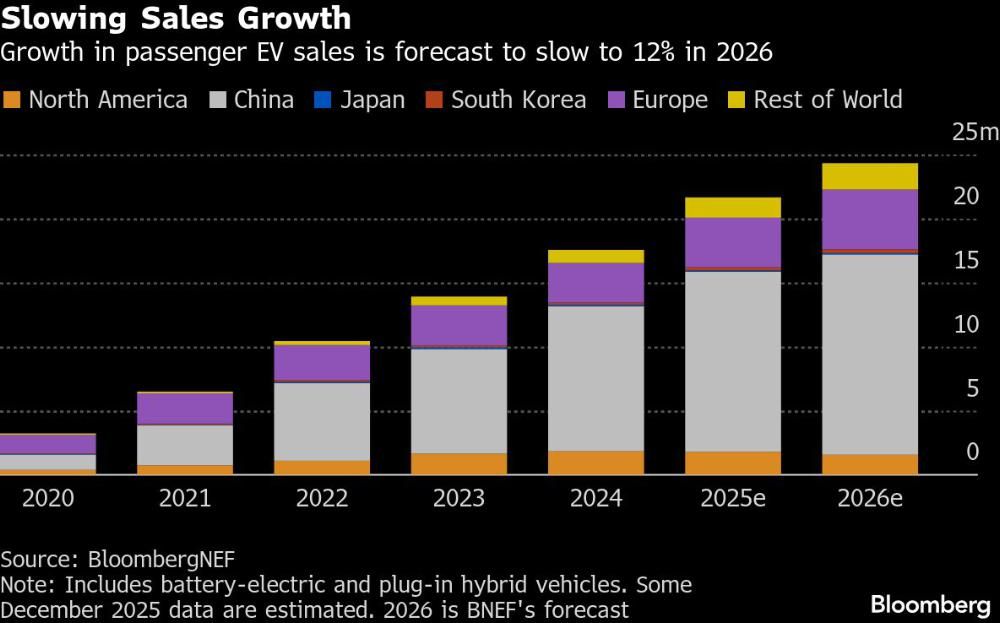
Global EV Sales Growth Forecast to Slow by 2026
This chart shows that while total EV sales continue to rise, the year-over-year growth rate is forecast to slow significantly, directly supporting the section’s theme of a 2026 production backlash.
(Source: EnkiAI)
The $60 Billion Correction: EV Investment Writedowns Signal Market Shift
The clearest quantitative signal of the failed “EV-only” strategy is the colossal financial writedowns and investment cuts automakers have announced since 2025, collectively exceeding $60 billion. These are not minor adjustments but massive charges against earnings that reflect canceled projects, devalued assets, and the high cost of scaling back an overly ambitious transition. This financial reckoning directly contrasts with the multi-billion-dollar investment announcements that characterized the 2021-2024 period.
- Stellantis reported the largest financial hit, posting a staggering $26.3 billion net loss for 2025 (€22 B), which it explicitly blamed on its overly aggressive EV strategy. The company is now unwinding its BEV supply chain, including the sale of its Ontario battery plant, to match actual consumer demand.
- Honda is cutting its planned investments in electrification and software by 30% through 2030, a reduction equivalent to about $20.7 billion (3 trillion yen). The capital is being redirected to accelerate the launch of new, in-demand hybrid models.
- Ford announced it will take a $19.5 billion charge to write down BEV investments. This decisive move allows the company to pivot future vehicle development resources toward its profitable truck business and an expanded hybrid portfolio.
- General Motors (GM) confirmed it would take a $6 billion writedown to unwind certain EV investments, a direct consequence of its pullback from the market. This follows a previous $1.6 billion loss reported in October 2025 related to changes in its EV rollout schedule.
Table: Major Automaker EV-Related Financial Writedowns and Investment Cuts (2025-2026)
| Automaker | Time Frame | Details and Strategic Purpose | Source |
|---|---|---|---|
| Stellantis | Feb 2026 | Reported a $26.3 B net loss for fiscal year 2025, attributing the result to an overeager EV strategy and initiating a scale-back of production. | Detroit Free Press |
| Honda | May 2025 | Announced a $20.7 B (3 trillion yen) cut in electrification and software investments through 2030 to shift focus toward new hybrid models. | Wards Auto |
| Ford | Dec 2025 | Taking a $19.5 B charge to write down EV investments, enabling a strategic pivot of new vehicle development resources to hybrids and smaller EVs. | Fastmarkets |
| General Motors (GM) | Jan 2026 | Announced a $6 B charge to unwind certain EV investments, citing a necessary pullback from the market to align with slower-than-expected adoption. | Reuters |
Automaker Alliances for Hybrids: De-Risking the EV Transition in 2026
In response to the immense costs and market uncertainty, automakers are increasingly forming strategic alliances to de-risk investments and share development costs for a mixed-powertrain future. While earlier partnerships focused heavily on pure BEV platforms, the most recent collaborations announced in 2024 and 2025 show a pragmatic expansion to include hybrids, software, and critical supply chain components, reflecting the new Hybrid Strategy 2026.
- In a landmark move, rivals Honda and Nissan announced in March 2024 that they are exploring a strategic partnership for EVs, hybrids, and in-vehicle software. This collaboration, which Mitsubishi is also set to join, is aimed at improving cost-competitiveness against global rivals.
- Ford is reportedly in discussions with Chinese automaker BYD to source batteries for its hybrid models. Such an alliance would leverage BYD’s scale and cost efficiencies in battery manufacturing to accelerate Ford’s hybrid production.
- Stellantis is considering using technology from its Chinese partner, Leapmotor, to lower the cost of its mass-market vehicles, a move that could incorporate hybrid or other cost-effective electrified powertrains.
- The collaboration extends beyond vehicle production to the surrounding ecosystem. In September 2024, BMW, Ford, and Honda launched a joint venture named Charge Scape, which focuses on developing vehicle-grid integration services to create value for EV owners.
Table: Key Automotive Partnerships for a Multi-Powertrain Future
| Partners | Time Frame | Details and Strategic Purpose | Source |
|---|---|---|---|
| Honda & Nissan | Mar 2024 | Exploring a strategic partnership to co-develop EVs, hybrids, and software to reduce costs and enhance competitiveness. Mitsubishi is also expected to join. | Green Car Reports |
| Ford & BYD (Reported) | Jan 2026 | Ford is reportedly in talks with BYD to source batteries for its hybrid models, aiming to leverage BYD’s manufacturing scale to reduce costs. | NEWS.AZ |
| BMW, Ford, & Honda | Sep 2024 | Launched Charge Scape, a joint venture to connect electric utilities, automakers, and EV customers to manage energy usage and support grid stability. | Honda News Canada |
| Toyota & Subaru | May 2024 | Deepened their long-standing partnership to co-develop three new all-electric crossovers, set for release by 2026, to share development costs and platform risk. | CBT News |
North American EV Slowdown: How U.S. and Canada are Driving the Hybrid Pivot
The strategic pivot away from a BEV-only future is most acute in North America, where a combination of slowing consumer demand, inadequate charging infrastructure, and shifting government policy has created a fertile market for hybrids. While Europe and China also face moderating EV growth, the U.S. and Canadian markets provide the starkest evidence of the consumer-led push back to hybrids.

Hybrid Sales Overtake Battery Electric in the US
This chart directly visualizes the ‘hybrid pivot’ in the US market, showing hybrid sales accelerating past the flattening sales of battery electric vehicles in early 2025.
(Source: Torque News)
- In the U.S., hybrid sales grew a remarkable 76% in 2023, with over 1 million units sold. This far outpaced the growth of BEVs and confirmed a decisive shift in mainstream consumer preference toward a technology that offers fuel savings without the range anxiety or lifestyle changes required by pure EVs.
- A 2024 Mc Kinsey study revealed a critical weakness in the BEV value proposition: 46% of U.S. EV owners are likely to switch back to a gasoline-powered vehicle for their next purchase, citing poor public charging infrastructure as a primary reason.
- Canadian government policy has adapted to this new reality. After EVs became “twice as hard to sell” in 2024 compared to 2023, Prime Minister Mark Carney suspended the country’s ambitious 2026 EV sales mandate. The new strategy includes revised, declining incentives for BEVs, acknowledging a more gradual adoption curve.
- This market reality directly led to automakers delaying or canceling major North American EV investments, including Honda’s postponement of a planned $15 billion EV and battery facility in Ontario and Toyota’s delay of U.S.-based EV production.
Hybrids Emerge as Mature Bridge Technology Amidst BEV Headwinds
The market correction of 2025-2026 validates HEVs as a mature, profitable, and immediately scalable technology, while exposing the persistent commercial and infrastructural immaturity of the pure BEV ecosystem. The narrative of 2021-2024, which positioned BEVs as the imminent and singular future, has been replaced by a pragmatic acceptance of hybrids as a critical bridge technology for the remainder of the decade.

US EV Market Hits the Brakes in 2025
Illustrating the ‘BEV headwinds’ described in the section, this chart quantifies the US market slowdown with a downwardly revised sales outlook and declining demand for key battery metals.
(Source: EnkiAI)
- The primary technological hurdle for BEVs remains the battery, which accounts for 40% to 50% of a vehicle’s manufacturing cost. This high cost, combined with the unprofitability of most EV programs outside of Tesla, creates immense financial strain on legacy automakers.
- In contrast, hybrids utilize smaller batteries and leverage decades of optimized ICE manufacturing, making them highly profitable. Toyota’s long-standing hybrid strategy is now expected to help it “outshine rivals” as the market pivots.
- The operational maturity of hybrids is a key advantage. They require no new charging infrastructure and impose no change in behavior for consumers, directly addressing the primary pain points of range anxiety and charging inconvenience that are hampering BEV adoption.
- While BEV technology continues to advance, the current market dynamics prove it is not yet ready for mass adoption beyond early adopters. Hybrids fill this gap, offering an immediate reduction in emissions while generating the profits needed to fund future BEV development.
2026 Outlook: Flexible Powertrains Will Define Automotive Winners
The most resilient automakers through 2026 and beyond will be those that master a flexible, multi-powertrain strategy, using profitable hybrid and ICE sales to fund a more patient and disciplined development of next-generation BEVs. The era of betting the entire company on a single technology pathway is over; the focus has shifted to managing a complex portfolio that meets diverse consumer needs.

EV Adoption Forecasts Cut For US & Global Markets
Aligning with the ‘2026 Outlook’ theme, this chart’s downwardly revised trend lines for EV adoption reflect the more patient and disciplined development strategy automakers are now pursuing.
(Source: The Information)
- If the current U.S. market trend continues, where HEV sales are projected to reach 17% market share in 2026 while BEVs fall to 6%, watch for more automakers to actively re-tool factories originally designated for BEVs to produce hybrids instead.
- If BEV inventory, which surged in 2024, continues to swell on dealer lots through 2025, expect further BEV price cuts, which will exacerbate financial losses and increase pressure on companies that lack a strong, profitable hybrid lineup to offset the decline.
- A critical signal to monitor will be the acceleration of partnerships between Western automakers and Chinese firms for low-cost batteries and hybrid systems. These collaborations could become essential for legacy OEMs to compete on cost in the mass-market electrified vehicle segment.
Frequently Asked Questions
Why are automakers suddenly pivoting away from their aggressive all-electric vehicle (EV) plans?
Automakers are reversing course due to a combination of slowing consumer demand for pure Battery Electric Vehicles (BEVs), significant financial losses on their EV programs, and a growing inventory crisis of unsold electric cars. The article notes this is a pragmatic response to a ‘severe market misalignment,’ leading them to reinvest in profitable and popular Hybrid Electric Vehicles (HEVs).
What is the total financial cost of this failed ‘EV-only’ strategy?
The article states that since 2025, major automakers have announced collective financial writedowns and investment cuts exceeding $60 billion. This includes a $26.3 billion net loss reported by Stellantis, a $19.5 billion charge by Ford, a $20.7 billion investment cut by Honda, and a $6 billion writedown by General Motors.
Does this mean automakers are giving up on electric vehicles entirely?
No, the shift is described as a ‘course correction,’ not a complete abandonment of electrification. The strategy is to move toward a more flexible, multi-powertrain approach. Companies plan to use the profits generated from selling popular hybrids and traditional cars to fund a more patient and disciplined long-term development of next-generation BEVs that better align with market readiness and infrastructure.
How is consumer demand different for hybrids versus pure EVs?
Consumer demand is a key factor driving the pivot. According to the article, U.S. hybrid sales grew by 76% in 2023. In contrast, BEV sales growth is slowing, with market share projected to fall to 6% in 2026. Many consumers are choosing hybrids because they offer immediate fuel savings without the range anxiety, charging infrastructure challenges, and lifestyle changes required by pure EVs.
What are automakers doing besides just building more hybrids?
In addition to shifting production focus, automakers are forming strategic alliances to share costs and de-risk the transition. The article cites several examples, such as Honda and Nissan exploring a partnership to co-develop EVs, hybrids, and software; Ford reportedly discussing sourcing hybrid batteries from BYD; and BMW, Ford, and Honda launching a joint venture called Charge Scape to improve vehicle-grid integration.
Experience In-Depth, Real-Time Analysis
For just $200/year (not $200/hour). Stop wasting time with alternatives:
- Consultancies take weeks and cost thousands.
- ChatGPT and Perplexity lack depth.
- Googling wastes hours with scattered results.
Enki delivers fresh, evidence-based insights covering your market, your customers, and your competitors.
Trusted by Fortune 500 teams. Market-specific intelligence.
Explore Your Market →One-week free trial. Cancel anytime.
