

Automotive Market Recalibration 2026: Why Hybrid Strategy Is Displacing EV Production
Industry Adoption Risks: How EV Subsidy Volatility Forces the 2026 Hybrid Pivot
Automakers are executing a decisive strategic pivot from pure electric vehicles to hybrids as a direct response to unreliable government subsidies and a demonstrated slowdown in mainstream EV adoption. The aggressive “EVs-at-all-costs” approach of the early 2020 s has given way to a more pragmatic, profit-driven focus on hybrids as a bridge technology for 2026 and beyond, designed to de-risk the long-term electrification transition.
- Between 2021 and 2024, the industry strategy was defined by an aggressive push into EVs, fueled by robust government incentives. The US Inflation Reduction Act (IRA) and Canada’s i ZEV program encouraged automakers like Ford to make significant capital commitments, such as its $3.5 billion investment in the Blue Oval Battery Park Michigan in 2023, and drove a period of rapid EV sales growth.
- Starting in 2025, this momentum reversed as the subsidy framework proved unreliable. The pivotal event was the expiration of the $7, 500 US federal tax credit for new EVs on September 30, 2025. This policy shock, combined with Canadian incentives like Quebec’s rebate being phased out by 2027, removed the primary market accelerator for high-cost EVs.
- The market reaction was immediate, with analysts forecasting a potential 43% drop in EV deliveries in the month following the credit’s expiration. In response, automakers recalibrated. Ford announced a massive $19.5 billion charge related to pulling back its EV plans, and Honda reduced its planned EV and software spending by 30%, with both companies shifting focus to a hybrid-heavy 2026 model lineup.

EV Sales Plummet After Tax Credit Ends
This chart directly visualizes the risk of subsidy volatility, showing a 74% sales drop after a tax credit ended, which is the core argument of this section.
(Source: The Buzz EV News)
Investment Analysis 2026: Capital Reallocation from EV Ventures to Hybrid Production
Major automakers are reallocating billions in capital, delaying or canceling long-term EV projects to fund a rapid expansion of profitable hybrid vehicle production. This financial restructuring is a direct consequence of unsustainable losses from early EV programs and a strategic decision to align investment with immediate, subsidy-free consumer demand.
- Ford’s financial pivot is the most pronounced, with the company recording approximately $19.5 billion in special charges to unwind its previous EV strategy. This follows an $8 billion net loss in 2025, primarily attributed to its EV division, forcing a delay of its EV profitability target to 2029.
- Honda is executing a more calculated shift, using profits from its legacy and hybrid vehicles to fund a ¥10 trillion (approximately $64 billion) global electrification plan. The strategy involves building out a complete Canadian EV supply chain with a CAD $15 billion investment, but with full EV production not starting until 2028, making near-term hybrid sales essential to fund the transition.
- The industry-wide nature of this trend is confirmed by hybrid leader Toyota, which is investing an additional $912 million across five U.S. plants. This investment is specifically targeted at increasing the production of engines and transaxles for its hybrid vehicles, signaling confidence in the segment’s sustained growth. The push to build out domestic manufacturing is a key theme, with many new facilities joining the list of the Top 10 US Mega Battery Projects of 2025 Revealed.
Table: Automaker Capital Shifts from EV to Hybrid Focus (2025-2027)
| Company / Project | Time Frame | Details and Strategic Purpose | Source |
|---|---|---|---|
| Ford / EV Restructuring | 2025-2027 | Announced ~$19.5 billion in special items charges to scale back EV plans after its EV division drove an $8 billion company net loss in 2025. | CNBC |
| Honda / EV & Software Investment | 2025 onwards | Reducing planned spending on future EV and software development by 30% to reallocate capital toward accelerating its hybrid vehicle roadmap. | Autoguide |
| Toyota / U.S. Hybrid Production | November 2025 | Investing an additional $912 million across five U.S. plants to increase manufacturing capacity for hybrid vehicle engines and transaxles. | Automotive News |
| Honda / Ontario EV Supply Chain | April 2024 | Announced a CAD $15 billion investment to build four new plants in Ontario for a full EV supply chain, with full production starting in 2028, funded by current hybrid sales. | The New York Times |
Geographic Focus: North America as the Center of the 2026 Hybrid Strategy
North America is the epicenter of the automotive industry’s hybrid pivot, with policy shifts and distinct consumer preferences in the United States and Canada driving massive investments in regional hybrid manufacturing. Automakers are localizing production to serve a market that is clearly signaling its demand for an affordable, transitional step toward electrification.

US Tax Credit Drives All EV Sales Growth
This chart reinforces the section’s focus on North America by showing that US EV sales growth is almost entirely dependent on models qualifying for tax credits.
(Source: Carscoops)
- The United States serves as the primary catalyst for the shift. The hard expiration of the $7, 500 federal EV tax credit in September 2025 fundamentally altered the competitive landscape, making the price-performance of hybrids more attractive than unsubsidized EVs for mainstream consumers.
- Canada has solidified its role as a key manufacturing hub for this transition. Honda’s CAD $1.38 billion retooling of its Alliston, Ontario plant in 2022 to lead CR-V Hybrid production was a precursor. Now, Ford’s decision to delay its Oakville, Ontario EV plant from 2025 to 2027 in favor of focusing on hybrids further cements the region’s role in the pivot.
- The strategy is a direct response to regional market data. In 2023, U.S. hybrid sales surged 65% to capture 8% of the market, while the rate of EV sales growth decelerated. Automakers are investing in North American plants to directly meet this demonstrated, profitable demand.
Technology Maturity: Commercial-Ready Hybrids Fund Next-Generation EV Development
Automakers are strategically deploying mature, profitable hybrid technology as a low-risk commercial solution to bridge the financial gap to the next generation of affordable, mass-market electric vehicles. This approach acknowledges that current EV platforms are not yet economically sustainable without subsidies, requiring an interim technology to generate profits and fund future R&D.

EVs Carry Significant Price Premium Over Hybrids
The chart quantifies the price gap between EVs and hybrids, illustrating why automakers are using mature, affordable hybrid technology as a commercial bridge.
(Source: Auto Innovators)
- Between 2021 and 2024, the technological focus was on scaling first-generation EV platforms. While commercially available, these platforms proved unprofitable for legacy automakers like Ford due to high battery costs, complex supply chains, and a reliance on government incentives for price competitiveness.
- The 2025-2026 period marks a shift to leveraging optimized hybrid systems. Honda is developing a new, dedicated platform for its next-generation hybrids, while Ford is expanding its Power Boost hybrid technology across its entire vehicle lineup. This is not R&D, but the mass deployment of a proven, profitable technology.
- This “bridge” strategy validates that current EV technology is not yet mature enough for unsubsidized mass adoption. The profits generated from hybrids are essential for funding the development of more cost-effective EV architectures and next-generation batteries, enabling a future where EVs can compete on their own economic merit.
SWOT Analysis: The Automotive Hybrid Pivot for 2026
The strategic shift toward hybrids allows automakers to capitalize on immediate market demand and profitability, leveraging their existing manufacturing strengths. However, it also exposes them to risks from unpredictable future regulations and intense competition from manufacturers who have long dominated the hybrid space.
Table: SWOT Analysis of the Automotive Industry’s Hybrid Pivot
| SWOT Category | 2021 – 2023 | 2024 – 2026 | What Changed / Resolved / Validated |
|---|---|---|---|
| Strengths | Existing manufacturing scale and strong brand loyalty were deployed to enter the EV market. | Leveraging decades of profitable and mature ICE/hybrid powertrain expertise to meet immediate consumer demand for affordability. | The strategy shifted from chasing a subsidized, high-cost EV market to leveraging core manufacturing strengths for immediate, unsubsidized profitability. |
| Weaknesses | High cost structure for first-generation EVs and lagging BEV-native competitors in software and efficiency. | Sustaining massive financial losses from dedicated EV divisions (e.g., Ford’s Model e), creating the perception of a failed EV-first strategy. | Mounting EV-related losses (Ford’s $8 B loss in 2025) became financially unsustainable, validating the need for a strategic retreat to profitable segments. |
| Opportunities | Capture nascent EV market share, benefiting from strong government purchase incentives and a positive ESG narrative. | Dominate the rapidly expanding hybrid segment, capture mainstream buyers not ready for full EVs, and use hybrid profits to fund next-gen EV R&D. | The slowing of EV adoption and the expiration of subsidies created a significant market opening for a “bridge” technology that did not exist at the same scale previously. |
| Threats | Competition from agile EV-native startups and significant supply chain disruptions for critical battery materials. | Unpredictable government policy (subsidy expiration or sudden reinstatement), intense competition from established hybrid leaders like Toyota. | The primary threat shifted from EV competitors to the volatility of government policy and the risk of being caught flat-footed if EV costs decline faster than expected. |
2026 Automotive Outlook: Tracking Hybrid Profitability as a Key Transition Signal
For the year ahead, the primary indicator of the automotive industry’s long-term health will not be EV sales figures but the financial performance of new hybrid programs. The ability of these programs to generate substantial profits is the critical factor that will determine the pace and success of the eventual transition to a fully electric future.
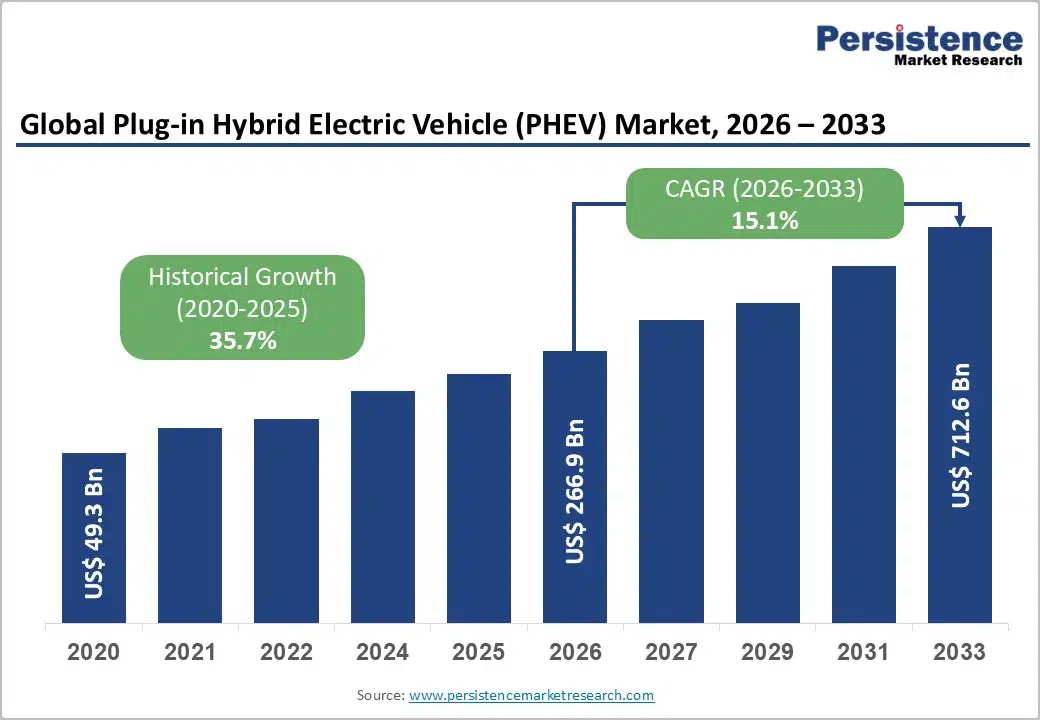
Hybrid Market Forecast to Exceed $700B
This chart’s long-term growth forecast for the hybrid market directly supports the section’s focus on the 2026 outlook and tracking hybrid sales as a key signal.
(Source: Persistence Market Research)
- If this happens: If the strong hybrid sales growth seen in recent years continues through 2026, and automakers like Ford and Honda report high-profit margins on these vehicle lines.
- Watch this: Monitor the quarterly financial reports for legacy automakers. Specifically, track the profit margins of their ICE and hybrid divisions (such as Ford Blue) and look for a corresponding reduction in the reported losses from their EV divisions (such as Ford’s Model e).
- These could be happening: A positive outcome would validate the “hybrid bridge” strategy, signaling that automakers are successfully funding their own long-term EV development without relying on volatile subsidies or capital markets. Conversely, weak hybrid margins would indicate a deeper structural profitability challenge for the industry, placing their long-term EV roadmaps in jeopardy.
Frequently Asked Questions
Why are automakers shifting their focus from electric vehicles (EVs) to hybrids?
Automakers are pivoting to hybrids as a direct response to the volatility and expiration of government subsidies, such as the $7,500 U.S. federal tax credit ending in September 2025. This policy change, combined with a slowdown in mainstream EV adoption, has made the aggressive EV-first strategy financially risky. Hybrids offer a more pragmatic, profitable ‘bridge’ to full electrification.
What are the financial implications of this strategy shift for companies like Ford and Honda?
The financial impact is significant. Ford is taking approximately $19.5 billion in charges to scale back its EV plans after its EV division drove an $8 billion company net loss in 2025. Honda is reducing its planned EV and software spending by 30%. Both are reallocating capital from money-losing EV programs to expand the production of profitable hybrid vehicles.
Does this mean automakers are giving up on EVs completely?
No, this is a strategic recalibration, not an abandonment of EVs. The article describes the hybrid focus as a ‘bridge strategy.’ Automakers are using mature, profitable hybrid technology to fund the long-term research and development of more affordable, next-generation EVs that can compete without subsidies. For example, Honda’s hybrid sales are intended to fund its CAD $15 billion Canadian EV supply chain, set for full production in 2028.
Why is North America the center of this hybrid pivot?
North America is the epicenter because of specific policy and market factors. The expiration of the U.S. federal EV tax credit in 2025 is the primary catalyst, making hybrids more price-competitive. In response, automakers are localizing production, with Honda retooling its Ontario plant for hybrids and Ford delaying its Oakville, Ontario EV plant to focus on the immediate, demonstrated consumer demand for hybrids in the region.
What is the key indicator to watch to see if this ‘hybrid bridge’ strategy is successful?
The key indicator is not EV sales, but the financial performance of the automakers’ hybrid programs. You should watch the quarterly financial reports from companies like Ford and Honda. If they report high profit margins from their hybrid divisions (like Ford Blue), it will validate the strategy, signaling they are successfully funding their long-term EV roadmaps without relying on volatile subsidies.
