

DAC Private Demand, $31.6 M Hafslund Celsio Deal, and Frontier’s 80% Market Influence (2021-2025)
$1 B+ AMC, Frontier’s Offtake Strategy for DAC Bankability
In 2025, Frontier‘s advance market commitment (AMC) model, backed by over $1 billion, became the primary private-sector mechanism for de-risking capital-intensive carbon dioxide removal (CDR) projects by providing bankable, long-term offtake agreements. This strategy directly addresses the lack of revenue certainty that has historically stalled project financing for first-of-a-kind facilities.
- Prior to 2025, the CDR market was characterized by small, exploratory purchases intended to seed a wide portfolio of technologies at the pilot stage. The period from 2021 to 2024 focused on learning and building the market infrastructure.
- The strategic focus shifted in 2025 toward enabling commercial-scale deployment. Instead of spreading capital across dozens of small pilots, Frontier began executing large, catalytic agreements designed to finance the construction of major facilities, moving the industry from R&D to infrastructure development.
- This demand-led strategy has created significant market concentration. In 2025, offtake agreements from Frontier and Microsoft accounted for over 80% of all purchased Direct Air Capture (DAC) and other permanent CDR volumes, creating a systemic dependency on a few large corporate buyers.
- The model’s application proved to be technology-inclusive. The year’s largest deal supported a Bioenergy with Carbon Capture and Storage (BECCS) project, indicating that Frontier‘s criteria prioritize permanence and verifiability over any single technological pathway.
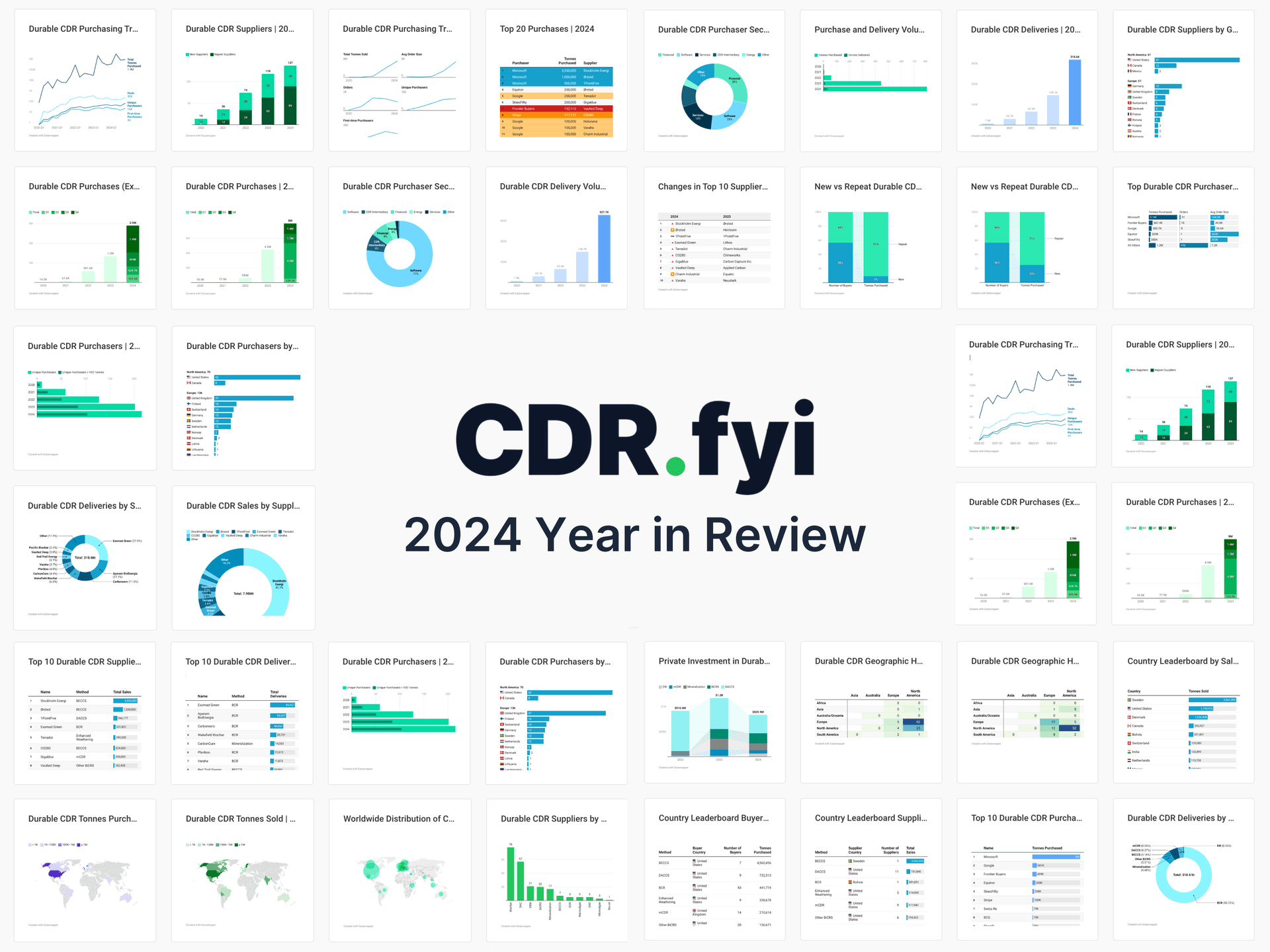
Explosive CDR Market Growth Sets Stage for Frontier’s $1B+ Bankability Strategy
This chart, showing explosive growth in the durable Carbon Dioxide Removal (CDR) market, provides the essential context for Frontier’s ambitious $1 billion+ Advance Market Commitment. The rapid market expansion underscores the urgency and opportunity for establishing bankable offtake strategies for technologies like Direct Air Capture (DAC).
(Source: CDR.fyi)
Investment via Offtake, Frontier’s $31.6 M Hafslund Celsio Deal
Frontier‘s financial strategy is not direct equity investment but the deployment of catalytic capital through purchase guarantees, with the $31.6 million offtake agreement for Hafslund Celsio in April 2025 serving as the year’s primary example of this model in action.
- The organization’s founding members, including Stripe, Alphabet, Shopify, Meta, and Mc Kinsey, committed over $1 billion to function as a dedicated purchasing fund, stimulating the supply side of the CDR market.
- The $31.6 million commitment to Hafslund Celsio is a direct application of this investment pool. By guaranteeing future revenue for 100, 000 tonnes of removal, the agreement provides the project developer with the collateral needed to secure traditional debt and equity financing for its capital-intensive plant.
- This private, demand-driven funding mechanism became more critical in 2025 as public funding faced instability. While Frontier provided a firm, bankable contract, proposed changes to the U.S. 45 Q tax credit and the potential cancellation of DOE-funded DAC Hubs created significant uncertainty for projects reliant on government support.
Table: Frontier Alliance Catalytic Investments and Commitments
| Partner / Project | Time Frame | Details and Strategic Purpose | Source |
|---|---|---|---|
| Hafslund Celsio | April 2025 | Frontier committed $31.6 million in an offtake agreement for 100, 000 tonnes of carbon removal. The deal provides a bankable revenue stream to finance a commercial-scale BECCS facility in Oslo, Norway. | CDR.fyi |
| Frontier Founding Members | 2022 – Ongoing | Stripe, Alphabet, Shopify, Meta, and Mc Kinsey collectively established the advance market commitment with over $1 billion to pre-purchase permanent carbon removal, aiming to accelerate technology and drive down costs. | Clean Air Task Force |
Frontier’s 1 Major 2025 Offtake, Hafslund Celsio and Founders
In 2025, Frontier‘s partnership activity was defined by the combined demand of its founding coalition and its focused execution of singular, high-impact offtake agreements, exemplified by the landmark deal with Norwegian supplier Hafslund Celsio.
- The demand side of the partnership model consists of the founding members, who pool their purchasing power to create an aggregated demand signal strong enough to underwrite new projects.
- On the supply side, the April 2025 agreement with Hafslund Celsio established a key partnership for the delivery of 100, 000 tonnes of permanent removal from its waste-to-energy facility in Oslo.
- Frontier‘s activities are strategically aligned with broader industry-shaping initiatives. Its goal of creating forward contracts and patient capital for emerging technologies directly supports the objectives of groups like the World Economic Forum’s First Movers Coalition.
Table: Frontier Alliance Strategic Partnerships (2025)
| Partner / Project | Time Frame | Details and Strategic Purpose | Source |
|---|---|---|---|
| Hafslund Celsio | April 2025 | Supply-side partnership where Hafslund Celsio will deliver 100, 000 tonnes of BECCS-based carbon removal, enabled by Frontier‘s $31.6 million offtake commitment. | CDR.fyi |
| Founding Members (Stripe, Alphabet, etc.) | 2022 – Ongoing | Demand-side alliance to aggregate over $1 billion in purchasing commitments for permanent carbon removal, creating a powerful, consolidated market signal. | Clean Air Task Force |
Europe Focus, Frontier’s 2025 DAC Deal Shifts to Norway
While early carbon removal purchases made by Frontier‘s founding members prior to 2025 were distributed across North America and Europe, the first major, large-scale offtake of 2025 was strategically centered in Europe with the Norwegian Hafslund Celsio project.
- From 2021 to 2024, pre-Frontier and early Frontier purchases were smaller and more geographically diverse, often supporting a range of startups and pilot projects located in the United States.
- The 2025 deal with Hafslund Celsio in Oslo, Norway, signaled a strategic pivot toward projects possessing a clear and stable policy environment. The project benefits from strong support from the city of Oslo, reducing political risk.
- This move to Europe contrasted with growing policy uncertainty in the U.S. during 2025, where new legislation and potential cancellations of Department of Energy funding for DAC Hubs created headwinds for domestic projects.
- By selecting a major Norwegian project, Frontier demonstrated its focus on bankability and project execution certainty, prioritizing mature projects with government backing over geographic allegiance.
$316/Tonne Price Signal, Frontier’s BECCS Bet on Commercial Scale
Frontier‘s 2025 strategy marked a pivot from funding a broad portfolio of early-stage technologies to catalyzing commercial-scale deployment of proven CDR pathways, selecting BECCS as a mature method capable of delivering volume and establishing a key price signal.
- The period between 2021 and 2024 was characterized by activities aimed at validating a wide range of technologies at the pilot scale, helping to identify the most promising pathways for permanent removal.
- The selection of the Hafslund Celsio BECCS project in 2025 represents a strategic choice to back a more mature technology (waste-to-energy combined with carbon capture) that is ready to scale and deliver large volumes sooner than many pure-play DAC facilities.
- The agreement’s implied price of $316 per tonne is a critical market signal. This price is significantly below the current cost of many early-stage DAC projects, which can range from $600 to over $1, 000 per tonne, yet it remains well above the industry’s long-term target of $100 per tonne.
- This pragmatic, technology-inclusive approach validates that the corporate market for permanent removal prioritizes verifiable, high-quality tonnes over allegiance to a single technology, a key finding echoed in the broader Carbon Capture DAC Market Report 2026.

CDR Tech Breakdown Justifies Frontier’s Strategic BECCS Bet
This chart illustrates the 2025 landscape of Carbon Dioxide Removal (CDR) technologies. It is critical for contextualizing Frontier’s strategic investment in Bio-energy with Carbon Capture and Storage (BECCS). By showing BECCS’s position relative to other technologies, the chart helps explain the rationale behind Frontier’s bet on this pathway to achieve commercial scale and its significance in the broader market.
(Source: AlliedOffsets)
Frontier Alliance 2025 SWOT Analysis for DAC Initiatives
The strategic position of Frontier in 2025 reveals a core strength in aggregating demand to make projects bankable, validated by the Hafslund Celsio agreement. However, this is balanced by a significant weakness in market concentration and external threats from volatile public policy.
- Strength: The AMC model’s ability to provide long-term, legally binding offtake agreements was validated as a successful de-risking mechanism for capital-intensive CDR projects.
- Weakness: The heavy reliance on Frontier and Microsoft for over 80% of market demand creates concentration risk and makes the entire sector dependent on the strategies of a few tech companies.
- Opportunity: The $316/tonne price point establishes a crucial benchmark that can attract new corporate buyers, expanding the coalition and diversifying market demand.
- Threat: Policy instability, such as potential changes to the U.S. 45 Q tax credit or cancellation of public funds, could undermine project economics even for projects with private offtake, slowing overall industry growth.
Table: SWOT Analysis for Frontier Alliance DAC Initiatives
| SWOT Category | 2021 – 2023 | 2024 – 2025 | What Changed / Resolved / Validated |
|---|---|---|---|
| Strengths | Theoretical AMC model with $1 B+ in pledges from founders like Stripe and Alphabet. Focus on small, exploratory prepurchases. | AMC model proven with $31.6 M bankable offtake for Hafslund Celsio. Shifted focus from pilots to enabling commercial-scale facilities. | The core hypothesis that AMCs can unlock project finance for CDR was validated by a major commercial agreement. |
| Weaknesses | Market demand was fragmented and nascent, with no clear price signals. Unclear if the AMC model would attract large-scale suppliers. | Extreme market concentration, with Frontier and Microsoft accounting for over 80% of purchases. High dependency on a few buyers. | While demand was aggregated, it became highly concentrated, revealing a new structural weakness for the market. |
| Opportunities | Potential to drive down costs through portfolio of pilot projects. Opportunity to establish standards for monitoring, reporting, and verification (MRV). | The $316/tonne price from the Hafslund deal sets a public benchmark, potentially attracting new corporate buyers seeking price certainty. | The opportunity shifted from nurturing technology to shaping market pricing and attracting a broader coalition of buyers. |
| Threats | Technological scalability risk. High costs of early DAC projects ($600-$1000+/tonne) could deter future investment. | Public policy instability (e.g., U.S. 45 Q uncertainty, potential DAC Hub cancellations) creating a volatile environment for projects reliant on blended finance. | The primary threat evolved from technology risk to policy and political risk, highlighting the need for stable government support to complement private demand. |
Frontier’s Next Move: A Large-Scale Pure DAC Offtake in 2026?
Following the successful execution of a major BECCS deal in 2025, the most critical signal to monitor in 2026 is whether Frontier commits to a comparable large-scale offtake agreement with a pure-play Direct Air Capture (DAC) developer.
- If Frontier signs a multi-million dollar, multi-year DAC deal, watch the price point closely. A price significantly higher than the $316/tonne paid for BECCS would confirm DAC‘s higher cost basis, while a closer price would signal rapid cost reductions.
- The execution of such a deal would immediately validate the bankability of large-scale DAC and likely trigger a new wave of private investment into DAC-specific manufacturing and project deployment.
- Conversely, if Frontier‘s next major deals continue to favor lower-cost CDR methods like BECCS or enhanced weathering, it could signal that pure DAC is not yet considered commercially competitive for large-volume offtakes, potentially slowing the scale-up of leading DAC companies.
- A key indicator of the model’s success will be the expansion of the buyer coalition. If new corporate members join the Frontier AMC in 2026, it will confirm that the strategy is successfully transitioning from a niche effort into a broader, more resilient market standard.

Industry Shift to Scale Underpins Speculation on Frontier’s Next Large-Scale Move
This chart visualizes the strategic industry-wide shift towards scaling and collaboration. It serves as a perfect introduction to the forward-looking question of Frontier’s next move. The trend shown in the chart provides the strategic backdrop for why a large-scale pure DAC offtake in 2026 is a logical and anticipated step for the alliance.
(Source: Results for Development)
The questions your competitors are already asking
This report covers one angle of Frontier’s strategy for scaling the permanent carbon removal market. The questions that matter most depend on your work.
- Is Frontier’s offtake strategy providing enough revenue certainty to make large-scale DAC projects truly bankable?
- What are the opportunities for DAC developers to secure financing outside of the Frontier and Microsoft ecosystem?
- Which carbon removal companies are best positioned to benefit from Frontier’s shift to commercial-scale deployment, and what sets them apart?
This report does not answer these. Enki Brief Pro does.
Your question, your angle, your framework. SWOT, PESTL, scenario modelling. The same niche depth, built around the decision your work actually depends on.
