

PEM Electrolysis Durability, Plug Power 275 MW Project, $750 M DOE Fund, and 52 Commercial Agreements (2021 to 2026)
Electrolyzer Project Bankability, Durability Defines Commercial Scale-Up
Project bankability in the green hydrogen sector now hinges less on peak efficiency and more on proven operational durability, creating a clear divide between commercially deployed technologies and those still facing materials science hurdles. The 10, 000-hour operational milestone has become the minimum requirement for securing financing for large-scale projects, shifting the focus of developers and investors toward long-term asset performance and predictable operational expenditures.
- Between 2021 and 2024, industry focus was on pilot projects and achieving higher efficiency metrics. This has shifted in 2025-2026 toward large-scale deployments, such as Plug Power‘s role as the supplier for a 275 MW green ammonia project in Canada, where long-term reliability and low degradation are non-negotiable for securing offtake agreements.
- Advanced Alkaline Water Electrolysis (AWE) and Proton Exchange Membrane (PEM) electrolysis have matured significantly, with AWE systems demonstrating lifetimes exceeding 80, 000 hours and commercial PEM systems now consistently validated for over 10, 000 hours. This proven durability makes them the default technologies for industrial-scale projects.
- In contrast, Solid Oxide Electrolyzer Cells (SOEC) and Anion Exchange Membrane (AEM) electrolyzers are being adopted in niche pilots where specific advantages are prioritized. For example, Dynelectro’s SOEC technology was selected for a synthetic fuel facility, a specific application where its high efficiency is critical, but its high degradation rates of 0.5% to 2% per 1, 000 hours prevent its widespread use in baseload hydrogen production.
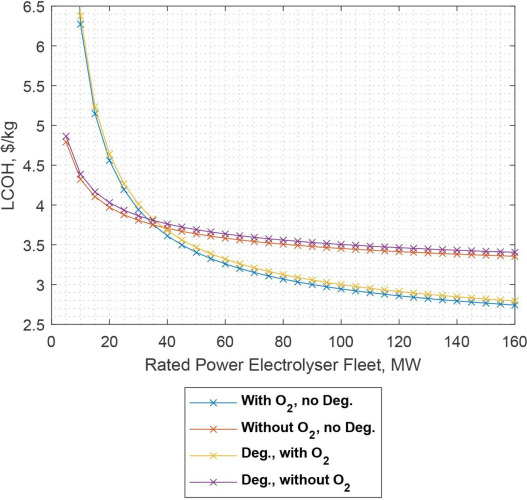
Durability Directly Impacts Hydrogen Production Cost
This chart directly illustrates the section’s core argument on bankability by showing how performance degradation increases the Levelized Cost of Hydrogen (LCOH), connecting operational durability to financial viability.
(Source: ScienceDirect.com)
$750 M in US Funding, DOE Backs Electrolyzer Manufacturing and Recycling
Public and private investment is increasingly targeted at solving the manufacturing and materials science challenges that limit electrolyzer lifetime, signaling a market-wide recognition of durability as a primary economic lever. Capital is flowing not just to novel cell designs but also to the industrial processes required to produce robust, reliable components at scale and to recycle them effectively, directly addressing the total cost of ownership.
- The U.S. Department of Energy’s (DOE) announcement in 2026 of $750 million in funding across 52 projects directly confronts this issue. The initiative is aimed at reducing the cost of clean hydrogen through advanced manufacturing and recycling R&D, both of which are intrinsically linked to extending component lifetime and mitigating degradation.
- Corporate capital expenditure reflects a similar strategy. Bosch‘s commissioning of its new Michigan electrolyzer facility in March 2026 is a strategic move to vertically integrate and control the quality and durability of critical components, ensuring a stable supply chain for its own projects and the broader market.
- Financing for earlier-stage companies remains tied to strict performance validation. Investors are requiring tangible proof of long-duration stability before committing to commercial-scale funding, making demonstration projects that surpass the 10, 000-hour mark a critical step for technology developers.
Table: Strategic Investments in Electrolyzer Durability and Scale-Up
| Entity / Investor | Time Frame | Details and Strategic Purpose | Source |
|---|---|---|---|
| U.S. Department of Energy (DOE) | 2026 | Announced $750 million across 52 selected projects to advance clean hydrogen electrolysis manufacturing and recycling, with a core objective of reducing cost and improving durability. | energy.gov |
| Bosch | March 2026 | Commissioned a new electrolyzer manufacturing facility in Michigan to scale up production of components, enhancing control over quality and durability for the hydrogen economy. | Fuel Cells Works |
ACWA Power Technology Alliances, New Partnerships Target SOEC and PEM Durability
Strategic partnerships formed in 2026 are evolving from simple offtake agreements to deep technology collaborations aimed at solving specific degradation challenges in next-generation electrolyzers. This shift indicates that major energy developers now see co-developing robust technology as a prerequisite for deploying it at the gigawatt scale.
- ACWA Power‘s activities in February 2026 exemplify this trend. The company initiated a collaboration with AVL to improve SOEC durability and began assessing new PEM technology from Shanghai H-Ray S&T, which aims to reduce precious metal content without sacrificing operational lifetime, a key factor in catalyst degradation.
- The selection of Dynelectro by Syntholene Energy for an e-fuel pilot establishes a model where an end-user provides a real-world testbed for a novel technology (SOEC). This de-risks the path to commercialization by validating performance and lifetime claims outside of a laboratory.
- Mature partnerships, such as the agreement for Plug Power to supply its PEM electrolyzers for a 275 MW project, highlight the final stage of this process. Here, a technology provider with a proven track record of durability is chosen for a large, bankable project, cementing its market leadership.
Table: Key Partnerships Targeting Electrolyzer Performance
| Partners | Time Frame | Details and Strategic Purpose | Source |
|---|---|---|---|
| Plug Power / Canadian Project Developer | April 2026 | Plug Power was selected as the electrolyzer supplier for a 275 MW green hydrogen and ammonia project, validating its PEM technology’s readiness for large-scale industrial deployment. | Hydrogen Insight |
| Syntholene Energy / Dynelectro | February 2026 | Dynelectro was chosen as the SOEC supplier for a synthetic fuel demonstration facility, with 20 MW of energy secured to pilot the high-efficiency technology and prove its durability for commercial scale-up. | dynelectro.dk |
| ACWA Power / AVL | February 2026 | Announced a collaboration to advance SOEC and co-electrolysis pathways, focusing on overcoming the material and operational challenges that currently limit the technology’s lifetime. | acwapower.com |
North America vs. Global R&D, Electrolyzer Manufacturing Expands in the US
While global academic and corporate R&D continues to advance materials science for all electrolyzer types, North America is emerging as a key hub for scaling the manufacturing of commercially proven technologies. This regional focus is driven by a combination of large-scale industrial project demand and supportive government policies aimed at building a domestic clean energy supply chain.
- The establishment of Bosch‘s Michigan manufacturing plant and Plug Power‘s supply agreement for the 275 MW Canadian project highlight a significant build-out of the North American supply chain for durable AWE and PEM systems between 2025 and 2026.
- This trend marks a shift from the 2021-2024 period, which was characterized by more geographically dispersed, smaller-scale pilot announcements. The current market shows a consolidation of large-scale manufacturing and deployment in regions with clear policy incentives, like the U.S. Inflation Reduction Act.
- Meanwhile, the effort to solve next-generation degradation issues remains a globally distributed activity. International partnerships, such as Saudi Arabia’s ACWA Power collaborating with firms in Europe (AVL) and Asia (Shanghai H-Ray S&T), are critical for advancing the fundamental science behind SOEC and AEM durability.
Technology Maturity, Durability Separates Leaders from R&D Projects
In 2026, the electrolyzer market is clearly segmented by technological maturity, with AWE and PEM operating at full commercial scale while SOEC and AEM remain in pilot or R&D phases due to unresolved degradation challenges. Real-world operational data has replaced theoretical efficiency as the primary determinant of a technology’s commercial readiness.

Performance Comparison of Mature Electrolyzer Technologies
This chart supports the section’s theme by directly comparing the performance of PEM and Alkaline electrolyzers, the two ‘leader’ technologies mentioned as having reached commercial maturity and scale.
(Source: LinkedIn)
- Between 2021 and 2024, the market narrative often focused on the future potential of all four major electrolyzer technologies. By 2026, extensive operational data confirms that only AWE and PEM consistently achieve the 10, 000-hour-plus lifetimes required for bankable projects, with advanced AWE systems leading at over 80, 000 hours.
- SOEC’s high efficiency is directly offset by its high degradation rate, reported between 0.5% and 2.0% per 1, 000 hours. This confines it to early commercial demonstrations where its performance can be validated, like the Syntholene Energy pilot, marking a critical test of its viability beyond the laboratory. Key players like Ceres Power are focused on resolving these degradation issues to unlock the technology’s potential.
- AEM remains the least mature technology from a durability standpoint. Lab data from 2026 showing high degradation rates (e.g., 2.5 m V/hour) in short-duration tests confirms its pre-commercial status, even as it continues to promise a low-cost, platinum-group-metal-free alternative.
SWOT Analysis, Electrolyzer Lifetime as a Key Market Differentiator
The electrolyzer market’s primary strength lies in the proven durability of mature technologies, but its key weakness is the high degradation of next-generation systems, which creates opportunities for materials innovation but threatens the bankability of projects relying on unproven hardware. This dynamic has created a two-speed market where reliability trumps theoretical performance.

Visualizing Performance Degradation Over Operational Lifetime
This chart perfectly visualizes the section’s central theme of ‘lifetime as a key market differentiator’ by showing how an electrolyzer’s performance degrades over 80,000 hours, illustrating the proven durability that defines a technology’s strength.
(Source: ScienceDirect.com)
Table: SWOT Analysis for Electrolyzer Technology Commercialization
| SWOT Category | 2021 – 2024 | 2025 – 2026 | What Changed / Validated |
|---|---|---|---|
| Strength | AWE’s established history and low CAPEX. PEM’s high power density and flexibility. | Demonstrated long-term durability of AWE (>80, 000 hrs) and PEM (>10, 000 hrs) in commercial settings. | The market validated that proven durability is the most critical strength for securing large-scale, bankable projects. |
| Weakness | High degradation rates and short lifetimes of emerging technologies like SOEC and AEM were known research challenges. | Quantitative data confirms high SOEC degradation (0.5-2% per 1, 000 hrs) and AEM instability as major commercial barriers. | The gap between lab potential and real-world performance for SOEC and AEM has been confirmed, solidifying their status as a key market weakness. |
| Opportunity | Anticipated growth of the green hydrogen market and government support policies. | Massive market growth forecast (e.g., electrolyzer market to $77 B by 2036) and targeted funding (e.g., DOE’s $750 M) create a huge incentive to solve degradation. | The scale of the market opportunity is now quantified, focusing R&D investment specifically on durability as the main path to capturing market share. |
| Threat | Risk that performance would not meet project finance requirements. Competition from blue hydrogen. | High degradation rates directly threaten the IRR and NPV of projects using unproven technology. Market share is consolidating around proven AWE/PEM suppliers. | The financial threat is no longer theoretical. Project models now show that high degradation makes projects unviable, concentrating risk on developers who choose less mature technologies. |
Scenario Modelling: SOEC’s Path to Commercial Viability in 2027
The commercial trajectory of Solid Oxide Electrolysis (SOEC) in the next 12 to 24 months depends entirely on whether developers can demonstrate a significant reduction in degradation rates in real-world pilots. Success would open a new front in the electrolyzer market, while failure would relegate the technology to niche, specialized applications for the foreseeable future.
- If this happens: Demonstration projects, such as the Dynelectro-Syntholene facility, report verified degradation rates below 0.5% per 1, 000 hours over at least one year of continuous or dynamic operation.
- Watch this: Look for announcements from key SOEC technology developers like Ceres Power or Bloom Energy regarding long-duration tests (over 5, 000 hours) that validate new materials, coatings, or operating protocols designed to mitigate high-temperature degradation.
- These could be happening: If degradation is successfully mitigated, expect a new wave of investment into SOEC manufacturing and project announcements for industrial applications where high efficiency and waste heat integration offer a clear economic advantage, directly challenging PEM’s position in sectors like e-fuels and ammonia production.
The questions your competitors are already asking
This report covers one angle of electrolyzer commercialization, focusing on durability and bankability. The questions that matter most depend on your work.
- Which electrolyzer companies are gaining or losing ground based on the 10,000-hour durability benchmark?
- What is the outlook for AWE and PEM deployment in industrial-scale projects through 2026?
- How does PEM durability compare to AEM and SOEC for securing project financing at scale?
This report does not answer these. Enki Brief Pro does.
Your question, your angle, your framework. SWOT, PESTL, scenario modelling. The same niche depth, built around the decision your work actually depends on.
