

AEM Electrolysis Scale-Up, Versogen’s 250 MW In Solare Factory, Horizon 5 MW System, and 2 Key Deals (2021-2026)
AEM Electrolyzer Commercial Projects, Versogen and Horizon Advance Scale-Up
AEM Electrolyzer Commercial Projects, Versogen and Horizon Advance Scale-Up
Anion Exchange Membrane (AEM) electrolysis is shifting from research validation to industrial-scale commercialization, with 2026 marking the delivery of the first multi-megawatt systems. This transition demonstrates the technology is moving beyond laboratory viability to prove its operational and economic performance in real-world industrial applications, a critical step for broader market acceptance.
- Prior to 2025, AEM technology was primarily validated in kilowatt-scale pilots and lab settings. The focus was on fundamental membrane and catalyst development.
- In April 2026, Horizon Fuel Cell Technologies delivered a 5 MW AEM electrolyzer system, establishing a new commercial benchmark for the technology’s capacity and challenging the scale of incumbent alkaline and PEM systems.
- The flexibility of AEM is being demonstrated through projects like the Basque-led H 2 SKID initiative, which is developing a 1.25 MW portable and containerized system integrating both AEM and PEM technologies for direct supply to industrial users.
- Application diversity is expanding, evidenced by the partnership between DRIFT Energy and Enapter announced in March 2026 to develop a marinised AEM electrolyzer for green hydrogen production at sea, opening an entirely new operational frontier.
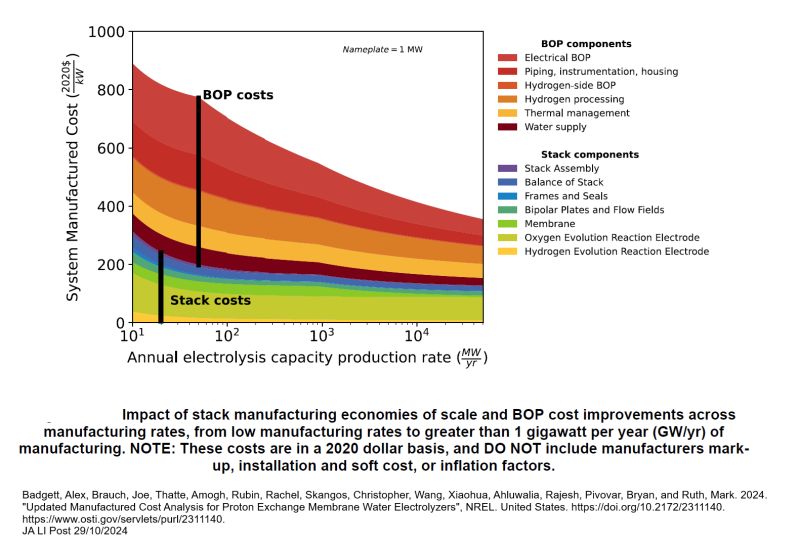
Manufacturing Scale Reduces Electrolyzer System Costs
This chart directly illustrates the section’s core topic: as AEM technology scales from kilowatt pilots to multi-megawatt systems, the cost per unit is expected to decrease, proving its economic performance.
(Source: LinkedIn)
$59 M in Funding, AEM Electrolyzer and Green Hydrogen Project Support
Capital is flowing into the AEM sector through a mix of venture funding for specialized technology firms and broader government support for the green hydrogen ecosystem. This combination of private and public investment validates the commercial potential of AEM and de-risks the capital-intensive process of scaling manufacturing and deploying first-of-a-kind projects.
- In March 2026, AEM materials specialist Shengshui Tech secured over $13.7 million in a Series A round, signaling investor confidence in the foundational components of the AEM supply chain.
- Direct investment in AEM system developers includes a $5 million venture funding round for HYDGEN announced in April 2026, aimed at accelerating electrolyzer development.
- Broader government initiatives, such as the German state of Baden-Württemberg’s €50 million (~$59 M) funding call for green hydrogen projects in February 2026, create the market pull necessary for emerging technologies like AEM to find commercial footing.
Table: AEM and Green Hydrogen Investments (2026)
| Company / Entity | Time Frame | Details and Strategic Purpose | Source |
|---|---|---|---|
| HYDGEN | April 2026 | Received $5 million in venture funding to advance the development and commercialization of its AEM electrolyzer technology. | Indian Chemical News |
| Shengshui Tech | March 2026 | Secured over $13.7 million (RMB 100 M+) in Series A funding to develop materials for AEM water electrolysis, strengthening a key part of the supply chain. | Pandaily |
| German State of Baden-Württemberg | February 2026 | Opened a €50 million (~$59 M) funding call to support green hydrogen projects, creating a market for electrolyzer deployment. | gasworld |
| Supercritical (investor: Shell) | January 2026 | Raised $18.8 million in a Series A round, with participation from Shell, to develop a novel high-pressure electrolysis technology, indicating major energy firm interest in disruptive solutions. | Upstream |
Versogen and In Solare 250 MW Factory Deal and 3 Other AEM Alliances (2026)
The primary strategy for AEM commercialization in 2026 is centered on strategic alliances that pair technology innovators with industrial-scale manufacturers and market leaders. This model allows AEM firms to overcome the high capital barriers to entry by licensing core technology to partners with established manufacturing capabilities and regional market access, accelerating the path from pilot to mass production.
- The definitive blueprint for this strategy is the February 2026 partnership between U.S.-based Versogen and India’s In Solare Energy. In Solare will build a 250-300 MW factory, scalable to 1 GW, using Versogen’s proprietary AEM technology to target the Indian market.
- In March 2026, Enapter partnered with DRIFT Energy to develop a marinised AEM electrolyzer, a collaboration aimed at creating a specialized product for the new offshore hydrogen production market.
- Major energy producers are now trialing the technology, with ACWA Power announcing in February 2026 it would test Power to Hydrogen’s (P 2 H 2) hybrid AEM system, which seeks to combine the cost structure of alkaline with the performance of PEM.
- A Spanish-German partnership announced in January 2026 aims to deploy Artificial Intelligence (AI) to accelerate AEM development, showing that collaboration extends to advanced R&D and process optimization.
Table: Key AEM Electrolyzer Partnerships (2026)
| Partner / Project | Time Frame | Details and Strategic Purpose | Source |
|---|---|---|---|
| Versogen & In Solare Energy | February 2026 | Technology licensing and manufacturing partnership. In Solare will build a 250-300 MW AEM electrolyzer factory in India using Versogen’s technology. | POWER Magazine |
| DRIFT Energy & Enapter | March 2026 | Co-development of a marinised AEM electrolyzer for producing green hydrogen at sea, combining DRIFT’s energy yacht concept with Enapter’s AEM stack expertise. | Fuel Cells Works |
| ACWA Power & Power to Hydrogen (P 2 H 2) | February 2026 | Technology trial of P 2 H 2’s hybrid AEM electrolysis technology, aiming to validate its efficiency and durability for large-scale green hydrogen production. | ACWA Power |
India vs. Europe: AEM Electrolyzer Manufacturing and Deployment Focus
The geographic focus of the AEM industry is bifurcating, with foundational R&D and specialized pilot projects remaining strong in North America and Europe, while plans for mass manufacturing are rapidly shifting toward high-growth Asian markets. This geographic split reflects a strategic push to align production capacity with government-backed hydrogen demand centers.
- Between 2021 and 2024, AEM development was heavily concentrated in the US and Europe, home to key innovators like Versogen (US) and Enapter (Germany) and early-stage projects like Spain’s H 2 SKID.
- The year 2026 marks a decisive pivot to Asia for manufacturing scale. The Versogen-In Solare agreement to build a gigawatt-scalable factory in India is designed to directly address the country’s National Green Hydrogen Mission.
- Indonesia is also emerging as an early adopter, with state-owned Pertamina planning to launch a green hydrogen pilot project in Lampung by 2026 using AEM technology powered by its geothermal resources.
- Europe continues to be a hub for advanced application development, as seen in the DRIFT-Enapter offshore electrolyzer project and the AI-focused Spanish-German R&D collaboration.
AEM Technology Maturity, Horizon’s 5 MW System vs. Durability Hurdles
AEM technology has successfully matured to the point of commercial-scale deployment, but its long-term viability remains conditional on proving membrane durability over extended operational lifetimes. While AEM avoids the material cost and scarcity issues of PEM electrolyzers, it must now demonstrate the industrial-grade reliability required for bankable, utility-scale projects.
- From 2021-2024, AEM systems were largely limited to lab and kilowatt-scale demonstrations. In 2026, Horizon’s delivery of a 5 MW system represents a significant step-change in proven capacity.
- The most critical remaining hurdle is durability. A World Bank report specifies a required lifetime of 20, 000 to 40, 000 hours for large projects, a benchmark that current AEM systems have not yet demonstrated in commercial operation, though lab tests show promise.
- The competitive pressure is intense. In April 2026, German manufacturer Sunfire launched a new 50 MW pressurized alkaline electrolyzer system, highlighting the scale that mature technologies are already offering the market.
- Despite the durability challenge, the high initial CAPEX for pilot-scale AEM and Solid Oxide Electrolyzer Cell (SOEC) systems is expected to fall significantly as manufacturing scales up, a process initiated by the new giga-factory plans.
SWOT Analysis, Versogen AEM Strengths and Commercialization Risks
The strategic position of AEM electrolysis is defined by its strong cost-reduction potential, which is currently balanced against significant technical and commercial risks related to durability and manufacturing scale. The developments in 2026 are beginning to address these weaknesses, but the competitive threat from established technologies is also intensifying.
Table: SWOT Analysis for AEM Electrolyzer Commercialization
| SWOT Category | 2021 – 2024 | 2025 – 2026 | What Changed / Validated |
|---|---|---|---|
| Strengths | Theoretical advantage of using non-precious-metal catalysts, promising lower CAPEX than PEM. | This advantage is now central to commercialization strategies, with firms like Versogen explicitly marketing their technology on this basis. | The PGM-free value proposition was validated as a key driver for partnerships like the Versogen-In Solare deal, aimed at producing cost-competitive hydrogen. |
| Weaknesses | Poorly understood long-term membrane durability and stability, with most tests at small scale and short duration. | Durability remains the primary bottleneck. The World Bank identified a 20, 000-40, 000 hour lifetime requirement, which is still unproven in the field. | The weakness has become the central focus of R&D and pilot projects. The performance of Horizon’s 5 MW system will be a critical test. |
| Opportunities | Growing global demand for green hydrogen and a rising awareness of potential supply chain constraints for PEM catalysts (iridium). | National hydrogen strategies (e.g., India’s) create massive, government-backed markets. Giga-factory plans (In Solare) are now in motion to meet this demand. | The opportunity shifted from theoretical to actionable, with partnerships directly targeting specific national hydrogen roadmaps and supply chain vulnerabilities. |
| Threats | Competition from rapidly maturing and scaling alkaline and PEM technologies. | Incumbents are scaling faster. Sunfire’s launch of a 50 MW alkaline module in 2026 shows a widening gap in commercial-scale availability. | The threat intensified. AEM must now prove its cost and performance benefits quickly before established technologies secure dominant market share in large-scale projects. |
What’s Next for AEM Electrolyzers, Horizon’s 5 MW System Performance Data
The single most critical factor for AEM’s market acceptance over the next 12 to 24 months will be the public availability of operational data from the first wave of multi-megawatt commercial deployments. This data will either validate the technology’s long-term reliability and economic proposition or expose the remaining gaps that need to be closed before AEM can be considered a bankable, mainstream technology.
- IF the 5 MW system from Horizon and other initial deployments report low degradation rates and high availability throughout their first year, THEN expect a significant increase in orders from industrial clients and a new wave of investment into AEM manufacturing scale-ups.
- WATCH for official announcements from In Solare Energy regarding the groundbreaking and construction timeline for its 250-300 MW factory in India. This milestone will signal that the supply chain is moving from planning to execution.
- THESE COULD BE HAPPENING: A series of technology-licensing partnerships modeled after the Versogen-In Solare deal may emerge, as other AEM innovators choose to partner with established industrial players to accelerate market entry rather than pursuing capital-intensive vertical integration.
The questions your competitors are already asking
This report covers one angle of AEM electrolyzer commercialization. The questions that matter most depend on your work.
- Which companies are gaining or losing ground in the AEM electrolyzer market?
- How does AEM electrolysis compare to PEM and alkaline for industrial-scale green hydrogen production?
- Versogen investments and funding. Is the ‘In Solare’ 250 MW factory on track for its target commissioning date?
- What are the opportunities for AEM electrolyzers in specialized markets like marine and mobile hydrogen?
This report does not answer these. Enki Brief Pro does.
Your question, your angle, your framework. SWOT, PESTL, scenario modelling. The same niche depth, built around the decision your work actually depends on.
