

XGS Energy Closed-Loop Geothermal, 150 MW Meta Deal, 115 MW CC Power Project, and 3 GW Pipeline (2025-2026)
Next-Gen Geothermal Execution Risk, XGS Energy Hires Operations Leaders to Deliver 3 GW Pipeline
The primary constraint for next-generation geothermal has shifted from technological feasibility to the capacity for large-scale project execution. XGS Energy‘s 2026 leadership appointments signal a direct response to this industry-wide bottleneck, indicating a strategic pivot from research and development to delivering its multi-gigawatt project pipeline. By recruiting seasoned operations, procurement, and finance executives from established energy players like bp and Calpine, the company is building the organizational infrastructure required to convert offtake agreements into operational assets.
The Shift from R&D to Construction
The transition from successful pilots to bankable, utility-scale projects represents the most significant hurdle for the enhanced geothermal sector. While the period between 2021 and 2024 focused on proving novel drilling and heat exchange concepts, the period from 2025 to today is defined by commercialization and construction. XGS Energy’s activities exemplify this market maturation, moving from technology validation to securing major commercial agreements with entities like Meta and California Community Power (CC Power).
De-risking Project Delivery
Hiring an executive team with a track record in complex, capital-intensive energy projects directly addresses execution risk. The appointment of Al Vickers as COO, a former CEO of BP Wind Energy, and Richard Chong as CFO, who led the $2.25 billion project financing for The Geysers, provides XGS Energy with the experience needed to manage construction, supply chains, and financing for its 3 GW pipeline. This strategic staffing is a critical signal that the company is preparing for the physical and financial demands of deploying hundreds of megawatts of geothermal capacity, which is necessary to meet commitments and build investor confidence.
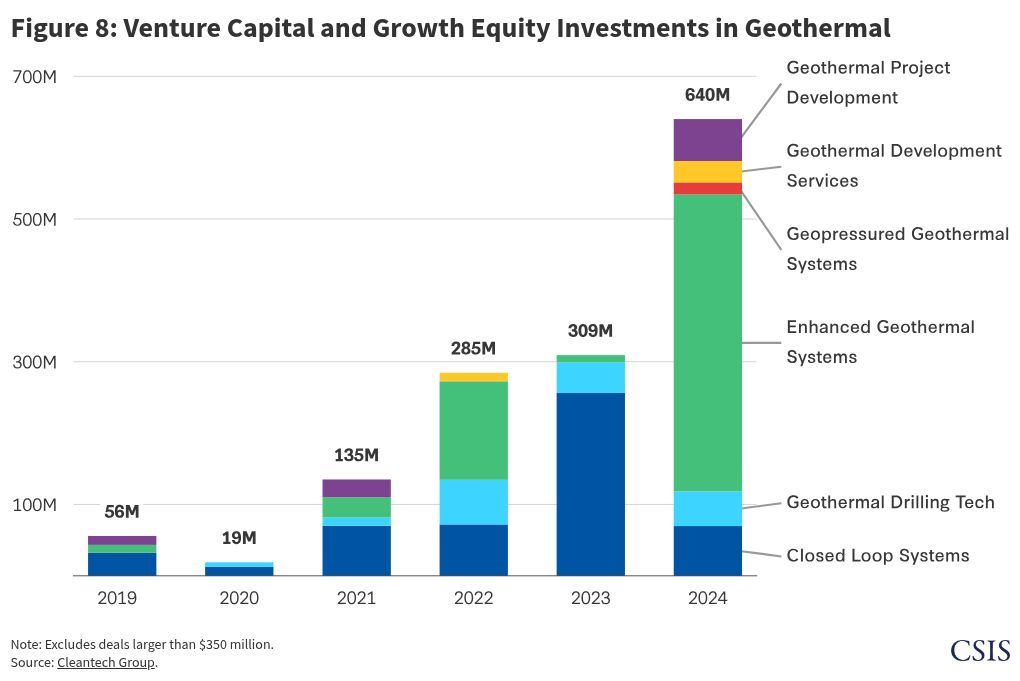
Geothermal VC Investments Soar 32x in Four Years
Venture Capital and growth equity investments in geothermal exploded from $19M in 2020 to $640M in 2024, excluding deals over $350M. This exponential growth signals significant confidence and acceleration in the geothermal sector, with Enhanced Geothermal Systems (EGS) and Project Development attracting the bulk of the capital.
Surging Capital Unlocks Geothermal Project Delivery & Innovation
This capital surge underpins the sector’s readiness for large-scale deployment, directly enabling project delivery targets, such as those implied by XGS Energy for 2026. High investment in EGS signals a focus on advanced technologies crucial for expanding geothermal’s geographic reach and efficiency. The exclusion of mega-deals from these figures implies even greater, often undisclosed, strategic investment, indicating a robust and rapidly expanding market.
(Source: Cleantech Group — via Google Geothermal 2026, 635 MW Surge, Ormat Deal – EnkiAI)
$1 B Meta Investment, XGS Energy Project Financing and IPO Signals
XGS Energy is securing the financial foundation necessary to support its transition to a large-scale project developer, underpinned by a major private investment and strategic financial hires that position it for a potential IPO. This financial strategy is designed to fund the capital-intensive process of drilling and power plant construction for its near-term projects with Meta and CC Power. The company’s ability to attract this level of investment is directly tied to its technical validation and the immense demand for firm, clean power from the data center industry.
XGS Energy Corporate and Project Finance
The company’s financial strategy evolved significantly between 2025 and 2026. In March 2025, XGS Energy secured $13 million in a funding round supported by key investors like Anzu Partners and Aligned Climate Capital to accelerate deployment. This was followed by the crucial hiring of Richard Chong as CFO in May 2026. His specific expertise in financing the world’s largest geothermal complex demonstrates a clear intent to structure bankable, multi-hundred-megawatt projects.
The $1 B Meta Project Investment
The landmark development agreement with Meta, announced in June 2025, is backed by a $1 billion private investment to develop the 150 MW project in New Mexico. This deal not only provides a foundational offtake agreement but also secures the project-level capital required for construction, which is estimated to create 3, 000 construction jobs. This model of pairing a large-scale PPA with dedicated project financing is a key enabler for building out the company’s broader pipeline.
XGS Energy IPO Considerations
By July 2026, XGS Energy had retained Morgan Stanley to evaluate options for a potential Initial Public Offering. This move signals confidence in its project pipeline and its ability to attract public market investors. An IPO would provide the substantial capital required to scale its “factory model” approach to geothermal development and execute on its multi-gigawatt ambitions, following a path similar to that of other next-gen geothermal players like Fervo Energy.
Table: XGS Energy Financial and Investment Milestones
| Date | Event | Details and Strategic Purpose | Source |
|---|---|---|---|
| Jul 2026 | IPO Advisor Hired | Retained Morgan Stanley to evaluate a potential Initial Public Offering, signaling a move toward accessing public markets to fund its gigawatt-scale pipeline. | Axios Pro |
| May 2026 | CFO Appointment | Hired Richard Chong, a veteran from Calpine who led the $2.25 billion project financing for The Geysers, to manage project financing and corporate finance strategy. | XGS Energy |
| Jun 2025 | Project Investment | A $1 billion private investment was committed to the development of the 150 MW geothermal project in New Mexico to power Meta’s data centers. | Route Fifty |
| Mar 2025 | Corporate Funding | Secured an additional $13 million in a funding round from investors including Anzu Partners and Aligned Climate Capital to accelerate deployment. | Utility Dive |

Global Geothermal Power Equipment Market Surging to $53.18B by 2035
The global geothermal power equipment market is set to expand significantly, projected to grow from USD 29.70 billion in 2025 to USD 53.18 billion by 2035. This represents a robust Compound Annual Growth Rate (CAGR) of 6.0% for the period of 2026-2035, signaling strong, sustained demand for geothermal technologies.
(Source: Spherical Insights — via Google Geothermal 2026, 635 MW Surge, Ormat Deal – EnkiAI)
XGS Energy 4 Strategic Alliances, Meta PPA and Baker Hughes Collaboration (2025 to 2026)
XGS Energy has assembled a complete ecosystem of strategic partners to mitigate execution risk and accelerate its project pipeline, covering offtake, technology, and supply chain. These alliances are not isolated agreements but interconnected components of a broader strategy to scale its closed-loop geothermal technology. By securing commitments from major energy users, technology providers, and materials suppliers, XGS has created a de-risked path to construction for its initial large-scale projects.
Securing Offtake with Meta and CC Power
The commercial viability of XGS Energy‘s pipeline is anchored by two major agreements. The June 2025 deal with Meta provides a 150 MW offtake for its New Mexico data centers, a crucial demand signal from a major tech corporation. This was followed by an April 2026 agreement with California Community Power (CC Power), a Community Choice Aggregator, to develop 115 MW of geothermal capacity in California, demonstrating the technology’s appeal to utility-scale buyers seeking firm clean power.
Enabling Execution with Baker Hughes
To translate its designs into producing wells, XGS Energy entered a strategic collaboration with Baker Hughes in March 2026. This partnership leverages Baker Hughes‘ extensive oil and gas expertise for well construction, drilling technology, and integrated project solutions. The collaboration will be first applied to the 150 MW New Mexico project, transferring proven methodologies to the geothermal space to improve efficiency and reduce drilling risks.
Mitigating Supply Chain Risk with Vallourec
Anticipating a major supply chain bottleneck, XGS Energy signed a critical agreement with Vallourec in January 2026. As a leading manufacturer of tubular products, Vallourec will provide the specialized steel goods necessary for XGS‘s closed-loop systems. This partnership is vital, as XGS projects it will become one of the world’s largest consumers of tubular goods in 2027 and 2028, and securing this supply is essential for its “factory model” deployment strategy.
Table: XGS Energy Strategic Partnership Analysis
| Partner | Date | Details and Strategic Purpose | Source |
|---|---|---|---|
| California Community Power (CC Power) | Apr 2026 | Development agreement for 115 MW of next-generation geothermal energy, securing a key utility-scale offtaker in the California market. | Business Wire |
| Baker Hughes | Mar 2026 | Strategic collaboration to provide drilling technology, well construction expertise, and integrated solutions for the 150 MW Meta project in New Mexico. | Baker Hughes |
| Vallourec | Jan 2026 | Supply and engineering agreement for tubular products essential for closed-loop systems, mitigating a critical supply chain risk for its multi-gigawatt pipeline. | Business Wire |
| Meta | Jun 2025 | Offtake and development agreement for 150 MW of geothermal power for New Mexico data centers, providing a foundational, creditworthy customer. | Business Wire |
Western US Geothermal Focus, XGS Energy Targets New Mexico and California Markets
XGS Energy‘s project development strategy is sharply focused on the Western U.S., specifically targeting states like New Mexico and California where high-grade geothermal resources overlap with significant demand for 24/7 clean power. This geographical concentration allows the company to leverage regional expertise, navigate specific regulatory environments, and address the acute power needs of data center hubs and communities transitioning away from fossil fuels.
New Mexico’s 150 MW Meta Project
New Mexico is the site of XGS Energy‘s flagship project with Meta. The state offers favorable geology for geothermal development and a supportive government, which lauded the project’s $1 billion investment. The 150 MW facility is set to increase New Mexico’s operating geothermal capacity tenfold, establishing the state as a significant player in next-generation geothermal energy and providing a blueprint for future projects in the region.
California’s 115 MW CC Power Agreement
California represents another key market, driven by its aggressive clean energy mandates and the need for reliable, baseload power to complement intermittent renewables like solar and wind. The 115 MW development agreement with CC Power positions XGS Energy to serve a large consortium of local energy providers. This partnership demonstrates the value of geothermal energy in a mature renewables market seeking solutions for grid stability.
Commercial Scale Readiness, XGS Energy Validates Closed-Loop Tech with 3, 000-Hour Test
XGS Energy‘s proprietary solid-state, closed-loop geothermal technology has successfully transitioned from the conceptual stage to commercial readiness, a milestone validated by extensive operational testing. This technical de-risking was a critical prerequisite for securing large-scale commercial offtake agreements and strategic partnerships. The demonstrated reliability of the system provides the confidence needed for customers and financiers to commit to multi-hundred-megawatt projects.
The 3, 000-Hour Operations Milestone
By September 2025, XGS Energy announced its system had achieved over 3, 000 hours of continuous operation at its pilot facility. This long-duration test proved the technology’s durability and performance, moving it beyond the short-term demonstrations common in the advanced geothermal sector. This validation was a pivotal moment, directly enabling the commercial discussions that led to the Meta and CC Power agreements.
Water-Independent System as a Differentiator
A key feature of XGS Energy‘s technology is its water-independent design. Unlike conventional geothermal or enhanced geothermal systems (EGS) that can require significant water resources, the closed-loop system circulates a fluid without interacting with underground reservoirs. This is a significant advantage, particularly when siting projects in water-scarce regions of the Western U.S. where many data centers are located. This attribute makes the technology particularly attractive to ESG-conscious customers like Meta.
SWOT Analysis, XGS Energy’s Execution Strengths and Market Threats
XGS Energy‘s primary strength lies in its strategic shift toward an execution-focused leadership team and its formation of a comprehensive partnership ecosystem. These internal strengths prepare it to capitalize on the opportunity presented by surging demand for firm clean power. However, the company faces external threats common to the entire energy construction sector, including supply chain constraints and competition from other well-funded geothermal developers.
Strengths and Weaknesses of XGS
The company’s core strengths are its validated technology, a de-risked project pipeline with anchor tenants, and an executive team capable of delivering large-scale infrastructure. A potential weakness is its current reliance on a small number of very large projects, which concentrates risk. Successfully navigating the transition from a technology-focused startup to a streamlined project delivery organization is its central internal challenge.
Opportunities and Threats for XGS
The market opportunity is immense, driven by the power demands of AI and data centers. The potential for an IPO presents an opportunity for a major capital injection to accelerate growth. The primary threats include industry-wide bottlenecks in drilling rigs and tubular goods, which could impact timelines and costs, and intense competition from other advanced geothermal companies like Fervo Energy, which are also securing large-scale projects and financing.
Table: SWOT Analysis for XGS Energy Geothermal Development
| Category | Strength/Opportunity | Weakness/Threat | Signal/Evidence |
|---|---|---|---|
| Strengths | Execution-focused C-suite with experience from bp and Calpine. | Appointments of Al Vickers (COO) and Richard Chong (CFO) in mid-2026. | |
| Bankable offtake agreements with major creditworthy partners. | 150 MW PPA with Meta and 115 MW development agreement with CC Power. | ||
| Weaknesses | High concentration of risk in a few large, initial projects. | Near-term revenue and validation are heavily dependent on the successful delivery of the New Mexico project. | |
| Opportunities | Surging demand for 24/7 firm, clean power from AI and data centers. | The Meta PPA is a direct response to this trend; data center power demand is a recurring theme in energy markets. | |
| Access to public markets for large-scale capital via potential IPO. | Hiring of Morgan Stanley in July 2026 to evaluate IPO options. | ||
| Threats | Industry-wide supply chain bottlenecks for drilling rigs and tubular goods. | The strategic partnership with Vallourec was explicitly formed to mitigate this known industry constraint. |
XGS Energy 2027 Outlook: Delivering the 150 MW Meta Project on Schedule
The most critical validation for XGS Energy‘s business model over the next 18-24 months is its ability to meet construction and commissioning timelines for the 150 MW Meta project in New Mexico. Success will prove that its “factory model, ” supported by an experienced team and strategic partners, can overcome the physical and logistical hurdles of geothermal development. Failure or significant delays would raise questions about the scalability of next-gen geothermal, even with a strong operational plan.
Bull Case Scenario for XGS
If XGS Energy meets its delivery targets for the New Mexico project, it will serve as powerful validation of its execution-focused strategy. This success would likely accelerate financing for the rest of its 3 GW pipeline, solidify its position as a market leader, and significantly strengthen its case for a successful IPO. On-time delivery would prove to investors and customers that the execution risk in next-gen geothermal can be effectively managed.
Bear Case Scenario for XGS
Conversely, if the project experiences significant delays or cost overruns, it would signal that even a well-structured team and partnership ecosystem can be overwhelmed by the inherent challenges of deep drilling and energy construction. Such a scenario could temper investor enthusiasm for the sector, complicate the company’s IPO ambitions, and provide an advantage to competitors. The key signals to watch will be progress updates on drilling, construction milestones, and any revisions to the project’s commercial operation date.
The questions your competitors are already asking
This report covers one angle of XGS Energy’s project execution strategy. The questions that matter most depend on your work.
- Fervo Energy projects and partners
- Geothermal project supply chain bottlenecks 2026
- New geothermal projects in New Mexico and California
- Tech company deals for firm clean power
This report does not answer these. Enki Brief Pro does.
Your question, your angle, your framework. SWOT, PESTL, scenario modelling. The same niche depth, built around the decision your work actually depends on.
