

PEM Fuel Cell Truck Risks, Hyzon Motors’ Collapse, 30+ Fleet Trials Halted, and OEM Consolidation (2024 to 2026)
Commercial Viability Risks in Hydrogen Trucking, Hyzon Motors’ Path to Liquidation
The failure of Hyzon Motors demonstrates that promising technology is insufficient to overcome the “commercialization valley of death” without a clear path to mass manufacturing and a supporting refueling infrastructure. The company’s trajectory from starting production of its 200 k W Class 8 truck in October 2024 to filing for dissolution just three months later in January 2025 serves as a critical case study for the entire hydrogen truck market.
From Production Start to Shutdown in 6 Months
In the second half of 2024, Hyzon Motors appeared to be gaining momentum. The company initiated production of its 200 k W fuel cell electric truck, secured North America’s first order for hydrogen-powered refuse trucks from Green Waste, and ran successful trials with logistics firm TALKE USA. However, this progress could not overcome fundamental market headwinds, including the high total cost of vehicle ownership and a severe lack of hydrogen refueling stations. By January 2025, the company’s board opted for liquidation, ceasing all operations.
The Shift from Startup Pilots to OEM Dominance
The collapse of venture-backed startups like Hyzon and Nikola Corporation has shifted market control to well-capitalized, legacy Original Equipment Manufacturers (OEMs). While Hyzon was shuttering its operations, established players like Hyundai were scaling their deployments, reaching 20 million km with their XCIENT fleet in Europe by January 2026. This signals a market consolidation where industrial giants with the resources to endure long development cycles and invest in ecosystem build-out are displacing pure-play technology startups. The future of heavy-duty transport decarbonization now rests with these established entities.
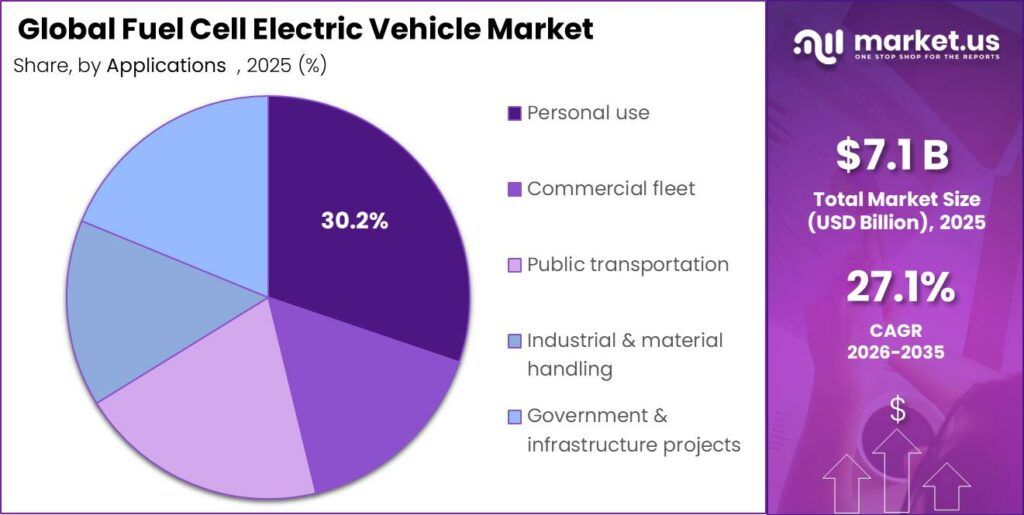
FCEV Market Booming with 27.1% CAGR; Commercial Fleets a Key Segment
The global Fuel Cell Electric Vehicle (FCEV) market is poised for significant growth, projected to reach $7.1 billion by 2025 and expand at a 27.1% CAGR from 2026-2035. While personal use currently accounts for 30.2% of the market, the commercial fleet segment represents a crucial and growing application for fuel cell truck deployments.
Robust FCEV Growth Validates Investment in Commercial Fleet Solutions
The substantial growth forecast (27.1% CAGR) validates the increasing demand and investment in FCEV technology across diverse applications. For specialized players like Hyzon Motors, the commercial fleet segment’s expansion is a key driver, signaling strong market readiness for fuel cell trucks and providing a strategic window for market penetration and scaled operations.
(Source: market.us — via Hydrogen Fuel Cell Vehicle Market Size and Share Report 2026)
Hyzon Motors’ Corporate Dissolution, NASDAQ Delisting and Asset Sale (2025)
Hyzon Motors’ rapid financial collapse and dissolution in early 2025 underscore the extreme capital-intensive nature of vehicle manufacturing and the market’s low tolerance for startups that fail to convert pilots into profitable, large-scale orders. The sequence of events from delisting to asset sale happened over a few short months, serving as a stark warning to investors in the sector.
Shareholder Dissolution Vote
After announcing its intent to liquidate in January 2025, the company moved quickly to formalize its demise. It was delisted from NASDAQ on February 20, 2025, effectively ending its life as a public entity. By March 25, 2025, stockholders officially approved the company’s dissolution, paving the way for the sale of its remaining assets and intellectual property. The final asset sale was approved on April 1, 2025.
Asset Acquisition by Horizon Fuel Cell
The company’s most valuable assets, its intellectual property, were acquired by its parent company, Horizon Fuel Cell Group, in August 2025. This development ensures the survival of Hyzon’s core PEM fuel cell technology, including designs for its next-generation 400 k W stack. However, this move also confirms the end of the road for Hyzon Motors as a vehicle manufacturer, with its technology now absorbed into Horizon’s component-focused strategy.
Table: Hyzon Motors Corporate Events and Cancellations (2025)
| Partner / Project | Time Frame | Details and Strategic Purpose | Source |
|---|---|---|---|
| IP Acquisition by Parent Co. | Aug 2025 | Horizon Fuel Cell Group acquired all intellectual property of the bankrupt Hyzon Motors, including its 200 k W and 400 k W fuel cell stack technology. | Gasworld |
| Final Asset Sale | Apr 2025 | Shareholders approved the final plans for a controlled shutdown and sale of remaining assets, formally dissolving the company. | Clean Trucking |
| Stockholder Dissolution Approval | Mar 2025 | Hyzon Motors’ stockholders voted to approve the company’s full dissolution and assignment for the benefit of creditors. | Hyzon Motors Investor Relations |
| NASDAQ Delisting | Feb 2025 | The company announced its delisting from the NASDAQ stock exchange and expected deregistration from the SEC, ceasing to be a publicly traded entity. | Hyzon Motors Investor Relations |
| Liquidation Announcement | Jan 2025 | Facing an inability to secure new capital, the board of directors decided to dissolve the company and liquidate its assets. | electrive.com |
Failed Pilot Programs, Hyzon Motors’ Unfulfilled Green Waste and Recology Trials
Despite securing high-profile trials with partners like Green Waste, TALKE USA, and Recology in late 2024, Hyzon Motors failed to translate these pilot successes into revenue-generating orders before its liquidation, highlighting the disconnect between operational validation and commercial adoption.
The Green Waste Refuse Truck Order
In October 2024, Hyzon announced what it called the first commercial order for a hydrogen-powered refuse truck in North America from waste management company Green Waste. During trials, the vehicle reportedly demonstrated fuel efficiency 230% to 300% better than diesel counterparts. This order was a significant milestone, but it was rendered moot by Hyzon’s dissolution just a few months later and was never fulfilled.
Trials with TALKE USA and Recology
Similar pilot programs showed technological promise but yielded no commercial traction. A trial of Hyzon’s Class 8 200 k W truck with logistics provider TALKE USA in Texas was successfully completed in October 2024. Another trial with a hydrogen refuse truck built in partnership with New Way Trucks was demonstrated to the U.S. Department of Energy during its first run with Recology in California. These programs validated the technology’s performance but did not convert into a sustainable order book to support the company’s high cash burn.
Table: Hyzon Motors Pilot Partnerships and Outcomes (2024)
| Partner / Project | Time Frame | Details and Strategic Purpose | Source |
|---|---|---|---|
| Green Waste | Oct 2024 | Secured North America’s first order for a hydrogen-powered fuel cell electric refuse truck. The project was halted and the order unfulfilled following Hyzon’s liquidation. | Hyzon Motors Investor Relations |
| TALKE USA | Oct 2024 | Completed a successful trial run of a 200 k W Class 8 hydrogen semi in Texas. The trial did not lead to further commercial deployments before Hyzon collapsed. | Clean Trucking |
| Recology & New Way Trucks | Sep 2024 | Showcased a hydrogen fuel cell electric refuse collection truck to the U.S. Department of Energy during a trial with Recology. The pilot did not generate commercial orders. | Fleet Equipment Magazine |
| Multi-Fleet Trial Program | Aug 2024 | Announced a trial program with over 30 fleets for its 200 k W Class 8 truck. The program was scheduled to run through February 2025 but was terminated due to the company’s dissolution. | Hyzon Motors Investor Relations |
North America vs. Europe, Hyzon Motors’ Failed Regional Focus
Hyzon Motors’ strategic retreat from Europe and Australia in July 2024 to concentrate on North America ultimately failed to secure its survival, while established OEMs like Hyundai successfully scaled deployments across multiple continents.
Hyzon’s North American Concentration
In mid-2024, Hyzon shuttered its operations in the Netherlands and Australia, citing difficult market conditions and a need to focus its dwindling resources on the more promising North American market. All of its subsequent activities, from the start of production of its 200 k W truck to its trial programs, were centered in the U.S. This regional consolidation proved insufficient to build a sustainable business, as the underlying challenges of high costs and lack of infrastructure were not unique to any single geography.
Hyundai’s Global Deployment Success
In stark contrast to Hyzon’s regional retreat and failure, Hyundai has pursued a successful multi-continental strategy. By early 2026, the company had 165 XCIENT Fuel Cell trucks operating in Europe and 63 units in North America. In March 2026, Hyundai announced the deployment of its first FCEV truck fleet in South America, with operations planned for Uruguay. This global approach, backed by a major OEM’s financial and logistical strength, demonstrates a more resilient model for navigating regional market differences and achieving scale.
PEM Fuel Cell Technology, Hyzon Motors’ 200 k W Stack vs. Business Model Failure
The market has validated the technical viability of PEM fuel cell stacks, as shown by Hyzon Motors’ efficient 200 k W system, but the company’s collapse proves that technology maturity does not guarantee business success without a cost-effective manufacturing model and available infrastructure.
The Promise of the 200 k W Stack
At its production launch in September 2024, Hyzon’s single-stack 200 k W fuel cell system was promoted as a significant advancement. The company claimed it was 30% lighter and smaller and 25% more cost-efficient than competing dual-stack systems. Its successful operation in trials with logistics and refuse collection partners confirmed its technical performance. However, the innovation in the lab and on the test track did not translate to a viable business case in the real world.
Horizon’s Plan for the 400 k W Stack IP
The future of Hyzon’s technology now lies with its parent, Horizon Fuel Cell. Following the IP acquisition in August 2025, Horizon announced its intention to integrate its latest VLS-IV Series 400 k W fuel cell stack, which builds on Hyzon’s technology, into heavy-duty trucks. The company is targeting a 15-20% improvement in hydrogen fuel savings. This pivot to a component supplier model, leveraging the acquired IP, is a more capital-efficient strategy than attempting to manufacture and sell entire vehicles.
SWOT Analysis for the Hydrogen Truck Market Post-Hyzon
The hydrogen truck market’s primary strength is its zero-emission potential for heavy-duty applications, but its critical weakness, exposed by the Hyzon failure, is the high total cost of ownership and reliance on nascent refueling networks.
Strengths and Weaknesses
The core strength of hydrogen fuel cell trucks lies in their ability to offer payload and refueling times comparable to diesel, a key advantage over battery-electric alternatives in long-haul and heavy-duty cycles. However, the market’s weaknesses are profound. The high upfront cost of vehicles and the near-total absence of a public hydrogen refueling network create a chicken-and-egg problem that startups like Hyzon could not solve. As of mid-2026, only a few thousand FCEV heavy trucks are operational globally, against a fleet of millions of diesel trucks.
Opportunities and Threats
The primary opportunity is driven by government mandates and corporate decarbonization goals, which are creating regulatory and financial tailwinds for zero-emission freight. The consolidation of the market around major OEMs like those in the H 2 Accelerate program presents an opportunity for a more coordinated and well-funded approach to infrastructure and vehicle deployment. The main threat remains the high cost of green hydrogen and the slow pace of infrastructure build-out, which could stall adoption and favor competing technologies like battery-electric trucks in more applications.
Table: SWOT Analysis for the Hydrogen Truck Market (2021-2025)
| SWOT Category | 2021 – 2023 | 2024 – 2025 | What Changed / Resolved / Validated |
|---|---|---|---|
| Strengths | High-power PEM fuel cell technology was demonstrated in pilot programs by multiple startups. The promise of fast refueling and long range attracted significant venture capital. | Hyzon’s 200 k W stack demonstrated high efficiency in real-world trials. OEM-led projects like Hyundai’s XCIENT fleet proved commercial-scale viability. | The technology’s performance is validated for heavy-duty use cases. The business model, not the core tech, was the primary failure point for startups. |
| Weaknesses | Extremely high total cost of ownership (TCO) compared to diesel. Fragmented and almost non-existent hydrogen refueling infrastructure. | The “valley of death” became apparent as Hyzon failed to convert pilots to profitable orders, leading to cash burn and collapse. Infrastructure build-out remained slow. | The market validated that a viable business model requires either massive capital reserves to wait for infrastructure or a focus on being a component supplier. |
| Opportunities | Government incentives (e.g., IRA in the U.S.) and decarbonization targets created strong policy support. | Major OEMs (Toyota, Volvo, Daimler) deepened their commitment through JVs like Cellcentric, signaling a shift to a more stable, long-term development model. | The market opportunity is being captured by established industrial players who can better manage the high capital costs and long timelines, leading to industry consolidation. |
| Threats | Competition from improving battery-electric truck technology. High cost and low availability of green hydrogen. Investor skepticism following Nikola’s fraud scandal. | Hyzon’s collapse further eroded investor confidence in pure-play hydrogen startups. Only 3, 000-5, 000 FCEV heavy trucks are operational globally. | The primary threat is the slow pace of ecosystem development, which could limit FCEVs to niche applications while BEVs capture a larger share of the market. |
Scenario Modelling for Hydrogen Trucking, Horizon Fuel Cell and OEM Consolidation
The most probable scenario for 2026 involves established truck manufacturers like Volvo, Daimler, and Toyota absorbing the market, with former startup IP, like Hyzon’s, being repurposed for component supply rather than full vehicle production.
Horizon Fuel Cell as a Tier-One Supplier
If Horizon Fuel Cell successfully integrates Hyzon’s IP into its new 400 k W fuel cell stacks, watch for announcements of partnerships with established truck OEMs. Instead of competing with them, Horizon is positioned to become a tier-one supplier of fuel cell systems. Signals to monitor include Mo Us or supply agreements with major European or North American truck manufacturers who are looking to accelerate their FCEV programs without bearing the full R&D cost of developing their own stacks from scratch.
The OEM Collaboration Model
The future of hydrogen trucking appears to be one of collaboration among giants. The Cellcentric joint venture, which saw Toyota join Daimler Truck and Volvo Group in July 2026, is a key indicator of this trend. This model pools resources to de-risk the massive investment in both fuel cell production and lobbying for infrastructure support. Expect to see fewer standalone fuel cell truck deliveries from new entrants and more large-scale, coordinated deployments from these powerful consortiums targeting specific, high-traffic logistics corridors where refueling infrastructure can be built out efficiently.
The questions your competitors are already asking
This report covers one angle of Hyzon Motors’ commercial trajectory. The questions that matter most depend on your work.
- Daimler Volvo Toyota hydrogen truck joint ventures
- new hydrogen refueling stations for trucks US Europe
- Horizon Fuel Cell supply agreements with truck makers
- total cost of ownership hydrogen vs battery electric truck
This report does not answer these. Enki Brief Pro does.
Your question, your angle, your framework. SWOT, PESTL, scenario modelling. The same niche depth, built around the decision your work actually depends on.
