

Green Hydrogen Project Viability, $665 M Atome FID, 75% of US Pipeline at Risk, and Two Competing Models (2021 to 2026)
Green Hydrogen Projects Face a Market Bifurcation
The global green hydrogen market is fracturing into two distinct development models, a trend crystallized by project outcomes between 2021 and today. The first model, exemplified by Atome Energy’s subsidy-free project in Paraguay, relies on unique geographic advantages, specifically access to extremely low-cost, high-capacity renewable energy to achieve economic viability. The second, more common model depends on direct government production subsidies, like the U.S. Inflation Reduction Act (IRA), leaving a majority of the global project pipeline exposed to significant policy risk and market volatility, as evidenced by a wave of cancellations and delays since January 2025.
- Before 2025, the industry narrative was driven by a wave of large-scale project announcements predicated on the assumption of strong and stable policy support, with companies building their financial models around incentives like the IRA’s $3.00/kg tax credit.
- Since January 2025, the market has undergone a severe recalibration, with over $22 billion in U.S. clean energy projects cancelled in the first half of the year alone. The hydrogen sector has been hit hard, with companies like Plug Power abandoning major projects due to financial and market headwinds that made the subsidy-dependent models unworkable.
- In contrast, Atome Energy’s Final Investment Decision (FID) on its Villeta plant in June 2023 was based on a long-term power purchase agreement (PPA) for low-cost Paraguayan hydropower. This structural cost advantage, estimated at $20-$30 per MWh with a 90% capacity factor, effectively replaces the need for direct production subsidies and insulates the project from the policy uncertainty plaguing other regions.
- The success of this resource-driven model signals that while subsidies may be necessary to stimulate demand in mature economies, the most competitive and resilient long-term producers will emerge from regions that can offer a structural cost advantage in renewable energy, not just a temporary policy one.
Hydrogen Project Cancellations, $14 B in U.S. Hubs On Hold
The “painful market recalibration” in the green hydrogen sector since early 2025 is most visible in the rising tide of project cancellations and indefinite delays. A significant portion of the project pipeline, once buoyed by policy optimism, has proven economically non-viable as developers grapple with financing difficulties, uncertain demand, and the risk of shifting government incentives. This trend underscores the fragility of projects built on policy assumptions rather than fundamental economic advantages.
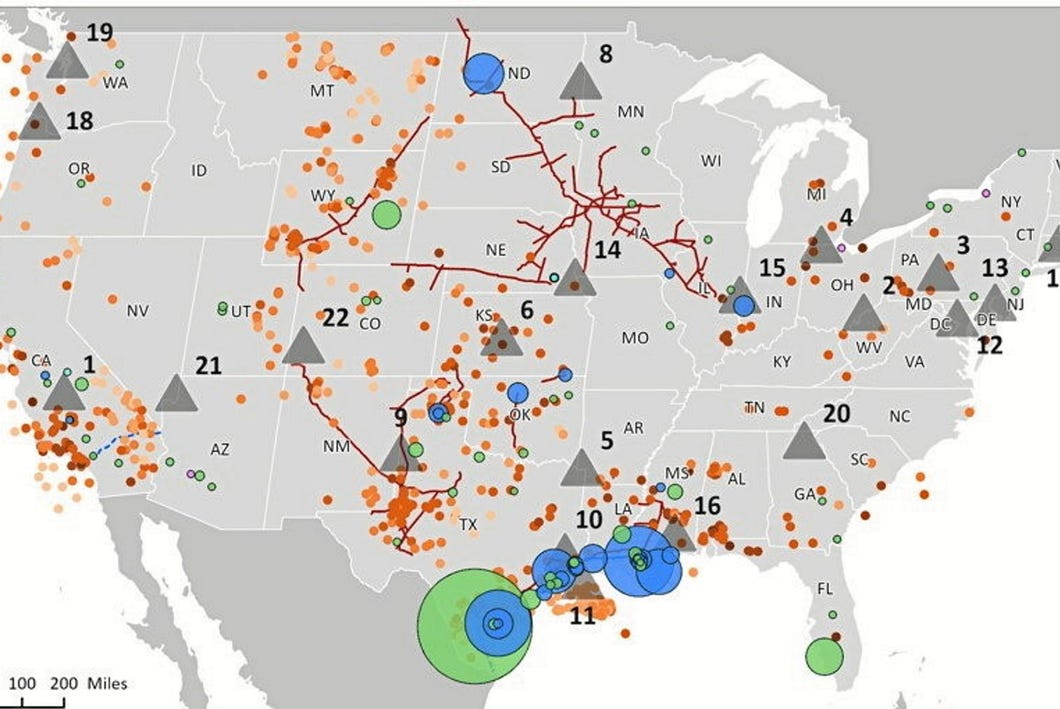
Map of U.S. Hydrogen Hubs
This map shows the locations of the U.S. hydrogen hubs, providing visual context for the project cancellations and delays discussed in this section.
(Source: Hydrogen Insight)
- Wood Mackenzie’s analysis of proposed changes to the U.S. clean energy tax landscape, such as the hypothetical “One Big Beautiful Bill Act, ” indicates that as much as 75% of the U.S. green hydrogen pipeline is at risk of failing to qualify for the crucial 45 V tax credits.
- This policy uncertainty has had tangible effects, with Industrial Info tracking at least $14 billion in U.S. hydrogen hub projects that have been officially canceled or put on hold. This includes Plug Power’s decision in March 2026 to abandon its planned green hydrogen facility in New York.
- The issue is global, with projects facing delays across multiple continents. For example, Scatec‘s 100 MW H 2 Global-backed green hydrogen project in Egypt was delayed again into the second half of 2025, reflecting widespread challenges in moving projects from announcement to operation.
Table: Recent Hydrogen and Clean Energy Project Setbacks
| Company / Region | Time Frame | Details and Strategic Purpose | Source |
|---|---|---|---|
| Plug Power (New York, USA) | Mar 2026 | Canceled the planned green hydrogen production project in Genesee County, citing financial unfeasibility and market headwinds, and sold the site to a data center developer. | Industrial Info |
| California, USA | Oct 2025 | The federal administration pulled $1.2 billion in funding previously allocated to the state for hydrogen development, signaling a significant policy shift. | Cal Matters |
| United States | H 1 2025 | A total of $22 billion in clean energy projects were canceled across the U.S. in the first half of 2025, resulting in the loss of 16, 500 jobs and highlighting broad market instability. | E 2 |
| Scatec (Egypt) | May 2025 | Delayed the start of its 100 MW green hydrogen project, backed by Germany’s H 2 Global initiative, to the second half of 2025 due to unspecified project execution challenges. | Hydrogen Insight |
Offtake Agreements, The Non-Negotiable Factor for Project Bankability
For a green hydrogen project to secure financing and reach a final investment decision, particularly one without subsidies, a long-term, binding offtake agreement is the most critical element. The principle of “no offtake, no FID” has become an industry mantra, reinforcing that revenue certainty is the ultimate de-risking tool for capital-intensive infrastructure investments. Recent partnerships show that securing a creditworthy buyer for the hydrogen or its derivatives is a prerequisite for moving forward.
- Atome Energy’s subsidy-free model in Paraguay is entirely dependent on its ability to secure long-term offtake agreements for green fertilizer, displacing carbon-intensive imports within the region’s large agricultural sector. The bankability of the project hinges on these contracts.
- The importance of offtake was explicitly stated by Air Products’ CEO, who confirmed that an FID for a major U.S. blue hydrogen project is contingent on securing buyers, a clear signal that even established players will not build on speculation.
- In March 2025, Total Energies and RWE demonstrated a successful offtake-driven model by securing a long-term agreement for green hydrogen supply to decarbonize the Leuna refinery in Germany, providing the revenue certainty needed for the project to proceed.
- Similarly, Kimberly-Clark’s agreement in July 2025 to replace half of the natural gas at its UK factories with green hydrogen provides a bankable, long-term demand signal that enables the financing and construction of the associated hydrogen production facility.
Global Competition, Resource Havens vs. Policy Havens
A clear geographic divergence in green hydrogen strategy is solidifying, separating “resource havens” from “policy havens.” Resource havens, like Paraguay, Chile, or parts of the Middle East, leverage exceptional natural endowments, such as low-cost hydro or solar, to build a durable, long-term cost advantage. Policy havens, primarily the U.S. and E.U., use subsidies and public funding to bridge the cost gap, creating a powerful but potentially volatile incentive structure that is vulnerable to political change.
- Paraguay represents the archetypal resource haven. Its ability to offer baseload hydropower at sub-$30/MWh prices gives the Atome project a structural advantage that is difficult for policy to replicate consistently over a 20-year project lifespan.
- The United States has positioned itself as the primary policy haven through the IRA’s $3.00/kg production tax credit. This has attracted immense investment interest, but the project cancellations of 2025-2026 and political threats to the IRA itself reveal the inherent risk of this model.
- The European Union is pursuing a hybrid strategy with its Re Power EU plan, aiming for 10 million tonnes of domestic production and 10 million tonnes of imports. This acknowledges that even a large, subsidized market will need to rely on imports from lower-cost resource havens to meet its targets.
- Other nations like India and China are also developing robust domestic strategies. India is using a combination of national goals and state-level incentives to drive down costs, with recent tenders discovering prices as low as $3.82/kg. China’s 2025 Energy Law streamlines development by officially classifying hydrogen as an energy resource.
SWOT Analysis of the Subsidy-Free Green Hydrogen Model
The viability of subsidy-free green hydrogen projects hinges on a specific set of strengths and opportunities, but it also carries significant weaknesses and threats that are being validated by market events from 2024 to 2025. These projects offer a path to de-risked, long-term profitability but are only feasible under a narrow set of ideal conditions, which limits their replicability on a global scale.
Table: SWOT Analysis for the Subsidy-Free Green Hydrogen Model
| SWOT Category | 2021 – 2023 (Conceptual Phase) | 2024 – 2025 (Market Reality) | What Changed / Resolved / Validated |
|---|---|---|---|
| Strengths | Hypothesized that low-cost, high-capacity-factor renewables (e.g., hydro) could create a competitive LCOH. Focus on import substitution for local markets (e.g., fertilizer). | Atome’s FID on a project with a sub-$30/MWh PPA confirms this hypothesis. The ability to operate electrolyzers at 90%+ capacity is validated as a key cost driver. | The core strength was validated: a structural energy cost advantage can effectively replace a production subsidy, creating a resilient business model insulated from policy shifts. |
| Weaknesses | High initial CAPEX for electrolyzers and associated infrastructure. Limited number of locations with the required world-class renewable resources. Dependence on securing long-term, bankable offtake agreements. | Electrolyzer CAPEX remains a significant hurdle, though costs are falling with scale. The “no offtake, no FID” principle is harshly enforced by capital markets, as seen in project delays. | The weakness was confirmed: without a guaranteed buyer and exceptionally cheap power, the high CAPEX makes the model unworkable. The geographic limitations remain a major constraint to widespread adoption. |
| Opportunities | Potential to capture a “green premium” for decarbonized products. Growing corporate and national net-zero commitments creating new demand pools. Volatility in fossil fuel prices making green alternatives more attractive. | Offtake agreements from companies like Kimberly-Clark and Total Energies show that industrial users are willing to sign long-term contracts to secure green hydrogen for decarbonization. | The opportunity for import substitution and locking in long-term contracts with industrial users has been validated as a primary revenue driver, de-risking the project for financiers. |
| Threats | Competition from heavily subsidized projects in other jurisdictions (e.g., U.S. IRA). Volatility in the commodity markets for end-products (e.g., ammonia, fertilizer). Project execution and logistics risks in developing markets. | The market turmoil of 2025, with mass cancellations of subsidized projects, paradoxically strengthens the case for the unsubsidized model by highlighting the dangers of policy dependence. | The primary threat of competition from subsidized projects has been partially mitigated by the validation of policy risk. However, commodity price and execution risks remain significant and must be managed through contracts and operational excellence. |
Scenario Modeling, Atome Energy and the Search for the Next Resource Haven
The critical signal to watch for over the next 12-18 months is whether another large-scale, subsidy-free green hydrogen project reaches a final investment decision in a different resource-advantaged region. While Atome Energy’s project in Paraguay provides a powerful proof-of-concept, its replication will confirm whether this is a niche, one-off success or the beginning of a durable, global production model based on geographic arbitrage.
- If another FID is announced for a project leveraging exceptional solar in Chile, wind in Mauritania, or hydro in another region, it would validate that the resource-driven model is replicable and that a global market for low-cost, unsubsidized green hydrogen is emerging.
- Watch for announcements of binding, long-term offtake agreements, as these are the leading indicator of a project’s bankability and proximity to FID. Memorandums of Understanding (Mo Us) are not a reliable signal.
- Conversely, if the next wave of FIDs comes exclusively from projects in the U.S. or E.U. that are explicitly dependent on subsidy awards, it would suggest that the high-CAPEX hurdle remains too great to overcome with resource advantages alone, and that the market will remain policy-dependent for the foreseeable future.
The questions your competitors are already asking
This report covers one angle of the two competing models for green hydrogen project economics. The questions that matter most depend on your work.
- Which companies are gaining ground with subsidy-free green hydrogen projects, and which are losing ground on subsidy-dependent models?
- What is the outlook for the US green hydrogen project pipeline by 2026, given the market recalibration since January 2025?
- What are the opportunities for replicating Atome’s subsidy-free model in other markets with low-cost renewable energy?
This report does not answer these. Enki Brief Pro does.
Your question, your angle, your framework. SWOT, PESTL, scenario modelling. The same niche depth, built around the decision your work actually depends on.
