

Koloma Geologic Hydrogen, $400 M in Funding, $50 M Osaka Gas Deal, and the Shift from Green H 2 (2024 to 2026)
The Geologic Hydrogen Risk Re-evaluation: Commercial Viability vs. Green Hydrogen Cancellations
The hydrogen sector is undergoing a fundamental risk re-evaluation, shifting capital and strategic focus from high-cost manufactured green hydrogen to low-cost, extracted geologic hydrogen. Between 2025 and 2026, the economic model for green hydrogen, which depends on massive subsidies and volatile electricity prices, began to break down, evidenced by a wave of large-scale project cancellations. This contrasts sharply with the “white gold rush” into geologic hydrogen, where companies are leveraging mature oil and gas technologies to target production costs below $1.00/kg, a price point that makes it directly competitive with incumbent fossil fuels.
The Green Hydrogen Contraction
The commercial case for green hydrogen deteriorated significantly after 2024. Projects predicated on ambitious cost-down curves and stable policy support faced a harsh reality of rising electricity prices, supply chain constraints for electrolyzers, and policy uncertainty around subsidies like the 45 V tax credit. This led to a market correction, with major energy firms either pausing or canceling multi-billion-dollar investments, demonstrating the fragility of a manufacturing-based hydrogen economy. The persistent unsubsidized cost of $5.00–$7.00/kg proved commercially unviable for most industrial applications without heavy government support, a situation defined as a major green hydrogen commercial risk.
The Geologic Hydrogen Expansion
While green hydrogen projects faltered, geologic hydrogen exploration accelerated, attracting significant venture capital and strategic interest. Startups like Koloma and Mantle 8 are not developing new chemistry; they are applying proven exploration and extraction techniques to a new resource. This approach bypasses the immense electricity demand and manufacturing scale-up challenges of electrolysis. The core value proposition is transforming hydrogen from a high-cost manufactured specialty chemical into a low-cost extracted primary energy source, similar to the historical trajectory of natural gas.
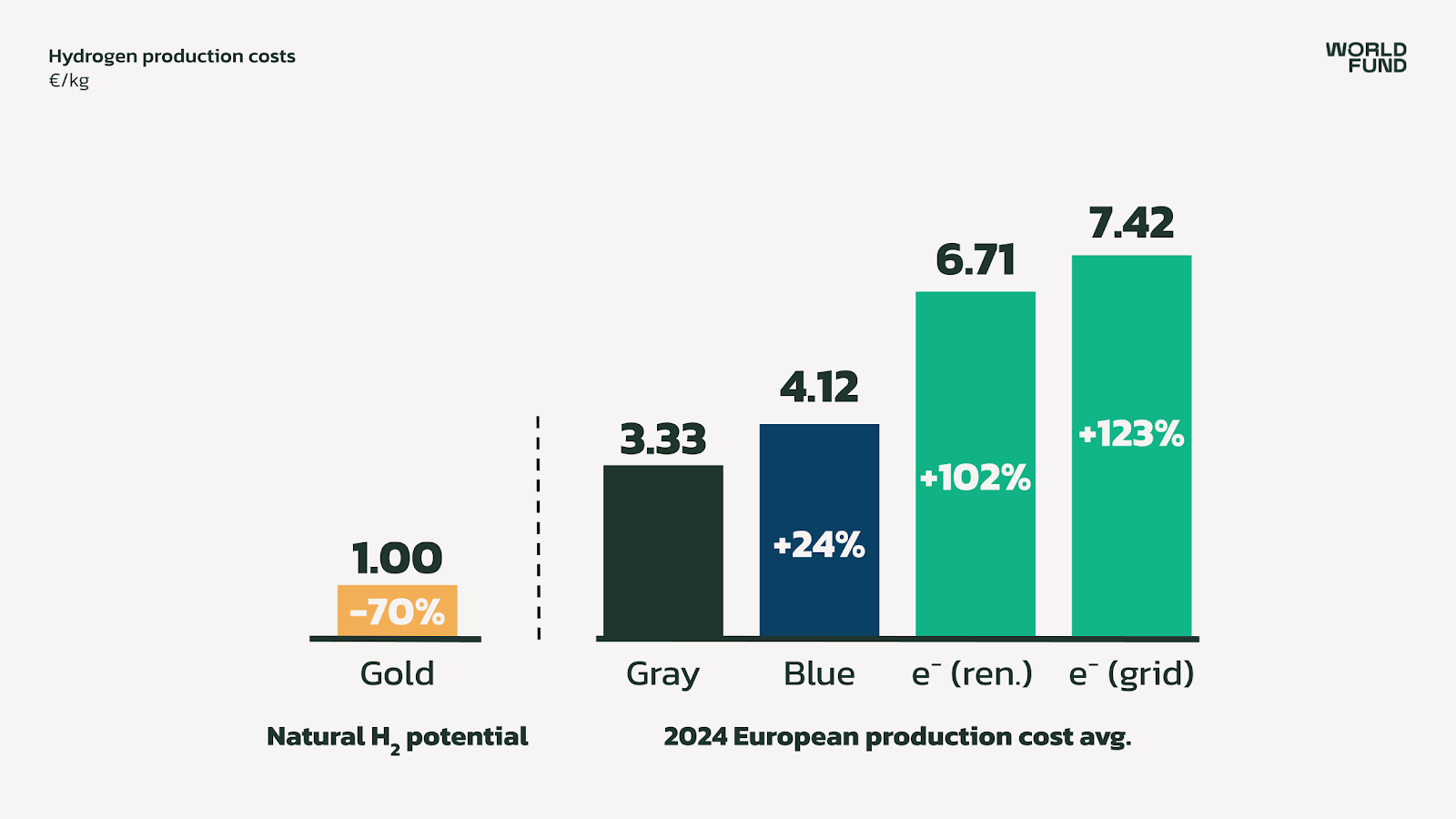
Geologic Hydrogen Poised to Disrupt Market with Ultra-Low Costs
Geologic hydrogen (Gold H₂) presents a disruptive cost potential at 1.00 €/kg, making it 70% cheaper than Gray H₂ (3.33 €/kg) and significantly below all other 2024 European production averages, including renewables-derived (6.71 €/kg) and grid-derived (7.42 €/kg) hydrogen. This cost advantage positions natural H₂ as a game-changer for industrial and energy applications.
Current Production Methods Uncompetitive Against Geologic Hydrogen
Current conventional (Gray, Blue) and electrolytic (renewable, grid) hydrogen production in Europe average 3.33-7.42 €/kg. The 70% cost advantage of natural H₂ at 1.00 €/kg renders existing methods economically unsustainable for broad-scale, low-carbon hydrogen deployment, forcing a re-evaluation of investment priorities towards exploration and extraction technologies.
(Source: Geologic hydrogen: A new primary energy source? | World Fund)
Koloma $400 M in Funding Signals Investment Shift From Green Hydrogen
Investment flows in the hydrogen market have reversed course, with capital rapidly moving away from subsidy-dependent green hydrogen projects and toward early-stage geologic hydrogen explorers. This pivot is not just about seeking higher returns; it reflects a strategic recalculation of which hydrogen production method can achieve scale and economic self-sufficiency first. The contrast is stark: while billions in green hydrogen projects are being written off, geologic startups are securing hundreds of millions in funding to prove out a resource that could fundamentally reset the market’s cost structure.
Geologic Hydrogen’s Funding Boom
The “white gold rush” is best illustrated by the significant funding rounds for key exploration companies. These investments are notable for both their size and the strategic nature of the backers, who are positioning themselves for a potential paradigm shift.
- Koloma’s War Chest: By January 2025, Koloma had quietly amassed over $400 million in funding from high-profile investors, making it the most well-capitalized company in the geologic hydrogen space. This level of investment provides a long runway for exploration and pilot testing.
- Strategic European Investment: In February 2025, Mantle 8, a European exploration startup, secured a €3.4 million seed round to scale its proprietary technology for identifying hydrogen accumulations, indicating the trend is global.
Green Hydrogen’s Capital Flight
The flow of capital into geologic hydrogen coincides with a significant outflow from the green hydrogen sector. Major projects, once announced with fanfare, have been quietly shelved or canceled, signaling a loss of confidence in their near-term economic viability.
- DOE Program Uncertainty: Leaked documents in October 2025 revealed that the U.S. Department of Energy was considering the cancellation of its $7 billion Hydrogen Hub grants, citing project delays and economic headwinds, undermining a cornerstone of the U.S. green hydrogen strategy.
- Major Project Cancellations: The period between 2025 and 2026 was marked by high-profile cancellations, including a joint 2 GW project by BP and Ørsted, reflecting the broader challenges facing the sector. Energy utility E.ON also notably pivoted its strategy away from production to focus on the demand side.
Table: Hydrogen Market Investment and Cancellation Events (2025-2026)
| Entity / Project | Time Frame | Details and Strategic Purpose | Source |
|---|---|---|---|
| Clean Hydrogen Project Cancellations | Mar 2026 | A wave of project cancellations for clean hydrogen signals a narrowing future, as economic and policy realities challenge initial ambitions. | Chemistry World |
| Mantle 8 Seed Funding | Feb 2025 | Natural hydrogen exploration startup Mantle 8 raised a €3.4 million seed round to scale its technology for locating geologic hydrogen deposits. | Mantle 8 |
| Koloma Funding Status | Jan 2025 | Geologic hydrogen explorer Koloma confirmed it had secured $400 million in funding, making it a leader in the race to commercialize natural hydrogen. | S&P Global |
| DOE Hydrogen Hub Grant Cancellations | Oct 2025 | Reports emerged that the Department of Energy was set to cancel its flagship $7 billion Hydrogen Hub program due to economic non-viability and delays. | Fuel Cells Works |
US vs. Global Plays: Koloma Leads Geographic Focus on Geologic Hydrogen
The global search for geologic hydrogen is concentrating activity in specific regions that offer a combination of promising geology and established industrial expertise. While early exploration is global, the United States, particularly the Midwest, has emerged as the primary hub of activity, driven by favorable geological models and a pro-business environment for resource extraction. This marks a departure from green hydrogen strategies, which focused on regions with abundant renewable energy sources like Chile or the Middle East.
The US Midwest Hub
The United States has become the center of gravity for geologic hydrogen exploration, with significant activity focused on ancient rock formations.
- Leading Exploration Efforts: Well-funded companies like Koloma are concentrating their initial exploration efforts in the U.S. Midwest, leveraging existing geological data from decades of oil and gas activity.
- Supportive State-Level Policy: In January 2026, Michigan’s governor issued an executive directive to establish the “Michigan Geologic Hydrogen Exploration and Preparedness Initiative, ” creating a formal state-level framework to support the industry’s development.
- Federal Resource Assessment: The U.S. Geological Survey (USGS) has been instrumental in building confidence, with models predicting trillions of tons of hydrogen may be accessible globally, lending scientific credibility to the exploration rush.
International Exploration Hotspots
While the U.S. leads, other countries with favorable geology and resource extraction industries are also becoming key players.
- Australia’s Yorke Peninsula: Gold Hydrogen is actively drilling on South Australia’s Yorke Peninsula, with its work representing one of the most advanced public exploration campaigns for natural hydrogen to date.
- European Activity: Exploration is also underway in Europe, particularly in Spain and France, with companies like Mantle 8 leading efforts to map potential resources in the Pyrenees region.
- Middle East Interest: In April 2026, reports indicated that Saudi Arabia was beginning to assess its own natural hydrogen resource potential, a significant signal from the world’s largest oil exporter.
Koloma 2026 Pilot Results, Geologic Hydrogen Production Data
The most critical factor for the geologic hydrogen sector in 2026 and beyond is the transition from theoretical models to tangible production data. The entire sub-$1.00/kg cost thesis hinges on the results of the first dedicated pilot wells. Success would validate the geologic extraction model and trigger a massive reallocation of capital across the energy industry. Failure would relegate geologic hydrogen to a niche curiosity and force the market back toward more expensive, manufacturing-dependent hydrogen pathways.
Validation Scenario: The White Gold Rush Accelerates
If initial pilot wells from a major player like Koloma successfully demonstrate sustained flow rates and high purity, the market reaction will be swift and decisive. In this scenario, geologic hydrogen’s low-cost structure becomes a proven reality.
- If flow rates are stable and production costs are confirmed to be near $1.00/kg, watch for a wave of acquisitions as energy majors like Exxon Mobil and Chevron move to secure resources by buying up successful explorers.
- If the produced hydrogen is of high purity (over 90%), watch for immediate offtake agreements with industrial users like refineries and ammonia plants seeking to displace their grey hydrogen consumption.
- If the first commercial projects are announced by early 2027, these could be happening: a sharp decline in the stock valuations of pure-play electrolyzer companies like Electric Hydrogen and a freeze on final investment decisions for new large-scale green and blue hydrogen plants.
Stall Scenario: The Geologic Mirage
Conversely, poor results from initial pilot wells would severely damage investor confidence and halt the sector’s momentum. This scenario unfolds if the geological resource is much harder or more expensive to extract than models predict.
- If flow rates are low or decline rapidly, watch for a rapid flight of capital from the sector as investors conclude that reservoirs are not commercially viable.
- If the gas streams contain high concentrations of methane or other contaminants, watch for regulatory bodies to impose costly purification requirements or classify the resource as a type of fossil fuel, destroying its “clean” value proposition.
- If leading companies like Koloma remain silent on drilling results through the end of 2026, these could be happening: a collapse in the valuation of smaller public exploration companies and a renewed, albeit reluctant, focus from policymakers on salvaging the struggling green hydrogen projects, such as those initiated by Air Products.

Geologic Hydrogen Investment Experiences Sharp Post-2024 Decline
Disclosed investment in geologic hydrogen peaked at nearly $300M across 6 deals in 2024, demonstrating initial strong interest. However, 2025 saw a substantial drop to ~ $60M, and 2026 (partial year) further declined to ~ $35M with only 1 deal, signaling a significant deceleration in capital deployment.
(Source: Cleantech Group — via Costs of gold hydrogen? – Thunder Said Energy)
The questions your competitors are already asking
This report covers one angle of the capital shift between green and geologic hydrogen. The questions that matter most depend on your work.
- Koloma pilot well results Midwest
- Geologic hydrogen offtake agreements
- US government policy on geologic hydrogen
- Oil and gas company investments in geologic hydrogen
This report does not answer these. Enki Brief Pro does.
Your question, your angle, your framework. SWOT, PESTL, scenario modelling. The same niche depth, built around the decision your work actually depends on.
