

PJM Grid Constraint, 32 GW Data Center Demand, FERC Mandates, and $6.3 B Capacity Market Impact (2024 to 2026)
PJM Grid Reliability Risks, 94% of Load Growth From Data Centers
The shift from predictable, modest load growth before 2024 to an explosive, data center-driven demand surge post-2025 has created a severe reliability crisis in the PJM Interconnection, fundamentally challenging its resource adequacy and operational stability.
The Pre-2025 Demand Forecasts
Prior to 2024, PJM experienced decades of relatively flat electricity demand, which allowed for methodical capacity planning and resulted in stable market prices. The grid operator’s long-term forecasts did not anticipate the exponential increase in power consumption that would be driven by the artificial intelligence boom. This period of stability created a market structure unprepared for the subsequent demand shock, leaving it vulnerable to the rapid, concentrated growth that began to materialize in interconnection requests and revised load forecasts.
The Post-2025 Demand Shock
Starting in 2025, long-term forecasts were radically revised. Projections showed a 32 GW increase in summer peak load by 2030, a figure that some analysts warned could reach as high as 65 GW. By 2026, it became clear that data centers were the primary driver, accounting for between 93% and 94% of this new demand. This created concentrated load pockets, particularly in the Dominion Energy zone, that the existing grid infrastructure was not designed to serve. The combination of this demand shock with accelerated retirements of thermal generation, totaling approximately 54 GW, led PJM to warn of a potential 25.1 GW capacity shortfall by 2030, a risk that was validated in the 2026 capacity auction.
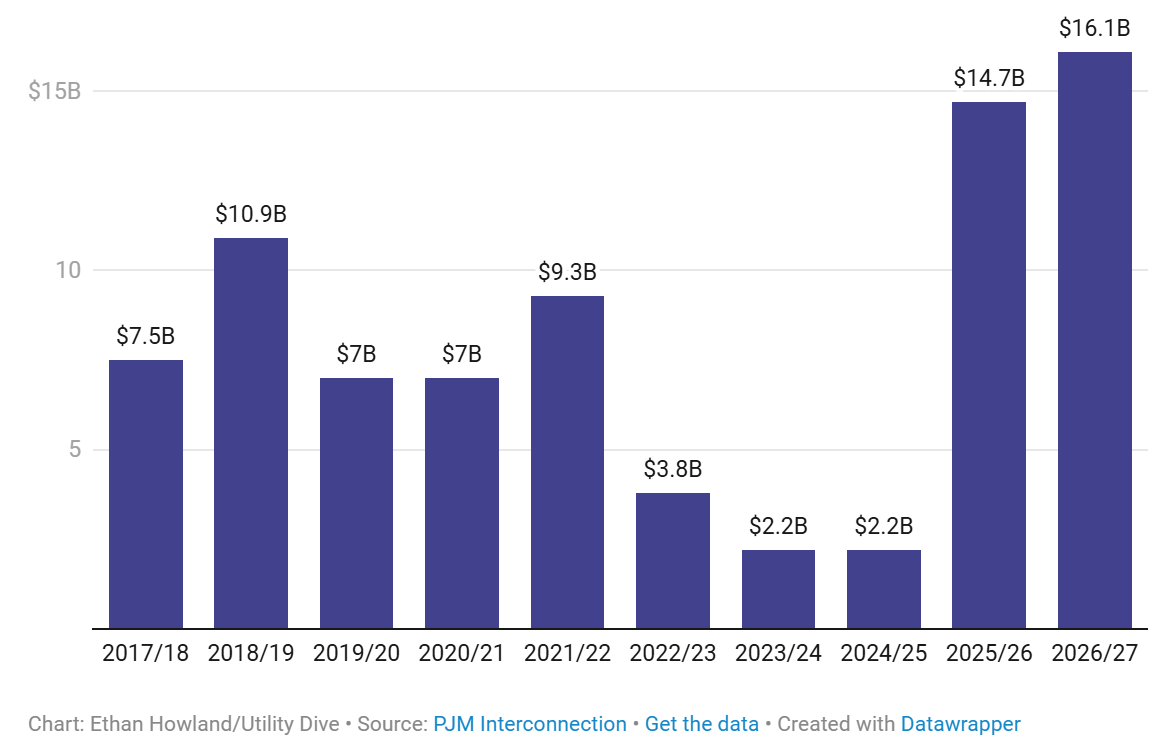
PJM Market Values Poised for 600%+ Surge by 2026/27
PJM-related monetary values are projected to skyrocket, increasing over 600% from $2.2B in 2024/25 to an estimated $16.1B by 2026/27. This dramatic surge follows a period of lower values from 2022/23 to 2024/25.
(Source: PJM Interconnection — via PJM's Record-High Capacity Prices Spark Sector Reckoning as Market Signals, Policy Battles Intensify)
PJM Capacity Market Failure, $6.3 B in Costs Driven by Data Centers
The failure of the PJM capacity market to secure adequate resources culminated in the July 2026 auction, which cleared at its price cap yet fell 6.8 GW short of reliability requirements. This event directly attributed $6.3 billion in costs to data center load and triggered aggressive intervention from the Federal Energy Regulatory Commission (FERC).
The 2026/2027 Auction Crisis
The 2026/2027 capacity auction was a watershed moment for the nation’s largest grid operator. The auction procured only 138, 318 MW of generation resources, falling 6.8 GW short of its reliability target. Prices cleared at the $325/MW-day cap in several constrained regions, a historic high that starkly contrasted with the more stable prices seen in auctions prior to 2025. The PJM Independent Market Monitor’s analysis of the results was unambiguous, reporting that new data center power demand was directly responsible for $6.3 billion of the total auction cost, shifting a significant financial burden onto all ratepayers in the region.
FERC’s Mandated Market Overhaul
In response to the auction failure and the clear threat to grid reliability, FERC launched an “Aggressive Targeted Action” in June 2026. This initiative compelled PJM to overhaul its rules for large load integration and interconnection. The federal mandate forces a structural shift toward greater cost responsibility for the entities driving the demand surge. Core to this reform is the development of new load tariffs and interconnection standards that could require large consumers like data centers to directly fund necessary grid upgrades or secure dedicated resources through measures like on-site generation.
U.S. East Coast vs. Other RTOs, PJM Remains Data Center Epicenter
While data center growth is a national trend, PJM remains the most severely impacted region due to its unique concentration of network infrastructure and proximity to major population centers. This has created a localized crisis that is far more acute than in other Regional Transmission Organizations (RTOs) like MISO.
PJM’s Concentrated Growth
Between 2021 and 2026, the PJM territory solidified its status as the world’s largest and most critical data center market. As of March 2026, the region had 8.8 GW of data centers already under construction, with a planned development pipeline of between 16.2 GW and 57.4 GW. This growth is heavily concentrated in specific transmission zones, overwhelming local grid segments and creating a far more complex challenge than just meeting overall peak demand.
Comparative RTO Analysis
Other RTOs are also experiencing growth but not at the same scale or concentration. MISO, for example, projects its own data center-driven demand will push its peak to 163 GW by 2035. While substantial, this represents a less acute near-term pressure compared to PJM’s projection of 222 GW by 2036, with a peak load of 253 GW possible by 2046. This geographic imbalance means that while the underlying driver is global demand for AI & Data Center Energy, the immediate grid stability risks and financial consequences are disproportionately borne by the PJM market.
SWOT Analysis, PJM Regulatory Reforms and Market Future
PJM’smarket crisis reveals deep structural weaknesses in its long-term planning and market design, which were not built for rapid, concentrated load growth. However, the crisis and resulting FERC mandate present a critical opportunity to forge a more resilient and responsive grid that correctly allocates costs and incentivizes the flexible resources needed for the future.
Table: SWOT Analysis of PJM Market Reforms for Data Center Integration
| Category | Strengths | Weaknesses | Opportunities | Threats |
|---|---|---|---|---|
| PJM Market Dynamics & Regulation Mature, organized capacity market provides a clear, though lagging, price signal for new investment. Large, diverse generation fleet and established transmission network. Forecasting models failed to predict the speed and scale of data center demand. The interconnection queue for new generation is backlogged with over 200 GW of projects, creating a critical bottleneck. FERC’s2026mandate provides regulatory backing to implement “cost-causer pays” principles, forcing data centers to fund grid upgrades. This creates incentives for new technologies like energy storage and demand response. Continued unmanaged growth of hyperscale data centers could outpace grid upgrades, leading to reliability failures. A significant ratepayer backlash could create political pressure to subsidize data center growth. Data Source(s) | PJM, FERC | PJM, Synapse Energy | Linklaters, White & Case | Monitoring Analytics, RTO Insider |
What to Watch in 2027: PJM’s New Rules for Data Center Integration
The critical signal to monitor through2027will be the specific design of PJM’s FERC-mandated tariffs and interconnection rules for large loads. These reforms will determine whether data centers become integrated, flexible grid partners or continue to be a primary source of system instability and escalating costs for all consumers.
The Impact of New Tariffs
IfPJMsuccessfully implements strict “cost-causer pays” principles in its new tariff structures, watch for a material change in data center development strategy. This could include a slowdown in new projects in the most constrained transmission zones or a rapid pivot toward business models that incorporate co-located generation and energy storage. The ability of developers to manage these new costs will be a key determinant of future growth patterns in the region.
Interconnection Queue Reform
The effectiveness of new load-side rules is entirely dependent on accelerating the supply side. Monitor the progress ofPJM’s** interconnection queue reforms, which aim to clear the 200 GW backlog of pending generation projects. If the process for bringing new resources online, particularly flexible gas plants and battery storage, is not significantly streamlined, the supply-demand gap will persist. The success of these reforms hinges on finding a balance that improves grid capacity without stifling necessary economic development. Watch for how utilities and state regulators react to PJM’s filings at FERC, as their support will be crucial for implementation. An increase in new AI data center projects in other RTOs could also signal a migration of load away from the congested and increasingly expensive PJM market.
The questions your competitors are already asking
This report covers one angle of the data center-driven power grid crisis. The questions that matter most depend on your work.
- new rules for data centers connecting to the grid
- other US regions with data center grid strain
- data centers building their own power plants
- speeding up new power plant grid connections
This report does not answer these. Enki Brief Pro does.
Your question, your angle, your framework. SWOT, PESTL, scenario modelling. The same niche depth, built around the decision your work actually depends on.
