

Viking PEM Fuel Cell Cruise Ship, 6.3 MW Fincantieri Build, $25 M System, and 2 Newbuild Agreements (2023 to 2026)
Maritime Hydrogen Projects, Viking Shifts from Cost to Regulatory Strategy
The commercial adoption of large-scale maritime hydrogen systems, exemplified by Viking’s Libra project, has shifted from a theoretical cost-reduction goal to a strategic necessity for regulatory compliance and market access, particularly for in-port emissions.
- In the 2021-2024 period, marine hydrogen was primarily in pilot phases, with projects like the Norwegian ferries establishing initial cost benchmarks of around $1.71 million per MW for fuel cell systems and highlighting the primary challenge of fuel availability.
- From 2025, the strategy solidified around solving the immediate problem of port emissions, with Viking and MSC both ordering hydrogen-powered vessels from Fincantieri designed for zero-emission hoteling power.
- This targeted application de-risks the investment by not relying on a non-existent global hydrogen bunkering network, a key barrier identified in earlier analyses, while providing access to increasingly stringent Emission Control Areas.
- The diversity of approaches, from Viking’s hydrogen fuel cells to AIDA Cruises’ use of biofuels and the development of onboard carbon capture, shows the industry is hedging its technology pathways, but Viking’s investment in a 6.3 MW system signals a firm commitment to the hydrogen route for newbuilds.
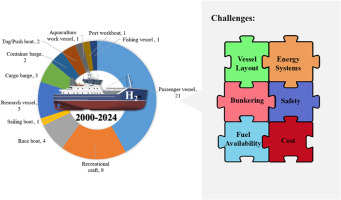
Passenger Vessels Lead Early Hydrogen Projects
This chart shows that passenger vessels, like Viking’s, represent the largest category of early hydrogen ship projects, providing context for the industry’s focus on this segment.
(Source: ScienceDirect.com)
$25 M CAPEX, Viking Fuel Cell System and Green Hydrogen Costs
Investment in marine hydrogen is characterized by high initial capital expenditures for onboard systems, with the long-term commercial case dependent on a significant reduction in the price of green hydrogen, which remains multiple times more expensive than incumbent fuels.
- The estimated CAPEX for the Viking Libra’s 6.3 MW fuel cell system is between $18.9 million and $25.2 million, based on 2025 industry estimates of $3, 000-$4, 000/k W.
- This aligns with earlier benchmarks from 2024, such as the Norwegian ferry project contract valued at approximately $20.5 million for 12 MW, demonstrating persistently high hardware costs.
- The primary operational cost hurdle is fuel, with 2026 data showing green hydrogen at $3 to $6 per kg, which is 4-5 times higher than traditional marine fuels, while grey and blue hydrogen are cheaper at $1.50 to $2.50 per kg.
- Payback models, such as Bloom Energy’s estimate of a 5-6 year period for its SOFC in Maritime systems, are contingent on factoring in carbon pricing and fuel cost savings, which are not yet fully realized for hydrogen.
Viking’s Fincantieri Partnership for Hydrogen Ship Construction (2023-2026)
Strategic partnerships between cruise operators and specialized shipbuilders are critical for de-risking the construction and integration of first-of-their-kind hydrogen propulsion systems.
- The central partnership is between Viking and Italian shipbuilder Fincantieri for the construction of the Viking Libra, validating Fincantieri’s capability in integrating novel hydrogen technologies.
- This relationship extends beyond a single vessel, with Fincantieri also constructing Viking’s “hydrogen-ready” conventional ships like the Viking Vela, delivered in December 2024.
- The market’s confidence in this partnership model is reinforced by MSC’s Explora Journeys also selecting Fincantieri in September 2023 to build two hydrogen-powered luxury cruise ships, creating a hub of expertise in Italy.
Table: Viking and MSC Hydrogen Project Partnerships
| Partner / Project | Time Frame | Details and Strategic Purpose | Source |
|---|---|---|---|
| Viking and Fincantieri (Viking Libra) | 2024 – 2026 | Construction of the world’s first hydrogen-powered cruise ship. Establishes a key operator-shipbuilder relationship for integrating complex, first-of-a-kind 6.3 MW fuel cell and LH 2 storage systems. | Hydrogen Insight |
| MSC (Explora Journeys) and Fincantieri | Sep 2023 | Order confirmed for two new hydrogen-powered luxury cruise ships. This validates the technical and commercial pathway established by Viking and solidifies Fincantieri’s position as the leading builder for this vessel class. | Shippax |
| Viking and Fincantieri (Viking Vela) | Dec 2024 | Delivery of a conventionally powered ship designed to be “hydrogen-ready.” This demonstrates a capital-efficient, modular strategy to future-proof assets for later retrofitting without bearing the full upfront cost and risk. | Business Wire |
Europe Leads Hydrogen Cruise Ship Projects, Viking and Fincantieri Central
Europe, particularly Italy and Norway, has become the epicenter for the development and deployment of large-scale marine hydrogen fuel cell projects, driven by a combination of stringent environmental regulations and specialized shipbuilding expertise.
- Italy, through the shipbuilder Fincantieri, is the primary construction hub for the first generation of hydrogen-powered cruise ships, including Viking’s Libra and MSC’s newbuilds announced in 2023.
- Norway’s regulatory environment, especially in its fjords, was a key early driver, catalyzing projects like the large hydrogen-fueled ferries announced in 2024 that provided crucial cost and technology benchmarks for the cruise sector.
- The focus remains on European routes where port-side emission rules are strictest, making the investment in hydrogen for hoteling power a regionally-focused, high-value strategy for operators like Viking.
- This contrasts with the US Maritime Fuel Cells market, which has seen activity in smaller vessel classes but has not yet produced a cruise ship project at this scale, reinforcing Europe’s leadership position.
PEM Fuel Cell Maturity, Viking Pushes from Pilot to Commercial Scale
While PEM fuel cells are a mature technology, their application in multi-megawatt configurations for primary marine power is transitioning from pilot to early commercial-scale deployment, with Viking’s 6.3 MW system representing a critical validation milestone.
- Between 2021 and 2024, marine fuel cell applications were largely limited to smaller-scale auxiliary power units or pilot projects, establishing technical feasibility but not commercial scale.
- The Viking Libra project moves the technology from pilot to a commercially integrated system, with its 6.3 MW PEM fuel cell installation serving as a primary power source for extended periods, far beyond supplementary use.
- The inclusion of a 4.7 MWh battery system demonstrates a key maturation step, indicating a sophisticated hybrid power management strategy to optimize efficiency and handle transient loads, a necessity for real-world operations.
- The primary remaining maturity challenge is not the fuel cell itself but the associated liquid hydrogen (LH 2) storage and bunkering infrastructure, which remains at a very low technology readiness level for global maritime operations.
SWOT Analysis, Viking’s Hydrogen Strategy Strengths and Risks
Viking’s hydrogen strategy leverages its brand and financial capacity to secure a first-mover advantage in zero-emission cruising, but it remains exposed to significant fuel cost volatility and infrastructure risks.

Hydrogen Bunkering Methods Illustrate Infrastructure Risk
This diagram illustrates the various hydrogen bunkering (refueling) options, providing a visual for the ‘infrastructure risks’ mentioned in the SWOT analysis.
(Source: ScienceDirect.com)
- The primary strength is building unparalleled brand equity and pre-compliance with future emission regulations.
- The main weakness is the substantial CAPEX premium and the reliance on a fuel source that is currently 4-5 times more expensive than alternatives.
- The opportunity lies in securing access to premium, emission-restricted destinations and establishing market leadership.
- The greatest threat is the slow development of a global green hydrogen bunkering supply chain, which could limit the vessel’s operational flexibility and keep fuel costs high.
Table: SWOT Analysis for Viking’s Hydrogen Cruise Ship Strategy
| SWOT Category | 2021 – 2024 | 2025 – 2026 | What Changed / Resolved / Validated |
|---|---|---|---|
| Strength | Demonstrated commitment to innovation with “hydrogen-ready” designs (e.g., Viking Vela). | Establishes market leadership as the first operator of a hydrogen cruise ship, creating significant brand differentiation and marketing value. | The strategy shifted from theoretical future-proofing to a tangible, high-profile demonstration of leadership, directly addressing environmentally conscious consumers. |
| Weakness | High projected CAPEX based on pilot projects (e.g., Norwegian ferries at $1.71 M/MW). High technical risk for a novel application. | Realized CAPEX is high (est. $18.9 M-$25.2 M for the system). OPEX is exposed to volatile green hydrogen prices ($3-$6/kg), which are 4-5 x higher than MGO. | The financial risks were validated. The commercial case now clearly depends on factors beyond direct cost savings, such as regulatory compliance and brand value. |
| Opportunity | Gain access to environmentally sensitive areas like Norwegian fjords by meeting future emission rules. | Secure long-term access to a growing number of ports and regions enacting zero-emission mandates, creating a competitive moat against non-compliant vessels. | The opportunity became more concrete as the primary strategic driver. It’s less about gaining access and more about avoiding being locked out. |
| Threat | Lack of any large-scale LH 2 bunkering infrastructure. Competition from more mature “drop-in” alternatives like biofuels used by AIDA. | The global LH 2 supply chain remains virtually non-existent. A failure of green hydrogen costs to decline as projected could make the system economically unviable to operate. | The primary threat remains unresolved and has been amplified. The project’s success is now explicitly tied to the development of an external market that Viking does not control. |
Viking 2026 Scenario: Watch Port Regulations and Green Hydrogen Costs
The success of Viking’s hydrogen strategy in 2026 and beyond will be determined by two key external factors: the proliferation of zero-emission port regulations and the rate of decline in green hydrogen production costs.
- If more port authorities in key cruise destinations (like Alaska, the Caribbean, or the Mediterranean) follow Norway’s lead in mandating zero-emissions at berth, watch for Viking and MSC to accelerate orders for hydrogen-powered ships, validating the initial investment.
- This could be happening as competitors who opted for LNG or are still using MGO with scrubbers will face increasing operational restrictions and costs, making Viking’s assets more valuable.
- If the cost of green hydrogen fails to fall below $3/kg by the time the Libra is fully operational, watch for the company to potentially rely more on its dual-fuel capabilities or limit hydrogen operations to only the most strictly regulated ports to manage OPEX.
- This could be happening if renewable energy curtailment does not lead to cheap electricity for electrolysis as projected, or if blue hydrogen becomes the dominant, lower-cost “clean” hydrogen source, altering the supply chain dynamics.
The questions your competitors are already asking
This report covers one angle of the commercial strategy for hydrogen-powered cruise ships. The questions that matter most depend on your work.
- What is actually happening with the Viking Libra project since the Fincantieri newbuild agreement?
- What is the cost breakdown of Viking’s $25M, 6.3 MW maritime fuel cell system?
- How do hydrogen fuel cells compare to biofuels and onboard carbon capture for meeting zero-emission port regulations?
This report does not answer these. Enki Brief Pro does.
Your question, your angle, your framework. SWOT, PESTL, scenario modelling. The same niche depth, built around the decision your work actually depends on.
