

ADNOC Hormuz Bypass Pipeline, $55 B Project Pipeline, 3.6 M BPD Export Capacity to Support 5 M BPD Production Target (2021-2026)
Hormuz Bypass Strategy, ADNOC Accelerates Pipeline to Mitigate Geopolitical Risk
Geopolitical instability in the Middle East, which escalated to the effective closure of the Strait of Hormuz in 2026, forced the Abu Dhabi National Oil Company (ADNOC) to accelerate its long-term infrastructure plans, shifting the strategic focus from theoretical risk mitigation to ensuring immediate supply security.
- Between 2021 and 2024, the primary bypass asset was the existing Abu Dhabi Crude Oil Pipeline (ADCOP), a 405 km pipeline with a capacity of 1.5 million barrels per day (bpd). This infrastructure served as a strategic insurance policy against the potential disruption of the Strait of Hormuz, through which approximately 21 million bpd of oil flowed, representing a significant concentration of global energy supply risk.
- From 2025 to 2026, the operational landscape changed dramatically. Heightened regional conflict and maritime threats transformed the theoretical risk into a tangible reality, prompting ADNOC to fast-track the construction of a new “West-East Pipeline” to double its bypass capacity. As of May 2026, this project was reported to be approximately 50% complete.
- This acceleration represents a fundamental pivot. The pipeline is no longer just a strategic alternative but a critical operational necessity to maintain export flows. The project is a key enabler for the UAE’s post-OPEC commercial strategy, as its exit from the organization, effective May 1, 2026, requires the physical infrastructure to independently bring its full production capacity to the global market.
$55 B in Projects, ADNOC Capital Expenditure to Secure Export Routes
ADNOC‘s commitment to de-risking its exports is validated by a massive capital expenditure program, with the pipeline expansion serving as a core component funded through increasingly common alternative financing structures like Public-Private Partnerships (PPPs).
- ADNOC announced plans to award projects worth AED 200 billion ($55 billion) between 2026 and 2028, signaling a major investment cycle focused on production capacity and export infrastructure security.
- While the exact cost of the new pipeline is not disclosed, industry benchmarks from 2022-2024 place the average cost of onshore pipelines at $1 million to $2 million per kilometer. For a new pipeline of approximately 400 km, this implies a capital expenditure between $400 million and $800 million.
- To fund such large-scale projects, Abu Dhabi is increasingly turning to PPP models. This financial strategy allows ADNOC to leverage private capital for critical infrastructure development, preserving state funds while accelerating project timelines, a trend noted by S&P Global in June 2026.
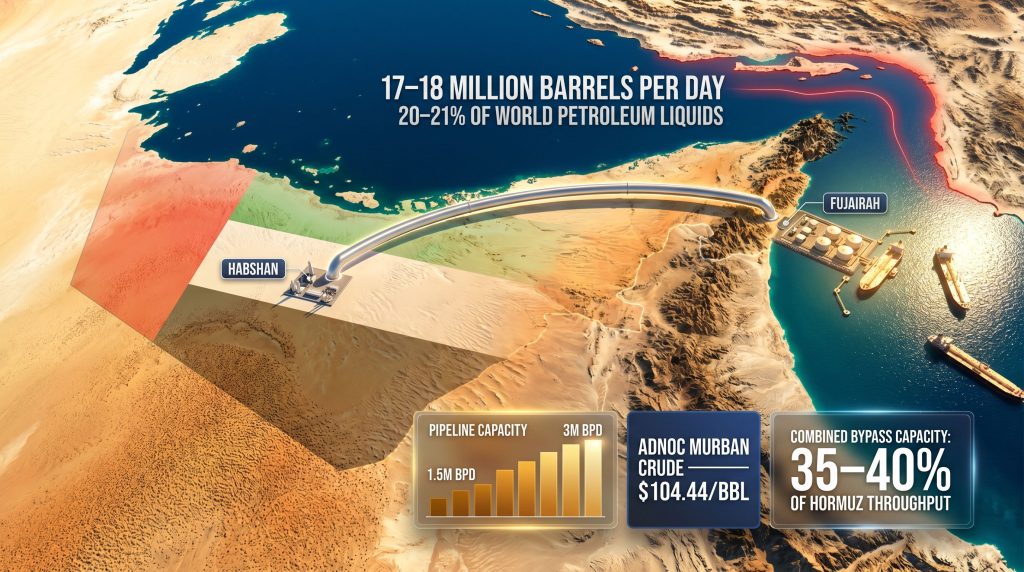
UAE Pipeline Expansion Bypasses Hormuz Strait
The section discusses significant ‘Capital Expenditure’ for ‘Projects’. The chart’s headline mentioning ‘Expansion’ directly correlates to large-scale project work that requires substantial financial investment.
(Source: Discovery Alert)
Table: ADNOC Strategic Infrastructure Investments
| Partner / Project | Time Frame | Details and Strategic Purpose | Source |
|---|---|---|---|
| West-East Pipeline Expansion | 2026 – 2027 | A new pipeline to double bypass export capacity from Fujairah to 3.0 – 3.6 million bpd. Project is 50% complete as of May 2026 and expected to be operational by 2027 to ensure market access amid Hormuz disruptions. | Reuters |
| ADNOC Capital Projects Pipeline | 2026 – 2028 | Plan to award AED 200 billion ($55 billion) in projects to support the production capacity increase to 5 million bpd by 2027 and enhance infrastructure resilience. | Oil & Gas Middle East |
| Multi-Fuel Pipeline to Fujairah | 2026 (Planning) | ADNOC is planning its first multi-fuel pipeline to transport refined products like gasoline, diesel, and jet fuel, further de-risking its downstream export business from maritime chokepoints. | Financial Times |
| Public-Private Partnership (PPP) Funding Models | 2026 | Abu Dhabi is expanding its use of PPPs to fund major infrastructure, including the AED 55 B project pipeline, to attract private investment and accelerate development. | S&P Global |
UAE vs. Saudi Arabia, ADNOC Pipeline Expansion in Regional Bypass Race
While the UAE’s pipeline expansion is a significant strategic move, it is part of a broader regional race to build bypass capacity in which Saudi Aramco currently leads, though ADNOC is aggressively investing to close the gap and establish the Port of Fujairah as a primary, secure export hub.
- In the 2021-2024 period, the regional bypass landscape was dominated by Saudi Arabia’s 1, 200-km East-West pipeline, with a nameplate capacity of 5 million bpd, which dwarfed the UAE’s 1.5 million bpd ADCOP pipeline.
- The crisis of 2025-2026 spurred both nations into action. ADNOC accelerated its project to reach a total bypass capacity of approximately 3.6 million bpd by 2027. Concurrently, Saudi Arabia pushed its existing pipeline to a maximum crisis capacity of around 7 million bpd.
- Even with these expansions, the combined major bypass capacity of approximately 10.6 million bpd can only cover about half of the 20 million bpd that normally transits the Strait of Hormuz, highlighting the continued strategic importance of the waterway.
- The trend is expanding regionally, with reports in June 2026 indicating that other Gulf producers like Kuwait, which are heavily reliant on the strait, are now more seriously pursuing regional pipeline tie-ups to gain alternative export access.

Map Shows Oil Bypasses for Strait of Hormuz
The section’s theme of a ‘Regional Bypass Race’ and comparison (‘UAE vs. Saudi Arabia’) requires a chart showing multiple routes. This chart, with its headline ‘Oil Bypasses’ (plural), provides the necessary regional context.
(Source: Reuters)
ADNOC Pipeline Technology for 3.6 M BPD Capacity (2021-2026)
The technology for large-scale crude oil pipelines is commercially proven, allowing for rapid construction schedules, but ADNOC’s new project integrates advanced systems for inspection, monitoring, and material integrity to ensure high reliability and long-term operational security.
- The existing ADCOP pipeline, operational since before 2021, established the technological and operational blueprint for the Habshan-Fujairah export route, demonstrating the viability of a large-diameter, long-distance pipeline in the region.
- The new expansion project builds on this foundation by incorporating advanced technologies to maximize safety and efficiency. These include the use of Intelligent Pigging (In-Line Inspection tools) for proactive maintenance and advanced fiber optic-based leak detection systems for real-time monitoring.
- To ensure long-term asset integrity, the project utilizes advanced materials and corrosion resistance techniques, such as high-density polyethylene (HDPE) liners and construction compliant with modern standards like API 5 L for line pipes.
- Beyond crude oil, ADNOC is also evaluating a separate pipeline for refined products. This move signals a diversification of the bypass strategy to protect its downstream value chain and secure export routes for products like gasoline, diesel, and jet fuel.
SWOT Analysis, ADNOC Hormuz Bypass Pipeline Strengths and Limitations
ADNOC‘s pipeline strategy effectively leverages its financial strength and geographic advantage to enhance energy security, but the project’s ultimate impact is constrained by the sheer scale of regional oil flows, a systemic risk that cannot be neutralized by a single nation’s infrastructure.
Table: SWOT Analysis for ADNOC Hormuz Bypass Pipeline
| SWOT Category | 2021 – 2024 | 2025 – Today | What Changed / Validated |
|---|---|---|---|
| Strengths | Existing 1.5 M bpd ADCOP provided a strategic hedge. Fujairah’s location offered a theoretical alternative export point outside the Persian Gulf. | Accelerated construction of a new pipeline to double capacity. UAE’s exit from OPEC allows it to leverage the new capacity for market share gain. Financial strength demonstrated by $55 B project pipeline. | The theoretical value of the Fujairah bypass was validated by real-world geopolitical events, transforming it from a “nice-to-have” into a critical national security asset. |
| Weaknesses | Bypass capacity (1.5 M bpd) was a fraction of the UAE’s total production and insignificant compared to the 21 M bpd Hormuz flow. Reliance on a single bypass pipeline. | Even with the expansion to 3.6 M bpd, total bypass capacity for the region (including Saudi Arabia’s 7 M bpd) covers only half of Hormuz transit volumes. High CAPEX required for expansion. | The crisis exposed the inadequacy of existing bypass infrastructure across the Gulf, confirming that even expanded capacity cannot fully replace the maritime route. |
| Opportunities | Position Fujairah as a major storage and trading hub. Attract investment in downstream facilities near the port. | Solidify Fujairah as a premier global energy hub. Lead regional infrastructure integration by offering pipeline tie-ups to neighbors like Kuwait. Capture global market share post-OPEC. | The pipeline project moves beyond a national strategy to become a potential cornerstone of a new, integrated regional energy grid that is less dependent on a single chokepoint. |
| Threats | Persistent geopolitical risk from Iran. The threat of attacks on maritime assets in the Strait of Hormuz was the primary concern. | Overland infrastructure itself can become a target. Competition from Saudi Aramco‘s larger and more established East-West pipeline. Risk of port congestion at Fujairah. | The threat matrix expanded from purely maritime chokepoints to include potential risks to fixed overland infrastructure, requiring different security considerations. |
ADNOC 2027 Outlook, 5 M BPD Production Target and Fujairah Hub
With the West-East Pipeline expansion on a fast track for a 2027 operational start, the most critical signal to watch is the parallel ramp-up of ADNOC‘s upstream production toward its 5 million bpd target, which will be the ultimate validation of the economic and strategic return on this massive infrastructure investment.
- If the new pipeline becomes fully operational by 2027 as planned, providing a total of 3.6 million bpd in bypass capacity…
- …watch for a corresponding stream of announcements from ADNOC regarding the completion of upstream expansion projects needed to supply this new pipeline capacity. A failure to align production growth with pipeline availability would strand the asset’s value.
- …these could be happening in parallel: major new investment decisions for storage tanks, jetties, and downstream processing facilities at the Port of Fujairah to handle the increased volume, and the formalization of pipeline tie-up agreements with neighboring countries, cementing a new regional energy export network.

Map Details ADNOC’s Hormuz Bypass Infrastructure
The section’s focus on the future ‘Fujairah Hub’ is best illustrated by a chart that details the physical ‘Infrastructure’ comprising this strategic asset, as stated in the chart’s headline.
(Source: MEES)
The questions your competitors are already asking
This report covers one angle of ADNOC’s Hormuz bypass strategy. The questions that matter most depend on your work.
- ADNOC investments and funding. Is the new ‘West-East Pipeline’ on track to support the UAE’s 5 M BPD production target post-OPEC exit?
- Which regional oil producers are gaining or losing ground as the UAE builds out its Hormuz bypass capacity?
- Who are ADNOC’s key engineering contractors and suppliers for the Hormuz bypass pipeline expansion?
- Hormuz bypass pipeline performance. What are the primary technical and operational risks in doubling ADNOC’s bypass capacity to 3.6 M BPD?
This report does not answer these. Enki Brief Pro does.
Your question, your angle, your framework. SWOT, PESTL, scenario modelling. The same niche depth, built around the decision your work actually depends on.
