

Offshore Wind Federal Risk, $1.8 B in Lease Buyouts for Total Energies & EDP, and 5 Project Suspensions (2021 to 2026)
US Offshore Wind Project Risk, Federal Policy Halts from Total Energies to RWE
The risk profile for U.S. offshore wind projects has fundamentally shifted from managing economic headwinds to surviving direct federal opposition, transforming a growth industry into one defined by strategic paralysis and litigation. Between 2021 and 2024, developers navigated inflation and supply chain constraints under a supportive policy framework. From 2025 onward, a complete reversal in federal policy created an existential threat, with the government actively using executive and legislative power to dismantle the sector.
- In the 2021-2024 period, the market was driven by the Biden-Harris Administration’s goal of 30 GW by 2030. While macroeconomic pressures led to PPA renegotiations and some cancellations, the overarching federal direction supported growth.
- On January 20, 2025, the Trump administration initiated its reversal with a memorandum halting new offshore wind leasing and pausing permits for existing projects, creating immediate and extreme regulatory uncertainty.
- The “One Big Beautiful Bill Act” (OBBBA), signed on July 4, 2025, curtailed critical federal tax credits, making the financing for new projects nearly impossible by imposing aggressive construction deadlines.
- On December 22, 2025, the Department of the Interior suspended the leases for all five major offshore wind projects under construction, including Coastal Virginia Offshore Wind (CVOW) and Vineyard Wind, citing national security concerns and halting billions in investment.
- This hostile environment forced companies into a defensive posture, with German utility RWE freezing all its U.S. offshore wind activities in April 2025 and other developers beginning to negotiate exits.
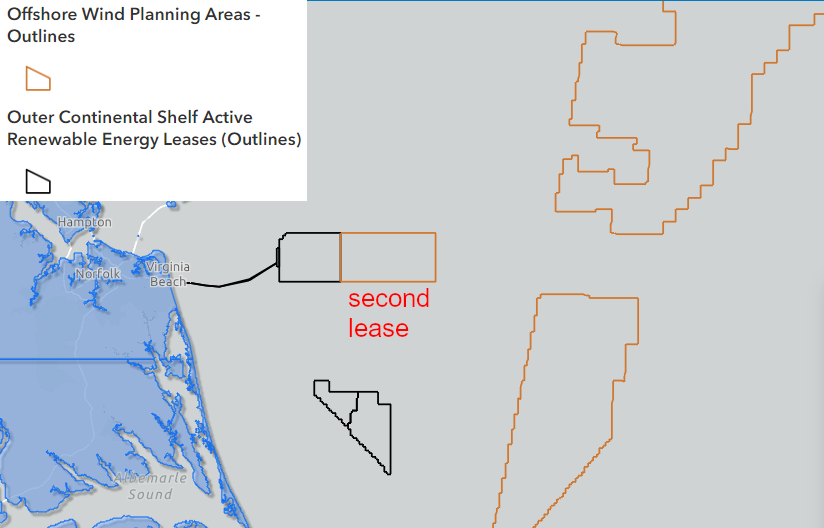
Map Details US East Coast Wind Leases
This map provides the essential geographic context for the section, which discusses risks and policy halts for US offshore wind projects. It visually grounds the locations of the leases where companies like Total Energies and RWE are operating and facing challenges.
(Source: Virginia Places)
$1.8 B in Cancellations, Total Energies and Other Developers Exit US Leases
The federal government weaponized taxpayer funds to accelerate the collapse of the U.S. offshore wind pipeline, committing nearly $2 billion to buy out leases from developers. This “pay-not-to-play” strategy represents an unprecedented use of public money to incentivize the abandonment of clean energy projects, with the deal involving Total Energies triggering a major legal challenge from affected states.
- The central conflict stems from a March 2026 agreement where the U.S. government committed to paying Total Energies approximately $928 million to terminate its leases for the Attentive Energy project (New York/New Jersey) and the Carolina Long Bay project.
- This followed an April 2026 deal where the administration paid EDP and Engie $885 million to walk away from their Bluepoint Wind and Golden State Wind leases off the California coast.
- A coalition of seven states, led by New York, filed a lawsuit on June 2, 2026, arguing the buyouts violate the Outer Continental Shelf Lands Act (OCSLA) and are an illegal use of executive authority.
- The buyouts have been effective in dismantling the project pipeline, which has contracted from 45 projects to just 23 over the past year, erasing years of development progress.
Table: Federal Buyouts of U.S. Offshore Wind Leases (2026)
| Company | Time Frame | Details and Strategic Purpose | Source |
|---|---|---|---|
| Total Energies | March 2026 | Agreed to a $928 million payment from the federal government to cancel its Attentive Energy and Carolina Long Bay leases. This deal is now the subject of a lawsuit by seven states. | ENR |
| EDP & Engie | April 2026 | Received an $885 million payment to abandon their Bluepoint Wind and Golden State Wind leases. This was the first major buyout under the new federal policy. | Los Angeles Times |
| RWE | May 2026 | Reportedly considering a similar exit deal. The company had previously frozen all U.S. offshore wind activities in April 2025 due to political uncertainty. | offshore WIND.biz |
Northeast vs Federal Government, Total Energies Lawsuit Shows Deepening Divide
The geography of U.S. offshore wind development has shifted from a bi-coastal expansion race to a legal battleground concentrated in the Northeast, where state governments are now the industry’s primary line of defense against federal opposition. While development was once a national ambition, the conflict is now defined by a coalition of states using the courts to protect their regional energy and economic goals.
- Between 2021 and 2024, geographic expansion was a key theme, with successful federal lease auctions held for areas off New York, New Jersey, the Carolinas, and California, driven by strong state-level procurement targets.
- From 2025, the focus narrowed dramatically as federal hostility froze development. The new center of activity is the court system, where northeastern states are fighting to preserve prior investments and future plans.
- The lawsuit filed on June 2, 2026, is led by New York and includes New Jersey, Connecticut, Maine, Massachusetts, Rhode Island, and Vermont. It directly challenges the federal government’s authority to pay Total Energies to abandon its leases in the region.
- The federal blockade has had direct consequences on state infrastructure plans, forcing the New Jersey Board of Public Utilities in August 2025 to delay its offshore wind transmission infrastructure development by over two years.
Total Energies and the US Market, Maturity Reversal from Growth to Litigation (2021 to 2026)
The U.S. offshore wind market’s maturation was abruptly reversed from commercial scaling to a state of government-induced paralysis, where legal challenges, not project execution, define progress. The industry shifted from a focus on reducing costs and building supply chains to litigating for its survival, fundamentally altering the metrics of success for developers like Total Energies.
- From 2021 to 2024, the market was progressing toward maturity. The first large-scale projects, Vineyard Wind and South Fork Wind, were under construction, and companies like Total Energies were actively expanding their portfolios by winning new leases. The primary focus was on achieving commercial viability and project execution.
- Starting in 2025, the market regressed into a state of arrested development. Active construction on five major projects was suspended, the pipeline of planned projects collapsed, and developer activity pivoted from development to negotiating exits or pursuing legal remedies.
- The primary validation point for the industry is no longer technical milestones or achieving a lower Levelized Cost of Energy (LCOE). Instead, it is the outcome of the lawsuit led by seven states, which will determine if billions in sunk costs can be salvaged.
SWOT Analysis, Total Energies and US Offshore Wind Federal Risk
The strategic landscape for U.S. offshore wind inverted between 2021 and 2026, as extreme political risk nullified market strengths and created existential threats. The industry’s foundation shifted from federal policy support and a large project pipeline to a reliance on state-level legal coalitions and the judicial system as its last line of defense.
Table: SWOT Analysis for U.S. Offshore Wind
| SWOT Category | 2021 – 2024 | 2025 – 2026 | What Changed / Validated |
|---|---|---|---|
| Strengths | Strong federal policy support (30 GW by 2030 goal); high demand from state-level procurements; falling LCOE projections. | A resilient and coordinated legal coalition of seven states; an independent judicial branch capable of reversing executive actions (e.g., reversing project suspensions in Feb 2026). | The source of industry strength shifted from federal executive policy to state-level legal resistance and the judicial system. |
| Weaknesses | Nascent domestic supply chain; port infrastructure limitations; high capital expenditure requirements. | Complete dependency on the outcome of litigation; frozen investment and development activity; inability to secure project financing due to policy risk. | Economic and logistical weaknesses were superseded by a fundamental inability to operate due to a hostile federal government. |
| Opportunities | Massive untapped wind resources; job creation potential; benefits from the Inflation Reduction Act (IRA) tax credits. | Establishing a legal precedent to limit executive authority in dismantling approved energy projects; potential for a market reset if the lawsuit succeeds. | Opportunities shifted from market growth and economic development to establishing legal guardrails that could enable a future recovery. |
| Threats | Inflationary pressures; rising interest rates; supply chain bottlenecks increasing project costs. | An executive branch actively working to eliminate the industry; use of taxpayer funds (nearly $2 billion) to buy out leases; legislative repeal of critical tax incentives. | The primary threat evolved from manageable macroeconomic factors to a direct and existential political risk that made the market un-investable. |
Total Energies and the 2026 Outlook, 1 Lawsuit Dictates Future of US Wind
The entire near-term future of the U.S. offshore wind industry now hinges on the outcome of the lawsuit filed by seven states to block the federal government’s lease buyouts. This legal challenge is the single most critical catalyst, and its resolution will determine whether the market can be salvaged or if the policy-driven collapse will become permanent.
- If the states’ lawsuit to block the $928 million Total Energies buyout succeeds, it could invalidate all similar deals and establish a powerful legal firewall against further executive attempts to dismantle the industry. This would be the first signal of a potential recovery.
- Watch for other developers, such as RWE, to halt any exit negotiations pending the court’s decision. A favorable ruling for the states could incentivize them to hold their leases rather than accept a buyout.
- The most critical near-term signal is any court order, such as a preliminary injunction, related to the lawsuit. Such a ruling would immediately alter the risk calculation for all developers, investors, and state governments.
The questions your competitors are already asking
This report covers one angle of the federal policy risk and strategic paralysis facing the US offshore wind sector. The questions that matter most depend on your work.
- Which offshore wind developers like TotalEnergies and RWE are most exposed to the federal policy reversal and project suspensions?
- What is the status of the five suspended offshore wind projects, including Coastal Virginia Offshore Wind and Vineyard Wind?
- What is the outlook for US offshore wind deployment through 2030, and is the original 30 GW goal still viable?
- How has the ‘One Big Beautiful Bill Act’ (OBBBA) impacted the financing and timelines for offshore wind projects?
This report does not answer these. Enki Brief Pro does.
Your question, your angle, your framework. SWOT, PESTL, scenario modelling. The same niche depth, built around the decision your work actually depends on.
