

Cameco Advanced Reactor Fuel, $80 B Westinghouse Deal, 22 M lbs India Contract, and Production Delays (2021 to 2026)
Uranium Supply Chain Risks Magnified by Production Delays and AI Demand Shock
The global uranium market has transitioned from a period of structural underinvestment into a state of acute supply fragility, where operational missteps are amplified by a new, unforeseen demand shock from the artificial intelligence sector. Between 2021 and 2024, the market was characterized by low prices and deferred production, creating the preconditions for a supply deficit. Since 2025, this deficit has become a market reality, exacerbated by production shortfalls at major producers and a surge in demand from data centers seeking reliable, carbon-free power, fundamentally altering the risk profile for the entire nuclear fuel supply chain.
- Between 2021 and 2024, years of depressed prices following the Fukushima incident led to a halt in new mine investment and the mothballing of existing capacity, including Cameco’s Mc Arthur River mine.
- Beginning in 2025, the demand side of the equation was rewritten by the power requirements of AI, with U.S. data center electricity needs projected to triple to 580 TWh by 2028, creating an urgent need for new baseload generation that nuclear is uniquely positioned to fill.
- This new demand collided with a tightening supply in 2025 and 2026. Cameco revised its 2025 production forecast for Mc Arthur River/Key Lake down to 14-15 million pounds from a target of 18 million pounds due to operational delays, while its primary competitor, Kazatomprom, also announced production cuts.
- The market bifurcation accelerated in 2026 following the U.S. ban on Russian uranium imports, increasing the strategic premium on reliable, Western-aligned suppliers like Cameco and pushing long-term contract prices toward the $100/lb mark.
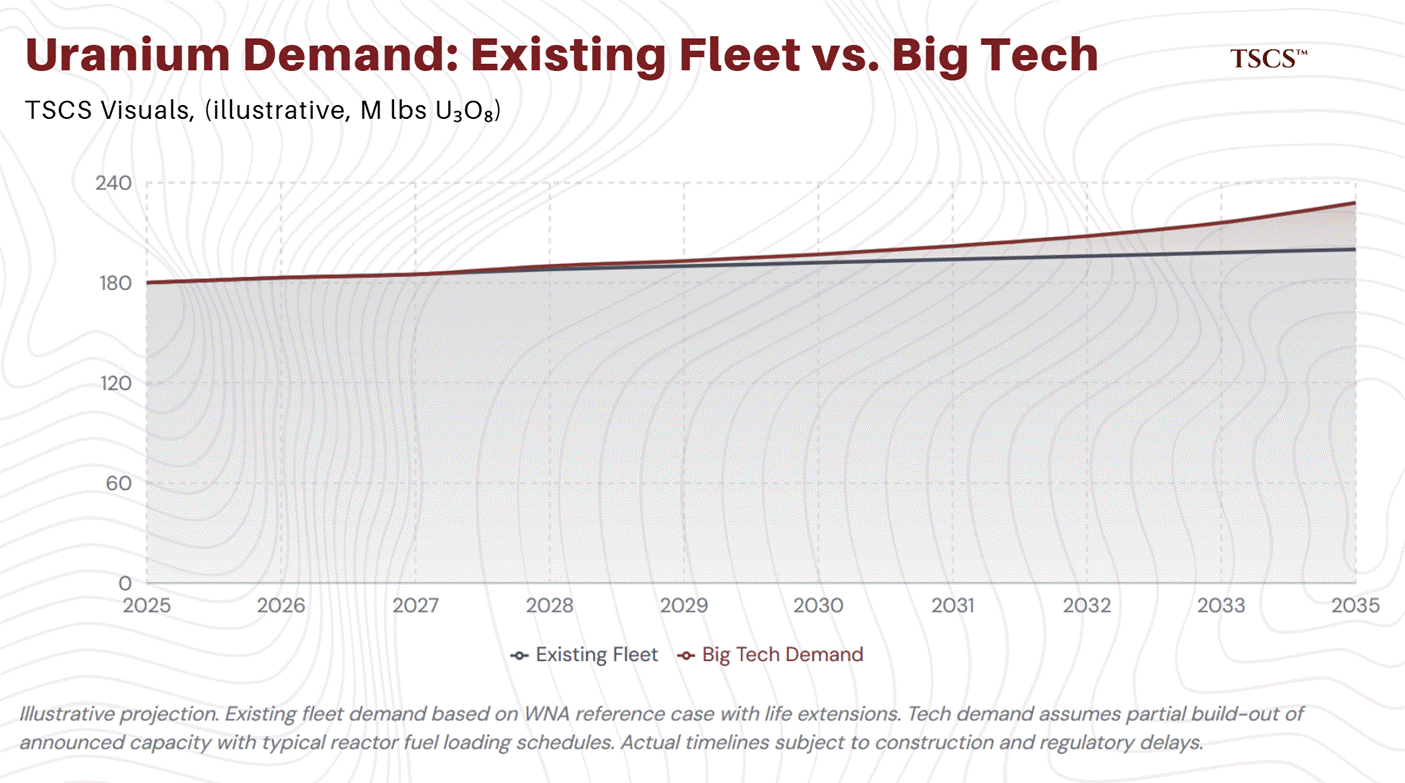
Big Tech Creates New Uranium Demand Shock
The section heading explicitly mentions an ‘AI Demand Shock.’ This chart’s headline is a direct and perfect match, illustrating the central thesis of the section by linking the cause (Big Tech/AI) to the effect (Uranium Demand Shock).
(Source: TSCS – Substack)
$17.5 B in Capital, Cameco Shifts Focus to Vertical Integration and Asset Ramp-Ups
Capital allocation in the uranium sector has pivoted from survival and maintenance to strategic expansion, with investments targeting both the security of upstream supply and the capture of downstream value. Cameco’s investment strategy exemplifies this shift, moving beyond its role as a pure-play miner to become an integrated nuclear energy company, a move financed by a market eager to fund the nuclear renaissance. This has also spurred investment from utilities like Southern Company and Dominion Energy in extending nuclear capacity.
- The most significant strategic investment was Cameco’s acquisition of Westinghouse Electric Company, finalized in 2025 with partner Brookfield Asset Management. This move provides vertical integration into reactor technology, services, and fuel fabrication.
- This acquisition was validated in October 2025 when the U.S. government struck a deal valued at up to $80 billion for new nuclear power plants, creating a direct downstream pull for Westinghouse technology and, by extension, Cameco’s fuel.
- Concurrent with its M&A strategy, Cameco is investing heavily in restarting and ramping up its tier-one assets, primarily the Mc Arthur River mine, with a long-term goal of reaching its licensed annual capacity of 25 million pounds to meet rising demand.
- Governmental support is de-risking these private investments. The U.S. Department of Energy is offering up to $17.5 billion in loan programs to support new reactor deployment, directly benefiting the ecosystem in which Cameco and Westinghouse operate.
Table: Cameco Strategic Investments and Capital Allocation
| Partner / Project | Time Frame | Details and Strategic Purpose | Source |
|---|---|---|---|
| DOE Loan Program | Jun 2026 | Up to $17.5 billion in low-interest loans offered by the U.S. Department of Energy to support fleet-scale nuclear reactor deployment, creating a significant demand pipeline for Westinghouse and Cameco. | Mining Weekly |
| Westinghouse Distribution | Early 2026 | Cameco received a $49 million cash distribution from its investment in Westinghouse, demonstrating early financial returns from the strategic acquisition. | Cameco |
| Mc Arthur River Ramp-Up | 2025 – 2026 | Ongoing investment to ramp up the Mc Arthur River mine towards its licensed annual capacity of 25 million pounds. This project is critical to meeting long-term contract commitments and alleviating Western supply deficits. | Fidelity |
| Westinghouse Acquisition | 2025 | In partnership with Brookfield, Cameco acquired Westinghouse, a leader in reactor technology. This vertically integrates Cameco across the nuclear fuel cycle, from mining to plant services. | Reuters |

Cameco Financials Show Strong Growth Forecast
This chart perfectly complements the table on ‘Cameco Strategic Investments and Capital Allocation.’ It provides a high-level visual summary of the expected outcome of the financial strategies and investments detailed in the table.
(Source: Yahoo Finance)
Cameco Strategic Alliances Reshape the Global Nuclear Fuel Market
Strategic partnerships have become the primary mechanism for navigating geopolitical risks and securing positions within a bifurcating nuclear fuel market. Cameco has leveraged alliances to lock in long-term demand, gain access to critical downstream markets, and solidify its role as the anchor of a Western-aligned supply chain. These moves are a direct response to the unreliability of historic supply chains and the need for energy security among allied nations.
- The joint acquisition of Westinghouse with Brookfield and the subsequent strategic partnership with the U.S. government, announced in October 2025, represent a foundational alliance to deploy American reactor technology on a global scale.
- In March 2026, Cameco signed a nine-year agreement with India’s Department of Atomic Energy to supply nearly 22 million pounds of uranium, a deal valued at an estimated $2.6 billion, securing a major non-Western market seeking to diversify its fuel sources.
- To counter Russian dominance in enrichment, Cameco signed an Mo U in February 2025 with Sask Power to evaluate developing a nuclear fuel supply chain in Saskatchewan, including potential enrichment services.
- A long-term supply agreement with Slovakia’s state-owned utility Slovenské Elektrárne in November 2025 further strengthened Cameco’s footprint in the European market as utilities actively shift procurement away from Russia.

Cameco Secures Decade-Plus Fuel Contracts
The section discusses ‘Cameco Strategic Alliances,’ and this chart provides a concrete, powerful example. Securing long-term contracts is a direct outcome of successful alliances and a key indicator of market reshaping.
(Source: TSCS – Substack)
Table: Cameco Strategic Partnerships (2025-2026)
| Partner / Project | Time Frame | Details and Strategic Purpose | Source |
|---|---|---|---|
| India DAE | Mar 2026 | Nine-year agreement to supply 22 million pounds of uranium concentrate, valued at an estimated $2.6 billion. This secures a major long-term contract with a key growing nuclear power. | Investor News |
| US Government & Brookfield | Oct 2025 | Strategic partnership to accelerate the deployment of Westinghouse reactor technologies, following the $80 billion deal for new nuclear power plants. This provides a direct line to future fuel and service contracts. | Cameco |
| Sask Power | Feb 2025 | Memorandum of Understanding (Mo U) to evaluate a comprehensive nuclear fuel supply chain in Saskatchewan, including uranium enrichment, to provide a Western alternative to Russian supply. | Macdonald-Laurier Institute |
US vs. Global Market, Cameco Anchors a New Western Nuclear Supply Chain
Geopolitical shifts have forced a realignment of the global nuclear fuel market, with North America emerging as the nucleus of a secure, Western-led supply chain. The period from 2021 to 2024 was the end of an era defined by globalized supply, including significant reliance on Russia and its allies. The period since 2025 is defined by energy security, with the U.S. and Canada taking decisive steps to onshore and friend-shore the entire fuel cycle, placing Cameco at the center of this new geographic focus.
- The most significant geographic driver is the U.S. effort to rebuild its domestic nuclear fuel capabilities. Policy support, including the Inflation Reduction Act and a $2.7 billion DOE investment announced in 2026 for domestic enrichment, aims to create a market for non-Russian fuel.
- As a Canadian company, Cameco is the primary beneficiary of this “friend-shoring” policy, providing a secure and stable source of uranium and conversion services for the U.S. market, which imports approximately 95% of its uranium.
- While North America is the core focus, Cameco is solidifying its role as the preferred Western supplier to a global customer base. Long-term contracts signed in 2025 and 2026 with partners in India and Slovakia demonstrate that nations outside the traditional Western bloc are prioritizing supply security over historic relationships.
- The growing urgency for clean power from tech giants like Google is primarily centered in the U.S., creating intense regional demand for new nuclear projects and their associated fuel contracts.

Uranium ETF Value Collapsed Post-2011
The section is about a ‘New Western Nuclear Supply Chain.’ This chart provides crucial historical context, illustrating the post-Fukushima market collapse that led to Western dependency on other regions and created the strategic imperative for the new supply chain Cameco is anchoring.
(Source: TSCS – Substack)
SMR Fuel Cycle Readiness is Now a Critical Path Constraint for Deployment
The transition of Small Modular Reactors (SMRs) from research concepts to commercially viable products is now directly constrained by the fragility of the nuclear fuel supply chain. Before 2025, the primary challenge for SMRs was technology development and licensing. Today, the critical question is whether the industry can produce the necessary fuel, particularly the High-Assay Low-Enriched Uranium (HALEU) many advanced designs require, at the scale and pace needed for deployment.
- Between 2021 and 2024, SMR development was led by technology companies, with fuel supply considered a future problem. Projects focused on achieving technical and regulatory milestones.
- Since 2025, with projects like the Darlington SMR project in Ontario moving toward construction, the fuel supply question has become immediate. Cameco’s investment in Westinghouse, a developer of SMRs like the AP 300 and e Vinci microreactor, gives it direct exposure to this emerging fuel market.
- The operational difficulties in ramping up conventional uranium production at Mc Arthur River in 2025 signal significant challenges ahead for the more complex HALEU fuel cycle, which has virtually no commercial-scale production outside of Russia.
- The successful deployment of SMRs, such as those being developed by Nu Scale Power, now depends not only on reactor technology but on the parallel success of massive government and private sector efforts to build an entirely new fuel supply chain from scratch.
SWOT Analysis of the Uranium Supply Chain
The uranium market is being reshaped by powerful and conflicting forces. An analysis of its strengths, weaknesses, opportunities, and threats reveals an industry at a critical inflection point, where immense opportunity is gated by significant execution risk.
- Strengths: Tier-one assets in stable jurisdictions and vertical integration offer a competitive advantage.
- Weaknesses: Operational execution risk has been validated by recent production downgrades.
- Opportunities: The AI-driven demand shock and bipartisan government support represent a paradigm shift.
- Threats: The entire supply chain is fragile, from mining inputs to enrichment capacity.

Uranium Supply Gap Projected to Widen Significantly
This chart is a strong visual for the SWOT analysis section, as the ‘supply gap’ represents a fundamental Threat for utilities and an Opportunity for producers like Cameco. It directly illustrates a core market dynamic that underpins the entire analysis.
(Source: The Pareto Investor – Substack)
Table: SWOT Analysis for the Uranium Supply Chain
| SWOT Category | 2021 – 2024 | 2025 – 2026 | What Changed / Validated |
|---|---|---|---|
| Strengths | Low-cost, tier-one assets (mothballed). Presence in stable political jurisdictions (Canada, Australia). | Restarted tier-one assets. Vertical integration into reactor tech (Westinghouse). Status as premier Western supplier. | The strategic value of being a non-Russian producer in a stable jurisdiction was validated and amplified by geopolitical events and policy shifts. |
| Weaknesses | Exposure to volatile spot prices. High costs of maintaining idled capacity. | Proven operational execution risk (Mc Arthur River delays). Dependence on a fragile supply chain for key inputs (e.g., sulfuric acid). | The theoretical risk of restarting complex mining operations was validated as a tangible weakness with the 2025 production downgrade. |
| Opportunities | Decarbonization narrative supporting nuclear energy. Gradual increase in long-term contract demand. | Exponential demand from AI/data centers. Massive government support (IRA, DOE loans). Market bifurcation leaving a void for Western suppliers. | The demand thesis for nuclear power fundamentally changed from a slow-moving climate solution to an urgent industrial necessity. |
| Threats | Persistent low uranium prices. Oversupply from state-owned enterprises (Kazatomprom). Negative public perception. | Geopolitical instability disrupting logistics. Industry-wide labor shortages and supply chain bottlenecks. Competitor production cuts creating market volatility. | Threats shifted from market-based (low prices) to operational and geopolitical (supply chain failure, resource nationalism). |

Uranium Market Deficit Deepens, Prices Spike
This chart is an excellent companion to the SWOT analysis table. It visually demonstrates the financial consequences (price spikes) of the supply deficit, which represents a key ‘Threat’ and ‘Opportunity’ detailed in the SWOT.
(Source: Global X ETFs)
2026 Scenario, Cameco Production and Contracting Are Key Signals to Watch
The trajectory of the nuclear renaissance in 2026 and beyond hinges on the uranium industry’s ability to execute. If producers like Cameco can deliver on their production promises and translate market demand into new contracts, it will validate the growth thesis. Failure to do so will expose the deep structural constraints of the supply chain and could temper the pace of nuclear deployment.
- If this happens: Cameco successfully meets its 2026 production guidance of 14-16.5 million pounds and demonstrates a clear path to its 25 million pound annual capacity target. This would signal that the worst of the operational restart challenges are resolved.
- Watch this: The announcement of new long-term contracts, particularly with non-traditional buyers. A power purchase agreement between a data center operator like Google or Amazon and a nuclear provider like Duke Energy would be a powerful market signal.
- These could be happening: A sustained uranium price above $90/lb could incentivize new exploration and development from junior miners, beginning the long process of building a healthier supply pipeline. Conversely, continued production delays could lead utilities to postpone reactor restarts or new build decisions due to fuel security concerns.
The questions your competitors are already asking
This report covers one angle of Cameco’s corporate trajectory. The questions that matter most depend on your work.
- new uranium mines coming online
- tech company nuclear power deals
- US domestic uranium enrichment projects
- recent long term uranium supply contracts
This report does not answer these. Enki Brief Pro does.
Your question, your angle, your framework. SWOT, PESTL, scenario modelling. The same niche depth, built around the decision your work actually depends on.
