

SMR Supply Chain, Nu Scale Power’s Standard Power Deal, $10 B Tech Investment, and PPA Bankability (2021 to 2026)
SMR Adoption Risks: Supply Chain Bottlenecks vs. PPA-Backed Demand Certainty, Nu Scale Power
The primary inhibitor to small modular reactor (SMR) deployment is not technology but the financial risk associated with an immature supply chain; however, recent long-term, fixed-price power purchase agreements (PPAs) from hyperscale data center operators are providing the bankable demand certainty required to stimulate new manufacturing investment. This shift addresses the longstanding stalemate where suppliers hesitated to build capacity without firm orders, and developers could not secure financing without them. This dynamic is also reflected in the strategies of established utilities like Southern Company and Dominion Energy, which are pursuing advanced nuclear options to manage projected load increases.
- Between 2021 and 2024, the SMR supply chain faced a critical “chicken-and-egg” problem where suppliers were reluctant to invest in scaling up capacity for nuclear-qualified components without firm, multi-unit orders. This hesitancy was compounded by a recognized shortage of skilled labor, including nuclear-qualified welders, machinists, and inspectors, creating a significant barrier to commercialization.
- Starting in 2025, the market shifted as hyperscalers began signing multi-decade PPAs, transforming speculative projects into bankable assets. Agreements like the one between Nu Scale Power and Standard Power to develop two SMR-powered data center sites signal committed, long-term demand that allows suppliers to secure financing for factory expansions.
- Despite this progress, significant bottlenecks persist, particularly in the domestic supply of High-Assay Low-Enriched Uranium (HALEU) fuel and the manufacturing of large forgings. The PPA structure creates the demand signal, but the physical ramp-up of this specialized industrial base will still dictate deployment timelines through 2030.
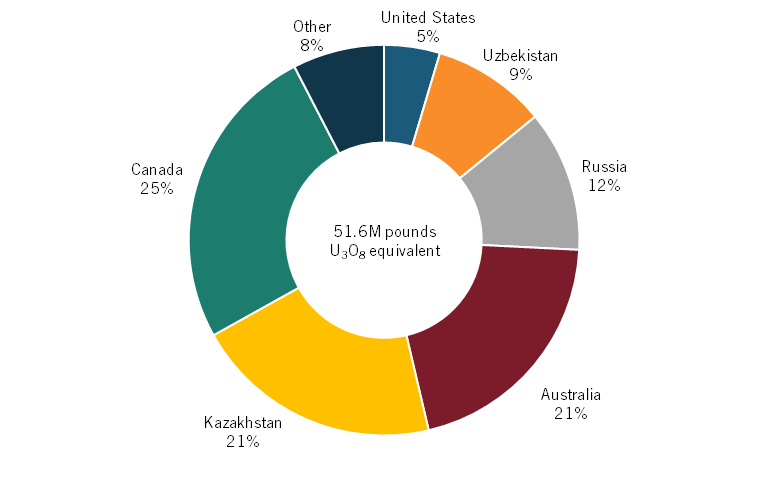
Global Uranium Supply Concentrated in Few Nations
This section discusses SMR adoption risks, specifically highlighting ‘supply chain bottlenecks.’ The chart directly visualizes this risk by showing the high concentration of global uranium supply in a small number of countries, illustrating a key vulnerability in the nuclear fuel supply chain.
(Source: Information Technology and Innovation Foundation (ITIF))
$10 B in Commitments, X-energy SMR Data Center Investments
Direct equity investments from technology companies are complementing PPAs by providing SMR developers with critical, upfront capital to navigate long development cycles and de-risk project execution. This financial backing from future customers like Amazon signals a deeper strategic alignment beyond simple energy procurement, accelerating technology development years before a reactor generates power.
- Tech giants have committed over $10 billion toward SMR development to power their data centers, a clear signal of their intent to secure a stable, carbon-free power source for the long term. This capital injection is crucial for first-of-a-kind (FOAK) projects with high initial costs.
- Amazon‘s strategic investment in X-energy in December 2025 is a primary example of this model. The funding helps X-energy advance its reactor design and manufacturing capabilities, directly supporting Amazon‘s goal of deploying SMRs for its data centers.
- This investment model provides SMR developers with the necessary working capital to manage the multi-year regulatory and licensing processes with the Nuclear Regulatory Commission (NRC), a period during which projects generate no revenue but incur significant engineering and legal costs.

Data Center Power Demand Projected to Surge
This section covers the ‘$10 B in Commitments’ for SMR data center investments. The chart provides the fundamental market driver for such large-scale investments by showing the massive projected surge in power demand from data centers, justifying the need for new, powerful energy sources like SMRs.
(Source: POWER Magazine)
Nu Scale Power Data Center Partnerships, Standard Power and Others (2025 to 2026)
Strategic partnerships have rapidly evolved from tentative Memorandums of Understanding (Mo Us) to definitive deployment agreements, as data center operators move to secure specific SMR technologies and development slots to meet their projected power needs for the early 2030 s. This transition marks a critical shift from exploration to execution, creating a pipeline of tangible projects.
- In April 2026, Nu Scale Power entered an exclusive technology agreement with Standard Power to develop two SMR-powered facilities in Ohio, intended to directly power data center operations. This moves beyond theoretical application to concrete site and technology selection.
- Google signed a deployment agreement with Kairos Power in March 2026, with the goal of deploying up to 500 MW of SMRs by 2035. This establishes a clear, long-range capacity target tied to a specific developer.
- In January 2025, Terra Power and Sabey Data Centers announced an Mo U for the potential use of Natrium advanced reactors. While an earlier-stage agreement, it represents the broadening interest across different SMR technologies to serve the data center market.
- Microsoft’s PPA with fusion developer Helion in April 2026, while for a different nuclear technology, reinforces the willingness of hyperscalers to sign long-term, pre-commercial contracts to secure novel, firm, and clean power sources. This trend is also evident in the large-scale energy planning of utilities like Duke Energy.

AI Data Center Power Needs Rival Nuclear Reactors
This section focuses on specific partnerships between Nu Scale and data centers. The chart perfectly explains the ‘why’ behind these partnerships by comparing the scale of AI data center power needs directly to the output of nuclear reactors, establishing nuclear as a viable, and necessary, solution.
(Source: tech plus trends)
Table: Key Nuclear and Data Center Partnership Agreements
| Partner / Project | Time Frame | Details and Strategic Purpose | Source |
|---|---|---|---|
| Google / Kairos Power | Mar 2026 | Deployment agreement to deploy up to 500 MW of SMRs by 2035, securing a long-term development pipeline for Google’s data center power needs. | Mintz |
| Meta / Prometheus Hyperscale | Jan 2026 | Non-binding Letter of Intent for a PPA to provide 100 MW of power from one or more SMRs, signaling initial commercial intent. | Data Center Dynamics |
| Talen Energy / Amazon Web Services (AWS) | Jun 2025 | A 17-year PPA for 1.92 GW of electricity from the existing Susquehanna nuclear plant, demonstrating the PPA model’s application at scale. | i Recruit |
| Terra Power / Sabey Data Centers | Jan 2025 | An Mo U to explore using Natrium advanced reactors, indicating early-stage collaboration to match reactor design with data center power requirements. | Terra Power |

SMRs vs. Renewables for Data Center Power
The section is a table listing key partnership agreements. This chart provides crucial context for why these partnerships are specifically forming around nuclear SMRs, by comparing their attributes for powering data centers against those of renewables, highlighting advantages like land use and reliability.
(Source: iRecruit.co)
US Dominance in SMR Siting, Nu Scale Power and Global Competition
The United States has firmly established itself as the global epicenter for SMR development aimed at data centers, driven by a combination of massive, concentrated power demand from the tech sector, substantial federal incentives, and a clearly defined regulatory pathway. This has given the U.S. a significant lead in tangible project development over other nations.
- As of May 2026, the U.S. leads the world with 28 distinct SMR siting activities, far outpacing Canada (9) and the UK (7). This activity is directly tied to powering industrial and data center loads.
- Project announcements are concentrated in states with growing data center industries and supportive regulatory environments, such as Ohio (Nu Scale Power/Standard Power) and Texas (Dow/X-energy), demonstrating a clear link between energy demand and SMR siting.
- Federal support through the Inflation Reduction Act (IRA), which provides crucial investment and production tax credits, significantly improves the economic viability of these capital-intensive projects in the U.S. compared to other regions.
- While the European Commission has set a goal for deploying its first SMRs by the early 2030 s, the U.S. market is characterized by more advanced, commercially-driven projects backed by firm offtake agreements from corporate buyers.

US Leads in Operational Nuclear Reactors, Lags in New Construction
This section discusses ‘US Dominance’ and ‘Global Competition’ in the SMR space. The chart directly addresses this theme by showing that while the US has a large existing fleet of reactors, it is falling behind in new construction, which is the crux of the future competitive landscape for SMR deployment.
(Source: Information Technology and Innovation Foundation (ITIF))
2027 Outlook: PPA-Driven Supply Chain Investment, Nu Scale Power
The single most critical signal for the SMR sector in the next 12-18 months will be the materialization of new, large-scale manufacturing capacity announcements from component suppliers, which would validate that PPA-backed demand from data centers is successfully de-risking the entire nuclear value chain.
- If this happens: Announcements of new or expanded factories for nuclear-grade forgings, valves, instrumentation, and control systems will confirm that the demand signals from hyperscaler PPAs are strong enough to unlock capital for the industrial base.
- Watch this: Monitor quarterly earnings calls and press releases from both SMR developers like Nu Scale Power and X-energy and their key industrial partners for specific commitments to new production lines or facilities.
- These could be happening: We may see an increase in SMR developers making strategic acquisitions of smaller manufacturing firms to secure their supply chains, or the formation of supplier consortiums to share the risk of building new capacity ahead of firm reactor orders.

Nuclear Power Leads in Energy Reliability
This section’s outlook connects ‘PPA-Driven’ investment with demand certainty. The chart’s focus on nuclear power’s superior reliability (capacity factor) provides the core rationale for why a data center operator would sign a long-term, binding Power Purchase Agreement (PPA), thereby securing the demand needed to spur supply chain investment.
(Source: Information Technology and Innovation Foundation (ITIF))
The questions your competitors are already asking
This report covers one angle of small modular reactor commercialization. The questions that matter most depend on your work.
- US nuclear fuel supply chain investment
- Nuclear component supplier factory expansions
- Nuclear reactor licensing timeline US
- Other data center deals for nuclear power
This report does not answer these. Enki Brief Pro does.
Your question, your angle, your framework. SWOT, PESTL, scenario modelling. The same niche depth, built around the decision your work actually depends on.
