

SOFC Data Center Deals, $5 B Brookfield Partnership, $7.65 B in Contracts, and 2 GW Bloom Energy Capacity Expansion (2025-2026)
The explosive power demand from artificial intelligence has collided with the structural limits of legacy electricity grids, creating a power vacuum that behind-the-meter (BTM) generation is aggressively filling. Protracted permitting, interconnection delays, and stalled financing for grid upgrades have made utility-scale power unreliable for the time-sensitive needs of data center operators. In this environment, Solid Oxide Fuel Cells (SOFCs) have emerged as a leading BTM solution, validated by a surge in commercial deployments and major capital commitments between 2025 and 2026. The technology’s rapid deployment schedule, high efficiency, and fuel flexibility provide a decisive advantage for critical infrastructure that cannot wait for the grid to catch up.
BTM Adoption for Data Centers, Bloom Energy and the 40 GW Texas Demand
The failure of grid infrastructure to meet exponential AI power demand has forced a rapid commercial pivot to on-site solutions, establishing SOFCs as essential infrastructure rather than a niche alternative. While grid reliance was the default model before 2024, the period from 2025 to 2026 marked an inflection point where the economic and operational risks of grid dependency became untenable for hyperscalers and data center developers.
- Before 2025, BTM generation was primarily viewed as a source for resilience or ancillary power. The market shifted dramatically as grid interconnection queues lengthened and project cancellations mounted, with 266 GW of power projects canceled in 2025 alone, creating a severe bottleneck for new data center developments.
- The insatiable energy appetite of AI became a primary driver, with projections showing Texas data center capacity alone surging to 40 GW by 2028. This created a “killer application” for SOFCs, which captured an estimated $7.65 billion in data center power deals in a 90-day period in early 2026.
- The core value proposition of SOFC technology shifted from efficiency and emissions to speed and certainty. Systems can be deployed in as little as 90 days, providing a stark contrast to the multi-year timelines for new grid connections, which represents a critical competitive advantage.
- The technology is also finding applications beyond data centers, signaling broader market validation. For example, the EU-backed HELENUS project was launched in February 2026 to develop next-generation SOFCs for the maritime sector, demonstrating the technology’s adaptability to other power-intensive industries.
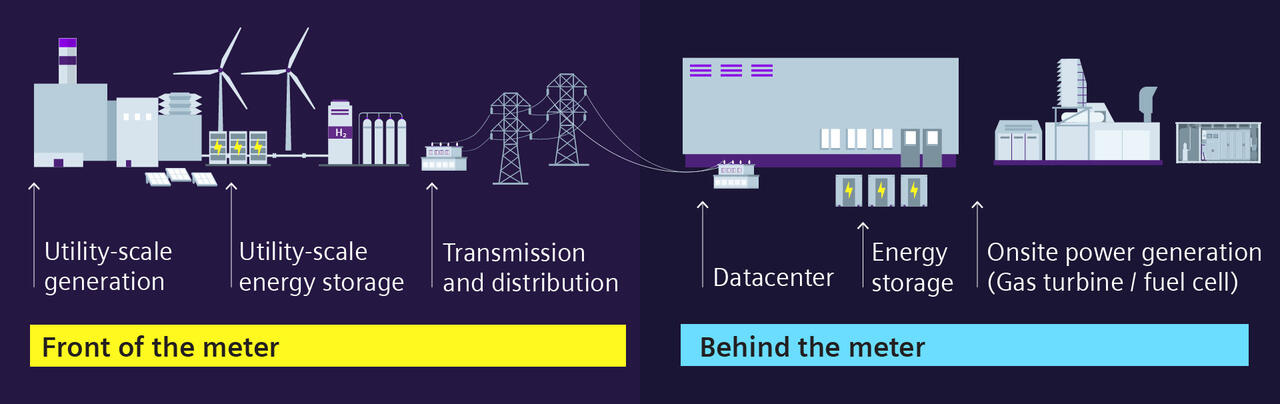
Diagram Defines ‘Behind-the-Meter’ Power Generation
This diagram provides a foundational visual definition of the ‘Behind-the-Meter’ (BTM) concept, which is essential for understanding the section’s core topic of BTM adoption for data centers.
(Source: Tech Investments)
$5 B Brookfield Fund, Bloom Energy and SOFC Project Finance
Major institutional capital began flowing into dedicated BTM fuel cell deployment vehicles in 2025 and 2026, validating the on-site power generation model and de-risking project finance for large-scale installations. This represents a significant change from the earlier market, which relied on smaller, project-specific financing and corporate balance sheets.
- The most significant validation of the BTM fuel cell model came in November 2025, when Brookfield Asset Management established a $5 billion infrastructure vehicle specifically to deploy Bloom Energy‘s SOFC technology at AI data centers globally. This move signaled strong investor confidence in the technology’s financial returns and scalability.
- The bankability of fuel cell projects was further demonstrated in March 2026 when a bank lender provided US$100 million in mezzanine financing to Scale Microgrids for a Combined Heat and Power (CHP) fuel cell project, confirming that financial institutions are now comfortable underwriting such assets.
- This investment is fueling a rapid expansion of manufacturing capacity. In July 2026, Bloom Energy announced plans to expand its annual production capacity to 2 GW, a move driven explicitly by the surge in demand from AI data centers and the need to fulfill large-scale deployment commitments.
Table: Key SOFC Investments and Financing Deals
| Partner / Project | Time Frame | Details and Strategic Purpose | Source |
|---|---|---|---|
| Bloom Energy | Jul 2026 | Announced expansion of annual manufacturing capacity to 2 GW to meet accelerating demand from AI data centers and fulfill large-scale deployment orders. | rejobs.org |
| Scale Microgrids | Mar 2026 | Secured $100 million in mezzanine financing from a bank lender for the Bridgeport fuel cell CHP project, demonstrating the growing bankability of SOFC installations for institutional investors. | White & Case |
| Bloom Energy / Brookfield Asset Management | Nov 2025 | Brookfield established a $5 billion investment vehicle dedicated to deploying Bloom Energy SOFCs at AI data centers, providing a massive pool of capital to accelerate BTM adoption. | Green Front Energy |
Centrica and Brookfield, 2 Major SOFC Deployment Partnerships (2025-2026)
Strategic alliances formed in 2025 and 2026 brought together SOFC technology providers, energy companies, and major financiers to create end-to-end solutions for BTM power. These partnerships focus on capturing the market created by grid deficiencies, targeting both off-grid industrial needs and the power-hungry data center sector.
- The partnership between Brookfield and Bloom Energy, announced in late 2025, aims to deploy up to $5 billion of SOFC technology for AI infrastructure, creating a powerful combination of technology and capital to bypass utility constraints.
- In May 2026, Delta Electronics and Centrica formed a strategic alliance to deploy SOFC power solutions specifically for off-grid energy needs. This partnership directly addresses the market for customers seeking independence from an unreliable grid.
- Public-private partnerships are also advancing the technology. The EU-funded HELENUS project, announced in February 2026, brings together Genevos and other European partners to develop next-generation SOFC solutions for the maritime industry, which will generate technology improvements applicable to stationary power. Another key player, Ceres Power, has also been active in forming partnerships to advance its technology.
Table: SOFC Strategic Partnerships and Alliances
| Partners | Time Frame | Details and Strategic Purpose | Source |
|---|---|---|---|
| Delta Electronics / Centrica | May 2026 | Formed a strategic partnership to deploy SOFC solutions for off-grid energy applications, directly targeting the market created by grid unreliability. | open PR |
| Genevos / European Union | Feb 2026 | Launched the HELENUS project to develop a next-generation SOFC solution for commercial shipping, aiming to reach TRL 7 and drive technology maturation. | Fuel Cells Works |
| Bloom Energy / Brookfield | Nov 2025 | Announced a strategic partnership to deploy up to $5 billion of Bloom Energy‘s SOFC technology into AI infrastructure, combining capital and technology for large-scale BTM projects. | Green Front Energy |
US vs. Asia-Pacific, SOFC Market Growth and Data Center Demand
While North America, driven by the U.S. data center boom and supportive policies, is the epicenter of BTM SOFC deployment, rapid growth in the Asia-Pacific region indicates a global trend toward energy decentralization in response to similar infrastructure constraints. The market’s geographic focus has intensified in areas where rapid industrial growth is outpacing grid capacity.
- The United States is the dominant market for BTM SOFCs, driven by the massive power requirements of AI data centers in hubs like Texas and Virginia. Federal policies like the Inflation Reduction Act provide significant tax incentives that lower the capital cost and improve the economics of fuel cell deployments.
- Market reports from 2026 consistently identify the Asia-Pacific region as the fastest-growing market for SOFCs. This growth is fueled by increasing energy demand, a push for energy security, and infrastructure limitations in rapidly industrializing nations, mirroring the dynamics seen in the U.S.
- Europe is pursuing a more R&D-focused strategy, using public funding mechanisms to advance next-generation SOFC technology for specific industrial goals like decarbonizing shipping, as seen with the HELENUS project. This approach is aimed at building technological leadership and future export opportunities.

Microgrid Market to Reach ~$170B by 2035
This chart provides crucial macro-level context for the section’s discussion on SOFC market growth. As SOFCs are a key microgrid technology, the projected expansion of the total microgrid market indicates a significant tailwind for SOFC demand.
(Source: Market.us)
TRL 7-8 Commercial Readiness, SOFC Cost and LCOE Viability
SOFC technology has reached a level of commercial maturity where its techno-economic viability is now determined less by its absolute cost and more by the immense opportunity cost of grid-related delays for critical infrastructure. In the period from 2025-2026, the conversation shifted from whether SOFCs were too expensive to whether companies could afford not to use them.
- Before 2025, the high capital cost of SOFCs compared to grid power or natural gas generators was a major barrier to adoption. The technology was generally considered to be at a pilot or early commercial stage for stationary applications.
- By 2026, SOFC systems reached a Technology Readiness Level (TRL) of 7-8, indicating they are demonstrated and ready for commercial deployment. This maturity is evidenced by systems achieving long-term durability of over 80, 000 hours in commercial settings.
- While CAPEX for pilot systems remains high (around €4, 000 to €5, 000 per k We), the Levelized Cost of Energy (LCOE) becomes highly competitive at the scale required for data centers. Studies show LCOE can decline from $0.194/k Wh for small systems to $0.162/k Wh at the gigawatt scale.
- The decisive economic factor is no longer the LCOE versus the grid, but the cost of stranded, powerless GPUs. For a hyperscaler, a 12-24 month delay waiting for a grid connection is economically indefensible, making the premium for a rapidly deployed SOFC system a sound investment.

SOFCs Show Decisive Cost Advantage Over Grid Power
This chart directly illustrates the section’s theme of ‘LCOE Viability’ by quantitatively comparing the cost of SOFC power against grid power, substantiating the claim of a decisive cost advantage.
(Source: Energy Industry Insights from Avanza Energy – Substack)
SWOT Analysis, SOFC Strengths and Grid Dependency Threats
The strategic position of SOFC technology was fundamentally altered between 2025 and 2026, as grid unreliability turned from a background risk into a primary market driver. The technology’s core strengths in reliability and deployment speed became paramount, while its weaknesses are increasingly viewed as manageable engineering and supply chain challenges rather than fundamental barriers.
- The key change is that the “Threat” of grid instability and financing stalls became the single greatest “Opportunity, ” creating a multi-billion-dollar BTM market where SOFCs have a distinct competitive advantage.
- The “Strength” of fuel flexibility (natural gas today, hydrogen tomorrow) provides a pragmatic decarbonization pathway that aligns with both immediate reliability needs and long-term sustainability goals.
- The primary “Weakness” remains the reliance on the natural gas supply chain and the challenge of rapidly scaling manufacturing to meet a sudden surge in demand, which could create bottlenecks.

SOFCs Deploy Years Faster Than Grid Connections
The chart exemplifies a key ‘Strength’ of SOFCs (rapid deployment) and highlights the ‘Threat’ of grid dependency (long connection wait times), making it a perfect illustration for the SWOT analysis section.
(Source: Energy Industry Insights from Avanza Energy – Substack)
Table: SWOT Analysis for SOFC Behind-the-Meter Deployment (2025-2026)
| SWOT Category | 2021 – 2024 View | 2025 – 2026 View | What Changed / Validated |
|---|---|---|---|
| Strengths | High efficiency, low criteria pollutants, continuous power. Primarily seen as a clean energy alternative for niche applications. | Rapid deployment (months, not years), proven reliability (five-nines availability), and fuel flexibility (natural gas, biogas, hydrogen). | The market validated speed and reliability as the most critical strengths, making SOFCs a primary solution for time-sensitive data center construction. |
| Weaknesses | High CAPEX compared to grid power and traditional generators. Perceived technology risk and limited manufacturing scale. | Continued reliance on natural gas infrastructure. Manufacturing capacity is a potential bottleneck to meeting demand from companies like the top 2 fuel cell companies. CAPEX remains a consideration. | The opportunity cost of grid delays now outweighs the high CAPEX, reframing the cost as an investment in speed-to-market rather than an expense. |
| Opportunities | Decarbonization goals, government subsidies for clean energy, potential use in microgrids. | Explosive power demand from AI data centers. A multi-billion-dollar BTM market created by grid interconnection delays and financing stalls. | The AI power demand surge became the “killer application” that moved SOFCs from a niche opportunity to a mainstream infrastructure solution. |
| Threats | Competition from other clean technologies (solar+storage). Fluctuations in natural gas prices. Policy uncertainty. | A future glut of grid capacity if large-scale transmission projects accelerate. Competing BTM technologies (e.g., advanced nuclear). A policy shift away from tech-neutral credits. | The threat of grid modernization remains long-term, but the immediate crisis has created a durable market for SOFCs expected to last through the decade. |
Bloom Energy Future Growth, BTM Data Center Market Scenarios
The primary trajectory for SOFCs in the next 12 to 18 months depends on the ability of manufacturers to execute on promised capacity expansions to meet the validated, multi-billion-dollar demand from the data center industry. The market has proven the demand exists; the key variable now is supply.
- If this happens: Major manufacturers like Bloom Energy successfully execute on their announced capacity expansions, such as the ramp-up to 2 GW annually. This would enable them to fulfill large-scale orders from hyperscalers and solidify SOFCs’ role as a mainstream power source for digital infrastructure.
- Watch this: The rate of new large-scale financing vehicles modeled after the $5 billion Brookfield partnership. The formation of similar funds would signal that capital markets continue to favor the BTM model over waiting for grid-scale projects.
- These could be happening: An acceleration in projects that blend alternative fuels, such as biogas or green hydrogen, into the fuel mix for SOFCs to address corporate decarbonization targets. Furthermore, expect increased competition as other fuel cell and modular power technology providers attempt to enter the lucrative data center market.
The questions your competitors are already asking
This report covers one angle of fuel cell adoption in the data center market. The questions that matter most depend on your work.
- Alternative on-site power for data centers
- Data centers using hydrogen fuel cells
- Infrastructure funds investing in data center power
- Data center projects facing power delays
This report does not answer these. Enki Brief Pro does.
Your question, your angle, your framework. SWOT, PESTL, scenario modelling. The same niche depth, built around the decision your work actually depends on.
