

Westinghouse Advanced Reactor Supply Chain, $80 B Brookfield Partnership, 10-Reactor Plan, and $17.5 B DOE Loan (2021 to 2026)
Nuclear Supply Chain Risk, Westinghouse 10-Reactor Demand Shock
The U.S. nuclear supply chain is undergoing a forced revitalization, shifting from decades of dormancy to facing a coordinated, large-scale demand signal driven by Westinghouse Electric Company. The primary risk to a domestic nuclear expansion is not technology but the atrophied state of the industrial base, particularly for heavy forgings and long-lead-time components. Westinghouse’s plan to deploy ten new AP 1000 reactors, backed by an $80 billion partnership, directly confronts this “chicken-and-egg” dilemma, where manufacturers would not invest without firm orders and developers could not order without a reliable supply chain.
Pre-2025 Supply Chain Atrophy
Before 2025, the U.S. nuclear supply chain was defined by its limitations following decades without significant new construction projects. The experience with cost and schedule overruns at projects like Plant Vogtle created intense risk aversion among suppliers, who were hesitant to invest in expanding capacity for a market that consisted of one-off, high-risk builds. This resulted in a constrained industrial base, with estimates indicating that existing global capacity could only support the deployment of approximately 3 GW of new large-reactor capacity per year, a fraction of what is needed to meet national energy and climate targets.
The 2026 Coordinated Demand Signal
The strategic shift occurred in late 2025 and 2026 with the announcement of a large-scale, programmatic approach to new builds. By committing to a standardized fleet of ten AP 1000 reactors, Westinghouse and its partners created a predictable, multi-year order book. This programmatic demand is designed to give suppliers the confidence to make capital-intensive investments in new tooling and production lines. This approach moves the industry away from bespoke, high-risk projects toward an assembly-line model that enables economies of scale, learning-curve efficiencies, and a more resilient domestic manufacturing base.
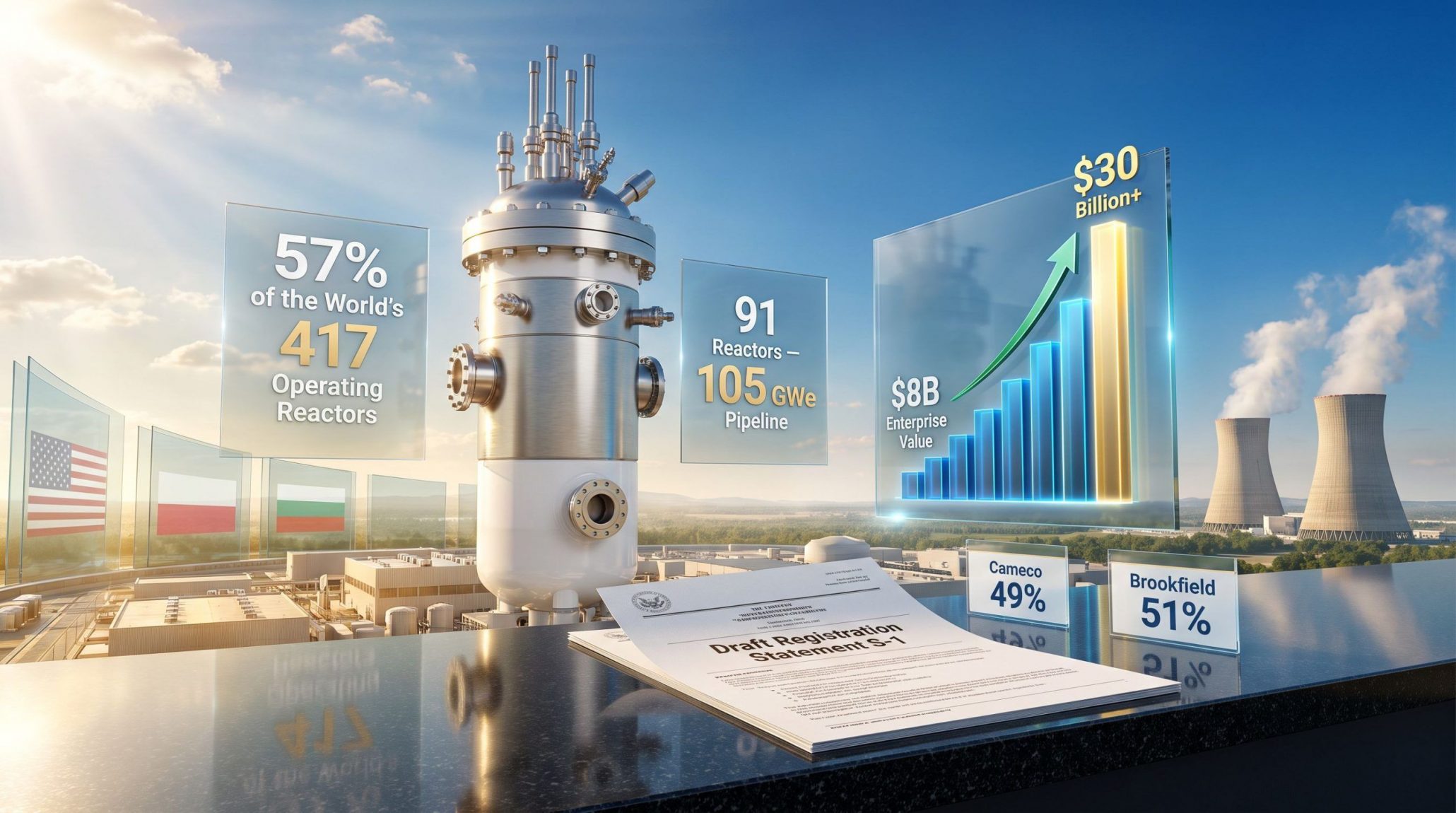
Westinghouse Dominates Nuclear Pipeline, Targets $30B+ Valuation
Westinghouse, implied by the S-1 filing and Brookfield/Cameco ownership, is a dominant force in nuclear, operating 57% of the world’s 417 reactors and boasting a 91-reactor (105 GWe) pipeline. The firm targets an aggressive growth in enterprise value from $8B to over $30B, signaling a massive expansion phase.
(Source: Westinghouse megadeal set to revitalize nuclear supply chain | Reuters)
$97.5 B in Capital, Westinghouse Reactor Deployment Plan (2025-2026)
A combination of private capital and substantial government financial de-risking underpins the entire Westinghouse reactor deployment strategy, directly addressing the investment paralysis that has plagued the nuclear supply chain. The credibility of the 10-reactor plan is anchored by a landmark $80 billion private financing partnership and a pivotal $17.5 billion federal loan commitment, which together solve the primary barrier to supplier investment: lack of guaranteed offtake.
- The pre-2025 period was characterized by a lack of large-scale, programmatic investment, with financing focused on individual projects or advanced reactor research rather than supply chain capacity.
- The major change in 2025-2026 was the creation of a massive, coordinated capital pool specifically designed to backstop a fleet of reactors, providing financial security for component orders with multi-year lead times.
- The plan is projected to generate $1 trillion in economic output over the 80-year lifespan of the reactors, creating a powerful economic case for the upfront public and private investment.
- Before this initiative, suppliers faced significant financial risk in manufacturing components like reactor pressure vessels without firm, multi-unit orders; the new financing structure effectively removes this risk.
Table: Key Investments in Westinghouse’s Reactor Plan and Nuclear Supply Chain (2024-2026)
| Investing Entity | Time Frame | Details and Strategic Purpose | Source |
|---|---|---|---|
| U.S. Department of Energy (DOE) | Jun 23, 2026 | Announced a $17.5 billion conditional loan commitment to procure specialized long-lead components for up to 10 AP 1000 reactors across five projects, directly de-risking the supply chain for manufacturers. | Inbound Logistics |
| U.S. Gov, Brookfield, Cameco | Oct 28, 2025 | Formed an $80 billion partnership to deploy a new fleet of AP 1000 reactors. The structure provides the financial backing and fuel cycle stability needed to support a multi-reactor construction program. | Reuters |
| Westinghouse | Nov 02, 2025 | Began construction of an 87, 000 sq. ft. manufacturing facility for its e Vinci microreactor program, advancing manufacturing readiness for a different segment of the nuclear market. | Nuclear Innovation Alliance |
| U.S. Government | Nov 12, 2024 | Set a national goal to add 35 GW of new nuclear capacity by 2035 and achieve a build rate of 15 GW per year by 2040, establishing the top-down policy driver for these investments. | U.S. Department of Energy |
Westinghouse Partnerships, Brookfield and Cameco Deals
The execution of the 10-reactor plan is enabled by a multi-layered partnership strategy that combines financial strength, fuel cycle expertise, and supply chain diversification. Prior to 2025, partnerships were often project-specific or focused on R&D. The new strategy, crystallized by the October 2025 announcement, establishes a durable, long-term consortium capable of executing a national-scale industrial project, addressing everything from reactor financing to fuel supply and component sourcing.
The Foundational Financial Alliance
The cornerstone of the entire initiative is the strategic partnership between the U.S. Government, Brookfield Asset Management, and Cameco. This alliance provides a comprehensive solution: Brookfield brings immense private capital and infrastructure investment expertise, Cameco secures the nuclear fuel cycle from front to back, and the U.S. government facilitates financing and permitting. This structure signals to the market that the 10-reactor program is not a speculative venture but a commercially robust, fully-funded endeavor.
Supply Chain and Technology Diversification
Beyond the core financial group, Westinghouse has actively formed alliances to expand its supplier base and technology portfolio. Agreements with Canadian suppliers in September 2024 and March 2025 demonstrate a deliberate effort to build a more resilient North American supply chain, moving beyond the confines of the U.S. industrial base. Concurrently, a March 2025 agreement with Terrestrial Energy to supply fuel for its molten salt reactor shows Westinghouse is also positioning itself as a key supplier for the broader advanced reactor market, diversifying its business beyond its own AP 1000 technology.
Table: Westinghouse Strategic Partnerships for Nuclear Supply Chain (2024-2026)
| Partner(s) | Time Frame | Details and Strategic Purpose | Source |
|---|---|---|---|
| Nordion, PSEG | Jan 28, 2026 | Signed long-term agreements to establish a domestic supply chain for Cobalt-60 (Co-60), a critical medical isotope, creating a new revenue stream and operational case for pressurized water reactors. | World Nuclear News |
| U.S. Government, Brookfield Asset Management, Cameco | Oct 28, 2025 | Announced a transformational $80 billion partnership to build a fleet of new AP 1000 reactors, creating the core demand signal to revitalize the supply chain. | Reuters |
| Terrestrial Energy | Mar 26, 2025 | Entered a partnership agreement for Westinghouse to supply fuel for Terrestrial’s molten salt reactors, expanding its fuel business beyond traditional light-water reactor designs. | Terrestrial Energy |
| Various Canadian Suppliers | Sep 26, 2024 | Signed Memoranda of Understanding (Mo Us) with three Canadian suppliers to support new build projects, expanding and diversifying the geographic base of its supply chain. | Westinghouse |
US vs. Canada, Westinghouse North American Supply Chain Focus
The geographic strategy for reviving the nuclear supply chain is distinctly North American, with the United States as the primary deployment market and Canada as a key partner for industrial capacity expansion. Before 2024, supply chain discussions were more fragmented. The period from 2024 to 2026 saw the emergence of a clear strategy: use massive U.S.-based demand and financing as an anchor to rebuild a continental, rather than purely domestic, manufacturing ecosystem.
- The core of the program, including the ten AP 1000 reactor sites and the bulk of the financing from the U.S. government and Brookfield, is centered in the United States to meet soaring domestic electricity demand from new industrial loads and AI data centers.
- Westinghouse’s Mo Us with multiple Canadian suppliers in 2024 and 2025 indicate a strategic decision to leverage Canada’s existing nuclear expertise and manufacturing capabilities to de-risk the supply chain and avoid over-concentration in a U.S. industrial base that is still rebuilding.
- This two-pronged approach allows Westinghouse to tap into a wider pool of skilled labor and manufacturing facilities, creating a more resilient and scalable supply web than a purely “Made in America” approach would allow.
- The strategy reflects a broader trend in the clean energy manufacturing sector, where allied nations are coordinating to build secure supply chains independent of geopolitical rivals.
AP 1000 Commercial Scale, Westinghouse Digital Optimization
Westinghouse’s strategy mitigates the immense challenge of its 10-reactor build by anchoring it in a mature, commercially proven technology while simultaneously leveraging advanced digital tools to de-risk construction and procurement. The core principle is to avoid the technological and execution risks associated with first-of-a-kind designs that have plagued past nuclear projects. This is a deliberate shift from the custom-engineering of the past to a standardized, repeatable manufacturing model.
- The Westinghouse AP 1000 is a Generation III+ pressurized water reactor with a standardized 1.1 GWe design and existing deployment history in the U.S. and globally. This standardization is the key enabler for batch ordering of components and achieving learning-curve efficiencies.
- To optimize the supply chain and construction process for this standardized design, Westinghouse is deploying its WNEXUS digital plant design platform. In a July 2025 proof-of-concept, the platform was used to autonomously generate and optimize modular construction plans.
- In February 2025, the company launched Hi VE, a nuclear-specific generative AI, designed to optimize plant operations, fuel consumption, and power output. These digital technologies aim to reduce costs and shorten the typical six-to-eight-year construction timeline.
- While the AP 1000 is the commercial-scale workhorse, Westinghouse is also advancing its 5 MWe e Vinci microreactor, with a new factory under construction in 2025. This shows a portfolio approach, with different technologies addressing different market segments and maturity levels. The fusion supply chain, with companies like Doosan Enerbility making reactor parts, represents a much earlier stage of development.
2027 Outlook, Westinghouse 10-Reactor Plan Execution Signals
The success of Westinghouse’s ambitious plan hinges on translating its unprecedented demand signal and financial backing into tangible industrial capacity. The critical period ahead will be defined by the physical expansion of the manufacturing supply chain. The primary signal to monitor in the next 12-18 months is whether heavy industrial suppliers commit capital to new or expanded facilities, validating that the demand-shock strategy is working.
- The most important validation point will be public announcements of new or expanded forging and manufacturing facilities by key global suppliers of large nuclear components. This would be the first definitive proof that the industry believes in the longevity of the order book.
- Watch for firm contracts and site selections from U.S. utilities, moving them from participants in the DOE loan program to committed customers for the first tranche of the ten AP 1000 reactors. This will confirm the commercial viability of the projects beyond the initial government backing.
- Monitor the disbursement of the first tranches of the $17.5 billion in DOE loan commitments. The flow of this capital to specific suppliers for concrete component orders will be a direct indicator of project momentum.
- A failure to see these signals emerge by early 2028 would suggest that suppliers remain skeptical of the program’s execution risk, potentially stalling the revitalization effort and indicating a return to the “chicken-and-egg” problem.

Global Zirconium Alloys Market Set for Explosive 1150% Growth by 2035
The global zirconium alloys market, critical for nuclear fuel cladding and structural components, is projected to surge from $1.3B in 2025 to $16.3B by 2035. This 5.1% CAGR signifies a massive demand increase for these key nuclear materials.
(Source: market.us — via Zirconium Alloys Market Size | CAGR of 5.1%)
The questions your competitors are already asking
This report covers one angle of Westinghouse’s large-scale reactor deployment plan. The questions that matter most depend on your work.
- US utilities planning new nuclear reactors
- Who makes nuclear reactor pressure vessels
- Where will Westinghouse build new AP1000 reactors
- Cost overruns on recent nuclear projects
This report does not answer these. Enki Brief Pro does.
Your question, your angle, your framework. SWOT, PESTL, scenario modelling. The same niche depth, built around the decision your work actually depends on.
