

Offshore Wind Cancellations, 9.4 GW Halted, $1 B Total Energies Lease Buyout, and 5 Major Projects Terminated (2025 to 2026)
US Policy Risk, Ørsted and 9.4 GW in Offshore Wind Projects Halted Since 2025
The primary risk for U.S. clean energy developers has fundamentally shifted from economic and supply chain pressures in the 2021-2024 period to direct, politically-motivated project terminations in 2026. While previous years saw projects struggle with inflation and permitting delays, the current environment is defined by active federal intervention, including stop-work orders and multi-billion dollar payments to cancel approved projects. This introduces a level of sovereign risk previously unseen in the U.S. renewables market, rendering traditional project financing models and development timelines obsolete.
- In the first half of 2026, the Trump administration halted construction on all large-scale offshore wind farms in U.S. federal waters, impacting 4.4 GW of capacity across foundational projects like Vineyard Wind 1, Revolution Wind, and Empire Wind, which are being developed by companies including Ørsted and Equinor.
- This contrasts with the 2021-2024 period, where challenges were primarily market-based, such as rising interest rates and supply chain costs, which led to contract renegotiations rather than government-forced cancellations.
- The mechanism of opposition has changed from procedural delays to direct financial intervention. The administration paid nearly $1 billion to Total Energies to abandon its offshore wind leases and reinvest the funds into U.S. oil and gas.
- The actions create extreme uncertainty for the entire project pipeline. Even projects with secured offtake agreements and proven technology are now at risk of being terminated by executive order, a signal that has a chilling effect on all future capital investment in the sector.
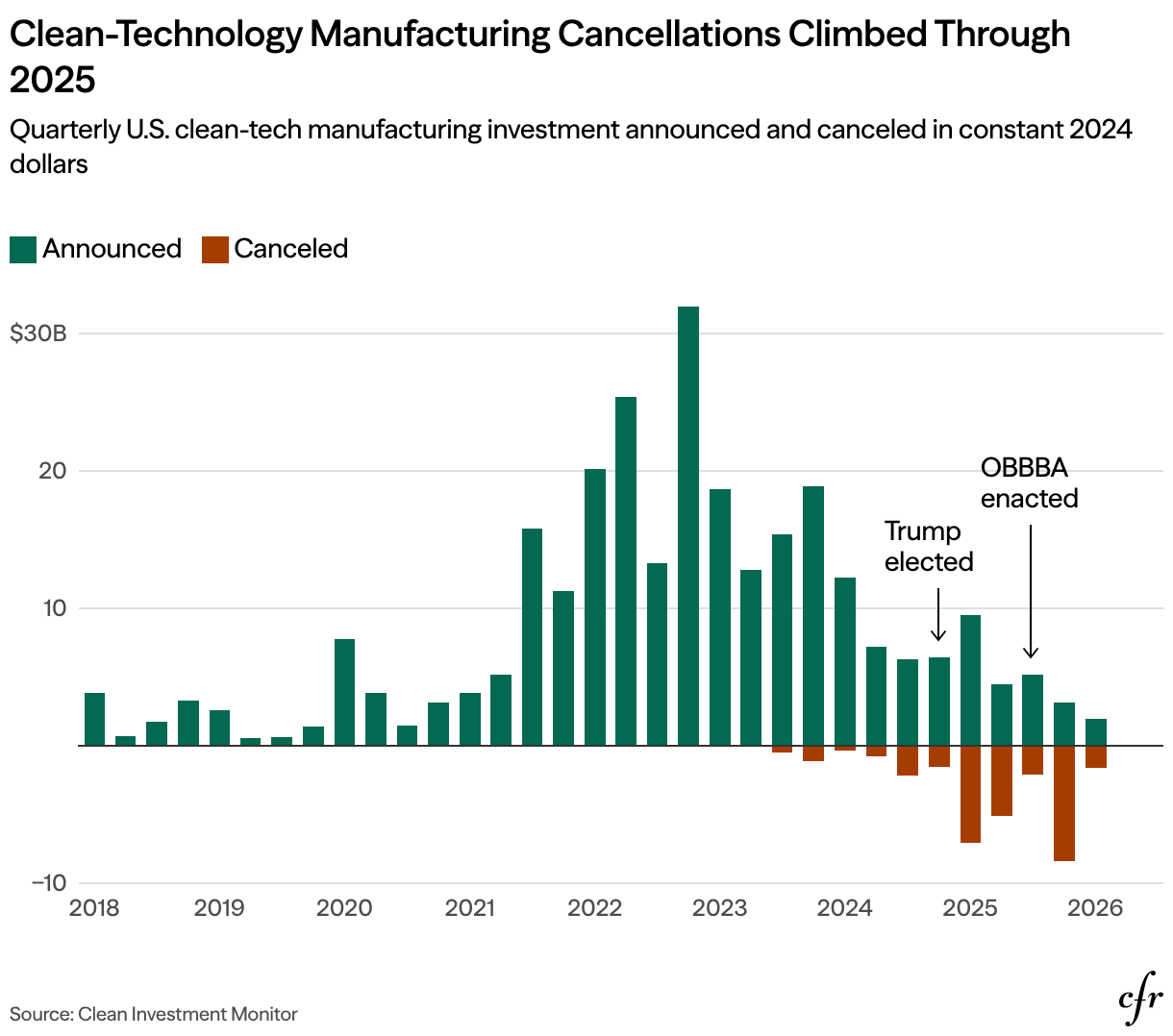
Clean-Tech Project Cancellations Surge Post-2024, Clouding Investment Landscape
U.S. clean-tech manufacturing project cancellations have surged dramatically since late 2024, with quarterly values reaching up to $8B. This rise coincides with political shifts and policy implementations, marking a significant increase from minimal prior cancellations and contrasting with earlier investment booms that peaked over $30B per quarter in 2023.
Policy Volatility & Implementation Snags Undermine Clean-Tech Project Execution
The stark increase in cancellations after political milestones like ‘Trump elected’ and ‘OBBBA enacted” suggests that policy uncertainty, evolving regulatory landscapes, or implementation challenges are significantly impacting project viability. This trend indicates a widening gap between announced commitments and actual project execution, deterring future investment.
EV and Battery Project Cancellations Hit Near-$8B Quarterly Peak
U.S. clean-tech manufacturing investment cancellations peaked near $7.8B in a single quarter in late 2025, predominantly in Zero Emission Vehicles (ZEVs) and Batteries. Early 2026 cancellations remain significant, primarily impacting Solar projects.
$83 B in Cancellations, Total Energies and US Clean Energy Policy Reversals
Direct federal policy reversals in 2026 have triggered the delay or cancellation of at least $83 billion in U.S. clean energy investments, with the offshore wind sector absorbing the most targeted and financially significant impacts. Unlike typical market downturns, these cancellations are not driven by a lack of demand or technological failure but by a strategic administrative effort to dismantle the clean energy project pipeline through lease buyouts, funding cuts, and permitting blockades.
- The Department of Energy rescinded nearly $8 billion in previously awarded clean energy funding, with 99% of the cuts affecting projects in blue states, primarily impacting carbon capture and hydrogen initiatives.
- The administration set a new precedent by paying energy companies to abandon renewable projects. This includes a deal for nearly $1 billion with Total Energies to terminate its Attentive Energy and Carolina Long Bay offshore wind leases.
- Following this pattern, Invenergy agreed to cancel its offshore wind developments for New Jersey as part of a settlement with the Department of the Interior, removing a significant volume of planned renewable capacity for the state.
- These high-profile cancellations are compounded by a broader “blockade” on permitting, which has indefinitely stalled hundreds of onshore wind and solar projects on federal land, including the 500 MW Kaskaskia Wind Project in Illinois.
Table: U.S. Clean Energy Project Cancellations & Halts (2026)
| Project / Initiative | Time Frame | Details and Strategic Purpose | Source |
|---|---|---|---|
| DOE Clean Energy Awards | Jul 2026 | The Department of Energy canceled nearly $8 billion in funding awards. California was most affected, losing $3.3 billion. The cuts targeted carbon capture, hydrogen, and grid projects. | Enverus |
| Invenergy Offshore Wind Projects | Jun 2026 | Invenergy settled with the Department of the Interior to cancel its planned offshore wind projects for New Jersey, removing a major source of future renewable power for the state. | Asbury Park Press |
| Bluepoint & Golden State Wind | May 2026 | Developers abandoned the planned 4.4 GW projects off the California coast following federal pressure and a strategic pivot by the administration toward conventional energy sources. | Defenders of Wildlife |
| Attentive Energy & Carolina Long Bay | Mar 2026 | The Trump administration paid Total Energies nearly $1 billion to abandon its offshore wind leases, with a requirement to redirect the investment into U.S. oil and gas projects. | The New York Times |
| East Coast Offshore Wind Construction | Jan 2026 | The administration issued stop-work orders halting construction on all major offshore wind projects, including Vineyard Wind 1 (800 MW) and Empire Wind (2 GW), citing national security reviews. | Utility Dive |
| Puerto Rico Solar Projects | Jan 2026 | Multiple solar projects valued at millions of dollars, intended to improve grid resilience in Puerto Rico, were canceled by the administration, undermining the island’s energy security efforts. | Associated Press |

Clean-Tech Project Cancellations Spike Amid Investment Slowdown
U.S. clean-tech manufacturing project cancellations surged from late 2024 through early 2026, with quarterly peaks approaching $10 billion. This coincides with a sharp deceleration in new announced investments, indicating increasing market uncertainty following political shifts.
Policy Uncertainty Fuels Clean Energy Market Apprehension
The rise in cancellations, particularly after ‘Trump elected’ in late 2024, signals heightened political risk overshadowing clean energy projects. The initial boom post-‘OBBA enacted” in 2022 is waning, as policy stability concerns now dominate investment decisions, impacting project viability.
Clean-Technology Investment Falls 50%+ From 2024 Peak Amid Policy Shifts
U.S. clean-technology manufacturing investment peaked at over $10B/quarter in 2024, primarily in batteries and zero-emission vehicles. However, it has since fallen by more than 50% across most categories by 2026, signaling a sharp reversal from previous growth driven by supportive policies.
US vs Global Cancellations, Invenergy and Trump Administration Actions in 2026
While project cancellations are occurring globally, the situation in the United States in 2026 is unique due to its driver: direct, top-down political opposition rather than market-based or logistical hurdles. In Europe and Asia, projects are typically stalled by grid connection queues and complex permitting. In the U.S., the primary driver is an explicit federal energy policy designed to halt renewable energy development, a risk factor not present in other major markets.
- In the U.S., the federal government is actively paying developers like Total Energies and settling with companies like Invenergy to terminate viable projects, a mechanism not seen in other regions.
- In the United Kingdom, developers like RWE are shelving projects, such as a 99.9 MW solar farm in Wales, but the cause is grid infrastructure limitations, with connection dates pushed out as far as 2035. This is a capacity issue, not a political one.
- In the Netherlands, Equinor halted plans for a blue hydrogen project (H 2 morrow) due to insufficient government support and slow development of carbon capture infrastructure, representing a failure of policy enablement, not active policy opposition.
- In South Korea, the Anma offshore wind project was derailed after failing to secure a military permit, highlighting a bureaucratic and inter-agency conflict, which is a common but distinct type of permitting risk compared to the widespread, politically-driven blockade in the U.S.
Technology Risk, AES Corporation and Local Opposition to BESS Projects
The 2026 wave of cancellations demonstrates that even commercially mature technologies are highly vulnerable to non-technical risks that can halt deployment. Between 2021 and 2024, the industry focused on scaling proven technologies and securing supply chains. Now, the primary obstacles are political and social, as policy shifts and local opposition have become potent forces capable of stopping even the most technologically and financially sound projects.
- The cancellation of the AES Corporation’s planned 320 MW battery storage project in California highlights this trend. The project was not stopped by technological failure or economic non-viability but by “fierce local opposition” centered on fire safety concerns.
- Utility-scale solar and onshore wind projects, which reached technological maturity years ago, are now stalled in permitting queues on federal land due to administrative slowdowns, as reported in early 2026. This is a political barrier, not a technical one.
- The U.S. offshore wind industry, which was on the verge of commercial scale-up with projects like Vineyard Wind 1 entering construction, was brought to a standstill by federal stop-work orders. The technology is proven and deployed globally, but its U.S. deployment was halted by political decree.
- This dynamic shifts the focus of risk management for developers. Where the priority was once on securing turbine supply agreements or managing construction timelines, it is now on navigating political volatility and building local community acceptance.
Scenario Modelling: Ørsted Project Halts and Future US Wind Viability
If the U.S. federal government’s policy of actively terminating and blocking clean energy projects persists, the most probable strategic response from major developers will be capital flight to more predictable markets and a pivot to litigation as a primary defense mechanism. The current environment makes it untenable to commit billions in long-term capital to large-scale infrastructure projects that can be nullified by political shifts, forcing a strategic reassessment of the entire U.S. market.
- If this happens: Watch for major European developers like Ørsted, Equinor, and Total Energies to issue formal announcements of reduced U.S. investment targets or outright withdrawals from the U.S. offshore wind market, reallocating capital to the EU and Asia.
- Watch this signal: An increase in the number and scope of lawsuits filed by states, such as New Jersey’s legal challenge over canceled leases, and by developers themselves to contest the legality of federal stop-work orders and lease terminations.
- This could be happening: A marked shift in investment away from federally-dependent, utility-scale projects toward smaller, distributed energy systems or projects located exclusively within states that offer strong, independent policy protections and subsidies, creating a fragmented and balkanized U.S. energy market.
The questions your competitors are already asking
This report covers one angle of political risk in the US clean energy sector. The questions that matter most depend on your work.
- European developer investment outside US
- legal challenges to federal energy project cancellations
- state level clean energy incentives
- offshore wind supply chain company outlook
This report does not answer these. Enki Brief Pro does.
Your question, your angle, your framework. SWOT, PESTL, scenario modelling. The same niche depth, built around the decision your work actually depends on.
