

Direct Air Capture (DAC) Viability, $180/ton 45 Q Credit, Microsoft’s Offtake Pause, and the $210 M Chestnut Carbon Deal (2025 to 2026)
DAC Commercial Projects: 45 Q Dependence and the Corporate Offtake Gap
The Inflation Reduction Act’s $180/ton 45 Q tax credit has successfully spurred the first wave of commercial-scale Direct Air Capture (DAC) projects in the U.S., but the incentive alone is insufficient to close the economic viability gap. As of 2026, a project’s success is not determined by the availability of the tax credit, but by its ability to secure high-value, long-term corporate offtake agreements to cover costs that still far exceed the federal subsidy. This has bifurcated the market between well-capitalized projects with strong corporate backing and those struggling to stack enough revenue to reach a final investment decision.
- The period from 2021 to 2024 was defined by technology demonstration and policy advocacy, with small-scale pilots proving technical feasibility at costs often exceeding $600 per ton. The passage of the IRA in 2022 fundamentally shifted the focus to commercial deployment.
- From 2025 to 2026, legislative and regulatory stability became critical. The enactment of the One Big Beautiful Bill Act in July 2025 preserved the IRA’s credit values, while the IRS’s issuance of Notice 2026-01 in December 2025 provided a crucial safe harbor for sequestration verification, de-risking project timelines. This stability allowed developers to move forward with financing and engineering.
- Despite policy certainty, the market’s dependence on the voluntary carbon market was highlighted by a reported pause in new carbon removal credit purchases by Microsoft in April 2026. This signals a shift where early, high-paying corporate partners are becoming more selective, placing greater pressure on DAC developers to demonstrate clear cost-reduction pathways.
- The result is a reliance on a “cost-stack” model. The $180/ton 45 Q credit forms a bankable floor, but projects require additional revenue from corporate carbon credit sales, often priced between $300 and $700 per ton, to be profitable.
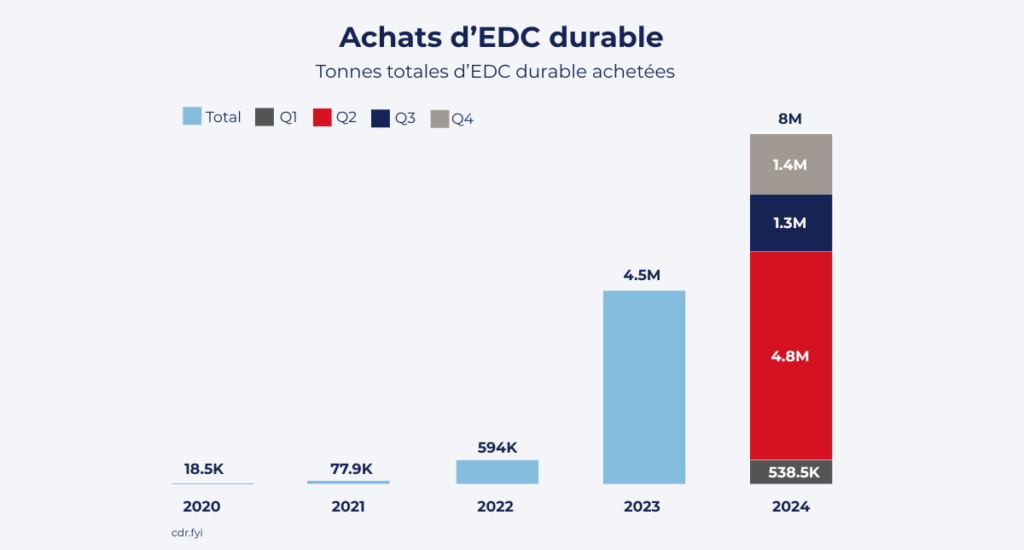
Durable Carbon Removal Purchases Skyrocket 43,000% Since 2020
Purchases of durable Carbon Dioxide Removal (CDR) have surged from 18.5K tons in 2020 to an estimated 8M tons in 2024, marking a remarkable 43,143% increase. The market experienced accelerated growth in 2023 with 4.5M tons purchased, and 2024 shows strong demand, particularly in Q2 and Q3 with 4.8M and 1.3M tons respectively.
Policy Incentives Like IRA 45Q Drive Market Maturity
The exponential growth in CDR purchases, particularly the dramatic ramp-up from 2023-2024, signals rapid market maturity and increasing corporate commitment, significantly influenced by strong policy incentives like IRA Section 45Q. These policies are creating a robust financial incentive ($180/ton for CDR) that de-risks investment and accelerates technology deployment.
Wide Cost Disparity in Carbon Capture Across Industries
Total Carbon Capture and Storage (CCS) costs range significantly from $36/tonne (Gas Processing) to $100/tonne (Cement) across various industries. While capture costs vary, the transport and storage component remains consistently at $25/tonne for all sectors analyzed, highlighting a fixed infrastructure cost.
(Source: One Big (Not So) Beautiful Boost for Carbon Capture – Taxpayers for Common Sense)
$210 M Credit Facility: Chestnut Carbon Signals New DAC Financing Models
Capital formation for DAC projects is evolving from venture-led equity funding of technology developers to sophisticated, asset-level project finance, a shift enabled by the IRA’s direct pay and transferability provisions. The $210 million credit facility secured by Chestnut Carbon in August 2025 exemplifies this trend, establishing a blueprint where the 45 Q tax credit acts as collateral, but only when bundled with long-term corporate revenue streams. This model is critical for funding the capital-intensive infrastructure required for gigaton-scale removal.
- The Chestnut Carbon deal, backed by a credit facility from J.P. Morgan, was structured to finance a portfolio of carbon removal projects by monetizing future revenue from both tax credits and the sale of carbon credits. This indicates a maturing financial market for CDR assets.
- Prior to 2025, investment was primarily concentrated in corporate equity for technology companies like Climeworks and Carbon Engineering. The new model treats the removal projects themselves as bankable infrastructure assets, similar to wind or solar farms.
- The transferability of the 45 Q credit allows developers without sufficient tax liability to sell their credits to other corporations for cash, providing upfront capital that is essential for construction. This mechanism is a foundational element of the new project finance structures.
- However, financial institutions require revenue certainty beyond the 12-year 45 Q claim period. This elevates the importance of 15-year or longer offtake agreements from investment-grade corporate buyers, which serve as the primary guarantee for lenders.
Table: Key Financial and Regulatory Events for DAC (2025 – 2026)
| Event | Time Frame | Details and Strategic Purpose | Source |
|---|---|---|---|
| Microsoft New Credit Purchase Pause | Apr 2026 | A reported pause on new carbon removal offtake agreements by a key early buyer, signaling a potential shift in the voluntary market toward price sensitivity and quality verification. | ESG News |
| IRS Notice 2026-01 | Dec 2025 | The Treasury and IRS issued a safe harbor for verifying CO 2 sequestration, providing regulatory certainty and de-risking investments for projects aiming to come online in 2025 and 2026. | IRS Newsroom |
| Chestnut Carbon Credit Facility | Aug 2025 | Secured a $210 million credit facility from J.P. Morgan to finance a portfolio of CDR projects, pioneering a project finance model based on stacked revenue from 45 Q credits and corporate offtakes. | J.P. Morgan |
| One Big Beautiful Bill Act (OBBBA) | Jul 2025 | Enacted into law, this legislation preserved the IRA’s enhanced 45 Q credit values, providing long-term policy stability critical for attracting capital to multi-decade infrastructure projects. | Carbon Capture Coalition |
US Market Focus: How 45 Q Concentrates Global DAC Development
The structure of the 45 Q tax credit has made the United States the undisputed global epicenter for large-scale DAC development, eclipsing activity in all other regions. While early pilots were geographically diverse, the post-IRA landscape of 2025-2026 shows a decisive concentration of capital and project announcements in U.S. regions that offer favorable geology for sequestration and established energy infrastructure. This concentration is a direct result of a policy that is currently unmatched anywhere else in the world.
- Between 2021-2024, DAC innovation was visible globally, with Climeworks launching its Orca and Mammoth plants in Iceland, leveraging geothermal energy. However, these projects operate without a subsidy comparable to 45 Q.
- From 2025 onward, nearly all announced projects targeting megaton-scale removal are located in the U.S. The primary driver is the $180/ton credit, which can be stacked with other incentives like the Department of Energy’s Regional DAC Hubs program grants.
- Development is clustering in areas with suitable saline aquifer formations for permanent storage, such as the Gulf Coast. The presence of established players like Exxon Mobil with expertise in geology and subsurface management further anchors activity in these regions.
- The lack of equivalent, bankable policy support in the EU Grid 2025, 30 TWh Curtailment, Secure Energy Report or Asia has created a significant competitive advantage for U.S.-based projects, attracting international developers and capital to the American market.
DAC Technology Readiness: Closing the Cost Gap from $600 to $300 Per Ton
DAC technology has moved beyond the research and development phase and is now being proven at a commercial scale, but its maturity is defined by economic rather than technical hurdles. The central challenge for the industry in 2026 is not proving that DAC works, but demonstrating that it can operate on a reliable cost-down trajectory. Current all-in costs, estimated between $600 and $1, 000 per ton, must fall significantly for the business model to become sustainable beyond a small pool of early corporate adopters.
- The 2021-2024 period successfully validated the core capture technologies at the pilot scale, confirming the viability of both liquid solvent and solid sorbent pathways. The focus was on operational hours and capture efficiency.
- In 2025-2026, the industry is focused on executing first-of-a-kind (FOAK) commercial plants. The operational data from these facilities is the most critical factor for validating cost models and securing financing for subsequent, lower-cost plants.
- A key performance indicator is energy consumption, which is the largest component of operational costs. Innovations in sorbent regeneration, heat integration, and process efficiency are the primary levers for reducing the cost per ton.
- The market is watching to see if developers can achieve a path to $300/ton. At that level, the $180/ton 45 Q credit covers a majority of the cost, making the remaining portion manageable for a much broader set of corporate buyers.
SWOT Analysis: DAC Market Strengths and Weaknesses Under 45 Q
The primary strength of the U.S. DAC market is its unparalleled federal policy support, which has created a bankable incentive structure. However, this is offset by the critical weakness of high technology costs, which makes the entire sector highly dependent on a volatile and still-maturing voluntary carbon market for revenue. Resolving this tension between strong policy support and weak standalone economics will define the industry’s trajectory through 2030.
Table: SWOT Analysis for the US Direct Air Capture Market (2026)
| SWOT Category | 2021 – 2023 Analysis | 2024 – 2026 Analysis | What Changed / Validated |
|---|---|---|---|
| Strengths | Emerging bipartisan support for carbon removal; strong R&D ecosystem; pioneering technology developers. | Bankable $180/ton tax credit with direct pay/transferability; long-term policy certainty via OBBBA; established regulatory framework for sequestration under the US EPA Energy Policy 2026, 31 Actions & Endangerment Finding. | Policy shifted from conceptual support to a concrete, monetizable financial instrument (45 Q), making large-scale projects feasible for the first time. |
| Weaknesses | Extremely high costs ($600-$1, 000+/ton); massive energy requirements; unproven business models. | Costs remain significantly above the 45 Q credit value; long project lead times (3-5 years); dependence on a small number of corporate buyers for revenue. | The core weakness of high cost was not resolved; instead, the market confirmed that 45 Q is a necessary but insufficient condition for profitability. |
| Opportunities | Potential for enhanced tax credits (realized in IRA); growing corporate climate pledges. | Stacking 45 Q with state-level credits and DOE grants; developing shared CO 2 transport/storage infrastructure; cost reductions from learning-by-doing at scale. | The IRA created opportunities to “stack” multiple forms of government support, and the first major projects are now testing this model. |
| Threats | Policy instability; public opposition to CO 2 pipelines and storage; competition from cheaper nature-based carbon credits. | Price sensitivity or purchasing pauses from key corporate buyers (e.g., Microsoft); project delays due to permitting or supply chains; future negative policy changes after 2033. | The threat shifted from a lack of policy to the fragility of the voluntary market needed to supplement that policy, creating a new form of commercial risk. |

IRA 45Q Credits Losing Real Value Through 2026
The real value of IRA Section 45Q credits is projected to decline significantly by 2026. Direct Air Capture (DAC) credits, initially at $180/ton in 2020, are forecast to drop to approximately $128/ton, while non-indexed credits fall from $82/ton to $59/ton.
Declining Incentives Intensify Pressure on Carbon Removal Project Economics
The erosion of real credit value for both DAC and conventional carbon capture intensifies pressure on project economics. This diminishing incentive requires developers to aggressively innovate and reduce operational costs to maintain project viability and attract long-term investment, especially for capital-intensive DAC projects.
Carbon Removal Market Set for Robust Growth, Driven by Geological Storage
The Global Carbon Dioxide Removal Market is projected to expand from $926.37 million in 2025 to nearly $4.9 billion by 2035, exhibiting an 18.1% CAGR. Geological storage methods will remain the largest segment, driving significant capital allocation into permanent sequestration solutions.
(Source: Carbon Dioxide Removal Market Size to Surge USD 3,169.06 Mn by 2035)
2027 Outlook: DAC Project Viability Hinges on Corporate Offtake Prices
The single most critical variable for the DAC sector over the next 18 months is the price and tenor of corporate offtake agreements. The Final Investment Decisions (FIDs) for the next wave of DAC plants depend entirely on securing purchase agreements at prices well above the $180/ton 45 Q floor. If offtake prices remain robust, project financing will accelerate; if they soften, the industry could face a period of significant project delays and strategic realignment.
- If this happens: Blue-chip corporations continue to sign multi-year offtake deals in the $300-$500/ton range for high-durability removal credits.
- Watch this: The successful financing of two to three additional large-scale DAC projects by early 2027, using project finance structures that replicate the Chestnut Carbon model and confirm its viability.
- This could be happening: A virtuous cycle is created where successful project financing validates the DAC asset class, attracting more conservative infrastructure capital and accelerating the build-out of shared CO 2 transport and sequestration hubs.
- Alternatively: If corporate demand wanes or buyers push for prices closer to the 45 Q value, watch for developers to pivot toward the $130/ton 45 Q utilization credit, seeking to create value-added products like sustainable aviation fuel (SAF) to create a new revenue stream and bridge the economic gap.
The questions your competitors are already asking
This report covers one angle of Direct Air Capture project financing. The questions that matter most depend on your work.
- companies buying large scale carbon removal
- direct air capture project financing deals
- direct air capture cost reduction pathways
- carbon removal incentives in Europe
This report does not answer these. Enki Brief Pro does.
Your question, your angle, your framework. SWOT, PESTL, scenario modelling. The same niche depth, built around the decision your work actually depends on.
