

Clean Energy Project Cancellations, $22 B Lost, 16, 500 Jobs Cut, and 1, 891 Projects Halted After Policy Shift (2025 to 2026)
Project Cancellation Risks, $22 B Lost as Security Policies Shift Investment Priorities
The 2026 Middle East conflict triggered a seismic policy response in the U.S., prioritizing domestic fossil fuel production and causing a wave of high-profile clean energy project cancellations as the financial calculus for developers abruptly changed. Before 2025, the Inflation Reduction Act (IRA) fueled a boom in clean energy investment. However, the subsequent energy crisis led to a rapid policy reversal, culminating in the “One Big Beautiful Bill Act” (OBBBA) signed on July 4, 2025, which rolled back or modified the market-distorting subsidies that had underpinned project economics.
- In the first half of 2025 alone, the policy shift directly resulted in the cancellation of $22 billion worth of clean energy projects and the loss of over 16, 500 jobs.
- The first quarter of 2025 saw an early signal of this trend, with 16 clean energy and EV manufacturing projects valued at $8 billion being shelved, including major wind energy developments.
- This trend reflects a broader market contraction, with data showing a total of 1, 891 power projects were cancelled by developers during 2025 as they grappled with the new financial and political reality.
- The U.S. policy reaction stands in contrast to the EU, which reinforced its REPower EU plan to accelerate renewables, and also contrasts with Asian development, where entities like the ADB are funding massive grid and power infrastructure expansion.
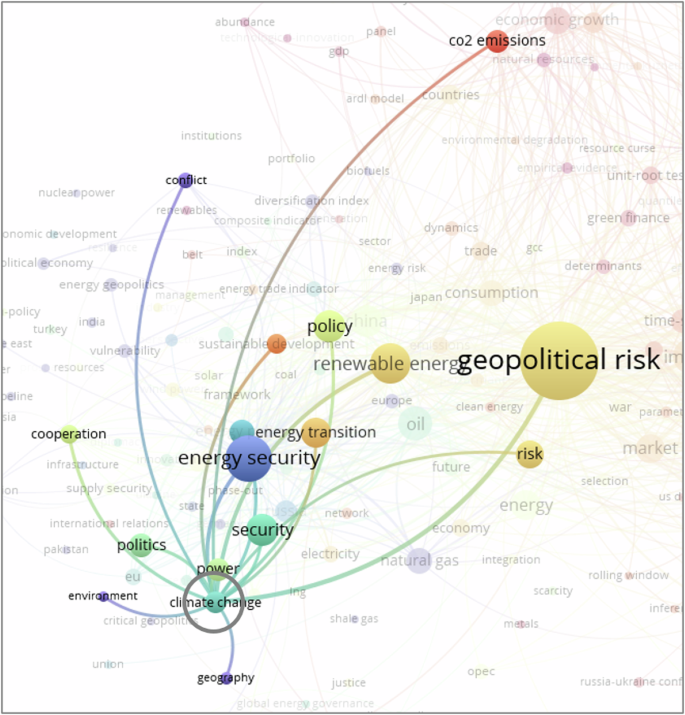
Chart Shows Interplay of Geopolitics and Energy
This introductory section sets a high-level theme of risk driven by a shift in security policies. The chart, which shows the abstract interplay between geopolitics and energy, perfectly visualizes this core theme.
(Source: Nature)
$22 B in Cancellations, Clean Energy and EV Manufacturing Projects Halted in 2025
The financial fallout from the U.S. policy pivot was immediate and substantial, with developers cancelling billions in planned investments across clean energy generation and EV manufacturing due to the removal of critical tax credits and increased market uncertainty. The shock to the global oil market from the conflict created a political environment where energy security was redefined as maximizing domestic fossil fuel output, directly undermining the financial models of subsidy-dependent renewable projects.
- The removal of tax credits established under the IRA made many projects, which were planned and financed based on those incentives, immediately non-viable from a returns perspective.
- The impact was felt across the clean energy supply chain, hitting not only utility-scale generation but also the burgeoning EV manufacturing sector, which had been a key beneficiary of the previous policy regime.
- This wave of cancellations demonstrates the acute sensitivity of the clean energy sector to policy stability and highlights how geopolitical events can translate into direct domestic industrial and employment consequences.

Mideast Conflict Dampens Carbon Capture Growth
The section quantifies the negative impact on clean energy. The chart provides a specific, tangible example of this trend, showing how the Mideast conflict is directly harming a clean energy technology (carbon capture), thus illustrating the broader point.
(Source: Rystad Energy)
Table: U.S. Clean Energy Project Cancellations (2025)
| Time Period | Value of Cancelled Projects (USD) | Jobs Lost | Number of Projects | Source |
|---|---|---|---|---|
| H 1 2025 | $22 Billion | 16, 500 | Not Specified | Latitude Media |
| Q 1 2025 | $8 Billion | Not Specified | 16 | Manufacturing Dive |
| Full Year 2025 | Not Specified | Not Specified | 1, 891 | Cleanview |

Map Details Geopolitical Context of Middle East Conflict
While the section calls for a table detailing the project cancellations, this map provides the essential ‘why’ behind those numbers. It grounds the data-heavy table in the geopolitical reality that is forcing the policy shifts and subsequent cancellations.
(Source: rasanah-iiis.org)
U.S. Epicenter, Policy Shift Drives Geographic Concentration of Project Cancellations
While the energy security crisis is global, the most acute and measurable project cancellations have been concentrated in the United States, where a direct policy reversal dismantled the financial framework supporting a national clean energy buildout. This response diverged sharply from that of other major economic blocs, which interpreted the same geopolitical shock as a reason to accelerate their transition away from volatile fossil fuel imports.
- The European Union responded to the crisis by accelerating its REPower EU plan, doubling down on investment in renewables and green hydrogen to enhance energy independence, supported by initiatives like a €30 B fund for EU carbon capture.
- In the U.S., the OBBBA legislation reversed course, leading to a significant drop in renewable investment, with spending on wind energy seeing a sharp decline post-legislation.
- This policy-driven contraction in the U.S. created a vacuum that developers and capital sought to fill elsewhere, reinforcing the investment momentum in regions like Europe and parts of Asia that maintained stable, long-term decarbonization policies.

US Projected to Dominate Global LNG Exports
The section identifies the U.S. as the epicenter of cancellations due to a policy shift. The chart explains this policy shift by showing its effect: the U.S. pivoting to become a dominant LNG exporter, thereby de-prioritizing domestic clean energy projects.
(Source: American Security Project)
Financial De-risking, Market Volatility Elevates Importance of PPAs and Cf Ds
The crisis has not stalled technological development, but it has dramatically altered the financial engineering required for commercial deployment, making long-term offtake agreements essential to de-risk projects and secure financing in a high-volatility environment. In the wake of the U.S. policy reversal, revenue certainty has replaced subsidy capture as the most critical element for project bankability.
- Before 2025, while important, offtake agreements were part of a financial stack heavily supported by federal tax incentives.
- Post-conflict and post-OBBBA, instruments like Power Purchase Agreements (PPAs) and Contracts for Difference (Cf Ds) have become the primary mechanism to secure financing by providing a guaranteed revenue stream amid extreme commodity price and policy uncertainty.
- This shift signifies a maturation of the market’s financial toolkit, forcing a greater reliance on commercial contracts to ensure project viability rather than depending on government policy.
- The ability to secure a long-term PPA from a creditworthy offtaker is now the key determinant of whether a clean energy project moves from blueprint to reality in the U.S. market.

Gulf Airline Flights Plummet After Iran Conflict Erupts
The section discusses the need for financial de-risking due to market volatility. The chart serves as a powerful proxy for this volatility, showing the dramatic economic impact of the conflict, which justifies the heightened focus on financial instruments like PPAs.
(Source: BBC)
SWOT Analysis, Clean Energy Project Viability in a Security-First Market
The new energy landscape presents clean energy projects with the strength of being a secure domestic resource, but exposes weaknesses related to policy dependency and supply chain vulnerabilities, creating both opportunities in resilient technologies and threats from resurgent fossil fuel support. The conflict has forced a re-evaluation of what constitutes a “secure” energy asset, with domestic renewables gaining strategic value even as their financial support has weakened in some regions.
- Strength: The primary strength of domestic clean energy is its insulation from foreign supply disruptions and volatile global commodity prices, a value proposition amplified by the Hormuz crisis.
- Weakness: The wave of cancellations in the U.S. exposed the sector’s critical weakness: an over-reliance on political subsidies, which can be withdrawn abruptly.
- Opportunity: The global pivot towards energy security has unlocked a record $2.2 trillion in clean energy investment for 2026, creating a massive pool of capital for projects in regions with stable policies.
- Threat: The primary threat is now direct policy competition from a politically resurgent fossil fuel industry, which is successfully framing its expansion as a national security imperative.
Table: SWOT Analysis for U.S. Clean Energy Projects Post-Conflict
| SWOT Category | 2021 – 2024 | 2025 – 2026 | What Changed / Resolved / Validated |
|---|---|---|---|
| Strength | Financial returns driven by strong IRA tax credit incentives and declining technology costs. | Strategic value as a secure, domestic energy source insulated from geopolitical volatility. | The core value proposition shifted from being primarily financial (cost savings) to being primarily strategic (energy security). |
| Weakness | Supply chain bottlenecks for components like solar panels from China and long grid interconnection queues. | Extreme sensitivity to subsidy changes, with project economics collapsing after the OBBBA policy reversal. | The crisis validated that the financial models for many projects were fragile and lacked resilience to political risk. |
| Opportunity | Meeting corporate and national decarbonization targets. | Accessing a record $2.2 trillion global clean energy investment pool motivated by security concerns. | The pool of available capital grew, but its allocation became conditional on policy stability and geopolitical alignment. |
| Threat | Rising interest rates and inflation increasing project costs. | Direct policy reversals (OBBBA) and renewed political support for domestic fossil fuel production as a primary security solution. | The primary threat evolved from macroeconomic headwinds to a direct, politically-driven challenge for market share and policy support. |

Middle East LNG Exports in 2025 Detailed
A SWOT analysis for U.S. clean energy must consider the competitive landscape. This chart details Middle East LNG exports, a key factor in the new ‘security-first’ market. This data informs the ‘Threats’ and ‘Opportunities’ sections of the SWOT analysis.
(Source: Wood Mackenzie)
Watch Signal, Will a New Wave of PPAs Revive Cancelled U.S. Projects?
The critical signal to watch in the coming year is whether corporate and utility buyers, motivated by their own ESG and price stability goals, will step in with a new wave of long-term Power Purchase Agreements at sufficient scale to revive some of the $22 billion in projects cancelled due to the federal policy shift. This would represent a private-sector-led recovery, partially insulating the industry from the whims of federal politics.
- If this happens, watch this: If developers begin re-announcing previously cancelled projects, citing new long-term corporate PPAs as the enabling factor, it will signal a structural shift in the market.
- These could be happening: Large energy users like Microsoft, which has already signed significant PPAs to support grid stability on the PJM Grid, could lead a new wave of offtake agreements. Such deals provide the revenue certainty needed to secure financing without federal subsidies.
- This trend would confirm that private sector demand for resilient, price-stable, and clean power can create a durable floor for development, even in the face of federal policy headwinds.
- Conversely, if PPA activity remains muted and focused only on the most economically advantaged locations, it will validate that the majority of the U.S. clean energy sector remains deeply dependent on federal policy for growth.

Map Details 2026 Iranian Strikes on GCC States
This forward-looking ‘Watch Signal’ section speculates on the future. The chart, a projection of potential military strikes in 2026, is a literal watch signal, visualizing a major future risk that would heavily influence any decision to revive cancelled projects.
The questions your competitors are already asking
This report covers one angle of the US energy investment landscape’s pivot from clean energy back to fossil fuels. The questions that matter most depend on your work.
- Which clean energy companies are losing ground, and which fossil fuel companies are gaining, in the US energy market after the ‘One Big Beautiful Bill Act’?
- What is the outlook for US wind and solar deployment by 2030 after the rollback of the Inflation Reduction Act?
- As the US prioritizes fossil fuels, is the EU’s REPowerEU plan attracting the clean energy investment leaving the US market?
- What are the new investment opportunities in the US domestic fossil fuel sector created by the ‘One Big Beautiful Bill Act’?
This report does not answer these. Enki Brief Pro does.
Your question, your angle, your framework. SWOT, PESTL, scenario modelling. The same niche depth, built around the decision your work actually depends on.
