

HIF Global DAC to E-Methanol, 100, 000 Ton Mabanaft Deal, $4 B Brazil Plant, and Porsche Partnership (2021 to 2026)
E-Methanol Projects, HIF Global Pilots and Commercial Scale-Up Risks
The primary risk to Direct Air Capture (DAC) to e-methanol adoption has shifted from technological proof-of-concept to economic viability, as high production costs and policy dependence constrain commercial scale-up despite successful pilot operations. While the integrated process is technically validated, its commercial future depends entirely on closing a significant cost gap with conventional and other green fuels through subsidies, carbon pricing, and technology cost-downs.
- Between 2021 and 2024, the industry focus was on pilot-scale validation. HIF Global’s Haru Oni plant became operational in late 2022, proving the technical feasibility of its integrated process which converts wind power into green hydrogen, combines it with captured CO 2, and synthesizes e-methanol and e-gasoline. Partnerships with Porsche and Siemens Energy were critical in validating the technology stack during this period.
- The period from 2025 to today marks a clear shift toward commercialization and market access. Securing the first-ever e-fuels pathway under California’s Low Carbon Fuel Standard (LCFS) in March 2025 was a critical regulatory milestone that created a viable offtake market. Subsequently, the April 2025 agreement with Mabanaft for 100, 000 tons of e-methanol provided crucial revenue security for future production.
- The central risk now is the severe cost disparity. E-methanol production costs, estimated between $1, 040 and $1, 809 per ton, are substantially higher than fossil methanol, which costs less than $250 per ton. This makes the business case entirely dependent on durable policy support like the US 45 Q and 45 V tax credits and compliance markets such as the EU Emissions Trading System.
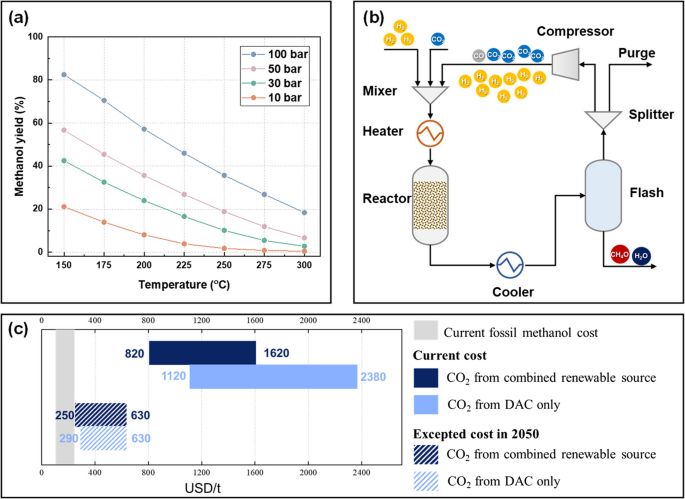
E-Methanol Costs Significantly Higher Than Fossil Fuels
The chart directly quantifies one of the primary ‘commercial scale-up risks’ discussed in this section. By showing that e-methanol costs are significantly higher than traditional fossil fuels, it provides the economic context for the challenges HIF Global faces in its pilot projects and future commercialization efforts.
(Source: Springer Nature)
$4 B Brazil Plant, HIF Global E-Fuels Investment Strategy
HIF Global’s investment strategy is transitioning from funding small-scale pilots to securing massive capital for industrial-scale facilities, a shift that exposes the high capital intensity and financial risk inherent in the e-fuels sector. The company’s ability to attract project financing for its multi-billion-dollar ambitions will serve as a key indicator of investor confidence in the long-term e-fuels market.
- The planned $4 billion e-fuels plant in Brazil, highlighted in February 2026, represents a significant escalation from the initial funding of the Haru Oni pilot plant. This move signals a strategic intent to transition from demonstration to mass production, targeting global supply chains.
- The high capital requirements are a defining challenge. A March 2026 analysis revealed that an e-methanol facility with an annual output of just 72, 000 tonnes requires an investment of approximately $650 million. This underscores the immense capital needed to build out production capacity at a scale that can impact global fuel markets.
- Success hinges on de-risking these large investments, primarily through long-term offtake agreements. According to market analysis, only about 22% of global renewable methanol projects have secured such agreements, making this a critical bottleneck for project bankability and a major focus for HIF Global’s commercial teams.
Table: HIF Global Strategic Investments and Capital Plans
| Partner / Project | Time Frame | Details and Strategic Purpose | Source |
|---|---|---|---|
| Brazil e-Fuels Plant | Feb 2026 | Announced plans for a $4 billion facility to produce green hydrogen and synthesize e-fuels. This project marks a major strategic step toward industrial-scale production and global expansion. | Reuters |
| E-Methanol Project Economics | Mar 2026 | An analysis highlighted that a 72, 000 tonne/year e-methanol project would require an investment of approximately $650 million, underscoring the high capital intensity of e-fuel production. | Storm Fisher |
HIF Global Partnerships with Mabanaft and Baker Hughes (2023 to 2025)
HIF Global’s partnership strategy has matured from alliances focused on proving core technology to those designed to secure market access and critical feedstock supply. This evolution reflects the company’s transition from a technology developer to a commercial producer navigating complex supply chains and market demands.
- Between 2021 and 2024, partnerships were foundational to validating the initial process at Haru Oni. Collaborations with Porsche as a high-profile offtaker, Siemens Energy for electrolysis technology, and Johnson Matthey for methanol synthesis were essential for de-risking the pilot phase and proving the integrated model worked.
- Starting in 2025, the strategic focus shifted to securing commercial viability and scaling the feedstock supply. The April 2025 offtake agreement with German energy company Mabanaft for 100, 000 tons of e-methanol was a critical step in securing a route to the marine fuel market and guaranteeing future revenue.
- The collaboration with Baker Hughes on Mosaic DAC technology, which saw a unit installed at Haru Oni in late 2024 and assembled by June 2025, marks a pivotal move to secure a truly atmospheric and scalable carbon source. This reduces reliance on biogenic or industrial CO 2 and aligns with the company’s long-term vision for a circular carbon economy.
Table: HIF Global Key Strategic Partnerships
| Partner / Project | Time Frame | Details and Strategic Purpose | Source |
|---|---|---|---|
| Mabanaft | Apr 2025 | Formed a partnership including an offtake agreement for 100, 000 tons of e-methanol per year to supply the shipping industry. This de-risks future production and establishes a commercial pathway. | Hydrogen World Expo |
| Baker Hughes | Mar 2023 – Jun 2025 | Collaborated to deploy and test Mosaic Direct Air Capture (DAC) technology. The first unit, designed to capture 600 tonnes of CO₂ annually, began assembly at the Haru Oni plant in June 2025. | HIF Global |
| Haru Oni Pilot Partners (Porsche, Siemens Energy) | Dec 2022 | Launched the Haru Oni pilot plant in collaboration with key partners. Porsche acts as a primary offtaker for e-gasoline, while Siemens Energy provides the core electrolysis technology. | MAN Energy Solutions |
| Honeywell | May 2023 | Signed an agreement to use Honeywell’s Methanol-to-Jet (Mt J) technology, a critical step for producing e-SAF (sustainable aviation fuel) from e-methanol and accessing the aviation market. | Carbon Herald |
Chile vs. US and Brazil, HIF Global Geographic Expansion
HIF Global’s geographic strategy leverages regions with exceptional renewable resources to establish production hubs, while simultaneously targeting policy-driven demand markets in North America and Europe to ensure commercial offtake. This dual approach of producing where energy is cheapest and selling where green premiums are highest is central to its business model.
- From 2021 to 2024, the company’s efforts were concentrated exclusively on Chile’s Patagonia region. This location was strategically selected for its world-class wind resources, which provided the low-cost renewable power necessary to make the Haru Oni pilot plant viable and prove the production model.
- In 2025, the strategy expanded significantly toward securing demand markets. Gaining approval under California’s LCFS in March 2025 was a landmark achievement, formally establishing the United States as a key target market where e-fuels can command a premium price.
- The announcement of a new project in Brazil in April 2025, followed by details of a potential $4 billion facility, signals a deliberate expansion into another region with strong renewable energy potential. This move diversifies production and is designed to create a global network of e-fuel supply hubs.
DAC Integration, HIF Global E-Methanol Technology Maturation
HIF Global has successfully advanced its integrated e-fuels process from a pilot-scale demonstration to a commercially validated pathway, with the key remaining challenge being the cost-competitiveness and operational scalability of its Direct Air Capture (DAC) component.
- The period from 2021 to 2024 focused on system integration, culminating in the first production of e-fuels at Haru Oni in December 2022. This milestone confirmed the technical viability of linking wind-powered electrolyzers, CO 2 capture, and methanol synthesis into a single, continuous process.
- A pivotal maturation step occurred in 2025 with the physical integration of a DAC unit at the Haru Oni plant, where assembly began in June 2025. This advances the technology from reliance on biogenic CO 2 to a truly circular model using atmospheric carbon, which is critical for global scalability.
- Although the integrated process is technically proven, it is not yet economically mature. The high capital costs and energy requirements for both DAC and green hydrogen production remain the primary barriers to achieving cost parity with fossil fuels, keeping the technology in a pre-commercial scale-up phase.

Diagram Contrasts E-Methanol Production Pathways
This diagram visually explains the core subject of the section: e-methanol technology. It illustrates the different production pathways, which is fundamental to understanding ‘DAC Integration’ and the ‘Technology Maturation’ process for HIF Global’s e-methanol production.
(Source: Global Maritime Forum)
HIF Global SWOT Analysis on DAC-to-E-Methanol Production
HIF Global’s first-mover advantage and integrated technology platform are significant strengths, but they are challenged by extreme production costs and a heavy reliance on volatile policy support. This dynamic creates near-term opportunities in niche compliance markets but presents a considerable threat to achieving the long-term scalability required to disrupt global fuel markets.
Table: SWOT Analysis for HIF Global’s DAC-to-E-Methanol Strategy
| SWOT Category | 2021 – 2023 | 2024 – 2026 | What Changed / Validated |
|---|---|---|---|
| Strength | Demonstrated technology integration at pilot scale (Haru Oni). Strong backing from strategic partners like Porsche. | Established first-mover advantage in integrated DAC-to-fuel production. Secured first US regulatory approval (LCFS), validating a commercial pathway. | The technology has moved from a conceptual pilot to a commercially recognized pathway, creating a template for future projects. |
| Weakness | Unproven economics at scale. Reliance on biogenic CO 2 for initial operations. High initial CAPEX for a small pilot plant. | Extreme cost premium over fossil fuels ($1, 040+/ton vs. <$250/ton). Low percentage of offtake agreements secured across the industry (22%). | The “green premium” has been quantified and is now the central commercial challenge, shifting focus from technical risk to economic risk. |
| Opportunity | Focus on premium, niche applications for high-profile customers (e.g., Porsche motorsports). | Growing compliance markets (shipping, aviation) driven by EU ETS and LCFS. Access to significant US tax credits (45 Q for DAC, 45 V for H 2). | The addressable market has expanded from specialized, voluntary niches to larger, regulated compliance markets. |
| Threat | Risk of technology integration failure at the pilot scale. Competition from other alternative fuels. | Policy risk (potential changes to subsidies or carbon pricing). Competition from lower-cost decarbonization pathways (e.g., biomethanol). Immense capital required for scale-up. | The primary external threat has shifted from technology risk to the stability of policy frameworks and competition from more mature, lower-cost alternatives. |
100, 000 Ton Mabanaft Deal, HIF Global Future Offtake Strategy
The critical factor for HIF Global’s growth in the next two years is its ability to replicate the Mabanaft offtake agreement, as securing long-term buyers is the primary mechanism to de-risk the massive capital expenditure required for its planned Brazil and US facilities.
- If HIF Global secures another major offtake agreement for its proposed large-scale projects, watch for a Final Investment Decision (FID) on one of those plants. This action would signal strong investor confidence and validate the commercial model beyond the initial pilot phase.
- Conversely, if no new significant offtake agreements are announced through 2026, this could indicate that potential buyers in hard-to-abate sectors are balking at the high “green premium, ” a development that could stall large-scale expansion plans despite the company’s technological successes.
- These signals are gaining traction: The Mabanaft deal in April 2025 demonstrated that a viable market exists in the regulated shipping sector. The approval of the California LCFS pathway in March 2025 opened another high-value compliance market. The key uncertainty is whether these early successes are repeatable at a scale sufficient to support multi-billion-dollar projects.
The questions your competitors are already asking
This report covers one angle of the commercial scale-up of DAC-to-e-methanol, focusing on HIF Global’s project economics and market access. The questions that matter most depend on your work.
- What is the cost breakdown of a commercial-scale DAC-to-e-methanol plant like HIF Global’s, and where are the greatest opportunities for cost reduction?
- HIF Global investments and funding. Is the planned $4 B Brazil plant on track for its production timeline following the Mabanaft offtake agreement?
- What is the outlook for DAC-to-e-methanol deployment now that it has an approved pathway under California’s Low Carbon Fuel Standard (LCFS)?
- Which shipping and automotive operators, beyond Mabanaft and Porsche, are actively securing e-methanol offtake agreements?
This report does not answer these. Enki Brief Pro does.
Your question, your angle, your framework. SWOT, PESTL, scenario modelling. The same niche depth, built around the decision your work actually depends on.
