

Alibaba’s 2025-2026 Energy Pivot: Why Nuclear Power Now Fuels Its AI Data Center Ambitions
Alibaba Group’s energy strategy for its massive data center network has fundamentally shifted, moving beyond a primary reliance on renewables like solar and wind to embrace nuclear power as a core solution for its AI ambitions. Driven by the exponential energy demands of artificial intelligence and a landmark $53 billion infrastructure investment, the company formed a joint venture with China National Nuclear Power in January 2026. This move signals a pragmatic recognition that intermittent renewables alone cannot provide the stable, dense, carbon-free baseload power required for global AI dominance.
Alibaba’s Commercial Projects: From Solar PPAs to Nuclear Joint Ventures in 2026
Alibaba has decisively evolved its commercial energy strategy from procuring intermittent renewables to directly securing firm, carbon-free baseload power through a major nuclear energy joint venture. This change marks a new strategic phase in powering large-scale AI infrastructure, prioritizing energy security and density over a purely renewables-focused approach.
- Between 2021 and 2024, Alibaba’s strategy centered on renewable procurement and on-site generation. The company became a leader in China’s green power trading market, purchasing over 1.61 billion k Wh of renewable energy in early 2024 and installing solar capacity at facilities like its Singapore headquarters and Zhangbei Data Center.
- The strategic inflection point occurred in January 2026 with the formation of a 250 million yuan ($35.9 million) joint venture with state-owned China National Nuclear Power Co. This partnership was explicitly created to secure a stable and reliable electricity supply for Alibaba’s expanding AI data centers.
- This pivot to nuclear power does not replace but rather complements Alibaba’s ongoing efficiency initiatives. The company continues to deploy its proprietary liquid and immersion cooling technologies, which have achieved an industry-leading average Power Usage Effectiveness (PUE) of 1.200 across its self-built data centers.
- The adoption of nuclear power is not an isolated move but reflects a broader industry realization. As the energy needs of AI models outpace the capabilities of intermittent solar and wind, tech giants are increasingly exploring nuclear energy to guarantee the 24/7 power required for high-density computing.
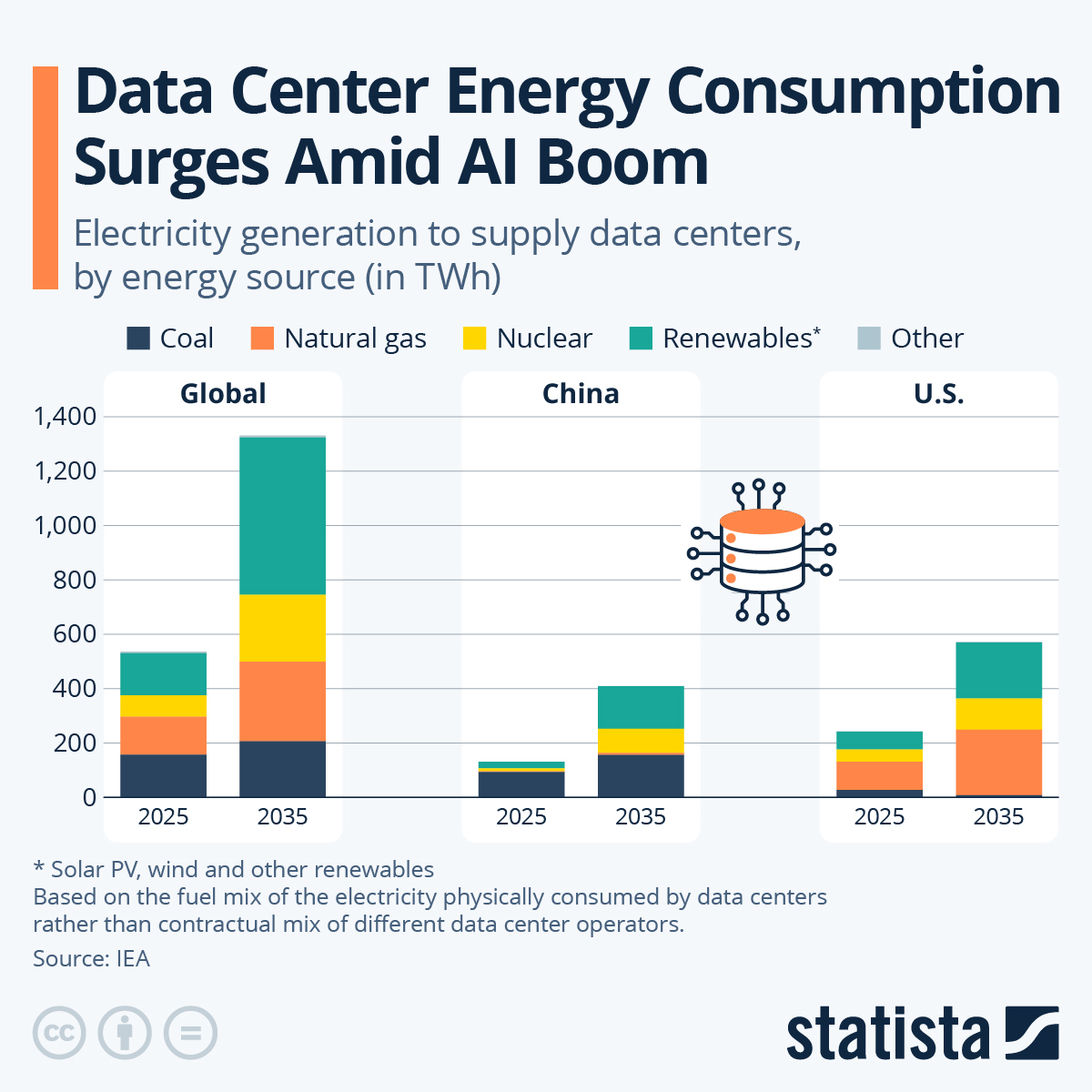
AI Boom Drives Nuclear Energy Adoption
This chart illustrates the rising energy demand from AI, justifying Alibaba’s strategic shift to nuclear power in China to secure a stable baseload supply.
(Source: Statista)
Alibaba’s Investment Analysis: Funding the Shift to AI-Ready Infrastructure
Alibaba is financing its infrastructure and energy strategy pivot with massive, multi-billion-dollar capital commitments and dedicated bond offerings, underscoring its focus on building out global AI capabilities. These financial instruments are directly funding the data center expansion and technological upgrades that necessitate a more robust and diversified energy supply, including the recent move into nuclear power.
- The company’s strategic direction was defined in February 2025 with a pledge to invest over 380 billion yuan ($53 billion) over three years into its AI and cloud infrastructure. This capital commitment provides the foundation for its aggressive global data center buildout.
- To specifically fund this expansion, Alibaba announced a $3.2 billion zero-coupon convertible bond in September 2025, with approximately 80% of the proceeds explicitly earmarked for expanding data centers and upgrading technology.
- The investment in the nuclear energy partnership, valued at 250 million yuan ($35.9 million), represents a targeted capital allocation to solve the critical baseload power problem, ensuring its larger infrastructure investments can operate reliably.
- In addition to these headline figures, Alibaba is also ramping up investments in complementary technologies like battery storage to manage grid stability, joining competitors such as Tencent and Byte Dance in addressing the systemic energy challenges posed by AI.
Table: Alibaba’s Key Strategic Investments 2025-2026
| Partner / Project | Time Frame | Details and Strategic Purpose | Source |
|---|---|---|---|
| China National Nuclear Power Co. JV | Jan 2026 | Established a $35.9 million joint venture to secure stable, low-carbon nuclear power for AI data centers, addressing the need for reliable baseload energy. | Bloomberg |
| Zero-Coupon Convertible Bond | Sep 2025 | Raised $3.2 billion, with 80% allocated to fund data center expansion and technology upgrades required to support its growing AI services. | Carbon Credits |
| Battery Storage Investment | Sep 2025 | Increased investment in renewable energy and battery storage solutions to manage soaring electricity demand from AI and ensure grid stability. | Energy Storage News |
| 3-Year AI & Cloud Investment Plan | Feb 2025 | Committed over $53 billion over three years to build out a global network of AI and cloud data centers, driving the need for a new energy strategy. | Computer Weekly |
Alibaba’s Strategic Partnerships: Building a Diversified Energy and Tech Ecosystem
Alibaba’s partnerships have strategically evolved from efficiency and renewable energy collaborations to include foundational alliances with nuclear power and AI hardware leaders. This shift directly supports its high-density computing needs and reflects a more holistic approach to securing the entire technology and energy value chain required for its AI services.
- In the 2021-2024 period, partnerships focused on efficiency and green technology. Key collaborations included working with Shell China to test advanced immersion cooling fluids and joining the Low Carbon Patent Pledge to share green data center designs.
- The partnership strategy pivoted in 2025-2026 to secure the foundational pillars of its AI strategy. The most critical alliance is the January 2026 joint venture with China National Nuclear Power to guarantee baseload power.
- This was complemented by a strategic partnership with Nvidia in September 2025 to integrate its advanced AI chips. While not an energy deal, this collaboration drives the underlying demand for more powerful and energy-intensive data centers, shaping Alibaba’s energy procurement decisions.
- At the same time, Alibaba continues to form alliances for global expansion and efficiency, such as its partnership with Digital Realty to leverage its global data center platform and with Wilo to deploy AI-driven water cooling systems.
Table: Alibaba’s Evolving Partnership Strategy 2022-2026
| Partner / Project | Time Frame | Details and Strategic Purpose | Source |
|---|---|---|---|
| China National Nuclear Power Co. | Jan 2026 | Formed a joint venture to build a stable, low-carbon power supply for AI data centers, marking a strategic pivot to nuclear energy for baseload power. | Tech in Asia |
| Nvidia | Sep 2025 | Integrated Nvidia’s advanced chips and AI development tools, directly increasing the computational density and energy requirements of its data centers. | Reuters |
| Digital Realty | Feb 2025 | Leveraged Digital Realty’s global platform to accelerate the secure and sustainable expansion of its international data center footprint. | Digital Realty |
| Shell China | Feb 2023 | Collaborated on energy transition, including testing Shell’s specialized immersion cooling fluids in Alibaba’s data centers to enhance energy efficiency. | Gasgoo |
Alibaba’s Global Data Center Expansion: From China’s Core to New International Hubs
While Alibaba’s core energy strategy pivot to nuclear is centered in China, it is simultaneously executing an aggressive global data center buildout across Asia, Europe, and Latin America. This rapid expansion is designed to create the global infrastructure footprint necessary to support its worldwide AI ambitions, though it creates a new challenge of securing clean and reliable power in these diverse international markets.
- Between 2021 and 2024, Alibaba expanded its global presence with new data centers in strategic markets, including its third facility in Frankfurt, Germany, and two new centers in Saudi Arabia. These new builds incorporated high sustainability standards, with the German facility designed to run on 100% renewable energy.
- The pace of international expansion accelerated significantly in 2025. Alibaba launched its first data center in Mexico and announced plans for new facilities in Brazil, France, and the Netherlands, while also opening its second data center in Dubai and a third in Malaysia.
- The nuclear joint venture with China National Nuclear Power is a domestic Chinese solution to power the core computational engine of this growing global network. It provides a stable energy foundation at home to support resource-intensive AI model training and development.
- This geographic split highlights a key strategic challenge: replicating this energy security abroad. While facilities like the Zhangbei Data Center in China are designed for 100% renewable use, securing equivalent clean baseload power for new data centers in Europe and Latin America will require navigating different energy markets and regulatory environments.

Chinese Tech Expands Global Cloud Footprint
This map visualizes the global expansion of Chinese cloud providers like Alibaba, directly supporting the section’s focus on building new international hubs.
(Source: Statista)
Alibaba Data Center Technology: From Mature Liquid Cooling to Strategic Nuclear Integration
Alibaba has successfully commercialized advanced liquid cooling to achieve industry-leading efficiency and is now integrating nuclear energy at a strategic level. The company is treating nuclear as a commercially necessary technology to enable its next phase of AI growth, shifting the innovation focus from in-house hardware efficiency to external energy source security.
- In the 2021-2024 period, Alibaba’s technological focus was on maturing and scaling its proprietary immersion liquid cooling. This technology reached full commercial scale, deployed in five major Chinese data centers and helping achieve a PUE as low as 1.09. Its maturity was confirmed when Alibaba released nine related patents to the public in 2022.
- Starting in 2025, the “new” technology being adopted is nuclear power, a mature energy source. The innovation lies in its strategic business integration, with Alibaba forming a direct joint venture to secure it as a dedicated power source. This treats nuclear as a scalable, off-the-shelf solution to the baseload power problem posed by AI.
- This strategic shift elevates the importance of energy procurement technology. The success of the nuclear venture depends less on novel reactor designs and more on the financial and logistical structuring of the partnership to deliver reliable, cost-effective power.
- Meanwhile, software-based efficiency tools like the Energy Expert platform, launched in 2022, continue to mature. This platform, which helps over 2, 000 companies manage their carbon footprint, complements the hardware and energy procurement strategies by optimizing consumption at the application layer.

Cooling Systems Are Major Energy Consumers
This chart highlights that cooling accounts for 40% of a data center’s energy use, underscoring the importance of Alibaba’s advanced liquid cooling technology for efficiency.
(Source: ScienceDirect.com)
SWOT Analysis for Alibaba’s AI and Energy Strategy 2026
Alibaba’s strengths in operational efficiency and massive capital access are fueling an aggressive global expansion, but this rapid growth introduces significant risks. The company faces the threat of a data center market bubble and new dependencies on complex energy sources like nuclear, which could present both strategic and reputational challenges.
- Strengths: Alibaba’s financial power and proven technological leadership in data center efficiency give it a strong foundation to execute its ambitious AI strategy.
- Weaknesses: The pivot to nuclear power, while solving the baseload energy problem in China, complicates its public ESG narrative and creates a heavy geographic dependency on its domestic market for this critical part of its energy strategy.
- Opportunities: Securing a stable, carbon-free power source like nuclear could provide a significant long-term competitive advantage in cost and reliability for its AI services, potentially setting a new industry standard.
- Threats: The primary threats are external market dynamics, including a potential oversupply of data center capacity, and the execution risks associated with its pioneering nuclear energy partnership.

Hyperscale Market Sees Explosive Growth
The projected 24.6% CAGR of the hyperscale data center market provides context for the ‘Opportunity’ in Alibaba’s SWOT while also hinting at the ‘Threat’ of a potential market bubble.
(Source: MarketsandMarkets)
Table: SWOT Analysis for Alibaba Data Centers
| SWOT Category | 2021 – 2024 | 2025 – 2026 | What Changed / Resolved / Validated |
|---|---|---|---|
| Strengths | Leadership in energy efficiency (PUE 1.215); proprietary liquid cooling technology at scale; strong renewable energy procurement in China. | Massive $53 B capital commitment for AI/cloud; industry-leading PUE improved to 1.200; first-mover advantage with nuclear JV for baseload power. | Validated its ability to improve efficiency while shifting its core strength from just technology to now include energy source security. |
| Weaknesses | Reliance on intermittent renewables (solar, PPAs) to meet 2030 clean energy goals; challenges in scaling green PPAs across all global regions. | Public messaging on “100% clean energy” now more complex with nuclear; heavy reliance on the Chinese market and a single state partner for its core baseload strategy. | Partially resolved the intermittency weakness in China but introduced a new weakness in geographic and partner concentration for its most critical power source. |
| Opportunities | Capitalize on green credentials and lead in sustainability; scale the “Energy Expert” Saa S platform to other companies. | Secure a major competitive advantage with stable, cost-effective, carbon-free power for AI; set an industry standard for powering hyperscale computing. | The strategic opportunity evolved from being the “greenest” cloud provider to having the most secure and powerful AI infrastructure. |
| Threats | Rising global energy costs; grid instability affecting data center operations; competition from other cloud providers on sustainability metrics. | Internal warning of a “data center bubble” from Chairman Joe Tsai; execution and regulatory risks of the nuclear JV; potential ESG backlash from investors. | The primary threat shifted from energy market volatility to the risk of over-investment and new, complex geopolitical and regulatory challenges associated with nuclear energy. |
Outlook for 2026: Execution of Nuclear Strategy and Global Expansion
The most critical development to watch in 2026 is the operational execution of Alibaba’s nuclear joint venture. The success or failure of this project will determine the viability of its high-density AI power strategy and set a powerful precedent for the entire global technology industry as it grapples with the energy demands of artificial intelligence.
- The primary focus will be on the joint venture with China National Nuclear Power. Monitoring milestones related to power generation, delivery timelines, and cost-effectiveness will be crucial to validating this strategic pivot.
- Attention should be paid to Alibaba’s capital expenditure and expansion pace in light of Chairman Joe Tsai’s warning of a potential “data center bubble.” Any slowdown in its global buildout could signal a mismatch between infrastructure investment and near-term AI service demand.
- It will be important to observe how Alibaba integrates nuclear power into its public ESG reporting and its progress toward its goal of running global data centers on 100% clean energy by 2030. This will test the market’s acceptance of nuclear as a “clean” energy source.
- Finally, watch for responsive moves from competitors. The actions of other tech giants in China, such as Tencent and Byte Dance, in securing their own stable power sources will indicate whether Alibaba’s nuclear strategy is becoming an industry-wide template.
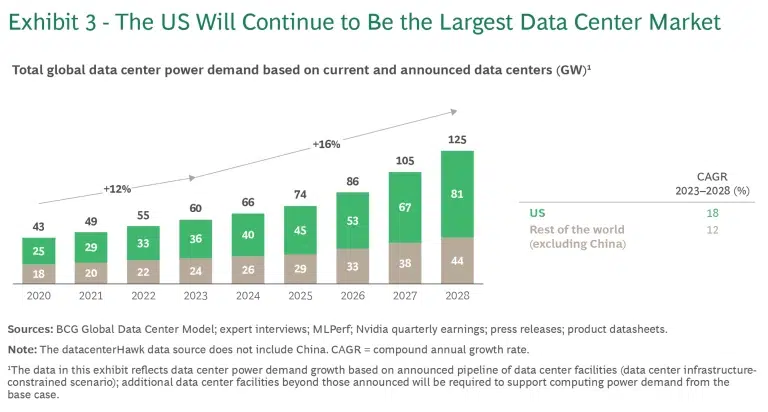
Data Center Power Demand to Double
The forecast for a near doubling of power demand by 2028 provides critical context for the outlook on Alibaba’s nuclear strategy, showing the scale of the energy challenge.
(Source: Boston Consulting Group)
Frequently Asked Questions
Why is Alibaba turning to nuclear power for its data centers?
Alibaba is turning to nuclear power because the massive and constant energy demands of its AI infrastructure cannot be met by intermittent renewables like solar and wind alone. The article explains that nuclear provides the stable, dense, carbon-free baseload power required 24/7 for high-density computing, which is essential for the company’s AI ambitions.
Has Alibaba stopped using renewable energy like solar and wind?
No. The article clarifies that the move to nuclear power complements, rather than replaces, Alibaba’s renewable energy efforts. The company continues to purchase large amounts of renewable energy and install on-site solar, but it is adding nuclear to its energy mix to solve the critical need for a reliable, non-intermittent power source.
How is Alibaba funding this major shift in its energy and AI strategy?
Alibaba is funding this shift through significant capital commitments. The article highlights a three-year, $53 billion investment plan for AI and cloud infrastructure announced in February 2025, and a $3.2 billion convertible bond issued in September 2025 specifically to expand data centers. The nuclear joint venture itself represents a targeted $35.9 million investment to secure baseload power.
Is this nuclear energy strategy being used for all of Alibaba’s data centers worldwide?
No, not at this time. The article states that the nuclear joint venture with China National Nuclear Power is a ‘domestic Chinese solution’ to power the core of its global network. While Alibaba is expanding its data center footprint internationally in places like Mexico and Brazil, securing equivalent clean and stable baseload power in those markets will require navigating different regulatory environments and energy markets.
What are the main risks of Alibaba’s pivot to nuclear power?
According to the SWOT analysis in the article, the main risks include the execution and regulatory challenges of the pioneering nuclear partnership, a potential ‘data center bubble’ from over-investment in infrastructure, and possible ESG backlash from investors. The strategy also creates a heavy reliance on a single state-owned partner in China for its critical baseload power.
