

Green Hydrogen in F&B, Kraft Heinz £40 M Pilot, $7.16/kg Price Point, and 4 Key Projects (2026)
Hydrogen F&B Adoption, Kraft Heinz £40 M Pilot vs. Niche Projects
Hydrogen adoption in the food and beverage sector in 2026 is bifurcated; while large-scale projects test industrial heat decarbonization, most activity is confined to high-temperature niches and value-chain inputs due to prohibitive costs and the availability of more mature alternatives like electrification for lower-temperature heat.
- The period before 2025 was largely characterized by exploratory studies and small-scale R&D. The year 2026 marks a clear shift with the planned operational launch of the Kraft Heinz £40 million green hydrogen project with Carlton Power at its Kitt Green plant, representing the first major commercial-scale test of hydrogen for industrial process heat by a global F&B company.
- Despite this flagship project, most new deployments in 2026 are highly specific and niche. Laos launched Asia’s first hydrogen-powered coffee roasting plant, and the German company HYTING deployed a flameless hydrogen air heater, both targeting high-temperature processes that are difficult to electrify.
- An increasingly significant application is emerging indirectly through the supply chain. F&B companies are focusing on low-carbon fertilizers derived from green ammonia, which uses green hydrogen as a feedstock, to address their substantial Scope 3 emissions. This strategy has gained significant traction since 2024 as companies face pressure to decarbonize their entire value chain.
- A parallel consumer-facing market has appeared, with brands like o Hy and Thirst Responder™ launching hydrogen-infused beverages. While this trend, which gained momentum in late 2025 and early 2026, helps build market familiarity with hydrogen, it does not contribute directly to the industry’s industrial decarbonization goals.
$7.16/kg Price, Green Hydrogen Economics Stall Broader F&B Adoption
The primary barrier to widespread hydrogen adoption in the food and beverage industry is economic, with 2026 green hydrogen prices in Europe at $7.16/kg, rendering it uncompetitive against incumbent fuels for the majority of thermal applications.
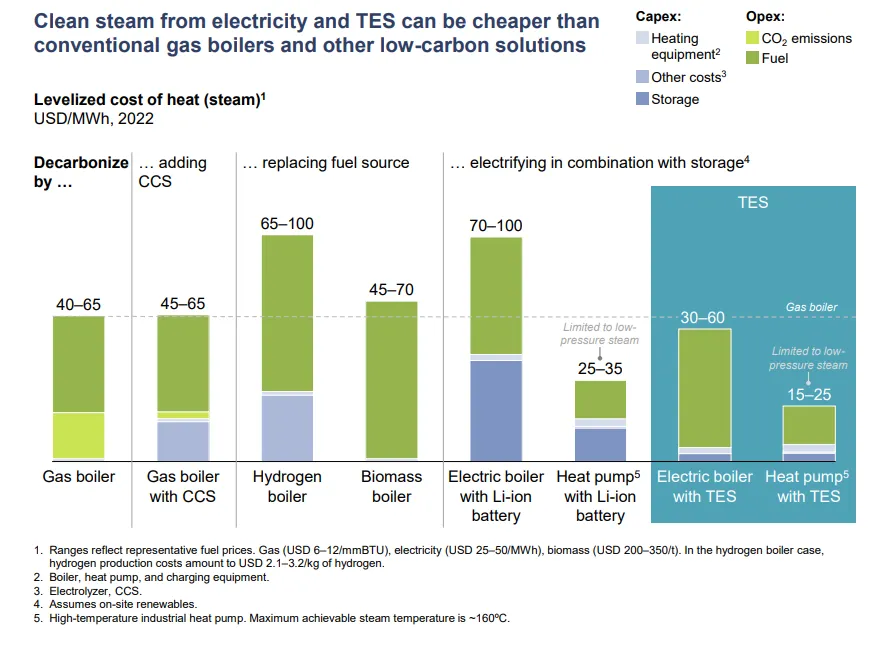
Hydrogen Cost for Heat Exceeds Alternatives
The chart validates the section’s economic argument, visually demonstrating that generating heat with hydrogen is significantly more expensive than with natural gas or electric heat pumps.
(Source: Kraftblock)
- The price disparity is a major deterrent for a margin-sensitive industry. Green hydrogen in Europe is over six times more expensive than grey hydrogen in the USA, which traded at approximately $1.10/kg in March 2026, making the business case for switching from natural gas difficult to justify without significant subsidies.
- High production and compliance costs are forcing strategic pivots even among producers. In January 2026, analysts noted that some European developers were shifting away from producing renewable fuels of non-biological origin (RFNBO) due to the challenging economics.
- While pioneering projects attract funding, the broader F&B industry cannot justify the high capital expenditure for converting existing plants or building new hydrogen-ready facilities. The struggles of the wider US hydrogen market with stalled projects and high costs temper growth expectations for industrial users.
- Future cost reduction remains the critical enabler. Economic modeling for new technologies like a solar co-electrolysis route suggests a potential levelized cost of hydrogen at $1.54 per kilogram, a price point that would make it competitive with fossil-fuel-derived hydrogen and unlock broader industrial use.
F&B Hydrogen Partnerships, Kraft Heinz and Carlton Power Lead £40 M Project
Strategic partnerships in 2026 are forming to de-risk first-of-a-kind hydrogen projects, combining the demand of industrial users with the technical and financial expertise of energy developers.
- The most significant industrial partnership in the sector is between Kraft Heinz and Carlton Power. The £40 million green hydrogen scheme at the Kitt Green plant in the UK, announced for a 2026 operational start, provides a clear model for collaboration between a large energy user and a specialist hydrogen developer.
- In the emerging consumer market, a different type of partnership is evident. The collaboration between Dr. Nicholas Perricone and Rocky Mountain High Brands to launch an ultra-premium hydrogen-infused wellness water in January 2026 shows how alliances are used to create and enter new high-margin beverage categories.
- These partnerships highlight the two distinct tracks of hydrogen’s entry into the F&B sector. The first is focused on the capital-intensive task of decarbonizing industrial operations, while the second is aimed at product innovation and capturing value in the functional beverage market. Major equipment suppliers like Cummins are also forming partnerships to navigate policy and supply chain issues.
Table: Key Hydrogen Partnerships in Food & Beverage (2026)
| Partner / Project | Time Frame | Details and Strategic Purpose | Source |
|---|---|---|---|
| Kraft Heinz / Carlton Power | Feb 2026 | A £40 million project to develop a renewable green hydrogen scheme to power manufacturing processes at the Kitt Green plant in the UK. This serves as a flagship industrial-scale pilot for decarbonizing process heat. | Carlton Power |
| Dr. Nicholas Perricone / Rocky Mountain High Brands | Jan 2026 | A partnership to launch an ultra-premium hydrogen-infused wellness water. This collaboration aims to leverage brand recognition and beverage expertise to penetrate the growing functional drink market. | Yahoo Finance |
| Kultura Brands / Thirst Responder™ | Jan 2026 | The launch of a new hydrogen water brand, with flavored versions shipping in February 2026. This reflects a strategy of rapid product development to capture market share in an emerging category. | Yahoo Finance |
Europe vs. Asia, F&B Hydrogen Projects Show Regional Divergence
Europe leads in large-scale industrial heat pilots driven by strong decarbonization policy, while Asia demonstrates leadership in novel high-temperature applications, and the U.S. focuses more on consumer products.

F&B Is Key Sector in EU Heat Projects
This chart shows the F&B sector is a major applicant in European heat decarbonization projects, directly supporting the text’s focus on European leadership in industrial pilots.
(Source: EU Climate Action – Official website of the European Union)
- The UK and Germany are the epicenters of European activity in 2026. The UK hosts the Kraft Heinz industrial pilot, supported by national decarbonization goals, while Germany is home to the HYTING flameless heater deployment, showcasing advanced technology for emissions-free heat. This follows a broader European push for hydrogen infrastructure, including fuel cell development.
- Asia is pursuing a strategy of targeted industrial upgrades. Laos launched the continent’s first hydrogen-powered coffee roasting plant in January 2026, aiming to add value to its coffee industry with a clean technology differentiator.
- Japan is concentrating on securing the supply chain and building energy independence. In January 2026, a major Japanese food processing group announced plans for an on-site green hydrogen plant using imported PEM electrolyzers, signaling a move to control its own low-carbon energy supply.
- In the United States, hydrogen’s main impact on the F&B sector in 2026 is through the consumer channel. The expansion of hydrogen water brands like o Hy into major retailers such as Meijer indicates a market focus on wellness products rather than industrial decarbonization, which lags behind Europe in this specific sector.
Hydrogen Heat Technology, Pilots Move to Commercial Operation in 2026
In 2026, hydrogen technology for F&B applications is transitioning from theoretical concepts to the “proving ground” phase, with several first-of-a-kind commercial pilots becoming operational, though widespread, market-ready scalability remains a future goal.
- The period from 2021 to 2024 was defined by feasibility studies and R&D. The year 2026 marks a critical turning point with the planned operational launch of the Kraft Heinz project, which will use green hydrogen for industrial process heat. This moves the application from a blueprint to a live commercial demonstration.
- Specialized technologies are already mature. The flameless heating unit deployed by HYTING is a commercially ready solution that provides precise, emissions-free process heat, demonstrating that technical solutions for specific needs exist today.
- On-site production using PEM electrolyzers, as planned by the Japanese F&B group, shows that the technology for decentralized green hydrogen generation is commercially available from suppliers like Sunfire and others. The primary hurdle is the economic viability of on-site production versus grid-supplied energy or delivered gas.
- The main constraint on maturity is not technological capability but economic scalability. The technologies to produce, transport, and use hydrogen for heat exist, but the high cost of the hydrogen feedstock and the required infrastructure investment remain prohibitive for mass adoption beyond well-funded and often subsidized pilot projects.
SWOT Analysis, Hydrogen in Food and Beverage 2026
Hydrogen in food and beverage faces a classic early-adopter dilemma: strong policy tailwinds and technological readiness for niche applications are met with significant cost headwinds and a lack of scalable infrastructure, creating both distinct opportunities and substantial risks for first-movers.

Green Hydrogen Offers Low CO2 at High Cost
This chart illustrates the central trade-off described in the SWOT analysis, showing green hydrogen has very low emissions (a strength) but is significantly more expensive than alternatives (a weakness).
(Source: ScienceDirect.com)
- Strengths have shifted from theoretical potential to demonstrated application in high-value niches.
- Weaknesses remain centered on the prohibitive cost of green hydrogen, which has not fallen fast enough for mass-market adoption.
- Opportunities are expanding beyond industrial heat to include value-chain decarbonization (green fertilizers) and new consumer products (hydrogen water).
- Threats are becoming more defined, with mature, lower-cost decarbonization alternatives like electrification posing a significant challenge to hydrogen in many F&B applications.
Table: SWOT Analysis for Hydrogen in Food & Beverage
| SWOT Category | 2021 – 2023 | 2024 – 2025 | What Changed / Validated in 2026 |
|---|---|---|---|
| Strengths | Theoretical potential as a zero-carbon fuel for high-temperature heat. General alignment with corporate ESG goals. | Initial pilot announcements and funding for R&D projects. Growing recognition as a solution for “hard-to-abate” sectors. | Technology is now proven in niche commercial applications like the Laos coffee roaster and the HYTING flameless heater. The Kraft Heinz project validates large-scale industrial interest. |
| Weaknesses | Extremely high cost of green hydrogen. Lack of production infrastructure and “last-mile” delivery to industrial sites. | Cost remained high despite policy support. Infrastructure development was slow. Projects faced long lead times. | The cost gap is quantified and stark in 2026, with green H 2 at $7.16/kg vs. grey H 2 at $1.10/kg. This remains the single biggest barrier to entry and is confirmed as a major constraint. |
| Opportunities | Primary focus was on replacing natural gas for industrial heat in ovens and dryers. | Exploration of hydrogen’s role in the broader value chain, including transportation and as a chemical feedstock. | The opportunity set has diversified significantly. In 2026, key opportunities include green fertilizers (Scope 3), on-site generation (Japanese F&B group), and consumer products (o Hy hydrogen water). |
| Threats | Competition from natural gas. General inertia and resistance to high CAPEX investments. | Direct electrification via industrial heat pumps emerged as a more mature and cost-effective solution for low-to-medium temperature heat. | The threat from electrification is now a primary factor. For the bulk of F&B thermal needs (pasteurization, sterilization), heat pumps are a more viable pathway in 2026, limiting hydrogen to high-temp niches. |
Hydrogen in F&B Scenario, Kraft Heinz Project Success is Critical
The success or failure of flagship projects like the Kraft Heinz £40 million initiative will dictate the pace of hydrogen investment in the food and beverage sector for the remainder of the decade.

Green Hydrogen Market Forecast Exceeds $115B
This forecast quantifies the significant future market potential, illustrating the large-scale opportunity that successful flagship projects, as described in the scenario, could help unlock.
(Source: Grand View Research)
- If the Kraft Heinz project demonstrates both operational reliability and a manageable total cost of ownership through 2026 and 2027, watch for other major F&B corporations to announce similar large-scale pilots, likely targeting government decarbonization grants to offset the high initial cost.
- Conversely, if the project encounters significant operational challenges or cost overruns, it will validate the industry’s current, more cautious approach. This would reinforce the preference for electrification via industrial heat pumps for low and medium-temperature heat and likely delay further significant hydrogen investments until the 2030 s.
- These could be happening: Continued innovation in hydrogen water will expand consumer familiarity, but a failure to bring green hydrogen production costs down toward the $1.50/kg target will keep industrial use confined to a few high-profile projects. The ability of major suppliers like Air Products to execute on large-scale production and distribution infrastructure will be a key external factor influencing F&B adoption.
The questions your competitors are already asking
This report covers one angle of hydrogen adoption in the food and beverage sector. The questions that matter most depend on your work.
- What is the status of the Kraft Heinz and Carlton Power green hydrogen project since the £40 million announcement?
- Which food and beverage operators are adopting hydrogen, and for which applications—from large-scale industrial heat to niche processes like coffee roasting?
- How does green hydrogen for high-temperature heat compare to electrification for lower-temperature processes in F&B decarbonization?
- What are the opportunities for green hydrogen in the F&B value chain beyond direct heat, such as in the production of low-carbon fertilizers?
This report does not answer these. Enki Brief Pro does.
Your question, your angle, your framework. SWOT, PESTL, scenario modelling. The same niche depth, built around the decision your work actually depends on.
