

Core Scientific AI Pivot, $1.2 B Core Weave Deal, 1.5 GW Texas Expansion, and 10+ Hosting Agreements (2024 to 2026)
2, 000 MW in AI Conversion Projects, Core Scientific and Tera Wulf Lead the Shift
The strategic conversion of Bitcoin mining facilities into AI data centers has accelerated from opportunistic pivots to a core business strategy, driven by the stark revenue disparity between the two operations and the critical time-to-market advantage miners hold. Before 2025, miners explored HPC as a supplementary revenue stream, but the post-2024 Bitcoin halving and an insatiable demand for power from hyperscalers solidified the pivot into a structural industry shift. Companies are now signing multi-year, gigawatt-scale hosting agreements that dwarf potential mining profits, reorienting their entire capital and operational focus toward serving AI clients.
- Between 2021 and 2024, Bitcoin miners primarily focused on scaling their mining capacity, with HPC and AI representing a small, experimental part of their portfolio. The main objective was securing low-cost power to maximize hashrate and Bitcoin production.
- Beginning in 2025, the dynamic inverted. The April 2024 halving reduced mining rewards, making the economics less favorable just as AI-driven power demand surged. This created an arbitrage opportunity, as AI workloads could generate revenue of $25 per kilowatt-hour, far exceeding the $1 per kilowatt-hour from Bitcoin mining.
- Publicly listed miners have now committed to over $70 billion in cumulative AI and HPC contracts, signaling a definitive capital reallocation away from crypto. Projections show AI-related services could constitute up to 70% of these companies’ revenue by the end of 2026, up from approximately 30% in early 2026.
- This transition is not just about revenue; it is about valuation. The market has begun to re-price these companies as AI infrastructure providers, which command higher, more stable multiples than volatile, commodity-exposed Bitcoin miners.
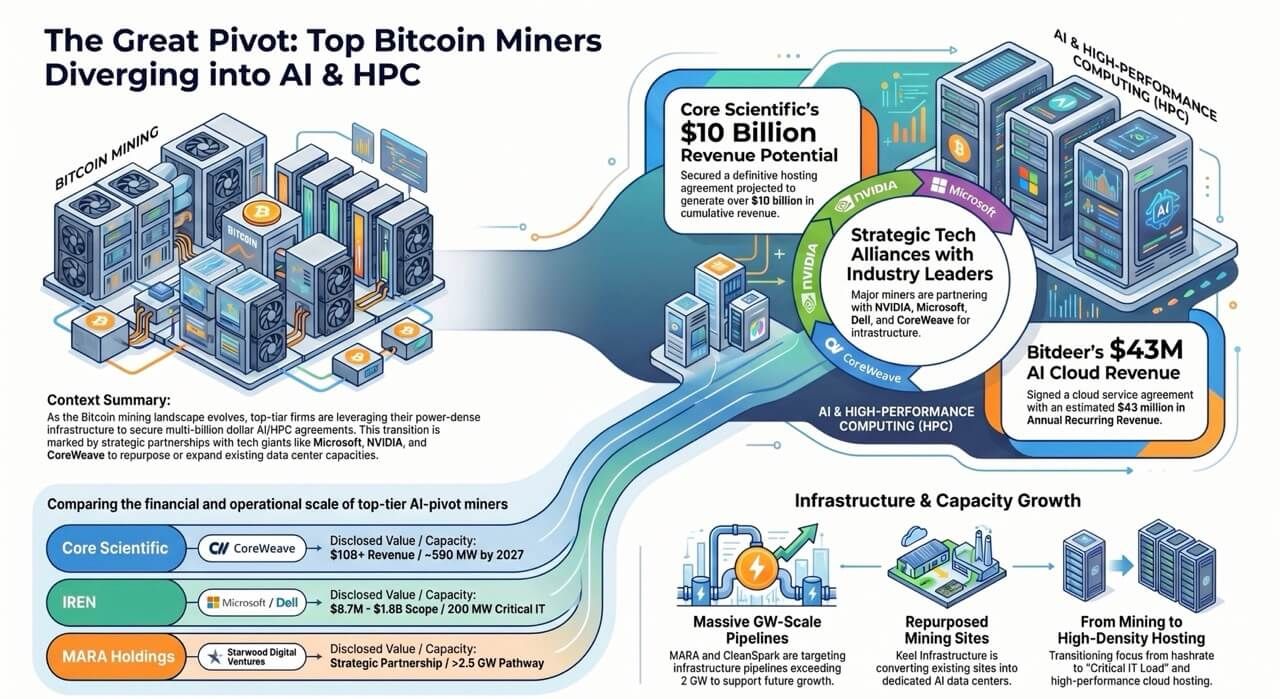
Bitcoin Miners Pivot to AI/HPC, Securing Multi-Billion Dollar Deals
Top Bitcoin miners are strategically pivoting their power-dense infrastructure to AI & High-Performance Computing (HPC). Core Scientific projects over $10 billion in cumulative revenue from AI/HPC, while Bitdeer has already secured a $43 million Annual Recurring Revenue (ARR) AI cloud service agreement, indicating a rapid re-allocation of computing resources.
Strategic Partnerships with Tech Giants Drive Infrastructure Conversion
This pivot is driven by critical strategic alliances with tech giants like NVIDIA, Microsoft, Dell, and CoreWeave, validating the demand for high-density computing. Companies such as IREN and MARA Holdings are transforming mining sites into dedicated AI data centers, shifting focus from volatile crypto markets to stable, high-growth AI compute services.
AI/ML Investment Dwarfs Crypto, Driving Market Shift
Venture capital investment in AI/ML dramatically outpaced Crypto/Blockchain from 2020 to 2024, peaking at approximately $145 billion for AI/ML in 2021, compared to Crypto’s peak of ~$30 billion. By 2024, AI/ML investment held strong at ~$120 billion, while Crypto plummeted to ~$10 billion.
(Source: Miner Weekly – The Great Bitcoin Mining Power Shift: Who Won Q1? | TheEnergyMag)
Partnership Analysis, Core Scientific Leads with $1.2 B Core Weave Expansion
Strategic partnerships between former Bitcoin miners and AI-focused companies or hyperscalers have become the primary mechanism for executing the infrastructure pivot. These alliances combine the miners’ key assets, energized land and power contracts, with the AI firms’ capital, technical specifications, and demand for compute capacity. These deals have evolved from simple hosting agreements to complex, long-term joint ventures and acquisitions that underscore the scale of the transition.
Table: Key Miner-AI Partnerships and Agreements (2025 to 2026)
| Partner / Project | Time Frame | Details and Strategic Purpose | Source |
|---|---|---|---|
| MARA and Starwood | Feb 2026 | MARA formed a strategic partnership with Starwood to accelerate the development of hyperscale and AI-capable data centers, leveraging MARA’s power assets. | MARA Press Release |
| Tera Wulf and Fluid Stack | Aug 2025 | Tera Wulf signed 10-year AI hosting agreements for over 200 MW with AI cloud provider Fluid Stack, securing long-term, stable revenue streams for its power infrastructure. | Tera Wulf Press Release |
| Core Weave and Core Scientific | Jul 2025 | Core Weave moved to acquire Core Scientific, following a series of large-scale hosting agreements, including a $1.2 billion expansion at the Denton, TX site to support AI workloads. This deal represents the culmination of the pivot trend, with a major AI cloud provider absorbing a top mining infrastructure operator. | Core Weave News |
| Bitfarms AI Conversion | Nov 2025 | Bitfarms announced plans to convert its 18 MW site in Washington to an HPC/AI data center, signing a $128 million supply agreement. This signaled a broader strategy to exit crypto mining entirely by 2027. | Bitfarms Press Release |
US Power Corridors, Core Scientific Focuses on Texas and Oklahoma
The geographic concentration of crypto-to-AI conversions is dictated by the availability of large-scale, grid-connected power, a legacy of the Bitcoin mining boom. States with favorable energy markets and regulatory environments, primarily Texas, Kentucky, and parts of the Southeast and Midwest, have become the epicenters of this activity. These regions offer the ready-to-build sites that allow companies to bypass the multi-year grid connection queues plaguing new data center developments in traditional markets like Northern Virginia.
- Texas is a prime location due to its deregulated energy market (ERCOT) and substantial power generation capacity. Core Scientific is executing a major expansion to 1.5 GW at its Pecos, Texas campus and is developing another large-scale campus in Muskogee, Oklahoma, capitalizing on the region’s power availability.
- Kentucky has also emerged as a key hub. Tera Wulf has expanded its digital and power infrastructure portfolio with strategic acquisitions in the state, while other mining companies are planning large-scale data center conversions in Eastern Kentucky, leveraging existing power agreements.
- Washington state, with its history of cheap hydroelectric power that once attracted miners, is now seeing conversions. Bitfarms is converting its Washington site for HPC/AI, demonstrating that legacy mining locations with power advantages remain valuable.
- Conversely, some states are implementing regulatory hurdles. New York launched a statewide moratorium on new hyperscale data centers in July 2026, and Illinois paused data center tax breaks, potentially redirecting future development to more welcoming jurisdictions.
Technology Maturity: Retrofitting From Air-Cooling to High-Density Liquid Cooling
The technical transition from a Bitcoin mine to an AI data center is a significant engineering challenge, moving from low-density, air-cooled facilities to high-density, liquid-cooled environments required for modern GPUs. While the core asset is the power substation and grid connection, the physical infrastructure requires substantial retrofitting. The maturity of this process has advanced from simple containerized solutions to sophisticated, purpose-built facilities capable of supporting the latest AI hardware from providers like Nvidia.
- Initial conversions before 2025 often involved retrofitting existing air-cooled buildings, which limited power density and the type of AI hardware that could be supported. This approach was faster but less efficient.
- From 2025 onwards, leading companies like Core Scientific and Tera Wulf began developing purpose-built AI data centers on their existing powered sites. These new builds incorporate direct-to-chip liquid cooling and can support power densities exceeding 1, 000 watts per square foot, a necessity for AI clusters.
- The cost of this upgrade is substantial. An AI data center can cost 10-15 times more per megawatt to build than a Bitcoin mine, reflecting the need for advanced cooling, higher-rated electrical infrastructure, and more robust building shells.
- Despite the cost, the time-to-market advantage is the decisive factor. Possessing an already-energized site is valued at $3-4 million per megawatt for a one-year lead time, justifying the high capital expenditure for retrofitting or new construction.
SWOT Analysis of the Core Scientific Pivot to AI Infrastructure
The pivot from Bitcoin mining to AI data center hosting presents a powerful strategic opportunity but also introduces new operational and financial risks. The analysis reveals a shift from a business model exposed to cryptocurrency volatility to one dependent on the capital expenditure cycles of hyperscale and AI companies. This transition has fundamentally altered the risk profile and long-term potential of former mining operators.
Table: SWOT Analysis of the Crypto-to-AI Data Center Pivot (2021-2025)
| SWOT Category | 2021 – 2024 | 2025 – 2026 | What Changed / Validated |
|---|---|---|---|
| Strength | Possession of low-cost, long-term power purchase agreements (PPAs). Operational expertise in running large-scale, energy-intensive facilities 24/7. | Ownership of energized, grid-connected land, providing a critical time-to-market advantage over new builds. Existing relationships with utilities and energy providers. | The core asset shifted from cheap power for mining to speed-to-market for AI. The 2-4 year grid connection delays for hyperscalers validated the immense value of miners’ existing energized sites. |
| Weakness | Extreme revenue volatility tied to Bitcoin price. High sensitivity to network difficulty and halving events, which directly impact profitability. | Lack of experience in building and operating high-density, liquid-cooled data centers. High capital expenditure required for retrofitting or new builds, increasing debt loads. | The technical skill gap became a primary weakness. Companies had to either acquire new talent or partner with specialists like Core Weave to bridge the gap between running a mine and a sophisticated AI data center. |
| Opportunity | Scaling Bitcoin mining operations to capture a larger share of the network hashrate. Vertical integration into power generation. | Massive, unmet demand for data center capacity from hyperscalers and AI firms. Ability to secure long-term, stable, high-margin revenue through hosting contracts. | The AI boom created a new, far more lucrative market for the miners’ primary asset: power. The opportunity shifted from a volatile commodity play to a stable infrastructure play, as evidenced by Tera Wulf’s 10-year hosting agreements. |
| Threat | Regulatory crackdowns on crypto mining’s energy consumption. Declining Bitcoin price and post-halving margin compression. | Competition from established data center REITs. Potential for local community pushback and moratoriums on data center construction due to power and water use. Risk of AI hardware supply chain disruptions. | Regulatory risk evolved from targeting crypto to targeting all large-load data centers. New York’s moratorium and growing resistance in other regions show that social license to operate is a rising threat for the new business model. |

AI Outpaces Bitcoin: 10x Revenue Multiplier Per Megawatt
AI workloads now generate 10x more revenue per megawatt than Bitcoin mining. This dramatic shift is compelling crypto miners, who possess critical grid-connected infrastructure, to convert their operations into AI data centers, reshaping the industry.
Power Grid Access: Miners” Strategic Advantage in AI Boom
The race for AI computing power is fundamentally a race for power infrastructure. Crypto miners, having secured significant grid access, are uniquely positioned to become major AI data center providers, capturing ~$70 billion in signed AI and HPC contracts and expecting ~70% of their revenue from AI by 2026.
Bitcoin Miners Pivot to AI/HPC Driven by Strategic Partnerships
Top Bitcoin miners are making a “Great Pivot” by converting their power-dense infrastructure to AI & High-Performance Computing (HPC) data centers. This shift is driven by strategic alliances with industry leaders like NVIDIA, Microsoft, Dell, and CoreWeave, with Core Scientific alone projecting over $10 billion in cumulative revenue potential and Bitdeer securing $43M in annual recurring AI cloud revenue.
(Source: What’s a Megawatt Worth? Analyzing the AI Opportunity for Bitcoin Miners: Report – Blockspace)
Scenario Modeling for Core Scientific: Consolidation and Integration
The most critical factor for former miners in the next 12-18 months is their ability to execute on construction timelines and secure long-term financing for capital-intensive AI builds, which will determine whether they become acquisition targets or successful standalone infrastructure providers. If these companies can successfully deliver gigawatt-scale capacity on schedule, they will solidify their position as essential enablers of the AI boom; failure to do so will invite consolidation from better-capitalized players.
- If this happens: Companies like Core Scientific and Hut 8 successfully bring their announced gigawatt-scale AI campuses online within the projected timelines and budgets.
- Watch this: Look for announcements of new, multi-hundred-megawatt hosting agreements with hyperscalers or major AI labs, as well as the successful closing of large-scale construction financing or green bonds. Hut 8’s commercialization of its 1 GW Beacon Point facility is a key signal.
- This could be happening: These miners will transition fully into AI infrastructure providers, commanding higher valuations and potentially starting to acquire smaller operators to consolidate power assets. The market will see a clear separation between a few large-scale winners and many smaller, struggling miners.
The questions your competitors are already asking
This report covers one angle of the Bitcoin mining industry’s pivot to AI infrastructure. The questions that matter most depend on your work.
- Bitcoin miner data center construction timelines and delays
- Financing for crypto miner AI conversion projects
- Impact of AI pivot on bitcoin network hashrate
- Liquid cooling technology supply chain for data centers
This report does not answer these. Enki Brief Pro does.
Your question, your angle, your framework. SWOT, PESTL, scenario modelling. The same niche depth, built around the decision your work actually depends on.
