

Power Ledger Blockchain Trading, $5 B Market by 2026, and 20+ Global Pilots Hindered by Regulation (2021 to 2026)
P 2 P Pilot Proliferation, Power Ledger Demonstrates Technical Feasibility
Power Ledger has successfully shifted from concept to execution, demonstrating the technical viability of its blockchain peer-to-peer (P 2 P) trading platform across numerous international pilots, yet large-scale commercial adoption remains constrained by market structure rather than technology. The push for grid decentralization is amplified by massive load growth from data centers operated by companies like Microsoft and electrification initiatives from industrial consumers, creating an urgent need for solutions that can manage distributed energy resources (DERs) effectively.
- Between 2021 and 2024, Power Ledger focused on validating its model through a series of pilots. A key project in Vietnam with EVN-CPC demonstrated P 2 P trading between a renewable energy generator and school rooftops, proving the system’s functionality in a real-world, emerging market context.
- The platform’s application extends beyond simple energy trading to include the management of renewable energy certificates (RECs), which was a core component of its earlier projects. This dual capability allows it to address both energy and environmental attribute markets.
- Data from P 2 P trading models consistently shows tangible economic benefits. Studies indicate potential consumer cost savings of 7-30% and reductions in intermediary transaction costs of 40-60% by automating settlement and removing bilateral contracting overhead.
- By 2025, the strategic focus pivoted from proving technical feasibility to navigating the path to commercial scale. The successful completion of numerous pilots confirmed the platform’s operational readiness, shifting the primary barrier to growth from technological limitations to regulatory and market-design challenges.
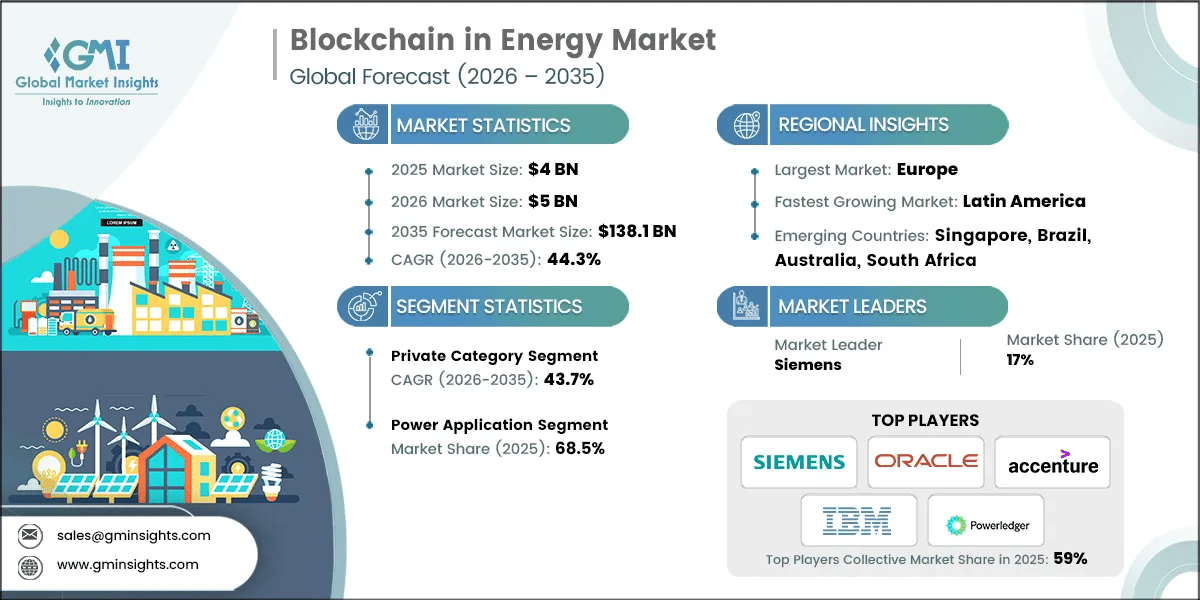
Blockchain Energy Market Set for Hyper-Growth: $5B (2026) to $138.1B (2035)
The Blockchain in Energy Market is projected to surge from $5 billion in 2026 to $138.1 billion by 2035, driven by a robust 44.3% CAGR. The Power Application Segment, holding a dominant 68.5% market share in 2025, underscores the immediate focus on decentralized power solutions.
Decentralized Energy Trading: Powerledger’s Role in a Consolidating Market
Powerledger’s presence among top players in this rapidly growing market signals its critical role in decentralized energy trading. With top players holding 59% collective market share, understanding niche applications and regional growth (e.g., Latin America’s fastest growth) is key to leveraging this high-CAGR environment.
Blockchain in Energy Market Set for 850% Growth to $38B by 2035
The global blockchain in energy market is projected to grow exponentially, from approximately $4 billion in 2025 to an estimated $38 billion by 2035. This massive 850% growth indicates a strong shift towards decentralized energy solutions powered by blockchain, with both public and private sectors contributing significantly to market expansion.
(Source: Blockchain in Energy Market Size, Industry Trends | 2035)
$5 B Market by 2026, Blockchain in Energy Investment Forecasts
Multiple market forecasts confirm strong growth expectations for the blockchain in energy sector, but the wide variance in long-term projections highlights significant uncertainty tied to the pace of regulatory reform and market scaling. While no direct collaboration between Power Ledger and a hyperscaler like Google is evident in market data, the sector’s growth is attracting significant attention from technology providers and investors.
- The overall blockchain in energy market is projected to grow from approximately $4 billion in 2025 to over $5 billion in 2026, according to reports from GM Insights. This reflects strong industry confidence in the technology’s application for grid modernization.
- The specific P 2 P energy trading platform segment, where Power Ledger operates, was valued at $0.5 billion in 2025 and is forecast to expand at a compound annual growth rate (CAGR) of 21.5% through 2034, indicating a robust niche market.
- Significant divergence exists in long-term forecasts. Projections for the broader blockchain in energy market by 2035 range from $31.8 billion (Precedence Research) to as high as $833.82 billion. This wide range signals that the market’s ultimate size is heavily dependent on overcoming non-technical barriers like regulation.
- The Energy Trading and P 2 P Transactions segment is expected to be the largest, commanding a 35.1% share of the market in 2026, confirming that Power Ledger’s core business is aligned with the sector’s primary growth driver.
Table: Market Size Forecasts for Blockchain in Energy vs. P 2 P Trading Platforms
| Forecast Provider | Market Segment | 2025 Market Size ($B) | 2026 Market Size ($B) | 2034/35 Forecast ($B) | CAGR (%) | Source |
|---|---|---|---|---|---|---|
| GM Insights | Blockchain in Energy | $4 | $5 | $138.1 | 44.3% | GM Insights |
| SNS Insider | Blockchain in Energy | $3.68 | $6.53 | $202.71 (by 2032) | 77.4% | SNS Insider |
| Precedence Research | Blockchain in Energy Trading | $1.98 | $2.61 | $31.8 | 32.0% | Precedence Research |
| Market Intelo | Peer-to-Peer Energy Trading | $0.5 | $0.61 | $2.8 | 21.5% | Market Intelo |

Blockchain Energy Market Poised for Explosive 44.3% CAGR Growth to $138.1BN by 2035
The Blockchain in Energy market, valued at $5 BN in 2026, is set for hyper-growth with a projected 44.3% CAGR to reach $138.1 BN by 2035. The Power Application Segment currently dominates with a 68.5% market share, underscoring blockchain’s critical role in decentralized energy trading.
Powerledger Positioned in High-Growth Decentralized Energy Sector
Powerledger’s presence among top players in a market accelerating at 44.3% CAGR to $138.1BN by 2035 highlights its strategic positioning in decentralized energy trading. This growth is driven by the ‘Power Application Segment’ (68.5% share), indicating blockchain’s pivotal role in transforming energy grids.
Blockchain Energy Trading Market to Skyrocket 1500% by 2035
The Blockchain in Energy Trading Market is projected for explosive growth, escalating from $1.98 billion in 2025 to $31.80 billion by 2035. This represents a staggering 1500%+ increase, signaling a rapid shift towards decentralized energy solutions.
(Source: Blockchain in Energy Market Size, Industry Trends | 2035)
India vs. Vietnam, Power Ledger Regulatory Sandboxes Drive Adoption
Power Ledger’s geographic strategy focuses on markets with favorable regulatory sandboxes that permit innovation, with India and parts of Southeast Asia emerging as key growth areas, while adoption in more mature, rigidly regulated markets lags. This approach prioritizes speed to market in regions where incumbent utility models are more open to partnerships with DER platforms.
- India has become a primary target market following policy movements in 2025-2026 to legalize P 2 P energy trading. The development of the “India Energy Stack” and pilot programs, such as those considered by the Uttar Pradesh Electricity Regulatory Commission (UPERC), create a clear pathway to commercialization.
- The completed pilot project with EVN-CPC in Vietnam serves as a successful template for entering emerging economies. By partnering with a major utility to test the system in a controlled environment, Power Ledger demonstrated value without disrupting the existing grid structure, a model it can replicate elsewhere.
- In its home market of Australia, Power Ledger has conducted numerous trials. However, progress toward continent-wide, commercial deployment remains slow due to fragmented state-level regulations and the established structure of the National Electricity Market (NEM).
- In contrast, regions like Europe and North America present greater challenges. Entrenched utility business models and complex, multi-layered regulatory frameworks, such as those overseen by grid operators like ISO-NE, create higher barriers to entry for disruptive P 2 P platforms despite high levels of DER penetration.
Power Ledger Solana Migration, Targeting Scalability Beyond Pilots (2024)
The migration from a private Proof-of-Authority chain to the Solana blockchain in late 2024 marked a critical technological pivot for Power Ledger, directly addressing the scalability and transaction cost challenges required for commercial operation. This move was a deliberate step to build an enterprise-grade platform capable of supporting high-frequency transactive energy.
- Prior to 2024, Power Ledger’s platform ran on a permissioned chain that offered control but faced limitations in throughput and interoperability with the broader digital asset ecosystem. This architecture was sufficient for pilots but not for mass-market deployment.
- The integration with Solana, completed in October 2024, was a strategic decision to leverage a high-performance public blockchain. Solana’s architecture is designed for thousands of transactions per second at a fraction of the cost of earlier blockchains like Ethereum, making it suitable for processing millions of energy micro-transactions in near real-time.
- This technological shift directly confronts one of the main historical criticisms of blockchain for energy applications: scalability. By adopting a more mature and faster base layer, Power Ledger positioned its technology to be a viable infrastructure solution for utilities, not just a niche application for small communities.
- With the scalability question largely addressed by this migration, the company’s focus has sharpened entirely on the commercial and regulatory hurdles that remain the primary obstacles to widespread adoption of its P 2 P trading solutions.
Power Ledger 2026 Growth, Regulatory Unlocking is the Key Variable
The primary determinant of Power Ledger’s growth trajectory through 2026 is not further technological advancement but the pace and scope of regulatory approvals that permit live, commercial P 2 P energy trading within local distribution networks.
- If this happens: If a major jurisdiction, such as an Australian state or a large Indian state like Uttar Pradesh, formally approves and rolls out a commercial framework for P 2 P energy trading in 2025 or 2026, it would serve as a powerful validation of the entire business model.
- Watch this: Key signals to monitor are policy announcements from energy regulators in markets where Power Ledger has an established presence. Favorable rulings from regulatory bodies in Western Australia, India’s CERC, or Vietnam would indicate imminent commercial opportunities and a first-mover advantage for the company.
- These could be happening: A successful regulatory greenlight would trigger a rapid shift from pilot projects to long-term, revenue-generating contracts with utilities and property developers. This would also likely spur a wave of partnerships with grid operators, such as National Grid, looking to procure P 2 P services as a non-wires alternative to costly infrastructure upgrades.
The questions your competitors are already asking
This report covers one angle of Power Ledger’s commercial trajectory. The questions that matter most depend on your work.
- Peer to peer energy trading regulation India
- Power Ledger competitors
- Utility adoption of peer to peer trading platforms
- Solana blockchain for enterprise applications
This report does not answer these. Enki Brief Pro does.
Your question, your angle, your framework. SWOT, PESTL, scenario modelling. The same niche depth, built around the decision your work actually depends on.
