

ACWA Power BESS Projects, 5, 000 MW EPI JDA, $200 M BCDA Solar Deal, and 4 Alliances (2025 to 2026)
Grid Infrastructure Risk Defines ACWA Power’s 5, 000 MW Philippine Strategy
ACWA Power’s entry into the Philippines is structured to directly address the country’s primary energy transition constraint: inadequate grid transmission capacity. The strategy combines strong local partnerships with a pragmatic mix of renewable and gas-fired generation to de-risk its ambitious 5, 000 MW development pipeline and ensure project bankability in a challenging infrastructure environment.
- The core execution risk for any new power project in the Philippines is grid congestion, which the country’s Energy Regulatory Commission (ERC) has identified as a critical barrier to achieving national renewable energy targets. ACWA’s June 2026 Joint Development Agreement (JDA) with Emerging Power Inc. (EPI) explicitly includes gas-fired power alongside renewables to provide stable, dispatchable energy that mitigates the intermittency of solar and wind, making the portfolio more valuable to the grid operator.
- The flagship 500 MW solar project in New Clark City, formalized through agreements with the Bases Conversion and Development Authority (BCDA) in 2026, incorporates a large-scale Battery Energy Storage System (BESS). This is not just a value-add but a strategic necessity, designed to provide ancillary services and absorb generation when transmission lines are at capacity, a direct countermeasure to grid limitations.
- Prior to the major 2026 agreements, ACWA Power’s activity in 2025 focused on building the foundational alliances necessary to navigate these risks. This includes an Mo U with the Maharlika Investment Corporation (MIC) to explore off-grid solutions, bypassing the main grid’s issues, and a partnership with Meralco Power Gen (MGEN), which brings deep local offtaker and regulatory experience.
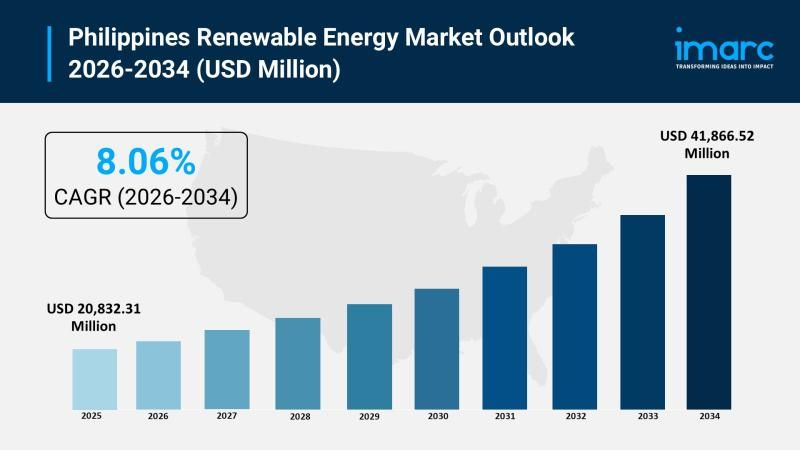
Philippines RE Market Poised for Explosive 8.06% CAGR Growth
The Philippines Renewable Energy Market is projected to nearly double from USD 20,832.31 million in 2025 to USD 41,866.52 million by 2034, achieving a robust 8.06% CAGR. This substantial growth highlights a rapidly expanding market ripe for large-scale clean energy investments.
Robust Market Growth De-Risks Mega Clean Energy Projects
This aggressive market expansion provides a compelling backdrop for major clean energy initiatives like the ACWA Power 5,000 MW joint development. The consistent 8.06% CAGR signals strong governmental commitment and investor confidence, de-risking significant capital deployment over the long term.
Philippines Renewable Energy Set for Triple-Digit Growth by 2035
Renewable power generation in the Philippines is projected to nearly triple from 23.6 TWh in 2026 to 68.6 TWh by 2035, indicating a robust and accelerating clean energy transition. Solar PV and Onshore Wind are forecast to be the primary drivers of this growth, with significant expansion throughout the period.
(Source: Philippines aims to attain 35% renewable energy generation by 2030)
ACWA Power Forges 4 Alliances to De-Risk Philippine Market Entry
ACWA Power’s Philippine market entry strategy is entirely dependent on a multi-layered partnership model designed to secure land, navigate complex regulations, ensure project offtake, and access local financing. These alliances, solidified between June 2025 and July 2026, provide the local operational capabilities that a foreign developer cannot replicate alone, making them essential for executing the 5, 000 MW plan.
- The most significant alliance is the Joint Development Agreement with Emerging Power Inc. (EPI), the renewable energy subsidiary of mining firm Nickel Asia Corp. This partnership provides critical local development expertise, site access, and a shared-risk framework for the entire 5, 000 MW portfolio.
- The agreement with the Bases Conversion and Development Authority (BCDA) is a government-level partnership that secures a 500-hectare site for the flagship 500 MW solar and storage project in New Clark City. This collaboration de-risks land acquisition, a common source of project delays in the Philippines.
- To address financing and broader government support, ACWA Power signed a Memorandum of Understanding with the Maharlika Investment Corporation (MIC), the nation’s sovereign wealth fund. This signals strong state backing and opens potential co-investment avenues, particularly for projects in off-grid areas.
- A strategic partnership with Meralco Power Gen (MGEN), a subsidiary of the country’s largest power distributor, focuses on joint development of utility-scale solar projects. This alliance is crucial for securing power purchase agreements (PPAs) and connecting projects to a major distribution network.
Table: ACWA Power’s Key Philippine Partnerships (2025-2026)
| Partner / Project | Time Frame | Details and Strategic Purpose | Source |
|---|---|---|---|
| Bases Conversion and Development Authority (BCDA) | Jan – Jul 2026 | Land reservation and lease agreement for a 500-hectare site in New Clark City. Secures land for the 500 MW solar and BESS flagship project, mitigating a key development risk. | Acwa, BCDA Advance Philippines’ Clean Energy … |
| Emerging Power Inc. (EPI) | Jun 2026 | Signed a Joint Development Agreement (JDA) to build up to 5, 000 MW of clean energy (renewables and gas) by 2030. This is the core partnership for the entire Philippine expansion. | Acwa and Emerging Power Inc. Sign Joint Development … |
| Maharlika Investment Corporation (MIC) | Jun 2025 | Signed an Mo U to explore and develop renewable energy projects, particularly in off-grid islands. Aligns project with national sovereign wealth fund and explores markets beyond the main grid. | Maharlika Investment Corporation and ACWA Power Sign … |
| Meralco Power Gen (MGEN) | Jun 2025 | Entered a strategic partnership to jointly develop utility-scale solar projects. Creates a direct path to offtake agreements with the Philippines’ largest power distributor. | MGEN, ACWA Power Enter Strategic Partnership … |
$200 M Investment Secures ACWA Power’s 500 MW Flagship BESS Project
ACWA Power’s financial commitment to the Philippines is anchored by an initial $200 million investment for its 500 MW solar and storage project in New Clark City. This project-level capital expenditure serves as a tangible down payment on the broader 5, 000 MW JDA, validating the company’s long-term execution plan and establishing a commercial-scale footprint.
- The investment, confirmed in January 2026, covers the development of the 500 MW solar PV facility coupled with a Battery Energy Storage System (BESS) on land leased from the BCDA. The cost structure equates to approximately $400, 000 per megawatt, a standard benchmark for utility-scale solar projects with storage in the region.
- This direct project equity investment by ACWA Power demonstrates its role as a co-developer and operator, not merely a passive financial partner. It aligns with the company’s global model of taking significant stakes in the assets it develops to control execution and capture long-term operational revenue.
- While the $200 million is the first announced sum, it represents only the initial phase. The full 5, 000 MW platform with EPI will require several billion dollars in total investment by 2030, which will likely be sourced through a combination of project finance, corporate debt, and potential co-investment from partners like the MIC.
Philippines Market Demands ACWA Power’s Pragmatic RE and Gas Mix
ACWA Power’s commitment to develop 5, 000 MW in the Philippines marks its most significant strategic move into the high-growth Southeast Asian energy market. This entry is timed to capitalize on the country’s pressing need for new capacity and its policy reform allowing 100% foreign ownership of renewable energy projects, but is shaped by the practical limitations of the local market.
- The Philippines represents an ideal entry point due to its aggressive renewable energy targets, which aim for a 35% share by 2030 under the National Renewable Energy Program (NREP). This creates a clear, long-term demand signal for developers like ACWA Power.
- The decision to deploy a mix of solar PV, BESS, and gas-fired power is a pragmatic acknowledgment of the current technology maturity and infrastructure readiness in the Philippines. The strategy relies on commercially proven technologies to ensure bankability and grid stability.
- The geographic focus is on large, developable sites like New Clark City in Tarlac, a special economic zone with streamlined permitting. The partnership with the MIC also signals a strategic intent to target off-grid islands, a distinct and underserved market segment within the Philippines that avoids mainland grid issues.
- Prior to 2025, ACWA Power’s portfolio was heavily concentrated in the Middle East, North Africa, and Central Asia. The Philippine venture diversifies its geographic risk and establishes a key operational hub to pursue further opportunities across the ASEAN region.

Philippines Renewable Energy Market Poised for 8.06% CAGR Growth
The Philippines renewable energy market is projected to nearly double, growing from USD 20.83 billion in 2025 to USD 41.87 billion by 2034, driven by an impressive 8.06% CAGR. This indicates robust expansion opportunities for clean energy projects.
Market Growth Validates Major Clean Energy Investment Trajectories
This significant market growth, validated by the 8.06% CAGR, provides a strong economic backdrop for large-scale investments like the ACWA Power Philippines 5,000 MW clean energy agreement by 2030. The market size demonstrates significant capacity for absorbing new supply and achieving national energy goals.
Philippines Renewable Energy Set for 400%+ Growth by 2035, Driven by Solar & Offshore Wind
The Philippines” annual renewable energy generation is projected to surge by over 400%, from approximately 14 TWh in 2020 to nearly 70 TWh by 2035. This explosive growth is primarily driven by substantial planned expansions in Solar PV and a rapid uptake of Offshore Wind capacity, signaling a clear national strategy to pivot towards large-scale clean energy deployments.
(Source: Philippines aims to attain 35% renewable energy generation by 2030)
Scenario Modelling for ACWA Power’s Philippine Execution Risks
The successful execution of ACWA Power’s 5, 000 MW pipeline by 2030 is primarily contingent on the timely expansion and modernization of the Philippines’ national transmission grid. While the company’s strategy mitigates some risk, large-scale project commissioning will ultimately depend on the grid operator’s ability to provide adequate interconnection capacity.
- If this happens: The Philippine government and private concessionaires accelerate grid transmission projects, particularly in Luzon where New Clark City is located. Watch this: Announcements from the National Grid Corporation of the Philippines (NGCP) regarding new transmission line approvals and construction timelines. The ERC’s statements on resolving transmission snags will be a leading indicator.
- If this happens: Grid upgrades continue to lag, creating interconnection queues and project delays. Watch this: ACWA Power and EPI may pivot their project pipeline to prioritize smaller, off-grid projects (as suggested by the MIC partnership) or projects in regions with available grid capacity. The ratio of gas-fired to renewable projects in their development plan might also shift toward more gas to guarantee dispatch.
- These could be happening: To force the issue, large developers like ACWA Power could engage in “at-risk” development, building generation assets in anticipation of future grid availability. They might also lobby for or directly invest in dedicated transmission lines for their project clusters, a model used in other developing markets to overcome public infrastructure deficits.
The questions your competitors are already asking
This report covers one angle of ACWA Power’s Philippine market entry strategy. The questions that matter most depend on your work.
- Philippines new transmission projects Luzon
- Competitor renewable energy projects Philippines
- Meralco renewable energy partnerships
- Philippines battery storage project incentives
This report does not answer these. Enki Brief Pro does.
Your question, your angle, your framework. SWOT, PESTL, scenario modelling. The same niche depth, built around the decision your work actually depends on.
