

Suncor Green Hydrogen Strategy, C$6.3 B Oil CAPEX, Pathways Alliance CCUS Focus, and 840 k bpd Production (2021-2025)
Incumbent Strategy, Suncor Energy’s C$6.3 B Oil Focus Amid Hydrogen Growth
In 2025, Suncor Energy deliberately prioritized returns from its core oil and gas business, deferring material investment in green hydrogen despite a rapidly expanding global market and favorable domestic policy. This strategy of maximizing value from legacy assets positions the company as a cautious incumbent, focusing on operational efficiency and shareholder returns over early entry into the energy transition’s next phase.
- From 2021 to 2024, industry dialogue centered on the energy transition, yet Suncor’s actions in 2025 solidified its commitment to fossil fuels, dedicating a C$6.1 billion to C$6.3 billion capital budget entirely to its upstream and downstream oil operations.
- The company’s decarbonization efforts are incremental, not transformative. The Heater 2101 Project at its Commerce City Refinery, which reduces NOx emissions, is a compliance-driven upgrade to sustain fossil fuel refining, not a pivot to new energy systems.
- This strategic inertia contrasts sharply with the burgeoning global green hydrogen market, which multiple research firms valued between $2.17 billion and $12.31 billion for 2025, with forecasts of exponential growth through 2035.
- While Suncor participates in the CCUS-focused Pathways Alliance, it announced no new partnerships, joint ventures, or collaborations in 2025 specifically for green hydrogen development, ceding early-mover advantage to more aggressive global competitors.
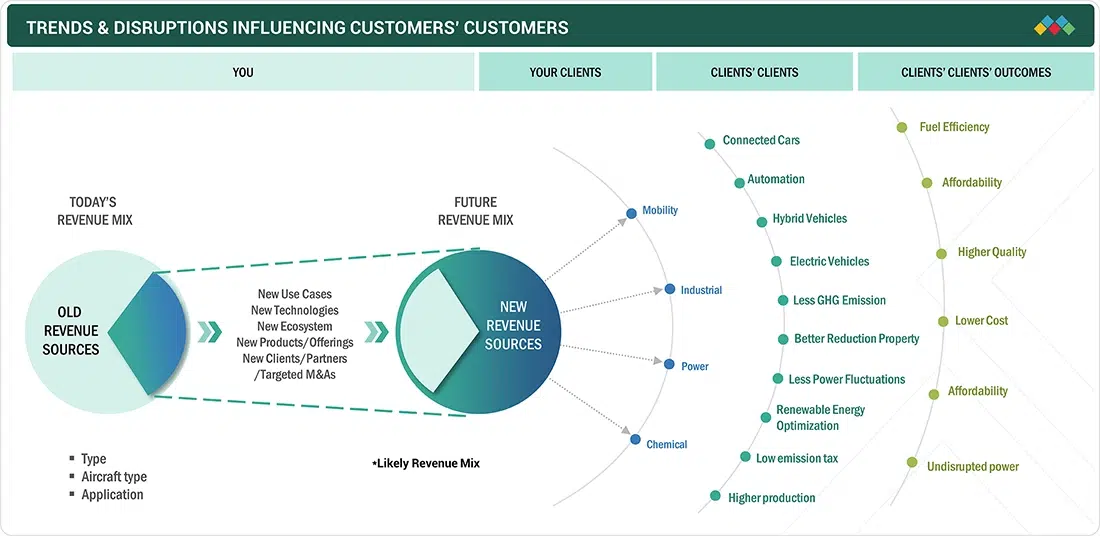
Diagram Shows Shift To New Energy Revenue Sources
This diagram illustrates the broader energy industry’s transition, providing essential context for Suncor’s incumbent strategy of focusing on oil ‘amidst’ the significant growth in new energy sectors like hydrogen.
(Source: MarketsandMarkets)
$6.3 B CAPEX, Suncor Energy’s 2025 Fossil Fuel Investments
Suncor’s capital allocation in 2025 and its guidance for 2026 reinforce a strategy of maximizing hydrocarbon value, with declining overall capital intensity and no designated funds for green hydrogen projects. The company’s spending demonstrates a clear focus on enhancing the efficiency and output of its existing asset base.
- The 2025 capital budget of C$6.1 billion to C$6.3 billion was directed toward sustaining and optimizing oil sands production, refining, and marketing, supporting a production target of 810, 000 to 840, 000 barrels per day.
- For 2026, Suncor plans to reduce capital spending to a range of C$5.6 billion to C$5.8 billion while simultaneously increasing upstream production to between 840, 000 and 870, 000 bpd, signaling a core focus on capital discipline within its hydrocarbon business.
- This spending strategy notably bypasses opportunities to leverage Canada’s substantial Investment Tax Credits (ITCs), which cover 15% to 40% of eligible capital expenditures for new clean hydrogen projects.
- The focus on oil and gas stands in contrast to the capital-intensive nature of the energy transition, where companies like Equinor are making multi-billion-dollar investments in alternative energy sectors.
Table: Suncor Energy Capital Expenditure vs. Competitor (2025-2026)
| Company | Time Frame | Details and Strategic Purpose | Source |
|---|---|---|---|
| Suncor Energy | 2026 (Forecast) | Capital Expenditure: C$5.6 B – C$5.8 B. Focus on increasing oil and gas production with lower spending, maximizing capital efficiency. | Reuters |
| Suncor Energy | 2025 (Forecast) | Capital Expenditure: C$6.1 B – C$6.3 B. Focus on sustaining and optimizing existing oil sands, conventional, and refining operations. | Reuters |
| Cenovus Energy | 2026 (Forecast) | Capital Expenditure: C$4.7 B – C$5.0 B. Focus on production growth and facility maintenance within core oil and gas operations. | National Observer |

Refining Dominates Green Hydrogen Market in 2025
As Suncor is a major refiner, this chart provides critical context for the competitive analysis table by showing that its core industry, refining, is the largest market for green hydrogen, framing its investment decisions.
(Source: Mordor Intelligence)
Suncor Energy and the Pathways Alliance Focus (2025)
In 2025, Suncor’s primary collaborative effort, the Pathways Alliance, prioritized carbon capture for oil sands decarbonization, signaling that blue hydrogen produced from natural gas with CCUS could be a more probable long-term entry point for the company than green hydrogen.
- Suncor remains a key member of the Pathways Alliance, a consortium with Canadian Natural Resources, Cenovus Energy, Imperial Oil, and others, whose foundational project is a large-scale carbon capture, utilization, and storage (CCUS) network.
- The alliance’s tangible work and investment focus in 2025 were on advancing this CCUS infrastructure, with no public announcements related to joint green hydrogen production facilities.
- This focus on CCUS creates a logical, infrastructure-led pathway toward blue hydrogen production, allowing Suncor to potentially leverage its existing natural gas assets and carbon storage capabilities in the future.

Hydrogen Demand Projected to Surge by 2050
This long-term demand projection for hydrogen aligns with the strategic, long-range decarbonization goals of the Pathways Alliance, providing the rationale for Suncor’s involvement and the alliance’s focus.
(Source: PwC)
Table: Suncor Energy Key Partnership Analysis
| Partner / Project | Time Frame | Details and Strategic Purpose | Source |
|---|---|---|---|
| Pathways Alliance | Ongoing in 2025 | A consortium of six major Canadian oil sands producers. The primary goal is to achieve net-zero emissions from oil sands operations by 2050, with a foundational project focused on building a major CCUS network in Alberta. This initiative does not currently include green hydrogen projects. | Imperial Oil |

NA Hydrogen Market to Reach $183B by 2034
This chart quantifies the North American hydrogen market opportunity, providing the financial scale necessary for the section’s analysis of Suncor’s key partnerships within its primary operating region.
(Source: Market Data Forecast)
Canada vs. Global Peers, Suncor Energy’s Domestic Focus
Suncor’s 2025 strategy concentrated capital and operations within its established Canadian footprint, foregoing opportunities to leverage federal clean energy incentives for hydrogen and falling behind European counterparts who are actively diversifying their energy portfolios globally.
- The company’s entire C$6.1 B-C$6.3 B capital budget was directed at its Canadian oil sands operations and North American refining network, with no major new energy investments announced outside this scope.
- This domestic focus means Suncor is not taking advantage of the Canadian government’s 15-40% Investment Tax Credit designed to spur clean hydrogen production, a key policy tool for building a domestic hydrogen economy.
- This approach contrasts with that of European energy majors, which are pursuing green hydrogen projects in multiple jurisdictions to build global supply chains and capture market share.
- Even Suncor’s key environmental project in the U.S., the Heater 2101 upgrade in Colorado, is tied to improving the performance of a legacy fossil fuel asset rather than building a new clean energy business line.

Asia Pacific Leads 2025 Green Hydrogen Market
This chart provides a direct global comparison, highlighting the market leadership of another region (Asia Pacific) to contextualize and frame the discussion of Canada’s position versus global peers and Suncor’s domestic focus.
(Source: Precedence Research)
SWOT Analysis, Suncor Energy’s Hydrogen Position
Suncor’s significant strengths in cash flow generation and operational execution are currently directed at its legacy oil business. This creates a substantial opportunity cost and exposes the company to long-term transition risk as the hydrogen economy develops without its participation.
- The company’s core competencies in managing large, complex industrial projects are a major strength but remain unapplied to the hydrogen sector.
- A key weakness is the high carbon intensity of its oil sands production, creating regulatory and reputational risk that could be partially mitigated by a pivot to clean hydrogen.
- The primary opportunity remains the ability to leverage federal incentives and its existing asset base to become a dominant player in Canada’s future blue or green hydrogen market.
- The most significant threat is being outmaneuvered by more agile competitors and diversified energy majors, leading to a permanent loss of market share in the future clean fuels economy.

Green Hydrogen Market Poised for Explosive Growth
This chart’s headline perfectly captures the primary ‘Opportunity’ aspect of a high-level SWOT analysis, setting the stage for why Suncor must evaluate a strategic position in the hydrogen market.
(Source: MarketsandMarkets)
Table: SWOT Analysis for Suncor’s Hydrogen Strategy
| SWOT Category | 2021 – 2024 | 2025 – Today | What Changed / Validated |
|---|---|---|---|
| Strengths | Strong balance sheet and cash flow from rising oil prices. Proven expertise in executing large-scale industrial projects in Canada. | Continued strong cash flow from oil and gas operations. Demonstrated capital discipline and operational efficiency improvements. | The 2025 strategy validated that Suncor’s primary strength is optimizing its core hydrocarbon business for maximum shareholder return, not diversification. |
| Weaknesses | High carbon intensity of oil sands. Perceived lag in energy transition strategy compared to European peers. Shareholder pressure for returns over R&D. | Lack of any publicly disclosed capital allocation to green hydrogen projects. Increased oil production targets further entrench the company in fossil fuels. | The company’s 2025-2026 guidance confirmed its weakness is a strategic reluctance to diversify, making it a laggard in the clean energy space. |
| Opportunities | Potential to leverage CCUS expertise for blue hydrogen. Favorable Canadian federal policy and tax credits for clean hydrogen were proposed. | Canadian federal Investment Tax Credits for clean hydrogen (15-40%) are available. A rapidly growing global hydrogen market presents a new growth vertical. | In 2025, the opportunities became tangible with defined tax credits and concrete market growth, yet Suncor did not act, validating its “wait-and-see” approach. |
| Threats | Long-term risk of declining oil demand. Stricter climate regulations. Competitors gaining first-mover advantage in clean fuels. | Competitors and other sectors are actively building hydrogen infrastructure. Risk of being locked out of future hydrogen supply chains and partnerships. | The threat became more immediate in 2025 as the hydrogen market grew without Suncor’s participation, increasing the risk of being left behind. |

PEM Electrolyzers Lead 2025 Green Hydrogen Market
A detailed, table-based SWOT analysis benefits from specifics. This chart highlights a key technological trend (PEM electrolyzer dominance) that represents a specific opportunity or threat to be detailed in the analysis.
(Source: Precedence Research)
Suncor Energy’s 2026 Outlook and Hydrogen Entry Points
Suncor’s most likely entry into the hydrogen market post-2025 will be through blue hydrogen, leveraged from its CCUS investments with the Pathways Alliance and contingent on federal policy clarity and project economics making it more attractive than continued oil sands investment.
- If the 3-year strategic plan update in early 2026 contains a material capital allocation for low-carbon fuels, watch for pilot projects focused on blue hydrogen production to supply its own refineries.
- If oil prices remain high and the company exceeds its cash flow targets, watch for increased shareholder returns (buybacks and dividends) to take precedence over capital-intensive diversification projects.
- If the Pathways Alliance CCUS project moves toward a final investment decision, this could be happening: Suncor and its partners may announce a large, industrial-scale blue hydrogen plant as a follow-on phase to utilize the carbon storage infrastructure.

Hydrogen to Power Market to See 26.68% CAGR
This chart identifies a specific, high-growth application segment (‘Hydrogen to Power’), directly addressing the section’s topic of potential ‘Hydrogen Entry Points’ for Suncor’s future strategy.
(Source: Fortune Business Insights)
The questions your competitors are already asking
This report covers one angle of Suncor Energy’s incumbent strategy in the hydrogen transition. The questions that matter most depend on your work.
- Which oil & gas incumbents are gaining or losing ground in the Canadian green hydrogen market?
- Is Suncor a good investment for exposure to the hydrogen economy?
- What is actually happening with the Pathways Alliance CCUS project since the announcement?
- What is the outlook for green hydrogen deployment by Canadian oil sands operators by 2030?
This report does not answer these. Enki Brief Pro does.
Your question, your angle, your framework. SWOT, PESTL, scenario modelling. The same niche depth, built around the decision your work actually depends on.
