

Renewable Natural Gas Policy Risks, $1/gallon Credit Pulls Supply from Grid, 59% Clean Power Cut Under OBBBA (2021 to 2026)
Risk to Grid Balancing, RNG Pulled to Transportation by $1/gallon Credits
Renewable Natural Gas (RNG) adoption for grid balancing is being directly undermined by a U.S. policy framework that strongly incentivizes its use as a transportation fuel, creating a severe market imbalance despite its technical suitability for power generation. This economic misalignment, rather than technical hurdles, represents the primary constraint on RNG’s ability to stabilize an increasingly intermittent power grid. While technically ready, the financial signals are steering this critical dispatchable resource away from the electricity sector where its reliability benefits are most needed.
- Prior to 2025, the Inflation Reduction Act (IRA) provided broad support through Investment Tax Credits for “qualified biogas property, ” encouraging development for various end-uses. However, the July 2025 “One Big Beautiful Bill Act” (OBBBA) shifted the landscape by delaying the federal methane fee and projecting a reduction in new clean power capacity by up to 59%, weakening incentives for RNG in the power sector.
- The primary market driver is now a set of lucrative transportation-focused incentives. The Section 45 Z Clean Fuel Production Tax Credit and the proposed Renewable Natural Gas Incentive Act of 2025 both offer credits of up to $1.00 per gallon, creating a powerful economic pull for RNG producers to sell into the vehicle fuel market.
- This incentive stacking makes it impossible for the power sector to compete. With RNG production costs at $7 to $26 per MMBtu compared to fossil natural gas at $3.50 to $4.50 per MMBtu, RNG requires subsidies to be viable. The transportation market currently offers the only subsidies at a scale that makes projects profitable.
- Consequently, electric utilities are left without a key tool to manage grid stability, even as new, inflexible power demands from AI & Data Center Energy 2026, >$200 B U.S. Utilities continue to grow. This forces a greater reliance on fossil fuels for peaking power or a turn to more expensive long-duration storage alternatives.
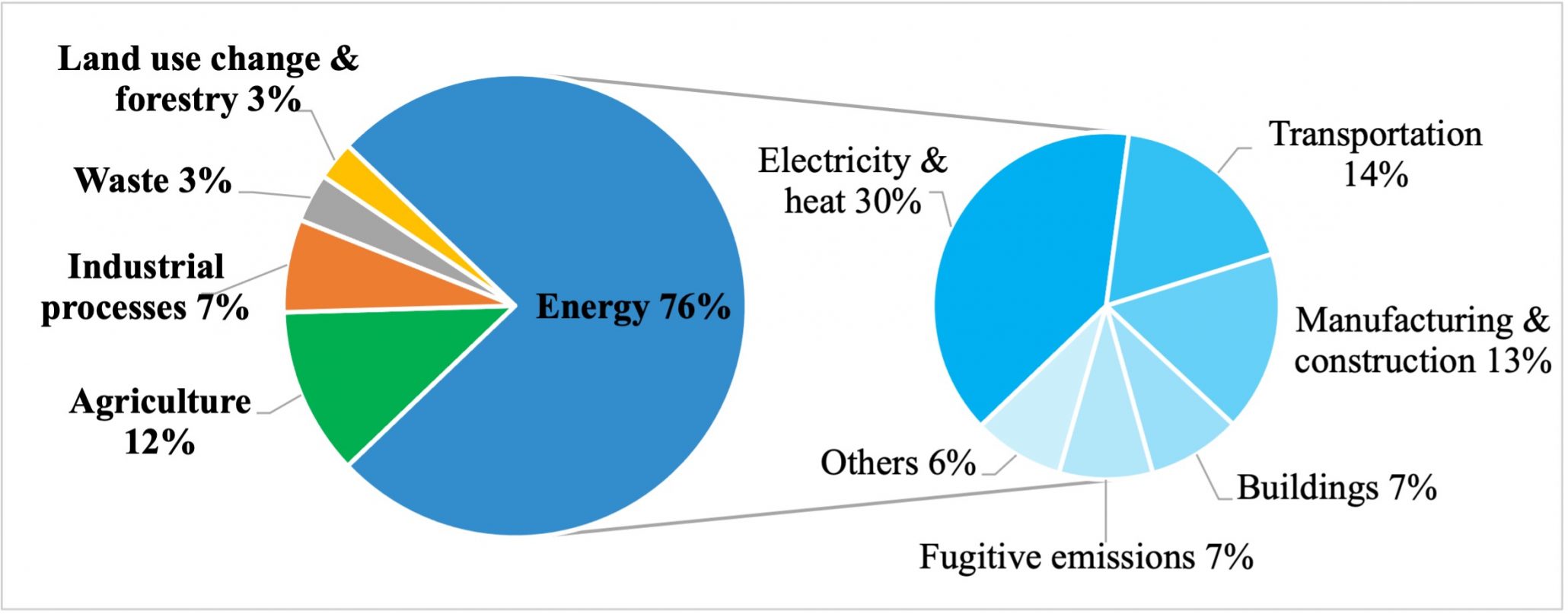
Electricity and Transportation are Major Emission Sources
The section discusses the competition for RNG between grid balancing and transportation. This chart visually establishes these two sectors as the primary end-uses and targets for decarbonization, providing essential context for why this policy-driven competition exists.
(Source: Cosci Press)
US vs. Global, U.S. Policy Creates Divergent RNG Use Cases (2021-2026)
While global projects continue to demonstrate the technical feasibility of injecting RNG into gas grids for broad energy use, the United States policy landscape post-2025 is creating a uniquely narrow market focused almost exclusively on the transportation sector. This divergence risks leaving the U.S. power grid without a critical, domestically produced, dispatchable low-carbon fuel that other nations are actively integrating for system-wide reliability.
- International projects like the Malabar Biomethane Injection Plant in Australia, which became operational in 2026, prove the technical viability of upgrading biogas and injecting it directly into public gas networks to decarbonize multiple sectors, including power.
- In the 2021-2024 period, the U.S. followed a similar path, driven by the IRA and state-level programs. In 2022, an estimated 89% of U.S. RNG production was injected into the pipeline system, available for offtake by utilities, industry, or vehicle fleets.
- The post-2025 policy environment in the U.S. fundamentally changes this dynamic. The OBBBA, combined with transportation-specific credits, now channels nearly all pipeline-injected RNG toward the vehicle fuel market, effectively starving the power sector of this resource.
- This contrasts with the situation in Europe, where despite higher RNG production costs ($17 to $26 per MMBtu), policy mechanisms within the EU Carbon Market 2026: Geopolitical Shocks Spark Risk are designed to support decarbonization across multiple end-uses, including power and heat, reflecting a more integrated energy system strategy.

Global Share of Solar and Wind Power Skyrockets
The section contrasts US and global RNG use cases. This chart illustrates the global trend driving the need for grid balancing solutions—the rise of intermittent renewables. It sets the global context, against which divergent U.S. policy can be explained.
(Source: Cosci Press)
Mature Technology, RNG Projects Face Economic, Not Technical, Hurdles
The technology for producing, upgrading, and utilizing Renewable Natural Gas for power generation is commercially mature and proven, with established processes and available equipment. The primary barrier to its deployment for grid-balancing services is entirely economic and policy-driven, not a result of technical limitations or a need for further research and development.
- Core technologies for RNG production are well-established, including anaerobic digestion and biogas upgrading. Innovations such as a novel direct methanation process, which can reduce fixed asset investment by 11% to 38%, are further improving cost-efficiency.
- The use of RNG in flexible power plants is also proven. High-efficiency engines, such as INNIO’s Jenbacher series, are specifically designed to run on biogas and RNG, providing the rapid-response power needed to balance intermittent renewables.
- During the 2021-2024 period, the industry focus was on scaling these proven technologies and leveraging existing infrastructure, confirming the technical concept. The challenge was recognized as cost and policy support.
- Post-2025, this challenge has crystallized. The technology works, but the business case for using it in the power market has collapsed in the U.S. due to a lack of specific incentives that can compete with those offered by the transportation sector. Unlike other clean firm technologies like the Fervo Energy Geothermal 2026, 10.5 GW Microsoft Deal, RNG’s market path is being dictated by competing sectoral policies.

Flexible Production Key to Biogas Profitability
The section focuses on the economic, not technical, hurdles for RNG projects. This chart directly addresses this theme by showing how a specific operational strategy—flexible production—is crucial for achieving profitability, linking technical capability to the economic outcome.
(Source: ScienceDirect.com)
SWOT Analysis, RNG Grid Balancing Opportunities vs. Policy Threats
RNG’s defining strength is its unique ability to provide dispatchable, low-carbon power by leveraging trillions of dollars in existing gas infrastructure. However, this is directly threatened by a U.S. policy environment that overwhelmingly favors its use in transportation, creating a significant market barrier that neutralizes its grid reliability value.

Chart Shows Dispatchable Gas Balancing Renewable Grid
The section provides a SWOT analysis for RNG in grid balancing. This chart perfectly illustrates a key ‘Opportunity’ from the analysis: using dispatchable gas, such as RNG, to provide stability and balance a grid with a high share of intermittent renewables.
(Source: Cosci Press)
Table: SWOT Analysis for RNG in Grid Balancing
| SWOT Category | 2021 – 2024 | 2025 – 2026 | What Changed / Validated |
|---|---|---|---|
| Strength | Leverages existing gas grid for storage and transport; drop-in fuel for dispatchable peaker plants, as demonstrated by firms like Ameresco. | Confirmed as a mature, dispatchable renewable source that is more cost-competitive and scalable in the near term than green hydrogen from sources like Eclipse Energy Hydrogen 2026, $3/kg Credit, Wood Deal. | The technical and infrastructure-synergy case for RNG as a balancing tool has been validated. Its advantage over other renewable dispatchable fuels is now clearer. |
| Weakness | High production cost ($7-$23/MMBtu) vs. fossil gas, making it highly dependent on policy support like the IRA and state LCFS programs. | Production cost premium remains, while the OBBBA’s delay of the methane fee removes a key economic driver for capturing biogas at its source. | The fundamental cost gap has not closed, and a key policy support mechanism (methane fee) has been weakened, increasing reliance on direct subsidies. |
| Opportunity | Growing need for grid firming due to intermittent renewables and massive new, inflexible loads from data centers. | Increasing value of ancillary services (frequency/voltage support) as the grid loses inertia from retired synchronous generators. | The grid’s need for the exact services RNG can provide has become more acute and financially quantifiable, increasing its potential value if a market existed. |
| Threat | Project permitting delays and competition from other decarbonization pathways being pursued by majors like Chevron Carbon Capture 2024, Gorgon Stage 3 Project. Broader market volatility, including LNG Supply Chain Risk 2026: Qatar Crisis Triggers Deficit, impacts gas pricing. | U.S. tax credits (Sec 45 Z, proposed RNG Incentive Act) create a powerful and direct financial pull to the transportation market, making power generation offtake uncompetitive. | The primary threat has shifted from general competition to a specific, policy-driven market distortion that actively prevents RNG from serving the power grid. The US LNG Expansion 2026: Unlocking The Modular Boom also competes for investment in gas infrastructure. |
RNG Projects Face 2026 Crossroads, Grid vs. Transport Incentives
The trajectory for Renewable Natural Gas in 2026 and beyond will be defined entirely by whether policymakers create incentives for the power sector that can compete with the highly lucrative transportation fuel market. Without a course correction that values grid reliability, RNG will remain a transportation-focused commodity, leaving a critical gap in the U.S. energy transition.
- If this happens: If no new federal or state-level incentives emerge that specifically reward dispatchable, renewable power, watch for a continued wave of RNG offtake agreements from the transportation and shipping sectors, further cementing its role as a vehicle fuel.
- This could be happening: Power utilities will be forced to rely more heavily on fossil natural gas for grid reliability, slowing decarbonization, or invest in higher-cost alternatives for long-duration storage, potentially impacting electricity affordability. The pivot by some Energy Majors Pivot 2026: Why They’re Exiting US Wind highlights the complex investment climate.
- If this happens: If states, ISOs, or federal regulators introduce capacity market products, clean peak standards, or other mechanisms that explicitly value firm, low-carbon generation, watch for utilities to begin signing new offtake agreements for RNG specifically for power generation, as demonstrated by the Ameresco Renewable Natural Gas 2026, $300 M HASI JV.
- This could be happening: A policy shift would signal a market rebalancing, unlocking new investment in RNG projects sited and designed to provide essential grid services and creating a viable business case for RNG’s most critical application.
The questions your competitors are already asking
This report covers one angle of the policy risks shaping the U.S. renewable natural gas market. The questions that matter most depend on your work.
- What is the outlook for RNG deployment in the power sector for grid balancing, given the competitive pull from transportation fuel credits?
- What is actually happening with RNG supply since the introduction of the $1.00/gallon transportation fuel credits?
- Which sectors, power generation or transportation, are successfully securing new RNG offtake agreements?
- What are the remaining opportunities for biogas projects in the electricity market, and which business models are viable without transportation credits?
This report does not answer these. Enki Brief Pro does.
Your question, your angle, your framework. SWOT, PESTL, scenario modelling. The same niche depth, built around the decision your work actually depends on.
