

Uniper Flexible Power Strategy, €5 B Investment, 890 MW CCGT Approval, and 5 Solar Projects (2024 to 2026)
Flexible Generation Adoption, Uniper €5 B Plan and Grid Stability Mandate
Major European utilities are recalibrating their energy transition roadmaps, prioritizing grid stability with flexible gas-fired generation as a direct response to the intermittency of renewables and a slower-than-expected hydrogen market. Before 2025, the strategy appeared more aggressively focused on green capacity, but market realities have forced a strategic pivot toward securing dispatchable power. Uniper’s shift from an €8 billion plan to a more focused €5 billion program exemplifies this industry-wide adjustment, where maintaining security of supply now runs parallel to, rather than behind, decarbonization goals.
- From 2021 to 2024, Uniper’s public targets were more aggressive, aiming for over 80% zero-carbon capacity by 2030. The company has since revised this, now targeting that at least 50% of its 15-20 GW capacity will be “renewable, low-carbon, or decarbonisable” by 2030, a change that explicitly accommodates new gas infrastructure.
- The core of the new strategy, confirmed in July 2026, is a €5 billion investment plan for 2025-2030, with more than half of the capital allocated to its “Flexible Generation” segment. This includes developing new hydrogen-ready combined-cycle gas turbine (CCGT) plants and large-scale battery storage.
- A definitive signal of this strategy in action is the preliminary approval Uniper received in May 2026 to construct an 890 MW hydrogen-ready CCGT plant in Germany. This project directly addresses the need for firm capacity to back up variable wind and solar power.
- This strategic pivot is not unique to Uniper and reflects a broader market recognition that grid flexibility, not just renewable capacity, is the critical enabler for a stable energy transition. The company is leveraging its existing 18.5 GW of flexible power capacity as a foundational asset for this strategy.
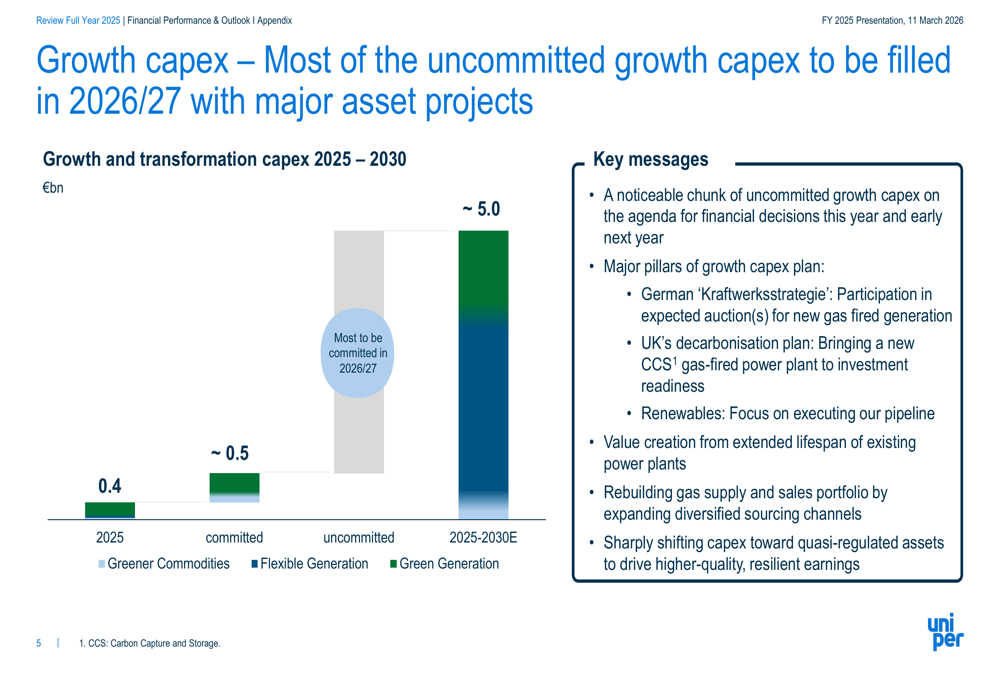
Uniper Commits €5B Capex by 2030, Prioritizing Flexible & Green Power
Uniper plans €5 billion in growth and transformation capex by 2030, with most of the uncommitted ~€4.5 billion (~90% of total) targeted for Flexible Generation and Green Generation. The majority of these capital commitments are slated for financial decisions in 2026/27, signaling an aggressive push towards decarbonization and asset transformation.
Policy-Driven Asset Transformation for Energy Security & Decarbonization
This strategic pivot aligns with European energy policies, notably Germany’s ‘Kraftwerksstrategie’ for gas-fired generation and the UK’s decarbonisation plan. Uniper’s focus on both flexible, CCS-ready gas plants and renewables aims to secure energy supply while transitioning to a lower-carbon future, reducing reliance on ‘Greener Commodities” and driving more resilient, quasi-regulated earnings.
Uniper Targets €1.3B EBITDA for Green & Flexible Generation in 2026
Uniper projects a combined Adjusted EBITDA of €1.3 billion from Flexible and Green Generation for FY 2026. Flexible Generation is set to contribute €1.0 billion (slightly above PY), emphasizing its strong role, while Green Generation is expected to deliver €300 million (significantly above PY), driven by improved nuclear plant availability.
€5 Billion in Capital, Uniper Flexible and Green Generation Investments
Uniper’s capital allocation for 2025-2030 confirms a strategic division between maintaining security of supply through flexible assets and concurrently expanding its renewable footprint. The investment plan is a pragmatic de-risking of its transition pathway, concentrating funds where they can provide immediate grid value while building foundational assets for a future hydrogen economy. This contrasts with a prior, more aggressive green investment posture that faced headwinds from market and regulatory delays.
- The company has committed approximately €5 billion in total capital expenditure between 2025 and 2030 for its transformation. This figure represents a recalibration from a previously floated €8 billion plan, reflecting a more cautious outlook on the pace of the hydrogen market’s development.
- Investment is split between two core segments, with over 50% of the €5 billion directed towards “Flexible Generation, ” including hydrogen-ready gas plants and batteries. Approximately one-third is allocated to the “Green Generation” segment for new solar and onshore wind projects.
- Geographically, Germany is the clear focus, with around half of the total €5 billion investment planned for projects within the country. This highlights Germany’s central role in Uniper’s strategy and the national requirement for new dispatchable power plants.
- In December 2025, Uniper approved final investment decisions for five new solar projects. This move is part of its plan to develop a pipeline of approximately 1 GW of shovel-ready renewable projects, demonstrating continued commitment to its green generation targets.
- Uniper is also directing investment toward new revenue streams, specifically targeting the development of energy solutions for power-intensive data centers, leveraging its existing power plant sites and generation capabilities.
Uniper Strategic Investments and Divestments
| Partner / Project | Time Frame | Details and Strategic Purpose | Source |
|---|---|---|---|
| Flexible & Green Generation | 2025 – 2030 | Planned investment of approximately €5 billion to transform its portfolio. More than half is for flexible generation (H 2-ready gas, batteries), with one-third for green generation (solar, wind). Around 50% of the total is for projects in Germany. | Uniper Reaffirms Strategy |
| Hydrogen-Ready CCGT Plant | May 2026 | Received preliminary approval to construct an 890 MW hydrogen-ready CCGT plant at its Scholven site in Gelsenkirchen, Germany. This project is a core component of its strategy to provide dispatchable power. | Enerdata |
| Solar Project Pipeline | December 2025 | Made investment decisions for five new solar projects as part of a strategy to build out a pipeline of approximately 1 GW of shovel-ready renewable projects. | Uniper |
| North America Power Portfolio | February 2025 | Completed the divestment of its US power business, signaling a strategic consolidation and sharpened focus on its core European markets for the energy transition. | Rigzone |

Uniper Commits €5B Growth Capex by 2030, Critical Decisions in 2026/27
Uniper is allocating ~€5 billion in growth capex for 2025-2030, with the bulk of uncommitted funds designated for decision-making in 2026/27. This investment is primarily split between Flexible Generation (e.g., new gas-fired power with CCS readiness) and Green Generation (renewables), indicating a decisive push towards energy transition.
Dual Strategy Balances Energy Security with Decarbonization Efforts
This substantial investment underscores Uniper’s strategic pivot towards high-quality, resilient earnings from quasi-regulated assets. The dual focus on flexible gas (with CCS) and renewables enables robust grid stability during decarbonization, addressing both energy security and climate goals in key markets like Germany and the UK.
Uniper’s FY26 Outlook: €1.3B Adjusted EBITDA, Green and Flexible Generation Lead Growth
Uniper forecasts a strong FY 2026 with Adjusted EBITDA at €1.3 billion, predominantly driven by €1 billion from Flexible Generation and significant contributions from Green Generation and Greener Commodities. Both Green and Flexible Generation segments are projected to perform significantly above previous year levels, underscoring robust momentum in their energy transition portfolio.
(Source: Electricity flexibility key for transition to renewable power system)
Uniper 500, 000 Ton/Year Ammonia Deal, AM Green Partnership (2026)
To secure its role in a future decarbonized energy system, Uniper is actively building a portfolio of low-carbon molecules through strategic partnerships, mitigating long-term supply chain risks. These collaborations are essential for creating a viable path to convert its gas-centric business model and infrastructure toward a future where hydrogen and its derivatives play a central role. The focus is on securing large-scale supply and mastering the technology to integrate these new fuels into the European grid.
- The cornerstone of its future fuel strategy is a long-term offtake agreement signed with AM Green in January 2026. The deal secures up to 500, 000 tons per year of renewable ammonia from a new production facility in Kakinada, India, for the European market.
- To enable the use of ammonia as a hydrogen carrier, Uniper signed a framework agreement with thyssenkrupp Uhde in November 2025. This partnership focuses on utilizing thyssenkrupp’s ammonia cracking technology, which will be vital for converting imported ammonia back into hydrogen at scale.
- Uniper is also developing critical infrastructure for hydrogen, having completed a demonstration project for storing hydrogen in an underground salt cavern in Krummhörn, Germany. This project validates a key technology required for managing large volumes of hydrogen to balance supply and demand.
Uniper Strategic Partnerships for Future Fuels
| Partner / Project | Time Frame | Details and Strategic Purpose | Source |
|---|---|---|---|
| AM Green | January 2026 | Signed a binding long-term offtake agreement for up to 500, 000 tons of renewable ammonia per year from India. This is a pivotal step in diversifying its procurement sources and establishing a green fuel supply chain for Europe. | Uniper |
| thyssenkrupp Uhde | November 2025 | Signed a framework agreement on the use of ammonia cracking technology. This collaboration aims to develop solutions for converting renewable ammonia back into hydrogen, a critical step in the value chain. | thyssenkrupp Uhde |
Germany vs. Global Supply, Uniper Geographic Focus for €5 B Plan
Uniper’s strategy executes a dual geographic focus by concentrating capital-intensive generation assets in its core German market while simultaneously diversifying its future low-carbon fuel supply chain on a global scale. Before 2025, the company had a broader international footprint, but the sale of its North American assets marked a clear consolidation around Europe. This approach grounds its physical infrastructure in the market with the most immediate need for flexible power while de-risking its fuel procurement from any single region.
- Germany is the epicenter of Uniper’s investment, earmarked to receive approximately half of the €5 billion capital allocation through 2030. This is driven by the country’s pressing need for new dispatchable power to complement its massive renewable build-out, as evidenced by the plan for the 890 MW CCGT project in Scholven.
- In contrast to its asset concentration, Uniper’s fuel procurement strategy is global. The landmark agreement with AM Green to source up to 500, 000 tons of renewable ammonia from India is a clear move to establish a diversified, cost-competitive supply chain for green molecules independent of European production constraints.
- The strategic shift is further defined by divestment. Uniper completed the sale of its US power business and portfolio to Grid Liance Holdco in February 2025, marking a definitive exit from the North American power market to sharpen its focus on European energy security and transition.
- Beyond Germany, Uniper continues to invest in its existing European portfolio, including upgrading its hydropower plants in Germany and Sweden, which contribute to its green and flexible generation capacity.
Technology Maturity, Uniper Hydrogen-Ready CCGTs vs. Green Hydrogen Supply
Uniper’s technology strategy hinges on deploying commercially mature hydrogen-ready gas turbines today while managing the significant risk associated with the less mature green hydrogen supply chain required for their future decarbonization. This approach acknowledges that while CCGT technology is proven and bankable, the full decarbonization of these assets depends entirely on the successful scale-up of a green hydrogen ecosystem that currently faces considerable technical and economic bottlenecks.
- The deployment of hydrogen-ready CCGTs, like the planned 890 MW facility, leverages a mature and reliable technology. The “hydrogen-ready” capability is an incremental, forward-looking feature, allowing Uniper to build new dispatchable capacity now with an option for future conversion, thereby managing near-term market needs.
- The primary technology risk lies in the green hydrogen value chain. Sources from 2025 and 2026 consistently point to a slower-than-expected market ramp-up, a lack of transportation and storage infrastructure, and uncompetitive costs as major hurdles, which directly informed Uniper’s decision to scale back its initial investment plan.
- Uniper is actively working to de-risk the “bridging” technologies required to connect hydrogen supply with its assets. Its partnership with thyssenkrupp Uhde on ammonia cracking and its successful hydrogen storage cavern test are crucial validation points, but these technologies are not yet deployed at the commercial scale needed to support its entire flexible fleet.
- In contrast, the renewable energy portion of its strategy, centered on solar and wind, relies on fully mature technologies. The plan to build out a 1 GW pipeline of shovel-ready projects represents the most technologically straightforward and de-risked component of its green transition efforts.
SWOT Analysis, Uniper €5 B Strategy and Market Execution
Uniper’s revised strategy leverages its incumbent strengths in conventional power generation to navigate near-term market weaknesses, but it simultaneously exposes the company to significant long-term threats if the hydrogen transition stalls. The framework pivots the company into an essential provider of grid stability, creating a strong market position for the next decade. However, the ultimate success of this approach is contingent on external factors like policy support and the technological maturation of the hydrogen economy.
SWOT Analysis for Uniper’s Energy Transition Strategy
| SWOT Category | 2021 – 2024 | 2025 – 2026 | What Changed / Validated |
|---|---|---|---|
| Strengths | Deep operational expertise in gas and power markets; significant existing flexible generation assets. | Leverages 18.5 GW of flexible capacity; deep expertise in gas trading and logistics; established relationships in core European markets. | The market shift toward valuing grid stability validated Uniper’s core strength in flexible generation, positioning it as an indispensable player. |
| Weaknesses | High exposure to volatile gas prices; large legacy fossil fuel asset base; financial instability leading to a government bailout. | Continued high dependency on German energy policy and future capacity market mechanisms; reputational risk from perceived slowing of green ambitions. | The recalibrated strategy acknowledges the slower hydrogen ramp-up but makes the company more reliant on favorable German policy for its new gas assets to be profitable. |
| Opportunities | Potential to become a leader in hydrogen imports and infrastructure; capitalize on growing demand for grid flexibility. | Securing first-mover advantage with large-scale green ammonia offtake (AM Green deal); targeting energy-intensive data centers as a new customer segment. | Uniper is actively capturing the opportunity in low-carbon molecules and new customer segments, moving from planning to execution with binding agreements. |
| Threats | Stranded asset risk for gas infrastructure; competition from pure-play renewable developers; regulatory uncertainty. | Significant stranded asset risk if new gas plants cannot be economically converted to hydrogen; slow development of hydrogen infrastructure and high costs; competition from battery storage. | The threat of stranded assets has intensified and is now the central risk of the new strategy, fully dependent on the cost-competitive availability of green hydrogen in the 2030 s. |
Scenario Modelling: Uniper’s Hydrogen Conversion Risk
The central variable determining the long-term success of Uniper’s €5 billion strategy is the future cost and availability of green hydrogen, which will dictate whether its new gas plants become valuable flexible assets or costly stranded ones. The company’s current path is a calculated risk that its assets will be essential for grid stability long enough for the hydrogen economy to mature. Monitoring key policy, technology, and supply chain signals is critical to assessing the viability of this bet.
- If this happens: A supportive pan-European policy framework for hydrogen emerges, including robust carbon pricing and capacity mechanisms that reward flexibility. Watch this: Uniper would likely accelerate Final Investment Decisions on additional hydrogen-ready CCGTs and seek to replicate its AM Green agreement with other global suppliers to further secure its long-term hydrogen supply.
- If this happens: The cost of green hydrogen remains high and necessary infrastructure, such as pipelines and import terminals, lags significantly behind power plant conversion timelines. Watch this: Uniper could face asset impairment charges on its new gas plants, be forced to extend their operational life on natural gas, and pivot its growth capital more aggressively toward its renewables and commercial trading segments.
- These could be happening: Progress on Uniper’s ammonia cracking project with thyssenkrupp Uhde and the operational data from its hydrogen cavern storage test will be the most immediate signals of technical de-risking. The successful financial close and first delivery from the AM Green project in India will validate the global hydrogen carrier supply chain model.
The questions your competitors are already asking
This report covers one angle of Uniper’s energy transition strategy. The questions that matter most depend on your work.
- Other European utilities investing in gas plants
- Germany new power plant strategy details
- Green ammonia supply contracts for Europe
- Hydrogen power plant conversion costs and timeline
This report does not answer these. Enki Brief Pro does.
Your question, your angle, your framework. SWOT, PESTL, scenario modelling. The same niche depth, built around the decision your work actually depends on.
