

Offshore Wind Divestments, Shell $1 B Sale, Ørsted Hornsea 3 Deal, and 5 Major Project Cancellations (2021 to 2026)
Offshore Wind Sector Risks, Shell $1 B Divestment and 5 Project Cancellations
Energy majors and utilities are strategically exiting or de-risking offshore wind projects, a significant reversal from the growth-focused strategy seen before 2025, driven by rising costs, policy instability, and a pivot back to higher-margin core operations. This marks a market-wide rationalization where financial discipline is superseding the pursuit of renewable capacity volume.
- Before 2025, the industry was characterized by rapid expansion and ambitious targets. However, the period since has been defined by strategic retreats. Shell’s plan to sell over $1 billion in offshore wind assets to fund its oil and gas business is the most prominent example of this shift to a “value over volume” strategy under CEO Wael Sawan.
- This is not an isolated event. In June 2025, Norwegian utility Statkraft announced it would stop most of its offshore wind development, canceling at least six projects. This was followed by a Mitsubishi-led consortium withdrawing from three projects in Japan, citing the difficult market environment.
- The US policy landscape shifted significantly with the passage of new legislation in 2025, which rolled back clean energy credits and created uncertainty that soured project economics. This culminated in moves like Total Energies accepting a buyout of nearly $1 billion for its US offshore wind leases to pivot back toward oil and gas investments.
- The combination of rising supply chain costs, higher interest rates, and unstable policy support has compressed returns, forcing even committed renewable players to reconsider their capital allocation. The series of project cancellations demonstrates that the sector’s high capital intensity is a major risk in volatile economic conditions.
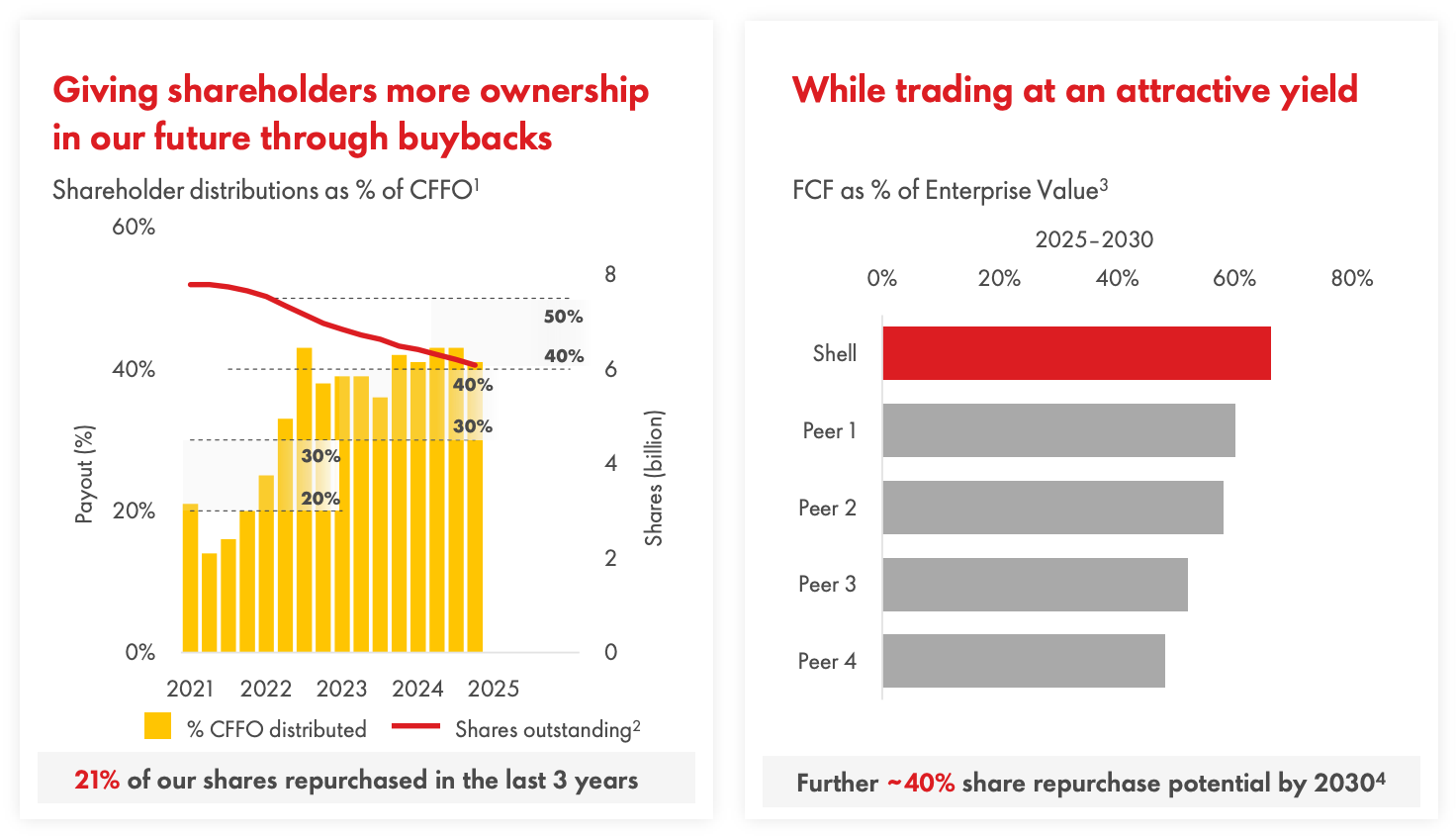
Shell Prioritizes Shareholder Returns and Buybacks
This chart explains the financial motivation behind Shell’s divestment. This prioritization represents a systemic risk to the capital-intensive wind sector, aligning perfectly with the section’s heading on “Offshore Wind Sector Risks”.
(Source: Trader Ferg – Substack)
Project Cancellations, Shell Divestment and Total Energies $1 B Buyout
A wave of high-profile project cancellations and strategic divestments starting in 2025 highlights the acute financial pressures facing the offshore wind industry. These moves are not signs of technological failure but of a clear-eyed economic reassessment by developers, who are unwilling to proceed with projects that no longer meet required return thresholds.
- The most significant strategic pivots include Shell’s planned $1 billion portfolio sale and Total Energies’ acceptance of a government buyout for its US leases, effectively removing two supermajors from key development projects.
- Utilities have also scaled back. Statkraft, a major European renewable player, halted development on at least six offshore wind projects in 2025 due to unfavorable market conditions, a major setback for European targets.
- In Asia, market challenges led a Mitsubishi Corporation-led consortium to withdraw from three offshore wind developments in Japan, while India’s first two offshore wind tenders were cancelled, delaying its national goals.
- Even before the major pullbacks of 2025, Eversource finalized its exit from the offshore wind sector in October 2024 by selling its stake in two projects to its joint venture partner and Global Infrastructure Partners (GIP).

Shell Pivots From Offshore Wind to Oil
This chart directly illustrates the major corporate divestment by Shell, which is a key topic of this section alongside other project cancellations.
(Source: AInvest)
Table: Offshore Wind Divestments and Cancellations
| Company / Project | Time Frame | Details and Strategic Purpose | Source |
|---|---|---|---|
| Total Energies | Mar 2026 | Accepted a buyout of nearly $1 billion for its US offshore wind leases, canceling development to refocus capital on oil and gas. | Utility Dive |
| Ørsted (Hornsea 3) | Dec 2025 | Completed the sale of a 50% stake in its 2.9 GW Hornsea 3 project to funds managed by Apollo. This “farm-down” strategy raises capital to fund the construction pipeline while de-risking the balance sheet. | Renewables Now |
| Statkraft | Jun 2025 | Announced a halt to most of its offshore wind development, leading to the cancellation of at least six projects amid rising costs and an unfavorable market. | Spinergie |
| Eversource | Oct 2024 | Completed its exit from the offshore wind business by selling its ownership stakes in two projects to Global Infrastructure Partners (GIP). | Utility Dive |

Wind Project Pipeline Shows Gap from 2026-2028
This chart provides a high-level visual summary of the cumulative impact of the individual divestments and cancellations that would be detailed in the accompanying table.
(Source: Deloitte)
Ørsted 2 Major Divestments, Apollo and ECP Deals Signal Capital Recycling (2025-2026)
Capital recycling through strategic partnerships and asset farm-downs has become a critical financing mechanism for offshore wind developers, enabling them to fund massive project pipelines in a tight investment climate. This strategy involves selling equity stakes in operational or late-stage development projects to financial partners, thereby de-risking balance sheets and freeing up capital for future growth.
- Ørsted, a global leader in offshore wind, exemplifies this model. The company completed the sale of a 50% stake in its massive 2.9 GW Hornsea 3 project to funds managed by Apollo in December 2025, a landmark deal to secure funding for one of the world’s largest wind farms.
- This was part of a broader divestment program. In May 2026, Ørsted also sold 50% stakes in three of its US onshore renewable projects to Energy Capital Partners (ECP) for approximately $572 million, demonstrating the use of capital recycling across its portfolio.
- The model allows developers to retain operational control while bringing in financial partners like infrastructure funds, which seek stable, long-term returns from de-risked energy assets. This symbiotic relationship is crucial for sustaining development momentum.
- This trend was also visible in Eversource’s 2024 exit, where it sold its interests in two US offshore wind projects to Global Infrastructure Partners (GIP), transferring the assets to a long-term infrastructure investor.
US vs. Europe, Offshore Wind Policy Shifts Drive Regional Divergence
While Europe remains the most mature market for offshore wind, a stark divergence in regional momentum has emerged since 2025, driven primarily by political and policy shifts. The U.S. market faced a significant, policy-driven shock that chilled investment, while Asian markets encountered their own setbacks, fragmenting the previously uniform global growth narrative.
- In the U.S., the policy landscape shifted significantly after the “One Big Beautiful Bill Act” (OBBBA) in July 2025 rolled back clean energy tax credits. The resulting uncertainty was a key factor in Total Energies’ decision to accept a government buyout of its leases and other developers pausing investment.
- Europe, despite its leadership, is not immune to economic pressures. Rising costs and supply chain risks have forced even established European players like Statkraft to pull back, signaling that even in a supportive policy environment, project economics have become challenging.
- Key Asian markets have also struggled to maintain momentum. In Japan, a Mitsubishi-led consortium withdrew from three offshore wind projects in August 2025, citing concerns about the market environment. Meanwhile, India’s ambitions were delayed after its first two offshore wind tenders were cancelled.
16 MW Turbines, Offshore Wind Technology Faces Cost and Scale Hurdles
Offshore wind technology is commercially mature and scaling at a rapid pace, with turbines now exceeding 15 MW, but this relentless pursuit of scale is exposing new cost and logistical challenges. The drive for larger, more efficient machines has contributed to the very supply chain bottlenecks and cost inflation that have pressured project returns since 2025.
- The industry has moved quickly from an average turbine size of 10 MW in 2025 to deploying next-generation machines like Goldwind’s commercially operational 16 MW turbine. While larger turbines improve energy capture, they require larger vessels, stronger foundations, and more complex port infrastructure, all of which drive up costs.
- These escalating capital requirements are reflected in the technology’s high Levelized Cost of Energy (LCOE), which is estimated at around $120/MWh, significantly higher than onshore wind. Capital expenditures average $2.43 million/MW.
- Technological risks also increase with scale. The July 2024 incident where a GE Haliade-X turbine blade snapped at the Vineyard Wind project served as a stark reminder of the material stresses and operational risks associated with these massive structures.
- As projects move into deeper waters, they require more complex and expensive floating foundations instead of fixed monopiles, further adding to the capital intensity and execution risk of next-generation projects. These supply chain pressures are a primary factor in recent project economics.
SWOT Analysis, Offshore Wind Growth vs. Financial Viability Risks
The offshore wind sector’s clear strengths in long-term, large-scale decarbonization are currently being tested by significant weaknesses in project economics and immediate threats from policy instability and supply chain inflation. Opportunities for growth remain immense, but realizing them requires navigating a much more complex risk environment than existed prior to 2025.
- Strengths: The core appeal of offshore wind is its ability to deliver large volumes of clean energy, supported by robust long-term demand and technology that is mature and scaling.
- Weaknesses: The sector’s primary weakness is its high capital intensity and cost structure, which makes it highly sensitive to interest rate changes, cost inflation, and policy shifts.
- Opportunities: Strong corporate demand for Power Purchase Agreements (PPAs) and the rise of the “farm-down” model provide new avenues for financing and de-risking projects.
- Threats: Unstable government policy, as seen in the U.S., and persistent supply chain bottlenecks pose the most significant threats to project pipelines and investor confidence.

Commodity Volatility Drives $11.2B Cash Outflow
This chart provides a concrete example of a major external “Threat” and “Financial Viability Risk,” making it a perfect fit for a section conducting a SWOT analysis of the sector.
(Source: Trader Ferg – Substack)
Table: SWOT Analysis for the Offshore Wind Sector
| SWOT Category | 2021 – 2024 | 2025 – Today | What Changed / Validated |
|---|---|---|---|
| Strengths | Rapid capacity growth driven by ambitious national targets and falling LCOE. Technology scaling quickly. | Technology continues to scale (16 MW+ turbines). Market projected to grow at a CAGR of 12-14%. | The long-term growth thesis remains intact, but the path has become more volatile. Projections are still strong despite near-term issues. |
| Weaknesses | High CAPEX relative to other renewables. Long project development timelines. | LCOE has risen to ~$120/MWh. Projects are highly exposed to rising interest rates and input costs. | The “stormy 2025” validated the sector’s vulnerability to macroeconomic shocks, proving that previous cost-reduction trends were not guaranteed. |
| Opportunities | Growing corporate PPA market. Emergence of green hydrogen as a new offtake source. | “Farm-down” model with infrastructure funds (e.g., Ørsted/Apollo) becomes a primary financing tool. Asset sales by oil majors create acquisition targets. | Capital recycling has been validated as a critical strategy for developers to fund growth without over-leveraging their balance sheets. |
| Threats | Nascent supply chain vulnerabilities. Potential for policy shifts in key markets. | Policy instability realized in the U.S. (“OBBBA”). High-profile project cancellations (Statkraft, Mitsubishi). Supply chain bottlenecks intensify. | The theoretical risk of policy change and cost inflation became a concrete reality, forcing a market-wide strategic re-evaluation of project viability. |
Shell’s $1 B Exit, A Test for Offshore Wind’s Long-Term Bankability (2026)
The key signal to watch in the next 12-18 months is whether specialist renewable operators and infrastructure funds acquire the assets being divested by oil majors like Shell, and at what valuation. This outcome will serve as a critical market test, validating either the sector’s long-term bankability despite near-term headwinds or revealing deeper structural concerns about its financial viability.
- If this happens: If well-capitalized buyers such as Brookfield, Macquarie, or a major utility acquire Shell’s portfolio at a valuation near its $1 billion+ target…
- Watch this: …it will signal that specialized players with a lower cost of capital and long-term horizon see significant value beyond the current turbulence. This would affirm the capital recycling model and suggest that the assets are simply moving from an owner with shifting priorities (Shell) to one whose core strategy is aligned with renewable generation.
- This could be happening: Conversely, a heavily discounted sale, a prolonged sale process with few bidders, or a failure to transact would signal deeper investor skepticism. Such an outcome could lead to further strategic exits by diversified energy companies and a broader slowdown in new project development as the market questions the long-term risk-reward profile of offshore wind. The launch of Shell’s sale process later this year, with a transaction targeted for 2027, will be a defining moment.

Shell Stock Rises Amid Share Buybacks
The positive stock market reaction to Shell’s exit strategy is a powerful illustration of the “Test for Offshore Wind’s Long-Term Bankability,” as it shows the market rewarding a move away from renewables.
(Source: Trader Ferg – Substack)
The questions your competitors are already asking
This report covers one angle of the strategic divestment trend in offshore wind. The questions that matter most depend on your work.
- Which energy majors are losing ground in the offshore wind market, and who might fill the gap?
- What is the outlook for offshore wind deployment in the US and Europe by 2030, following recent project cancellations and policy shifts?
- Shell’s ‘value over volume’ strategy. How does it impact their investments across renewable energy versus oil and gas?
This report does not answer these. Enki Brief Pro does.
Your question, your angle, your framework. SWOT, PESTL, scenario modelling. The same niche depth, built around the decision your work actually depends on.
