

ASML Semiconductor Supply Chain Risks, €43 B EU Chips Act, 20% Market Share Goal, and TSMC’s Role (2021 to 2026)
ASML Confronts Geopolitical Risk from €43 B EU Chips Act and US Export Controls
The global semiconductor industry has fundamentally pivoted from a hyper-efficient, globalized model to one fragmented by geopolitical objectives, exposing critical technology suppliers like ASML to new and significant interventionist risks. This shift is defined by the rise of “techno-nationalism, ” where governments in the EU, U.S., and China are using industrial policy to re-shore production, directly challenging the market-based principles that have governed the sector for decades.
- Between 2021 and 2024, the industry operated on a globalized, efficiency-first basis. The model’s vulnerability was exposed by COVID-19 supply shocks and escalating U.S.-China trade tensions. In response, the EU formulated the European Chips Act, a policy framework designed to reclaim technological sovereignty.
- From 2025 to today, this policy became binding regulation. The EU Chips Act mobilizes over €43 billion ($47 billion) in public and private investment with the goal of doubling the EU’s global market share to 20% by 2030. Critically, it includes a “crisis response” mechanism that grants the European Commission authority to request companies prioritize the supply of specific chips, a power that directly threatens the operational autonomy of firms like ASML.
- ASML leadership has warned that such intervention could backfire. The company argues that its technology’s success, and the industry’s progress, depends on serving a global market to fund the immense R&D costs of next-generation systems. Forcing prioritization would disrupt this highly optimized global network, leading to inefficiencies, higher costs, and a potential slowdown in innovation.
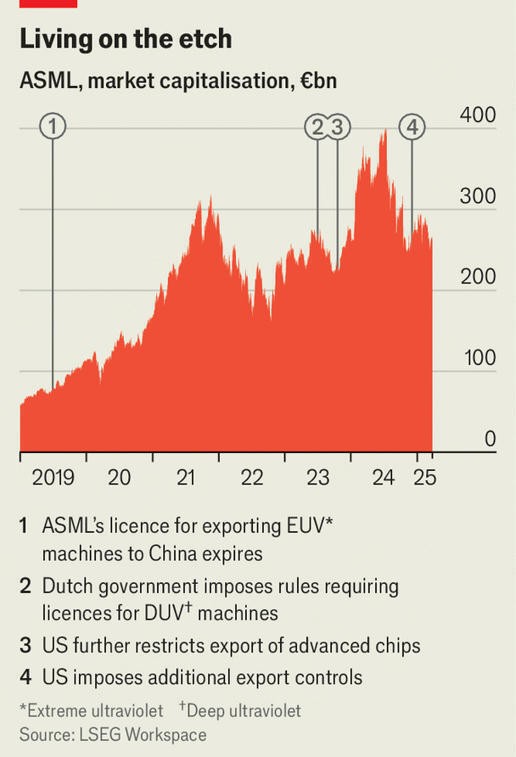
ASML Market Cap Fluctuates with Geopolitical Events
The chart’s headline, which links market capitalization to geopolitical events, perfectly visualizes the ‘Geopolitical Risk’ discussed in the section, showing the real-world financial impact of policies like the EU Chips Act and US export controls.
(Source: LinkedIn)
$170 B+ in Global Subsidies, ASML Navigates US, EU, and China Chip Acts
The global race for semiconductor self-sufficiency has ignited a subsidy war, with major economic blocs committing over $170 billion in public and private funding to onshore manufacturing, creating a volatile and politically charged investment environment. This aggressive industrial policy, while intended to build resilience, introduces significant market distortions and project uncertainties that companies must navigate.
- The United States’ CHIPS and Science Act allocates $52.7 billion in direct subsidies and tax credits to boost domestic manufacturing and R&D, with a clear national security focus.
- The European Chips Act aims to mobilize over €43 billion ($47 billion) through relaxed state aid rules and public-private partnerships to achieve its 20% global market share goal.
- China is preparing a new incentive package worth up to $70 billion for its domestic chip sector, building on over $50 billion previously allocated through its “Big Fund” to reduce reliance on foreign technology from firms like Broadcom and ASML.
- This policy-driven boom is not without risk. In 2025, policy uncertainty was cited as a direct cause for major project delays. For instance, Intel acknowledged that “unpredictable political concerns” slowed progress at its Ohio facility, demonstrating how capital-intensive projects are vulnerable to shifting political winds.
Table: Government Semiconductor Incentive Programs: A Global Comparison
| Region/Country | Program Name | Total Funding/Value (USD) | Stated Goals | Source |
|---|---|---|---|---|
| China | National Integrated Circuit Industry Investment Fund (Big Fund) / Made in China 2025 | Up to $70 billion in a new package, on top of $50 billion+ previously allocated. | Achieve self-sufficiency in critical semiconductor technologies and reduce reliance on foreign suppliers. | Bloomberg |
| United States | CHIPS and Science Act | $52.7 billion in subsidies plus tax credits valued at an estimated $24 billion. | Onshore semiconductor manufacturing, R&D, and supply chain resilience. | Wikipedia |
| European Union | European Chips Act | Over €43 billion ($47 billion) in public and private investments. | Double global market share to 20% by 2030, ensure security of supply. | european-chips-act.com |
| South Korea | K-Belt Semiconductor Strategy | Part of a push to attract over $450 billion in private investment by 2030, including an increased tax credit rate. | Solidify its global leadership in memory and foundry sectors. | Pw C |
ASML Sales Data Shows Asian Dominance vs. EU’s 2% Share (2021 to 2026)
ASML‘s regional sales data reveals a stark geographic disconnect between the EU’s policy ambitions and the current manufacturing reality, where Asia remains the undisputed center of advanced semiconductor production. This concentration highlights the systemic risk of EU intervention, as any move to redirect supplies would disproportionately impact the world’s largest chipmakers while providing minimal direct benefit to Europe’s nascent capacity.
- Throughout 2021-2024, and continuing into 2025-2026, ASML‘s lithography system sales have been overwhelmingly concentrated in Asia. In Q 2 2025, Asia accounted for 81% of total shipments, with Taiwan (35%), China (27%), and South Korea (19%) as the top three destinations.
- This trend is consistent with historical data. In Q 3 2022, Taiwan and South Korea alone represented a combined 71% of ASML‘s sales, underscoring their long-standing roles as the world’s primary foundries for advanced logic and memory chips.
- In sharp contrast, the EU’s share of ASML‘s system sales remains minimal, accounting for just 2% in Q 2 2025 and 4% in Q 3 2022. This small footprint means any attempt by the EU to “direct” ASML‘s global supplies would disrupt the operations of key partners like TSMC and Samsung, creating global instability without meaningfully increasing the EU’s domestic output.
US vs. EU, ASML’s EUV Monopoly Remains the Unassailable Chokepoint
Despite a global subsidy race aimed at creating regional chip ecosystems, ASML‘s absolute monopoly on Extreme Ultraviolet (EUV) lithography technology ensures it remains the single most critical chokepoint in the advanced semiconductor value chain. This technological dominance gives its warnings against government intervention significant weight, as no nation can achieve leading-edge chip manufacturing without its cooperation.
- From 2021-2024, ASML solidified its position as the world’s sole supplier of EUV systems, the technology required for all advanced chips at nodes of 7 nm and below. This monopoly was the result of a two-decade, multi-billion-dollar R&D effort that no competitor has been able to replicate.
- In 2025-2026, this technological indispensability has become a central factor in geopolitical strategy. With a single EUV machine costing between $200 million and $400 million and accounting for up to 25% of a new fab’s capital expenditure, ASML‘s technology is the foundation upon which multi-billion-dollar national chip strategies are built.
- This status makes ASML a powerful voice against market fragmentation. The EU’s goal to produce advanced chips domestically is entirely dependent on securing these machines. Consequently, heavy-handed directives that threaten ASML‘s global business model could compromise the very technological sovereignty the EU seeks to build. The need for advanced chips is a key driver for the growth of AI, with companies like Open AI and Deep Seek requiring immense computational power.
ASML Scenario Modeling: EU Intervention vs. Market-Led Growth in 2026
In 2026, ASML‘s primary strategic challenge will be to reconcile escalating government policy mandates with the economic realities of the global marketplace it needs to fund future innovation. The company’s path forward will be determined by whether governments, particularly the EU, choose to use their new powers to direct the supply chain or adopt a more market-aligned, incentive-based approach.
- If the EU exercises its crisis powers to direct supplies: Watch for immediate friction with non-EU nations whose chip allocations are disrupted, potentially leading to retaliatory trade measures. This would validate ASML‘s concerns, likely causing project delays and creating a chilling effect on future fab investments in Europe. The key signal would be the first official designation of a “semiconductor crisis” by the European Commission.
- If the EU prioritizes incentives over intervention: This would indicate that ASML‘s warnings have been heeded. In this scenario, the EU Chips Act would function primarily as a subsidy package to attract investment, not a tool for command-and-control. Watch for continued high demand and shipments to Asia, driven by the unabated AI boom, while new European fabs slowly ramp up based on market logic.
- The most critical signal for 2026: Monitor how the European Commission defines the threshold for a “crisis” under the Chips Act. A broad definition would signal a move toward greater intervention, while a narrow one reserved for true national emergencies would suggest a more cautious, market-respecting approach. This will set the precedent for industry-government relations for the next decade.