

Sustainable Aviation Fuel Offtake Agreements, American Airlines Signs Google Deal, $900 M Frontier Pledge, and 11 New Contracts (2025 to 2026)
Commercial Offtakes Displace Grants in Project Finance
The primary mechanism for financing large-scale clean technology projects has pivoted from a reliance on direct government grants and tax credits to the commercial certainty provided by long-term offtake agreements. This structural shift is a direct response to increasing capital costs and political volatility surrounding fiscal incentives, forcing projects to secure bankable, contracted revenue streams to achieve financial close. Lenders and investors now prioritize the strength of a project’s offtake contracts above potential government support.
- Between 2021 and 2024, project finance models were heavily structured around incentives like the U.S. Inflation Reduction Act (IRA), with government support forming a core pillar of a project’s capital stack.
- The landscape changed significantly in 2025 with events like the enactment of the “One Big Beautiful Bill Act” (OBBBA) on July 4, 2025, which initiated an accelerated repeal of many IRA tax credits. This created a “subsidy cliff” that magnified the risk of projects dependent on policy.
- By 2026, a project’s viability is almost exclusively determined by its ability to secure a “bankable” offtake agreement from a creditworthy counterparty. These legally binding contracts, which guarantee the purchase of future output for 10 to 20 years, have replaced subsidies as the cornerstone of non-recourse project finance.
- Lenders now view government incentives as temporary enhancements rather than a foundational element of financial models. The focus has moved from policy risk to commercial counterparty risk, elevating the importance of the offtaker’s credit rating.
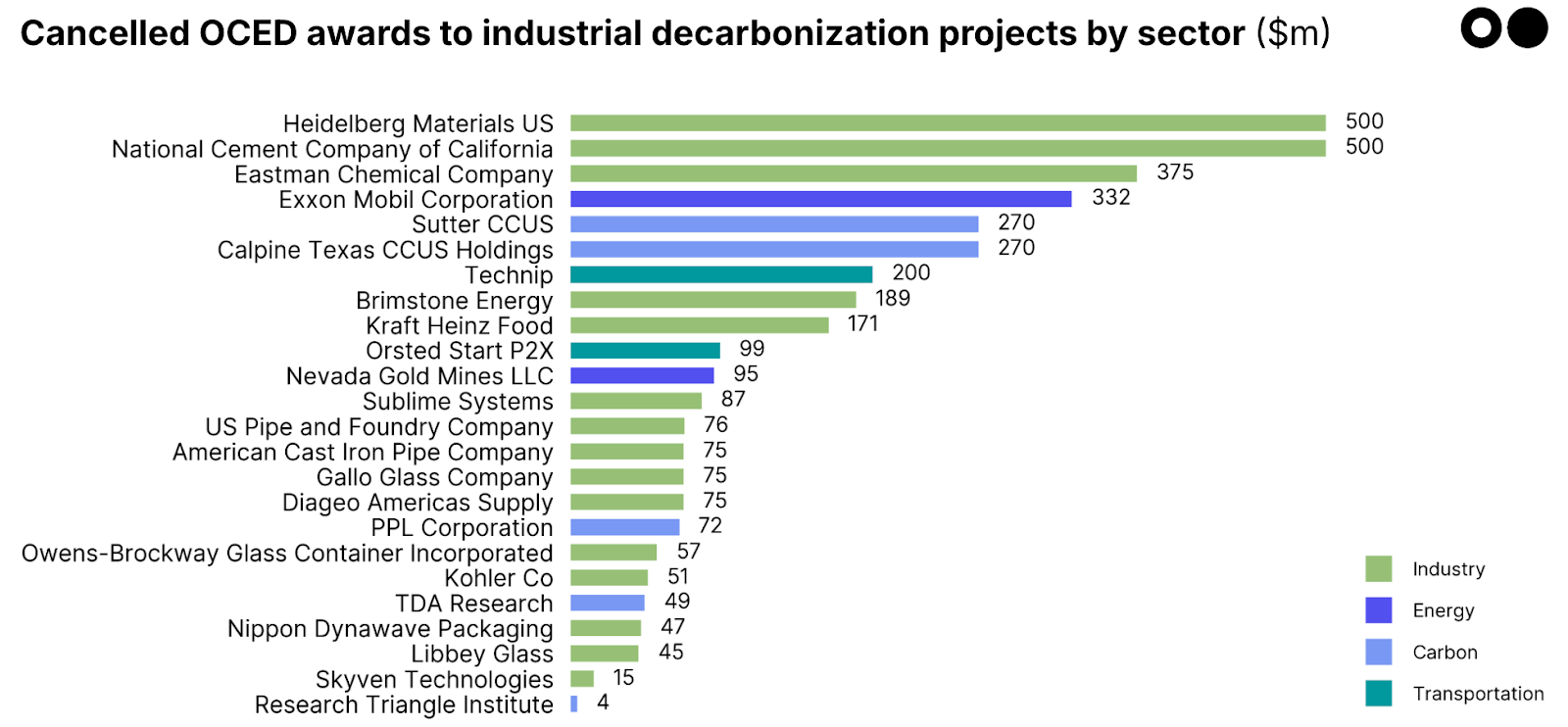
Major Decarbonization Projects Face Significant Grant Cancellations
The chart reveals over $3.6 billion in cancelled OCED awards for industrial decarbonization projects across various sectors. Heidelberg Materials US and National Cement Company of California lead with $500M each, highlighting a substantial withdrawal of public funding from critical climate initiatives. This indicates a challenging funding landscape where traditional government support is unreliable.
Funding Gaps Drive Shift Towards Alternative Project Finance
The cancellation of substantial government awards forces industrial decarbonization projects to seek alternative financing. This fuels the urgency for robust private capital solutions, like long-term offtake agreements, to de-risk projects and secure funding. The $3.6B in cancelled grants creates a clear market vacuum for private sector innovation in project financing.
(Source: 🌎 OCED’s not-so-clean break #248)
$52.4 B Project Finance Market Pivot to Contracted Revenue
Investment flows within the growing project finance market are now dictated by the strength of offtake contracts, with capital moving away from projects solely dependent on volatile government grants. This trend is evident in the cancellation of grant-dependent projects and the success of those backstopped by strong commercial agreements, reflecting a fundamental re-evaluation of risk by capital providers in a post-subsidy environment.
- The global project finance market, valued at $28.6 billion in 2025, is projected to reach $52.4 billion by 2034, with growth increasingly tied to projects with secured, long-term revenue streams.
- The unreliability of grant-based funding was highlighted by the cancellation of a significant $1.2 billion Department of Energy award for clean hydrogen hubs, demonstrating the political risks associated with direct government support.
- In contrast, projects with robust offtake agreements are successfully attracting capital. For example, Brazil Potash pre-sold 91% of its future production, a move that was critical in catalyzing the construction financing phase for its project.
- The burgeoning private credit market, which grew to an estimated $1.96 trillion in 2026, is a key source of capital for these projects but demands the de-risking provided by guaranteed offtake revenue before committing funds.
Table: Key Offtake Agreements Enabling Project Finance (2024-2026)
| Partner / Project | Time Frame | Details and Strategic Purpose | Source |
|---|---|---|---|
| American Airlines / Google | June 2026 | A record-breaking agreement for Sustainable Aviation Fuel (SAF), demonstrating a model where corporate buyers co-procure SAF to aggregate demand and support new production. | American Airlines |
| Commonwealth LNG / Undisclosed Buyers | May 2026 | Secured long-term LNG offtake agreements that were essential for advancing the Commonwealth LNG project toward a final investment decision. | Baker Botts |
| Brazil Potash / Various Offtakers | October 2025 | Pre-sold 91% of its future potash production through offtake agreements, providing the revenue certainty needed to secure construction financing. | Brazil Potash |
| NOVONIX / Stellantis | November 2024 | A binding offtake agreement for high-performance synthetic graphite for EV batteries. This secures a key revenue stream for NOVONIX’s production expansion. | NOVONIX |

Offtake Agreements Emerge as Core Project Finance Collateral
The diagram clearly positions the ‘Offtake Agreement’ as a direct link between the ‘Project Company (special purpose vehicle)’ and the ‘Offtaker’. This highlights its critical role in guaranteeing revenue streams, which are essential for securing ‘Senior Debt” from financial institutions like banks and multilateral development institutions. This long-term contract structure is depicted as foundational for project viability and financing.
De-risking Projects: Long-Term Contracts Reduce Reliance on Public Funds
By providing predictable cash flows, offtake agreements significantly de-risk project investments. This reduces the project’s dependency on ‘Government’ support, which includes ‘Public funding’ and ‘Guarantees”. As projects mature and markets stabilize (e.g., in renewable energy or infrastructure), these robust contractual frameworks allow them to attract private capital, shifting the financing burden away from public grants and toward commercial lenders.
Offtake Contracts Emerge as Key Project Finance Driver
The diagram illustrates a robust ecosystem where long-term energy contracts and off-take demand from energy-consuming industries are central to clean energy production. This signals a market-driven shift, with Member States facilitating scale and visibility, reducing reliance on direct grants.
(Source: Tripartite Contracting for Clean Electricity – Clean Air Task Force)
US Policy Volatility Cedes Ground to EU’s Stable Offtake Frameworks
While the U.S. historically attracted significant investment through direct subsidies, its recent policy volatility is shifting the geographic focus of project development toward regions like the European Union that offer more stable, long-term contractual support mechanisms. These frameworks, designed to de-risk commercial agreements rather than directly fund projects, are proving more attractive to lenders focused on long-term revenue predictability.
- From 2021 to 2024, the U.S. Inflation Reduction Act (IRA) served as a powerful magnet for global clean energy investment, making the country the primary destination for capital.
- Starting in mid-2025, legislative actions like the OBBBA introduced significant uncertainty into the U.S. market, undermining the bankability of projects reliant on federal tax credits.
- In contrast, the EU and member states like the Netherlands have been refining their use of Contracts for Difference (Cf Ds) and other offtake support mechanisms. These tools provide revenue stability by guaranteeing a certain price for a project’s output, making them highly attractive to project financiers.
- This dynamic is also creating opportunities for emerging economies. Regions like North Africa are leveraging their renewable resources to attract green industrial investment by facilitating long-term offtake agreements with European buyers. Similarly, developers in Canada Critical Minerals are using offtakes to finance new mines.
Bankable Offtakes Accelerate Novel Tech from Pilot to Commercial Scale
Offtake agreements have become the primary catalyst for advancing technologies from pilot and demonstration stages (Technology Readiness Level 6-7) to full commercial deployment (TRL 8-9). By providing the long-term revenue certainty required for first-of-a-kind (FOAK) project financing, these contracts bridge the “missing middle” of financing that grants alone can no longer fill.
- During the 2021–2024 period, government grants and R&D funding were effective at advancing technologies through the early pilot stages. However, this support often stopped short of what was needed for commercial-scale deployment.
- In 2025 and 2026, the key barrier for technologies like Sustainable Aviation Fuel (SAF), green hydrogen, and Direct Air Capture is not technical feasibility but securing the financing for a FOAK commercial plant. A binding offtake agreement is now the non-negotiable key to unlocking that capital.
- Corporate buyers like Microsoft have become crucial market makers, using advance purchase commitments through initiatives like Frontier to create a bankable demand signal for nascent technologies like carbon dioxide removal.
- The structure of the offtake is also maturing, with financial instruments being tailored to a technology’s risk profile. Fixed-price contracts provide maximum security for FOAK projects, while more established technologies like Battery Energy Storage Systems (BESS) are seeing more complex optimization and revenue-sharing agreements.
SWOT Analysis: Project Finance via Offtake Agreements
While offtake agreements provide critical revenue certainty and de-risk projects for lenders, their effectiveness is constrained by counterparty credit risk and the inherent complexity of negotiating multi-decade contracts for new and often volatile commodities. The market has shifted from managing policy risk to managing commercial contract risk.
Table: SWOT Analysis for Project Finance Based on Offtake Agreements
| SWOT Category | 2021 – 2023 | 2024 – 2026 | What Changed / Validated |
|---|---|---|---|
| Strengths | Offtakes supplemented strong government incentives (IRA), creating highly attractive project economics. | Provides essential revenue certainty and bankability in the absence of reliable subsidies. Converts market-exposed revenue into a contracted, predictable cash flow stream. | The primary role of offtakes shifted from an economic enhancer to the core pillar of project viability. |
| Weaknesses | Negotiations were often complex, but subsidy backstops could cover some pricing gaps. | High dependence on offtaker’s creditworthiness. A non-investment-grade counterparty can render a project unbankable. Complex and lengthy negotiations create high transaction costs. | Counterparty risk has replaced policy risk as the primary concern for lenders and developers. |
| Opportunities | Leveraging subsidies to sign offtakes at competitive prices. | A new class of corporate offtakers (e.g., tech companies like Google, Microsoft) is emerging to meet ESG goals. Governments are exploring new de-risking tools like Contracts for Difference (Cf Ds). | The universe of creditworthy offtakers is expanding beyond traditional utilities and industrial firms. |
| Threats | Risk of subsidy clawbacks or changes in tax policy interpretation. | Offtaker default or bankruptcy. Political instability leading to market disruptions. Price discovery for novel products (e.g., green hydrogen, SAF) makes setting 20-year prices difficult. | The primary threat is now commercial and contractual, focused on the long-term financial health of the buyer. |
Scenario: Watch for Government-Backed Offtake Insurance in 2026
The next evolution in project finance will likely involve governments shifting from providing direct project grants to offering guarantees or insurance for private offtake agreements, directly addressing the market’s primary bottleneck: counterparty credit risk.
- If this happens: Government bodies in the U.S. and EU begin rolling out programs that partially or fully backstop offtake contracts signed with non-investment-grade or emerging-sector buyers, making these agreements “bankable.”
- Watch this: Look for policy announcements from the U.S. Department of Energy’s Loan Programs Office or the European Investment Bank detailing new “offtake guarantee” instruments. Also monitor pilot programs targeting strategic sectors like SAF, Canada Critical Minerals, or green hydrogen.
- These could be happening: A wave of Final Investment Decisions (FIDs) for previously stalled first-of-a-kind projects could be triggered. Specialized private credit funds may emerge to focus specifically on financing projects with these government-backed offtakes, accelerating the deployment of new clean technologies.
The questions your competitors are already asking
This report covers one angle of clean technology project finance. The questions that matter most depend on your work.
- Companies buying sustainable aviation fuel long term
- New green hydrogen projects with purchase agreements
- How to manage buyer default risk in project finance
- European government support for clean energy contracts
This report does not answer these. Enki Brief Pro does.
Your question, your angle, your framework. SWOT, PESTL, scenario modelling. The same niche depth, built around the decision your work actually depends on.
