

Applied Materials Semiconductors, $500 M Expansion, Meta’s $13 B Cable Investment, and 4 New Subsea Projects (2021 to 2026)
AI Infrastructure Risk: Semiconductor and Connectivity Convergence Projects
The market has shifted from diversifying semiconductor supply chains between 2021 and 2024 to strategically co-locating advanced manufacturing and high-capacity digital infrastructure in response to explosive AI demand. Recent activities from 2025 to 2026 show a clear pattern: investments are creating integrated, high-performance digital supply chains in politically stable hubs like Singapore. This convergence mitigates geopolitical risk while building the foundational layers for the next generation of AI and data center operations.
- Between 2021 and 2024, the primary driver for investment in Singapore was supply chain de-risking. Major firms like Global Foundries and Silicon Box committed billions to new fabs to reduce dependence on other regions, supported by Singapore’s government incentives. Applied Materials’ initial “Singapore 2030” plan, announced in 2022, was part of this trend.
- From 2025 to today, the strategy has evolved. Applied Materials’ new US$500 million investment to double its Singapore capacity is now explicitly tied to the AI-driven demand for sophisticated manufacturing equipment. This physical expansion is happening in parallel with a surge in subsea cable projects terminating in Singapore.
- The new wave of infrastructure, including the Candle, SJC 2, and I-AM Cable systems, connects Japan and Southeast Asia directly to Singapore’s data centers. This demonstrates a strategic coupling of chip manufacturing capabilities with the data transport networks required to make those Semiconductors & AI Chips useful for global AI workloads.
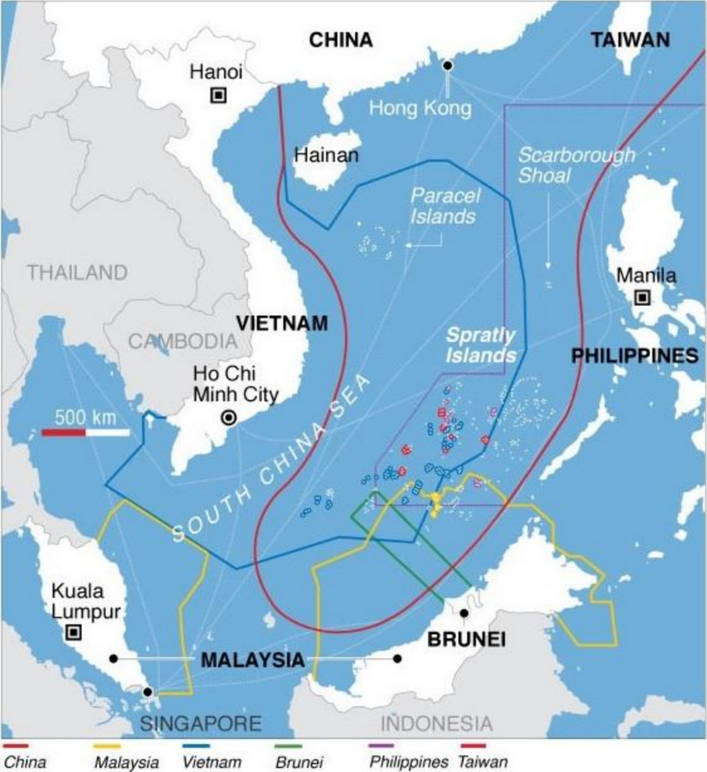
Map Shows Disputed Territorial Claims in South China Sea
This map directly illustrates the geopolitical risk factor central to this section. Disputed claims in the South China Sea pose a direct threat to subsea cable infrastructure and supply chain stability, which are critical components of the ‘AI Infrastructure Risk’ being analyzed.
(Source: Springer Nature)
$18 B in Investments, Applied Materials’ Digital Infrastructure Focus
Capital deployment has accelerated and refocused from general industrial capacity to building a complete, end-to-end AI ecosystem. Early-period investments were about securing physical production, while the current funding wave, heavily influenced by hyperscale data center operators, is about integrating that production with the global network. This trend is validated by direct investments into private subsea cables and massive government support for both R&D and manufacturing.

Map Details Global Subsea Cable Infrastructure
This map provides crucial context for the section’s focus on investments in digital infrastructure. It visualizes the global connectivity network, specifically the subsea cables that form the backbone of the digital ecosystem where Applied Materials is focusing its investments.
(Source: Frontiers)
Table: Strategic Investments in Singapore’s Digital Ecosystem
| Company / Project | Time Frame | Details and Strategic Purpose | Source |
|---|---|---|---|
| Applied Materials | Jun 2026 | Announced a US$500 million investment to build a new campus, doubling its manufacturing capacity in Singapore and creating 1, 000 new jobs to meet demand for AI chip equipment. | Economic Times |
| Singapore Government | Mar 2025 | Committed S$500 million (approx. US$370 million) for a national semiconductor R&D fabrication facility, lowering the barrier to entry for innovation and supporting the local ecosystem. | Business Times |
| Silicon Box | Jul 2023 | Opened a US$2 billion advanced chiplet factory, reinforcing Singapore’s role in the critical advanced packaging segment of the semiconductor value chain. | Singapore EDB |
| Global Foundries (GF) | Sep 2023 | Opened a US$4 billion fab expansion in partnership with the Singapore Economic Development Board to increase global manufacturing capacity. | Global Foundries |
| Applied Materials | Dec 2022 | Broke ground on a S$600 million (approx. US$450 million) facility under its “Singapore 2030” plan, initially focused on supply chain resilience and R&D. | Applied Materials |
Partnership Analysis, Applied Materials and Hyperscaler-Led Consortiums
The structure of strategic partnerships has evolved from bilateral agreements between manufacturers and governments to complex, multi-party consortiums led by hyperscale cloud providers. This change indicates that the primary customers for digital infrastructure, companies like Meta and Microsoft, are now dictating the strategic direction of network build-outs to ensure capacity for their AI services. This vertical integration is a powerful market force, accelerating deployment and reorienting supply chains around their core data center hubs.
Table: Key Digital Infrastructure Partnerships
| Partner / Project | Time Frame | Details and Strategic Purpose | Source |
|---|---|---|---|
| Candle Cable Consortium | Sep 2025 | Meta, Soft Bank, and NEC are building the 8, 000 km Candle system connecting Japan to Singapore. This hyperscaler-led project uses a 24-fiber pair configuration for large-capacity AI data transmission. | NEC |
| SJC 2 Cable Consortium | Jul 2025 | A Singtel-led consortium, with NEC as the supplier, activated the 10, 500 km SJC 2 cable. It directly links Singapore and Japan with 126 Tbps capacity, serving data center and cloud connectivity needs. | Data Center Dynamics |
| I-2 SEA Cable Project | Jul 2026 | Microsoft and Lightstorm contracted NEC to build a cable linking India to Singapore and Malaysia. This project secures a critical digital corridor for data flow into Southeast Asia’s hub. | Sub Tel Forum |
| Global Foundries / EDB | Sep 2023 | A traditional partnership model where GF collaborated with Singapore’s Economic Development Board (EDB) on its $4 billion fab, driven by national industrial policy and supply chain diversification. | Global Foundries |
Singapore vs. Global Hubs, Applied Materials’ Geographic Focus
Singapore has solidified its position as the undisputed nexus for the Indo-Pacific’s converged digital and physical supply chain, leveraging its geographic centrality and stable political environment. While the 2021-2024 period saw Singapore compete with other nations for individual factory investments, the 2025-2026 period shows it has become the essential landing point and integration hub for regional infrastructure projects. Japan’s strategy to build new, secure data corridors consistently terminates in Singapore, reinforcing its central role.
- Singapore as the Core Hub: Applied Materials’ decision to double its manufacturing capacity in Singapore, combined with its plan to hire 1, 000 new workers, underscores the city-state’s role as its primary Southeast Asian base. The company’s expansion into Malaysia, Thailand, and the Philippines is for supply chain support, with Singapore as the command and control center.
- Japan as a Strategic Partner: Japan, through companies like NEC and NTT, is a key enabler of this network. Projects like the Candle, SJC 2, and I-AM cables all originate or connect to Japan but use Singapore as their primary Southeast Asian anchor point. This highlights a “friend-shoring” strategy where secure corridors are built between allied, technologically advanced nations.
- Hyperscaler Influence on Geography: The investment decisions of content providers like Meta (Candle) and Microsoft (I-2 SEA) are now defining key geographic data corridors. Their selection of Singapore as the landing point for multiple high-capacity cables directly influences where other digital infrastructure, including data centers and AI compute facilities, will be located.

Energy Costs Compared Across AI Infrastructure Hubs
This chart directly supports the section’s comparative analysis of ‘Singapore vs. Global Hubs.’ Energy cost is a primary factor in the operational expense and viability of an AI infrastructure hub, making this comparison essential for evaluating Singapore’s competitive position.
(Source: LinkedIn)
Technology Maturity: From Component Diversification to System Integration
The market has matured from validating individual technology components in new geographies to validating an integrated systems approach for AI infrastructure. Between 2021 and 2024, success was measured by the ability to build and operate a standalone semiconductor fab outside of traditional locations. Today, success is defined by the ability to create a high-performance ecosystem where advanced chip manufacturing, assembly, data centers, and global fiber networks are tightly integrated in one secure and efficient location.
- 2021-2024 Validation: The successful launch of Global Foundries’ $4 billion fab and Silicon Box’s $2 billion chiplet factory in Singapore proved that complex semiconductor manufacturing could be geographically diversified. This period focused on de-risking the physical supply chain at the component level.
- 2025-2026 Validation: The concurrent announcements of Applied Materials’ expansion and multiple subsea cable landings (SJC 2, Candle) validate a systems-level strategy. The technology being matured is the entire digital supply chain itself. The use of advanced 24-fiber pair technology in the Candle cable, for instance, is a direct response to the massive bandwidth requirements of AI, connecting the source of chips to the centers of data.
- Government as an Enabler: Singapore’s policy has also matured. The S$1 billion semiconductor R&D fund and the new S$500 million national fab facility (by 2027) are no longer just incentives for single factories. They are tools to build an integrated ecosystem, ensuring the hardware produced by companies like those using ASML and Applied Materials equipment can be immediately leveraged by the local and regional digital economy.
SWOT Analysis of the Converged Digital Supply Chain Strategy
The strategic convergence of semiconductor manufacturing and digital connectivity in hubs like Singapore presents a powerful opportunity to meet AI demand but also introduces new concentration risks. This analysis shows a clear validation of the model’s strengths, driven by government support and private capital, while highlighting emerging threats related to cost and geopolitical dependency.
Table: SWOT Analysis for Singapore’s Converged Infrastructure
| SWOT Category | 2021 – 2024 | 2025 – 2026 | What Changed / Validated |
|---|---|---|---|
| Strengths | Strong government support (EDB partnerships), established logistics hub, skilled workforce initiatives. Focus on attracting individual manufacturing plants. | Proactive, large-scale funding (RIE 2025 plan), a clear regulatory framework for subsea cables, and a proven track record of delivering complex projects (e.g., GF fab). | The strength of Singapore’s model was validated as it transitioned from a single-industry focus to becoming an integrated digital and physical infrastructure hub, attracting both manufacturers and network builders. |
| Weaknesses | High operating costs compared to other SEA nations, land scarcity, and reliance on attracting foreign talent and investment. | Increased concentration risk with more critical infrastructure in one location. Rising construction costs for both fabs and subsea cables, with Asian costs projected to hit $7.5 billion by 2029. | The weakness of concentration risk became more acute. As Singapore becomes more critical, it also becomes a more significant single point of failure for the regional AI supply chain. |
| Opportunities | Geopolitical tensions (US-China) driving supply chain diversification. Growing demand for chips in automotive and 5 G. | Explosive demand for AI infrastructure. “Friend-shoring” trend favors stable, allied nations. Hyperscalers directly funding and accelerating infrastructure build-outs. | The opportunity shifted from capturing diversified manufacturing to capturing the entire high-value AI infrastructure stack. AI became the primary, massive demand driver, eclipsing previous growth catalysts. |
| Threats | Competition from other countries offering subsidies. Potential for geopolitical instability in the South China Sea affecting shipping lanes. | Increased strategic importance makes subsea cables and fabs potential targets for sabotage. Over-reliance on hyperscaler CAPEX, which could be volatile. | The threat evolved from economic competition to include national security risks associated with hosting a critical node in the global digital economy. The reliance on Big Tech budgets like those of Space X and Deep Seek introduces new market volatility. |
Scenario Modeling: Applied Materials’ Role in Hyperscaler Integration
The most critical strategic trend to watch is the continued vertical integration by hyperscale cloud providers, which could reshape the entire digital infrastructure value chain. If hyperscalers like Meta and Microsoft expand their direct investment from subsea cables into the semiconductor supply chain, they could become the ultimate arbiters of both digital and physical infrastructure development.
- If this happens: Hyperscalers could begin co-financing advanced packaging facilities or even providing capital for semiconductor equipment in exchange for prioritized capacity, further concentrating their control over the AI technology stack.
- Watch this: Monitor announcements from Meta, Google, and Microsoft related to partnerships with semiconductor equipment makers like Applied Materials or advanced packaging firms like Silicon Box. Also, track the ownership structure of new subsea cables; a continued shift to 100% private ownership by hyperscalers would be a strong signal.
- These could be happening: The formation of the Candle consortium, led by Meta, is a clear indicator of this trend gaining traction. The immense US$400 billion in collective CAPEX announced in 2025 by major tech firms for AI infrastructure provides the financial firepower for such strategic moves. This consolidation of power by companies with massive AI compute needs, like those using Broadcom or Intel chips, is the defining dynamic for the coming years.
The questions your competitors are already asking
This report covers one angle of the convergence between semiconductor manufacturing and digital infrastructure. The questions that matter most depend on your work.
- Other regions competing with Singapore for AI infrastructure
- Hyperscaler investment in advanced chip packaging
- South China Sea subsea cable route security
- Singapore vs Japan data center operating costs
This report does not answer these. Enki Brief Pro does.
Your question, your angle, your framework. SWOT, PESTL, scenario modelling. The same niche depth, built around the decision your work actually depends on.
